
富临精工

Search documents
龙蟠科技沪港两市融资超30亿负债率增速仍远超同行 产能利用率不足拟定增再募20亿
Xin Lang Zheng Quan· 2025-08-27 11:39
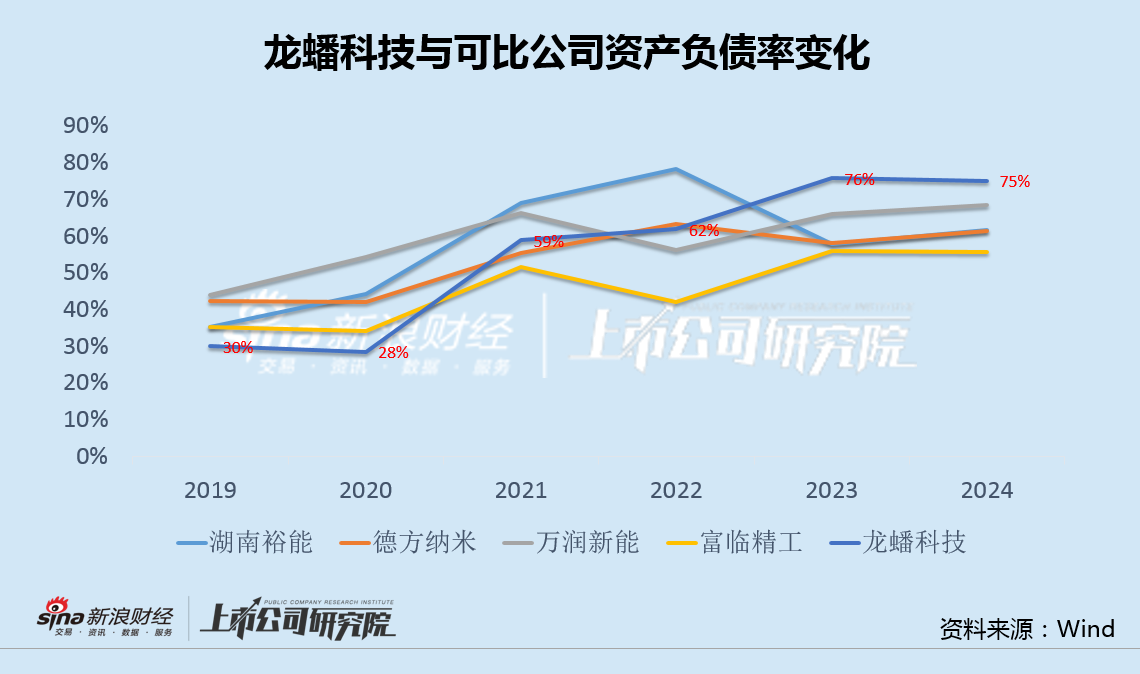
Core Viewpoint - Longpan Technology announced a plan to raise 2 billion yuan through a private placement to fund high-performance phosphate cathode material projects and supplement working capital, despite facing rapid increases in debt levels compared to peers [1][2][8]. Financing Activities - Longpan Technology has raised over 3 billion yuan through various financing methods since its A-share listing in 2017, including convertible bonds, private placements, and Hong Kong IPOs [7]. - The company plans to raise 2.06 million shares, totaling 2 billion yuan, for projects involving 11,000 tons and 8,500 tons of high-performance phosphate cathode materials [2][8]. - Previous financing activities include 400 million yuan from convertible bonds in April 2020 and 2.2 billion yuan from a private placement in June 2022 [3][4]. Debt Levels - Longpan Technology's debt ratio has increased significantly, reaching 78.41% by June 2025, with interest-bearing liabilities totaling 11.6 billion yuan, a 50-fold increase from 245 million yuan at the end of 2017 [10]. - The company's debt growth rate is notably faster than that of comparable companies such as Hunan Youneng and Defang Nano [8]. Capital Expenditure and Utilization - The company has consistently engaged in large capital expenditures, yet its overall capacity utilization remains below 80%, with additional capacity under construction [14]. - Longpan Technology's research and development expenditure has been increasing, significantly outpacing that of comparable companies, but this has not translated into improved profitability [12][15]. Market Performance - Despite the ongoing financing and investment efforts, Longpan Technology's stock price has halved compared to the price during its previous private placement in 2021, raising concerns about the effectiveness of its financing and investment strategies [15].


高端制造行业:智元机器人合作伙伴大会回顾
Xin Lang Cai Jing· 2025-08-27 06:38
Core Insights - The first Zhiyuan Robotics Partner Conference was held on August 21 in Shanghai, focusing on accelerating the commercialization of embodied intelligence and transitioning the industry from "technical exploration" to "scaled commercial application" [1] Group 1: Ecosystem Development - Zhiyuan Robotics aims to build a comprehensive ecosystem by 2025, positioning embodied intelligence as the next smart terminal after smartphones and automobiles [1] - The strategy includes mass production of general-purpose humanoid robots, creating a robust collaborative software and hardware platform, and expanding into industrial, commercial, and home scenarios [1] - Key initiatives for ecosystem co-construction involve open-source middleware (AimRT), datasets, and the "Lingqu OS" system, alongside an integrated strategy to promote industry collaboration [1][3] Group 2: Product and Technology Strategy - The CTO introduced a "1+3" full-stack technology strategy, which includes one robot body and three core intelligences: motion intelligence, interaction intelligence, and operation intelligence [2] - Three product series were showcased: Expedition A2 (the first globally certified commercial humanoid robot), Yuanshi G1 (industrial/commercial data tasks), and Lingxi X2 (an educational robot) [2] - The company is focusing on eight major application scenarios, providing scalable solutions across various industries [2] Group 3: Partnership and Resource Allocation - The 2025 partnership policy will tier high-end resources directly to quality partners, with a goal of deploying over 100,000 general-purpose robots in three years [3] - Zhiyuan Robotics is establishing a closed-loop value chain through strategic partnerships, optimizing component development and production while enhancing robot performance and quality [3] Group 4: Supply Chain and Investment Strategy - Several listed companies are involved in Zhiyuan's ecosystem, covering key components such as actuators, sensors, AI models, and assembly [4] - Investment strategies include following the supply chains of leading robot manufacturers, with specific focus on companies like Lianyi Zhizao and Green Harmonic [4] - The market outlook suggests a potential shift in focus towards Tesla's supply chain following the release of Optimus V3 in Q4 2025 [4]

机器人ETF鹏华(159278)涨超1.6%,人工智能产业再迎重磅利好
Xin Lang Cai Jing· 2025-08-27 06:05
Group 1 - The core viewpoint of the news highlights a significant rise in the National Robot Industry Index (980022) and its constituent stocks, driven by the recent issuance of the State Council's opinions on implementing the "Artificial Intelligence +" initiative, which emphasizes six key areas for development [1][2] - The index saw a strong increase of 2.29%, with notable gains from stocks such as Keda Intelligent (300222) up 19.98%, and other companies like Maihe Co. (301199) and Jiangsu Beiren (688218) also experiencing substantial growth [1] - The "Artificial Intelligence +" initiative aims to enhance foundational support capabilities across various sectors, including technology, industry development, and global cooperation, while also setting quantifiable goals for the proliferation of artificial intelligence [1][2] Group 2 - Recent trends indicate a surge in participants in the humanoid robot sector, with major domestic companies like Huawei, ByteDance, BYD, Xiaomi, and others increasing their investments in embodied intelligence, alongside international players like Tesla and Figure AI accelerating their commercialization efforts [2] - The emergence of companies like DeepSeek is seen as a catalyst for the development of general-purpose robotic models, which is expected to facilitate the commercialization of humanoid robots, marking a phase of diverse innovation within the industry [2] - The top ten weighted stocks in the National Robot Industry Index account for 40.09% of the index, indicating a concentrated investment in key players such as Stone Technology (688169) and Ecovacs (603486) [3]
江西升华现有高实密磷酸铁锂年产能30万吨
起点锂电· 2025-08-27 03:54
Core Viewpoint - The article highlights the growing demand and market potential for high-pressure dense lithium iron phosphate (LiFePO4) materials, particularly through the collaboration between Fulin Precision and leading battery manufacturers like CATL and BYD [4][5]. Group 1: Event Information - The 8th Sodium Battery Summit Forum will be held on August 28, 2025, in Shenzhen, focusing on the technological advancements and production capacity in the sodium battery industry [3]. - The event is organized by Qidian Sodium Battery and Qidian Research Institute, with over 600 participants expected [3]. Group 2: Company Developments - Fulin Precision's subsidiary, Jiangxi Shenghua, has an annual production capacity of 300,000 tons of high-density lithium iron phosphate, leading the market in high-end power applications [4]. - Jiangxi Shenghua has established strong partnerships with major lithium battery manufacturers, including CATL and BYD, and is experiencing increased market demand for its products [4]. Group 3: Business Agreements - In August 2024, Fulin Precision and CATL signed a business cooperation agreement, with CATL committing to a minimum annual purchase of 140,000 tons of lithium iron phosphate from Jiangxi Shenghua from 2025 to 2027 [5]. - A supplementary agreement was made where CATL will pay a one-time advance of 500 million yuan to support the production capacity expansion of Jiangxi Shenghua, ensuring annual purchases of at least 80% of the promised capacity from 2025 to 2029 [5].



绵密产业网 阳耀创新途——探寻中国科技城绵阳的跃迁密码
Shang Hai Zheng Quan Bao· 2025-08-26 20:29
Core Insights - Mianyang is recognized as a city thriving on technology and innovation, with a strong historical foundation in scientific development [1] - By the end of 2024, Mianyang will have 20 national defense research institutes and over 260 innovation platforms, ranking 15th among China's top 100 cities in terms of technological innovation strength [1] Industry Development - Mianyang has developed a robust industrial scene, exemplified by the successful live demonstration of the A2-W robot by Zhiyuan Robotics, showcasing the city's advanced industrial capabilities [2] - The city has established a complete industrial chain in electronics and new energy, supported by leading companies such as Changhong and BOE [2] Technological Advancements - iFlytek has launched a robot super brain platform application center in Mianyang, indicating the city's strong technological foundation and favorable business environment [3] Financial Integration - Mianyang has become the first prefecture-level city in China to have service bases for the Shanghai, Shenzhen, and Beijing stock exchanges, enhancing the connection between local industries and capital markets [4] Company Success Stories - Huafeng Technology, a state-owned enterprise, has seen steady revenue growth since 2020 and successfully listed on the Shanghai Stock Exchange in 2023, becoming the first state-owned enterprise in Sichuan to do so [5][6] - The local government played a crucial role in facilitating Huafeng Technology's IPO by resolving competitive issues with another state-owned enterprise [7] Talent Attraction and Retention - Mianyang has implemented various measures to attract and retain talent, including the establishment of a talent group and a special fund of 1 billion yuan for talent development [8] - The city has successfully attracted high-end talent, which has led to significant business transformations, such as the upgrade of Fulin Precision's operations [8] Ecosystem and Collaboration - Mianyang is characterized as a city that integrates cutting-edge technology, solid industry, and a livable environment, fostering a collaborative ecosystem for businesses [9]
绵密产业网,阳耀创新途—— 探寻中国科技城绵阳的跃迁密码
Shang Hai Zheng Quan Bao· 2025-08-26 20:25
Core Insights - Mianyang is recognized as a technology-driven city, with a strong emphasis on innovation and a rich history in scientific development [6] - The city hosts 20 national defense research institutes and over 260 innovation platforms, ranking 15th among China's top 100 cities in terms of technological innovation strength [6] - Recent developments include the successful live demonstration of a general-purpose embodied robot by Zhiyuan Robotics, marking a significant milestone in industrial automation [4][6] Industry Development - Mianyang has established a complete industrial chain in electronics and new energy, supported by leading companies such as Changhong, BOE, and Huikang [7] - The city is becoming a hub for artificial intelligence, with iFlytek announcing the establishment of an application center for its robot super brain platform [7] - The integration of industry and finance is highlighted by the establishment of service bases for major stock exchanges, enhancing the connection between local industries and capital markets [8] Company Performance - Huafeng Technology, a company specializing in connectors, has seen steady revenue growth since 2020 and successfully listed on the Shanghai Stock Exchange in 2023, becoming the first state-owned enterprise from Sichuan to do so [9][10] - The local government played a crucial role in facilitating Huafeng's IPO by resolving competitive issues with another state-owned enterprise [10] - Financial support from local institutions has been instrumental in the development of companies like Changhong Energy, providing various credit resources to meet funding needs [10] Talent and Innovation - Mianyang is actively attracting talent through initiatives such as the "Technology City Talent Card," which offers exclusive services to talent in various sectors [11] - The government has implemented policies to support talent acquisition and retention, including a talent evaluation mechanism and the establishment of a talent development fund [12] - The collaboration between local enterprises and high-end talent has led to significant advancements in innovation, exemplified by the partnership between Fulin Precision and a doctoral team for robotics development [12]



中国机器人:汽车的后浪 | 海斌访谈
Di Yi Cai Jing· 2025-08-26 07:52
Core Insights - The development of the Chinese automotive industry has significantly contributed to the affordability and accessibility of key components like LiDAR, chips, and batteries, which are essential for humanoid robots [1][7][12] - The price of LiDAR has decreased to one-tenth of its original cost over the past decade, making it a standard feature in intelligent driving systems [3][7] - Chinese companies such as SUTENG and Hesai Technology have emerged as leaders in the LiDAR market, providing products priced below 10,000 yuan, with performance surpassing that of ten years ago [3][4] - The collaboration between automotive and robotics sectors is fostering technological advancements, with automotive companies partnering with humanoid robot manufacturers to enhance capabilities [4][5] Automotive Industry Impact - The automotive industry's push towards electrification and intelligence has led to advancements in core components, making them more efficient and cost-effective for humanoid robots [7][12] - The integration of advanced chips in vehicles, such as the Horizon SuperDrive system, showcases the potential for these technologies to be adapted for robotics [5][6] - The competitive landscape in the automotive sector is driving innovation, which benefits the robotics industry by providing high-quality, low-cost components [7][12] Robotics Development - Humanoid robots are increasingly utilizing technologies developed for the automotive industry, particularly in areas like LiDAR and chipsets [4][10] - Companies like Zhiyuan and Yushu are already deploying humanoid robots in practical applications, indicating a shift towards commercialization [10][11] - Despite advancements, humanoid robots still face challenges in hardware and algorithm development, with significant room for improvement in areas such as tactile feedback and battery life [11][12] Competitive Landscape - The competition between China and the US in the robotics field highlights China's strengths in supply chain efficiency and lower manufacturing costs, while the US excels in high-performance chips [9][12] - Chinese companies are rapidly advancing in various robotics sectors, including drones and cleaning robots, positioning themselves as key players in the global market [9][12] - The year 2023 is seen as a pivotal moment for the commercialization of humanoid robots, with expectations for significant market penetration [9][11]


智元机器人全系产品正式开售,关注宇树新品发布 | 投研报告
Zhong Guo Neng Yuan Wang· 2025-08-26 01:02
Core Insights - The humanoid robot concept index increased by 4.71% from August 17 to August 22, 2025, outperforming the CSI 300 index by 0.53 percentage points [1][2] - Year-to-date, the humanoid robot concept index has risen by 68.52%, surpassing the CSI 300 index by 53.92 percentage points [1][2] - Chengdu Huamei had the highest weekly increase among related stocks at +36.23%, while Jack Co. experienced the largest weekly decline at -12.88% [2] Policy Developments - Shanghai has released an implementation plan to accelerate the development of "AI + Manufacturing," which includes building "AI + Manufacturing" factories and promoting the practical deployment of various types of embodied intelligence, represented by humanoid robots [3] Product and Technology Updates - Zhiyuan Robotics launched a new product, "Lingxi X2-W" [3] - Junsheng Electronics introduced the industry's first integrated embodied intelligent robot "Omni Controller" for chest and chassis assembly [3] - Tiantai Robotics signed a global order for 10,000 humanoid robots, marking the beginning of large-scale commercial use of humanoid robots [3] - Yushu Technology is set to launch a new humanoid robot with 31 degrees of freedom [3] - Huandong Technology's precision transmission R&D center and intelligent manufacturing base project has commenced in Zhejiang Province [3] - Zhiyuan's humanoid robot products "Lingxi X2 Youth Edition" and "Expedition A2 Youth Edition" are now available for pre-sale online [3] - Weimail VMR officially released the world's first humanoid robot head module, OmniHead [3] Investment and Financing Activities - Shibite Robotics completed a B+ round financing of over 100 million yuan, exclusively invested by Yicun Capital's Bit Songling Fund [3] - Shaping Technology completed a new round of financing led by Shunwei Capital, with existing shareholders including China Merchants Venture Capital and Deep Venture Capital participating [3] Key Company Developments - Yachuang Electronics announced that its power modules have achieved indirect bulk supply to META [4] - Shengshi Technology plans to establish a wholly-owned subsidiary to combine AI and humanoid robot technology with trendy toy innovation [4] - Xinzhi Group announced a deepening partnership with core client XD to further expand joint module cooperation [4] Market Perspective - On August 18, Zhiyuan Robotics launched three quadruped robot products targeting entertainment and education sectors, as well as industrial applications [5] - Zhiyuan's six core product lines are now available for sale on Zhiyuan Mall and JD Mall, indicating accelerated product and commercialization evolution [5]
人形机器人规模化应用需闯关
Bei Jing Ri Bao Ke Hu Duan· 2025-08-26 00:56
Group 1 - The World Robot Conference and Humanoid Robot Games held in Beijing have garnered significant public attention, showcasing the capabilities of humanoid robots in sports and performance [1] - The "Galaxy Space Capsule," a robot-operated convenience store, has achieved full autonomous service, with plans for expansion into popular commercial areas [2] - Companies like Songyan Power and Zhiyuan Robotics are ramping up production capabilities, with Songyan aiming for 200 units of delivery capacity by August [2] Group 2 - The humanoid robot industry is accelerating towards commercialization, with many companies transitioning from prototype demonstrations to small-scale deliveries [2] - The future of robotics may not be limited to humanoid forms, as various shapes and designs could emerge to better serve different functions [3][5] - Current humanoid robots are primarily designed for data collection and AI training, but the definition of "robot" is expanding to include non-humanoid forms that are more efficient in specific applications [5] Group 3 - Despite some companies receiving large-scale orders, the adoption of humanoid robots in everyday life remains slow, with over 70% of disclosed orders coming from educational and research institutions [6] - Key challenges facing the mass adoption of humanoid robots include operational capabilities, generalization abilities, and cost control [6] - The industry faces a significant data issue, as limited data and simulation capabilities hinder the development of versatile robots for various applications [6] Group 4 - Predictions suggest that within three years, household humanoid robots could perform simple tasks like conversation and dog walking, while more complex tasks may take 5 to 10 years to achieve [7]
造机器人:一场“谁都能干”的“全民运动”?
3 6 Ke· 2025-08-26 00:15
Core Insights - The nature of building robots is changing, moving from a joke to a reality, as the barriers to entry are lowering significantly [1][3][9] - Various players from different industries are entering the robotics field, driven by their unique motivations and market opportunities [10][11][12] Industry Trends - The influx of companies from diverse backgrounds, including traditional manufacturing, investment, and even alcohol production, indicates a broadening interest in robotics [2][10][11] - The number of humanoid robot-related companies in China has surged, with 834 existing firms as of late July 2025, reflecting a growth rate of over 180% year-on-year [3][8] Technological Advancements - Key components for robots, such as sensors and actuators, are becoming more accessible and affordable, allowing for easier assembly of robots [4][8][9] - Domestic companies are beginning to break the monopoly of foreign brands in critical areas like harmonic reducers and linear actuators, enhancing local production capabilities [6][8] Investment Landscape - Significant investments are being made in the robotics sector, with companies like Jiuding Investment planning to invest 213 million yuan in a robotics core component firm [2][10] - The capital market is responding positively, with multiple robotics companies announcing new rounds of financing and IPO plans [3][10] Market Dynamics - The competition is intensifying as companies seek to differentiate themselves in a crowded market, with some focusing on cost reduction and efficiency improvements [8][9] - The industry is expected to evolve into a multi-faceted ecosystem where specialized firms cater to specific applications, while a few giants may dominate the general humanoid robot market [17][18] Challenges Ahead - Despite the advancements, the integration of various components and ensuring their seamless operation remains a significant challenge for the industry [16][17] - The need for real-world data and practical applications is critical for the successful deployment of robots in operational environments [15][17]