中国核建

Search documents
!顾军被查
Zhong Guo Ji Jin Bao· 2026-01-19 12:31
Group 1 - The former Deputy Secretary of the Party Committee and General Manager of China National Nuclear Corporation (CNNC), Gu Jun, is under investigation for serious violations of discipline and law, as announced by the Central Commission for Discipline Inspection and the National Supervisory Commission [1] - Gu Jun has held various significant positions within the nuclear industry, including Vice Chief Engineer and Deputy General Manager of Qinshan Third Nuclear Power Company, and General Manager of China Nuclear Engineering Corporation [2] - CNNC is a major state-owned enterprise directly managed by the central government, with total assets exceeding 1.6 trillion yuan and approximately 180,000 employees [3] Group 2 - Gu Jun's career includes serving as Chairman of China Nuclear Engineering Corporation, from which he resigned in October 2018 due to personal reasons [2] - Following his removal from the position of General Manager, CNNC announced a change in leadership in March 2024 [2] - Gu Jun has participated in various public activities and corporate research as the former General Manager of CNNC [3]
顾军被查,曾是中国首批反应堆操纵员
第一财经· 2026-01-19 12:27
作者 | 第一财经 林春挺 2026.01. 19 本文字数:959,阅读时长大约2分钟 顾军,男,1963年6月生,江苏启东人,毕业于上海交通大学核动力工程专业。公开资料显示,顾军是中国核电行业资深技术专家,职业生涯起步于中 国大陆首座核电站——秦山核电站。1980年代,他作为首批反应堆操纵员参与秦山核电站建设,后逐步晋升至秦山第三核电有限公司副总工程师兼调试 生产准备处处长。1999年12月起,他历任秦山第三核电有限公司副总经理、三门核电项目筹备处副主任、三门核电有限公司副总经理等职,并于2007 年4月起担任三门核电有限公司总经理、党委书记,主导三门核电项目开发建设。 1月19日,中央纪委国家监委网站挂出的消息显示:中国核工业集团有限公司(下称"中核集团")原党组副书记、总经理顾军涉嫌严重违纪违法,目前 正接受中央纪委国家监委纪律审查和监察调查。 对于顾军被查,多名核电行业人士向第一财经记者表示"很突然"。一位曾与其共事的业内人士称,顾军长期深耕核电技术领域,早期以专业能力突出著 称,在秦山核电、三门核电等项目中积累了较高声望。 2011年4月,顾军调任国家核电技术公司,历任董事、总经理、党组成员;20 ...


中核集团原总经理顾军被查,曾是中国首批反应堆操纵员
Di Yi Cai Jing· 2026-01-19 11:38
对于顾军被查,多名核电行业人士向第一财经记者表示"很突然"。 2011年4月,顾军调任国家核电技术公司,历任董事、总经理、党组成员;2015年3月起,他进入中国核 工业建设集团公司(中核建集团前身),先后担任董事、党组副书记、总经理,并于2015年11月兼任中 国核工业建设股份有限公司董事长。2018年7月,中核集团与中核建集团重组后,顾军出任中核集团董 事、总经理、党组副书记,直至2024年卸任。 在顾军此次被查之前,2025年6月,中国东方电气集团有限公司(下称"东方电气")官网管理团队页面 出现重要变动,该公司董事长、党组书记俞培根的相关信息已被悄然撤下。2025年12月24日,政协第十 四届全国委员会第四十五次主席会议审议通过关于撤销刘国跃、俞培根政协第十四届全国委员会委员资 格的决定,提请政协第十四届全国委员会常务委员会第十五次会议追认。值得关注的是,到东方电气任 职之前,俞培根长期在中核集团担任要职,曾任该公司副总经理。 2025年5月,中核集团总经理申彦锋接替余剑锋,出任该公司董事长。而卸任中核集团董事长的余剑 锋,彼时已有数月未出现在公司公开活动中。 1月19日,中央纪委国家监委网站挂出的消息 ...
重磅突发!顾军被查
Zhong Guo Ji Jin Bao· 2026-01-19 11:09
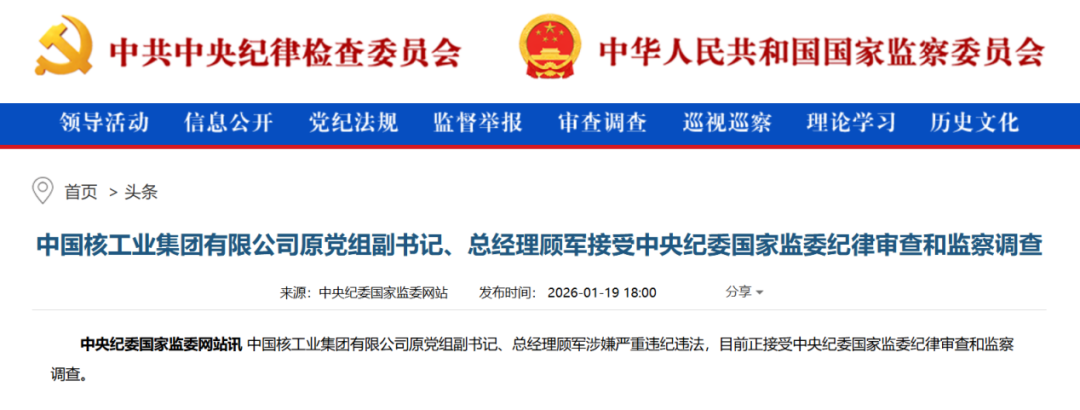
【导读】中国核工业集团有限公司原党组副书记、总经理顾军被查 公开简历显示,顾军,男,汉族,1963年6月生,江苏启东人,毕业于上海交通大学核动力工程专业。高级管理人员工商管理硕士,研究员级高级工程 师。1983年7月参加工作,1989年4月加入中国共产党。 顾军曾任秦山第三核电有限公司副总工程师、副总经理,三门核电有限公司副总经理、党委副书记、总经理、党委书记,国家核电技术公司董事、总经 理、党组成员等职务。 2015年,顾军任中国核工业建设集团公司总经理、董事、党组副书记。2018年,顾军任中国核工业集团有限公司董事、总经理、党组副书记。 反腐重磅消息来了! 1月19日,中央纪委国家监委官网通报:中国核工业集团有限公司原党组副书记、总经理顾军涉嫌严重违纪违法,目前正接受中央纪委国家监委纪律审查 和监察调查。 2025年10月,顾军曾以"中核集团战略与管理咨询委员会委员、中国核工业集团有限公司原总经理、党组副书记"身份前往某高校做主题演讲。 据介绍,中国核工业集团有限公司是中央直接管理的特大型国有重要骨干企业,是国家核科技工业主体,是推进核能开发利用、核工程建设、核技术应用 的国家队和主力军。中核集团资产规模 ...
重磅突发!顾军被查
中国基金报· 2026-01-19 11:06
【导读】中国核工业集团有限公司原党组副书记、总经理顾军被查 中国基金报记者 晨曦 反腐重磅消息来了! 1月19日,中央纪委国家监委官网通报:中国核工业集团有限公司原党组副书记、总经理顾军 涉嫌严重违纪违法,目前正接受中央纪委国家监委纪律审查和监察调查。 公开简历显示,顾军,男,汉族,1963年6月生,江苏启东人,毕业于上海交通大学核动力 工程专业。高级管理人员工商管理硕士,研究员级高级工程师。1983年7月参加工作,1989 年4月加入中国共产党。 顾军曾任秦山第三核电有限公司副总工程师、副总经理,三门核电有限公司副总经理、党委 副书记、总经理、党委书记,国家核电技术公司董事、总经理、党组成员等职务。 2015年,顾军任中国核工业建设集团公司总经理、董事、党组副书记。2018年,顾军任中国 核工业集团有限公司董事、总经理、党组副书记。 另外,顾军还曾任上市公司中国核建的董事长。2018年10月,中国核建公告称,顾军因个人 原因申请辞去公司董事长、董事职务。 2024年3月,中国核工业集团有限公司发布关于总经理发生变动的公告。根据国务院下发的 相关文件,顾军不再担任中国核工业集团有限公司董事、总经理等职务。 此 ...

华泰研究:AI链洁净室与电子布高景气延续
HTSC· 2026-01-19 03:10
Investment Rating - The report maintains a "Buy" rating for several companies including 亚翔集成 (603929 CH), 中材国际 (600970 CH), 四川路桥 (600039 CH), 精工钢构 (600496 CH), 东方雨虹 (002271 CH), 凯盛科技 (600552 CH), 华新建材 (600801 CH), 中国巨石 (600176 CH), 中国核建 (601611 CH), and 上峰水泥 (000672 CH) [10][32][33][34][35][36] Core Insights - The report highlights that AI upgrades and domestic substitution are driving continued high demand in cleanroom and electronic fabric sectors, with significant capital expenditure increases from major companies like Micron and TSMC [2][13] - The cleanroom and electronic fabric markets are expected to maintain a tight supply-demand balance, particularly for high-end products, due to ongoing investments in advanced processes and PCB [13][14] - The report emphasizes the importance of emerging industries and traditional sectors, recommending a balanced investment approach in Q1 2026 [2][13] Summary by Sections Industry Overview - The cleanroom and electronic fabric sectors are experiencing sustained high demand driven by AI hardware investments, with TSMC raising its 2026 capital expenditure guidance to USD 52-56 billion, a 30% increase from 2025 [2][13] - The report notes that the supply of high-end electronic fabrics is tight, particularly for second-generation fabrics and Low CTE (LCTE) products, which are expected to see price increases [2][13] Company Dynamics - 亚翔集成's revenue forecast has been adjusted upwards based on strong order growth and capital expenditure increases from major semiconductor companies [14][33] - 中材国际 reported a 12% year-on-year increase in new orders for 2025, indicating a recovery in its order structure and a shift away from reliance on the domestic cement industry [34] - 四川路桥's revenue for the first three quarters of 2025 increased by 1.95% year-on-year, with a significant rise in net profit, reflecting strong project execution and order growth [35] Market Trends - The report indicates that the cement market is facing a slight decline in prices, with a 1.4% decrease week-on-week, while the glass market shows mixed performance across regions [22][23] - The electronic fabric market is experiencing stable prices after recent increases, with a continued tight supply for high-end products [20][27] Recommendations - The report recommends focusing on companies that are well-positioned to benefit from the ongoing trends in cleanroom and electronic fabric sectors, including 亚翔集成, 中材国际, and 四川路桥, among others [2][10][32][33][34][35][36]


天津大学成立工程建筑学中心 培养解决复杂工程问题领军者
Xin Lang Cai Jing· 2026-01-18 16:22
Core Viewpoint - The establishment of the Engineering Architecture Center at Tianjin University represents a significant initiative to optimize academic disciplines and innovate educational models in response to changing times [1][2]. Group 1: Center Establishment and Objectives - The Engineering Architecture Center is the first second-level discipline platform for engineering architecture approved in domestic universities, aiming to integrate architecture, structure, environment, technology, and social humanities with engineering logic at its core [1]. - The center is dedicated to cultivating leading talents capable of systematically solving complex engineering problems [1]. Group 2: Collaborative Framework and Resources - The center will be led by the School of Architecture and collaborate with multiple internal units, including the School of Civil Engineering, School of Environment, Intelligent Computing Department, and Design Institute, to deeply integrate resources from leading enterprises such as China Construction Technology Group and Tianjin Huahui Engineering Design Co., Ltd [2]. - It will also engage in close cooperation with prestigious international institutions like Tokyo University of Science and Southeast University to create a collaborative innovation entity that integrates production, education, research, and application [2]. Group 3: Educational and Research Impact - The center aims to serve as an important platform for high-level interdisciplinary cooperation and innovative talent cultivation, contributing new momentum to the high-quality development of architecture and engineering disciplines in China [2]. - An international teaching faculty will be established, incorporating outstanding frontline architects to develop a new curriculum system that provides students with interdisciplinary learning experiences [1].
可控核聚变产业化迎黄金发展期,产业链企业迎新机遇
Zheng Quan Shi Bao Wang· 2026-01-18 12:20
Group 1 - The 2026 Nuclear Fusion Energy Technology and Industry Conference successfully concluded in Hefei, Anhui, marking a key transition of controllable nuclear fusion from laboratory research to large-scale industrialization [1] - The commercialization of controllable nuclear fusion is accelerating, with significant breakthroughs in domestic projects such as EAST achieving 1 million degrees Celsius for 1066 seconds, and the CRAFT project nearing completion [2] - The industry is expected to enter a capital expenditure expansion cycle from 2025 to 2028, with projected total investments in major domestic projects reaching 146.5 billion yuan [2] Group 2 - The explosive growth of the controllable nuclear fusion industry is creating vast development opportunities for upstream and downstream enterprises, with companies like Western Superconducting and Shanghai Electric leading in their respective fields [3] - Capital participation is providing sustained momentum for the development of the industry chain, with companies like Zhongyou Capital investing heavily in fusion energy projects [4] - The conference is expected to further accelerate resource integration and collaborative innovation within the industry chain, enhancing the growth potential of quality enterprises [4]
“可控核聚变”热潮背后
经济观察报· 2026-01-17 06:13
Core Viewpoint - The A-share "nuclear fusion" concept companies may face a long performance gap before commercial power generation is realized, despite recent funding and technological breakthroughs in the sector [4]. Group 1: Market Dynamics - On January 15, 2026, the implementation of the "Atomic Energy Law" encouraging controlled nuclear fusion coincided with a market style shift, leading investors to focus on the "controlled nuclear fusion" sector as a potential new market leader [2]. - Recent funding activities, such as Shanghai Xinghuan Fusion Technology's completion of a 1 billion yuan Series A financing, have set records for domestic private fusion companies, indicating strong investor interest [2][16]. - Several listed companies in the "nuclear fusion concept" category, including China First Heavy Industries and China Nuclear Engineering, experienced significant stock price increases, but many issued announcements clarifying that they currently have minimal related revenue [3][25]. Group 2: Technological Advancements - The nuclear fusion industry is seeing advancements in technology, with breakthroughs in high-temperature superconducting magnets, which are crucial for achieving the necessary magnetic field strength for fusion [11][18]. - The energy density of nuclear fusion is significantly higher than that of nuclear fission, with 1 gram of deuterium-tritium fusion fuel releasing energy equivalent to 11.2 tons of standard coal, making it a promising solution for future energy needs [9]. - The development of compact fusion reactors is being facilitated by high-temperature superconductors, which allow for smaller and more cost-effective designs compared to traditional fusion reactors [11]. Group 3: Challenges and Future Outlook - Despite optimism in the investment community, significant challenges remain, including material durability under extreme conditions, tritium supply issues, and the need for high-throughput neutron sources for testing new materials [20][21]. - The timeline for commercial nuclear fusion is projected to extend to around 2050, with various milestones set for experimental and demonstration reactors in the coming decades [24][28]. - The current market for nuclear fusion equipment is expected to grow significantly, with estimates suggesting an annual scale of 266 billion yuan by 2035, but achieving this will require overcoming substantial technical and operational hurdles [27].



“可控核聚变”热潮背后
Jing Ji Guan Cha Wang· 2026-01-17 05:08
Core Viewpoint - The implementation of the "Encouragement and Support for Controlled Nuclear Fusion" in the Atomic Energy Law of China is expected to drive investment and interest in the nuclear fusion sector, marking a potential shift in market focus from commercial aerospace and AI applications to nuclear fusion technology [2][3]. Investment and Market Dynamics - The A-share market experienced a style switch, with funds moving away from previously favored sectors like commercial aerospace and AI applications towards the "controlled nuclear fusion" sector, driven by recent positive industry news [2]. - Significant investments have been made in the nuclear fusion sector, including a record A-round financing of 1 billion yuan by Shanghai Xinghuan Fusion Technology Co., which indicates strong investor interest [2][14]. - Companies like China First Heavy Industries and China Nuclear Engineering have seen their stock prices surge, reflecting market enthusiasm for nuclear fusion concepts, despite these companies warning of limited current revenue from related projects [3][21]. Technological Advancements - The nuclear fusion industry is witnessing breakthroughs in technology, such as the successful excitation of high-temperature superconducting magnets to 20.8 Tesla, which is crucial for enhancing fusion power density [2][16]. - The development of high-temperature superconductors is making commercial nuclear fusion more feasible by allowing for smaller and more cost-effective fusion devices [9][10]. Energy Demand and Supply - The increasing demand for energy, particularly driven by AI and data centers, is creating a sense of urgency for alternative energy sources like nuclear fusion, which is seen as a potential solution to the looming energy supply challenges [4][5]. - The energy density of nuclear fusion is significantly higher than that of traditional fossil fuels and nuclear fission, making it an attractive option for future energy needs [6][12]. Market Projections - The global nuclear fusion equipment market is projected to reach an annual scale of 266 billion yuan by 2035, indicating substantial future market potential despite current challenges in achieving commercial viability [23]. - The timeline for achieving commercial nuclear fusion is optimistic, with expectations for experimental reactors by 2030 and commercial reactors by 2050 [25]. Challenges and Risks - Despite the optimism, significant challenges remain, including material durability under extreme conditions, tritium supply issues, and the need for advanced testing facilities to validate new materials [17][18][19]. - The current state of nuclear fusion technology is still in the experimental phase, and companies are facing a long path to commercial viability, with many listed companies clarifying that their current revenues from fusion-related activities are minimal [21][22].