海富通基金

Search documents
从“万亿俱乐部”扩容到排名剧烈洗牌:2025年公募基金走向质量竞争新阶段(附TOP40榜单)
Xin Lang Cai Jing· 2026-01-23 04:21
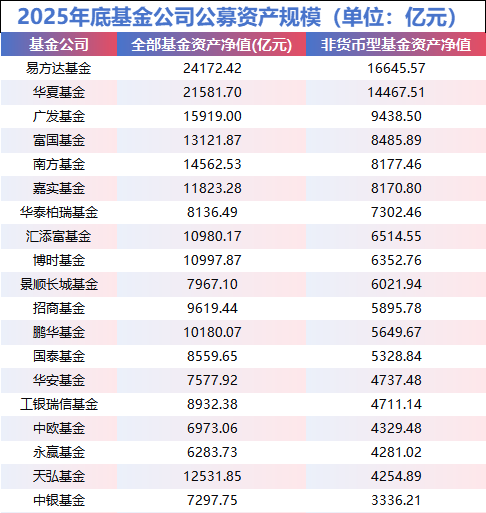
Core Insights - The public fund industry is experiencing significant growth, with a shift from "scale expansion" to "quality and distinctive competition" among companies [1][14][25] - Ten fund companies have surpassed a management scale of 1 trillion yuan, with Huatai and Penghua becoming new members of the "trillion club" in 2025 [1][14] Fund Management Scale - The total net asset value of public funds in 2025 reached 241,724.2 million yuan for E Fund, 215,817.0 million yuan for Huaxia, and 159,190.0 million yuan for GF Fund, among others [2][15] - The top three companies, E Fund, Huaxia, and GF Fund, have maintained their positions for two consecutive years, with an average growth rate of approximately 20% for most companies [2][15] Growth and Ranking Changes - E Fund's non-monetary asset scale grew by 24.5% to 16,645.57 million yuan, while Huaxia's increased by 24.4% to 14,467.51 million yuan [3][16] - Hai Futong Fund emerged as the biggest "dark horse," rising 14 places to 26th with a 73.3% increase in non-monetary scale, reaching 2,103 million yuan [5][17] - Companies like Morgan Fund and Huashang Fund also saw significant ranking improvements, reflecting the effectiveness of their differentiated strategies [5][18] Declines in Rankings - Wanji Fund dropped 5 places to 35th, with a scale decrease of 11.4%, marking the most significant decline among the top 40 [7][20] - Companies such as Jiao Yin and Pu Yin An Sheng also faced declines, with scale reductions of 11.7% and 12.0% respectively, attributed to challenges in their traditional fixed-income sectors [7][20] Industry Trends - The industry is transitioning from a phase of "universal growth" to one characterized by "structural differentiation and survival of the fittest," as indicated by the competitive landscape [10][23] - Companies that have successfully adapted to market changes and focused on innovative product lines are showing robust growth, with median scale increases exceeding 25% [5][18]

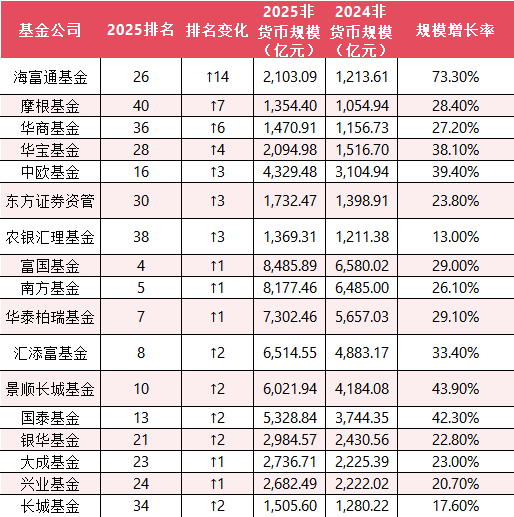
2025非货规模“上升榜”揭晓:海富通成最大黑马,摩根、华商等中小公司异军突起
Xin Lang Cai Jing· 2026-01-23 04:21
Core Insights - The public fund industry is experiencing significant growth in management scale, with notable disparities in growth rates among companies, indicating a shift from "scale expansion" to "quality and differentiation competition" [1][6][10] Group 1: Company Performance - Hai Fu Tong Fund emerged as the biggest "dark horse," rising 14 places to rank 26th, with a non-monetary scale increase of 73.3% to 210.3 billion yuan, driven by dual efforts in "fixed income +" and equity products, particularly in pension management and customized institutional services [1][7] - China Europe Fund moved up 3 places to 16th, with a scale growth of 39.4%, reinforcing its position as an "active equity expert" [1][7] - Invesco Great Wall Fund and Guotai Fund each rose 2 places, with scale increases exceeding 42%, benefiting from their strategies in ETF and active quantitative fields [1][7] - Huatai-PB Fund improved its ranking by 1 place to 7th, with a scale growth of 29.1%, solidifying its leading position in broad-based and dividend ETFs [1][7] - Huitianfu Fund climbed 2 places to 8th, with a scale increase of 33.4%, as consumer and pharmaceutical-themed products continued to attract capital [1][7] Group 2: Emerging Companies - Among smaller firms, Morgan Fund (China) and Huashang Fund rose 7 and 6 places respectively, reflecting the potential of "boutique" and "specialized" strategies in a competitive market [2][7] - Companies that saw ranking improvements generally exhibited three characteristics: focused product lines in advantageous sectors, dual-driven growth from institutional and retail businesses, and proactive layouts in innovative areas like ETFs and quantitative strategies [2][7] Group 3: Industry Trends - The median growth rate of companies that improved their rankings exceeded 25%, significantly surpassing the industry average, indicating their sustained active management capabilities [2][7] - The dramatic changes in the non-monetary scale rankings serve as a clear "scorecard" of the industry's fierce competition and evolving landscape, primarily reflecting capital flows and market enthusiasm [5][10]
多只基金官宣降费!低费率基金持续扩容
Zhong Guo Ji Jin Bao· 2026-01-23 01:17
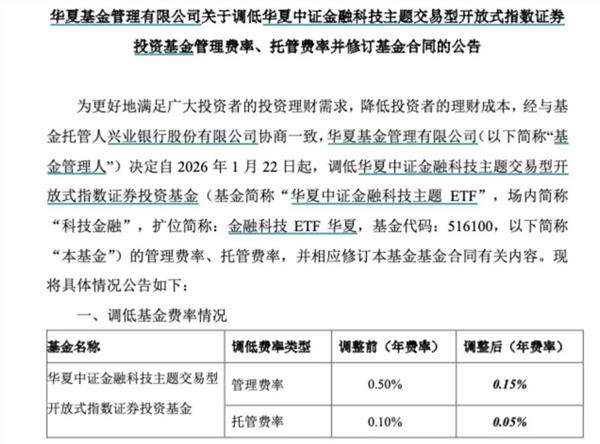
Core Viewpoint - The comprehensive fee reform in the public fund industry has been fully implemented, leading to a continuous trend of fee reductions among various funds to lower investment costs for investors and enhance their sense of returns [1][7]. Group 1: Fee Reductions Announced - Multiple funds have announced fee reductions, including Huaxia Fund, which lowered the management fee from 0.50% to 0.15% and the custody fee from 0.10% to 0.05%, achieving reductions of 70% and 50% respectively [3][5]. - Tianhong Fund reduced the management fee from 0.70% to 0.30% and the custody fee from 0.15% to 0.05%, with reductions of 57.1% and 66.7% respectively [5]. - Other funds, such as Guangfa and Huatai, have also announced similar fee reductions, with management fees dropping to as low as 0.15% and custody fees to 0.05% [6]. Group 2: Growth of Low-Fee Funds - As of January 1, the new regulations on public fund sales expenses have been implemented, marking the completion of a two-year fee reform process, resulting in an increase in low-fee funds [7]. - Currently, nearly 1,200 funds have annual management fees of 0.15% or lower, while over 2,400 funds have custody fees of 0.05% or lower, primarily consisting of stock index funds, bond funds, and money market funds [8]. - The management fees for public REITs generally range from 0.1% to 0.2%, with some products exceeding 0.5%, while custody fees can be as low as 0.01% [8]. Group 3: Industry Transformation - Industry experts believe that the public fund fee reform represents a systemic and structural reshaping of the industry ecosystem rather than a mere fee reduction [9]. - In the long term, this reform is expected to shift the industry focus from scale expansion to service enhancement, contributing to sustainable development within the industry [9].
降费、降费!又有基金出手
Zhong Guo Ji Jin Bao· 2026-01-22 22:55
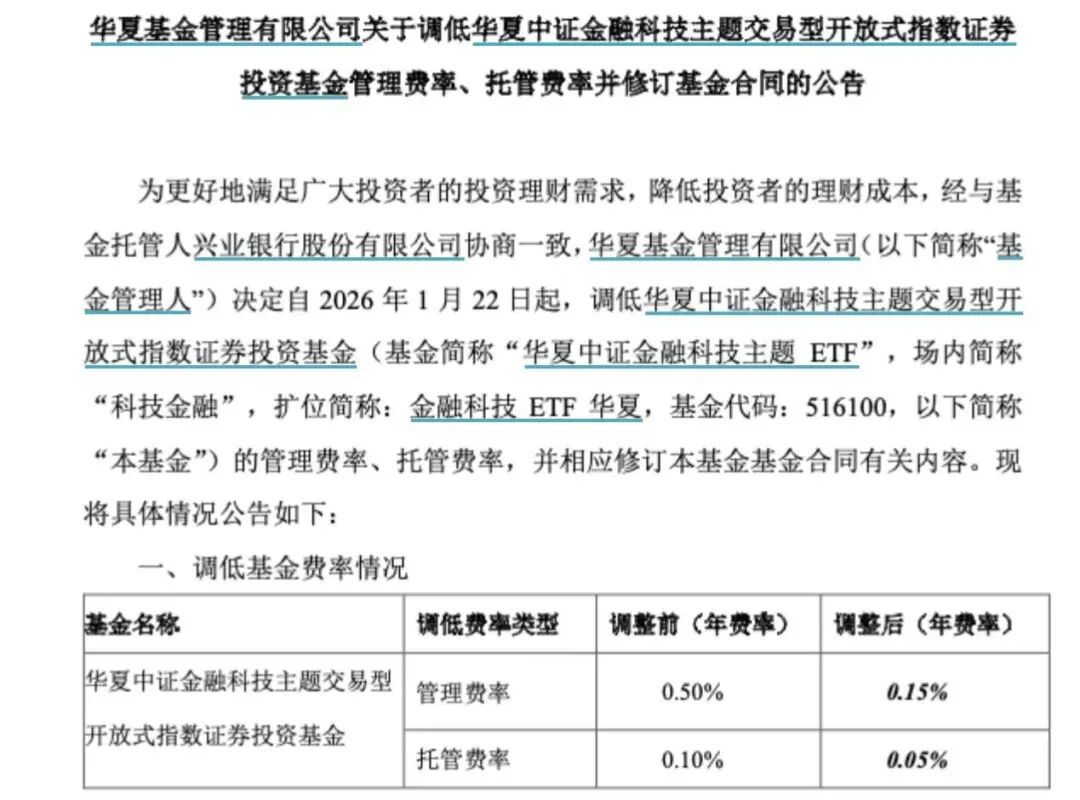
Core Viewpoint - The comprehensive fee reform in the public fund industry has been fully implemented, leading to a continuous trend of fee reductions among various funds to lower investment costs for investors and enhance their return experience [1][7]. Group 1: Fee Reductions Announced - Multiple funds have announced fee reductions, including Huaxia Fund, which lowered the management fee from 0.50% to 0.15% and the custody fee from 0.10% to 0.05%, representing a reduction of 70% and 50% respectively [3][5]. - Tianhong Fund reduced its management fee from 0.70% to 0.30% and custody fee from 0.15% to 0.05%, with reductions of 57.1% and 66.7% respectively [5]. - Other funds, such as GF Fund and Huatai Baoxing, have also announced similar fee reductions, contributing to a broader trend of decreasing fund fees across the market [6]. Group 2: Impact of Fee Reform - As of January 1, 2026, the implementation of the "Publicly Raised Securities Investment Fund Sales Expense Management Regulations" marks the completion of a two-year fee reform process, resulting in a significant increase in the number of low-fee funds [7]. - Currently, nearly 1,200 funds have an annual management fee of 0.15% or lower, while over 2,400 funds have a custody fee of 0.05% or lower, primarily consisting of stock index funds, bond funds, and money market funds [7]. - The fee reform is seen as a systemic and structural transformation of the industry, shifting the focus from scale expansion to service enhancement, which is expected to promote sustainable development in the long term [8].
降费!降费!又有基金出手
中国基金报· 2026-01-22 16:07
Core Viewpoint - Multiple funds have announced fee reductions to lower investment costs for investors and enhance their return experience, following a comprehensive fee reform that has been in place for over two years [2][3]. Group 1: Fee Reductions Announced - 华夏基金 has announced a reduction in management and custody fees for its Financial Technology ETF, effective January 22, 2026, with management fees decreasing from 0.50% to 0.15% (a 70% reduction) and custody fees from 0.10% to 0.05% (a 50% reduction) [5][7]. - 天弘基金 will lower the management fee from 0.70% to 0.30% (a 57.1% reduction) and the custody fee from 0.15% to 0.05% (a 66.7% reduction) for its Tianhong Ninghong six-month holding period mixed fund, effective January 21, 2026 [8]. - 海富通基金 will reduce the management fee for its Hai Futong Ruixiang one-year regular open bond fund from 0.50% to 0.40% starting January 21, 2026 [8]. Group 2: Market Trends in Fund Fees - As of January 1, 2026, the implementation of the "Publicly Raised Securities Investment Fund Sales Expense Management Regulations" marks the full realization of the fee reform, leading to an increase in low-fee funds [10]. - Nearly 1,200 funds now have annual management fees of 0.15% or lower, primarily consisting of stock index funds, bond funds, and money market funds, while over 2,400 funds have custody fees of 0.05% or lower [10]. - In the actively managed equity fund category, a unified fee cap was established on July 7, 2023, with management fees not exceeding 1.2% and custody fees not exceeding 0.2%, resulting in these rates becoming common [11]. Group 3: Industry Implications - The ongoing fee reductions indicate a systemic and structural transformation in the industry, moving from a focus on scale expansion to service enhancement, which is expected to contribute to sustainable industry development in the long term [11].

看准医药医疗投资机会 公募机构加速布局
Zheng Quan Ri Bao· 2026-01-21 16:17
Group 1 - Three new healthcare-themed funds were launched on January 21, with fundraising amounts of 168 million, 75.87 million, and 10.01 million RMB respectively [1] - The launch of these funds indicates a growing interest among public fund institutions in the healthcare sector, with several firms filing for similar funds this year [1] - The advantages of the initiator funds include lower fundraising thresholds and a tighter alignment of interests between fund managers and investors, which can enhance management effectiveness [1] Group 2 - The healthcare sector has shown significant internal performance differentiation, with innovative drugs and export-related industries achieving notable excess returns [2] - Fund managers maintain an optimistic outlook for the healthcare industry, anticipating a gradual recovery in overall revenue growth by 2026, with a focus on innovative drug supply chains and medical outsourcing [2] - The innovative drug sector is transitioning from rapid imitation to differentiated innovation, with a marked increase in overseas licensing transactions by domestic pharmaceutical companies since 2020 [2] Group 3 - Investment strategies in the healthcare sector for 2026 will focus on innovation upgrades and domestic demand improvements [3] - The innovative drug and device investment opportunities are expected to continue, but investors will seek greater certainty, making stock selection more critical [3] - The traditional Chinese medicine sector is currently undervalued, presenting long-term investment potential, while certain segments of consumer healthcare and medical devices are beginning to recover [3]
两市ETF两融余额减少8.12亿元丨ETF融资融券日报
2 1 Shi Ji Jing Ji Bao Dao· 2026-01-21 03:23
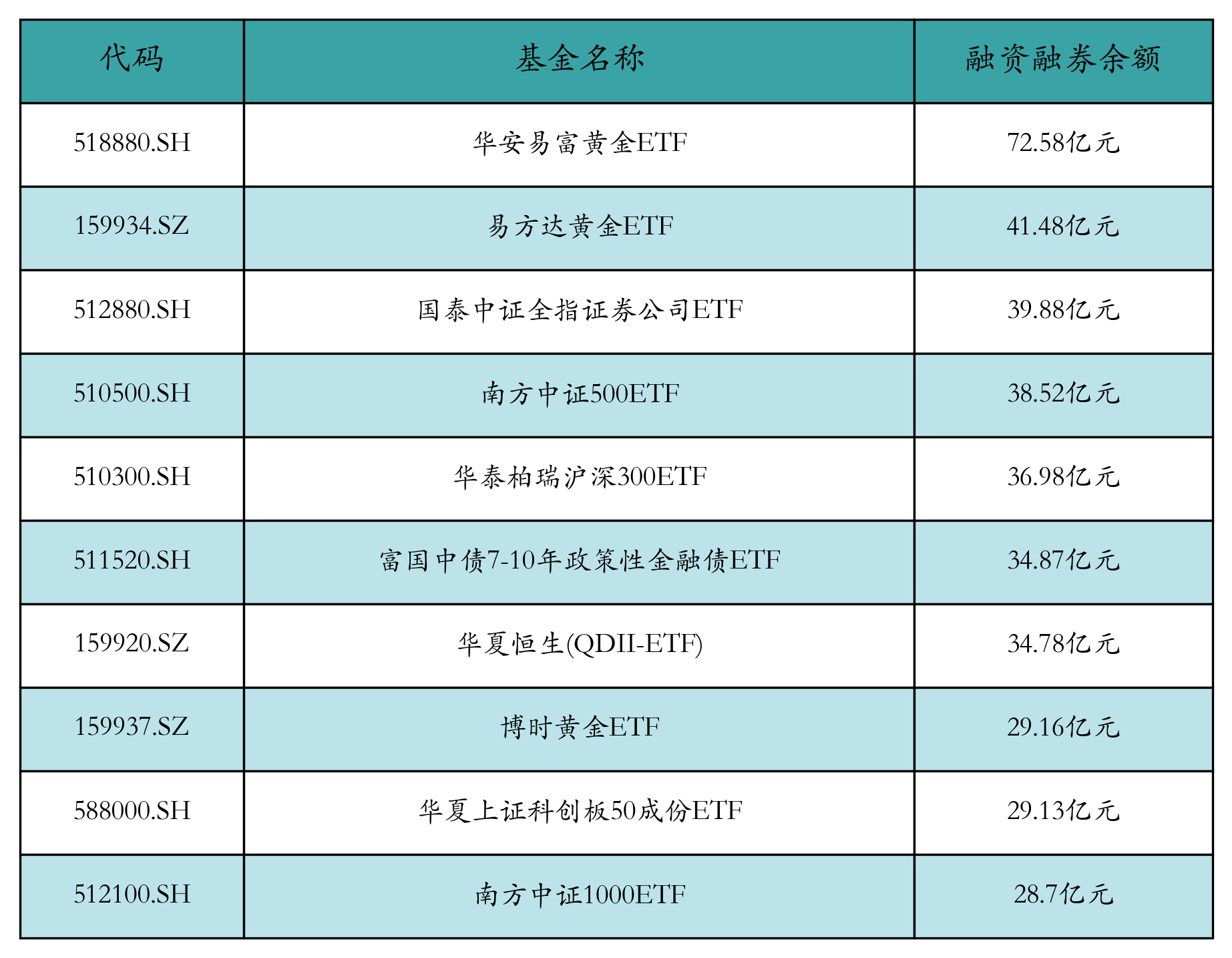
Market Overview - As of January 20, the total ETF margin balance in the two markets is 122.93 billion yuan, a decrease of 0.81 billion yuan from the previous trading day [1] - The financing balance is 115.22 billion yuan, down by 0.998 billion yuan, while the securities lending balance is 7.71 billion yuan, an increase of 0.186 billion yuan [1] - In the Shanghai market, the ETF margin balance is 86.28 billion yuan, a decrease of 0.61 billion yuan, with a financing balance of 79.51 billion yuan, down by 0.808 billion yuan [1] - In the Shenzhen market, the ETF margin balance is 36.65 billion yuan, a decrease of 0.202 billion yuan, with a financing balance of 35.71 billion yuan, down by 0.19 billion yuan [1] Top ETF Margin Balances - The top three ETFs by margin balance on January 20 are: - Huaan Yifu Gold ETF (7.258 billion yuan) - E Fund Gold ETF (4.148 billion yuan) - Guotai CSI All-Share Securities Company ETF (3.988 billion yuan) [2] Top ETF Financing Amounts - The top three ETFs by financing amount on January 20 are: - Hai Futong CSI Short Bond ETF (5.135 billion yuan) - Huatai-PB Southern Dongying Hang Seng Technology Index (QDII-ETF) (1.078 billion yuan) - Huaxia Hang Seng Technology (QDII-ETF) (1.005 billion yuan) [4] Top ETF Net Financing Amounts - The top three ETFs by net financing amount on January 20 are: - GF CSI Hong Kong Innovative Medicine (QDII-ETF) (88.0038 million yuan) - Bosera 30-Year Treasury Bond ETF (62.1176 million yuan) - Huabao CSI Medical ETF (50.7989 million yuan) [5] Top ETF Securities Lending Amounts - The top three ETFs by securities lending amount on January 20 are: - Southern CSI 1000 ETF (1.52 billion yuan) - Southern CSI 500 ETF (1.18 billion yuan) - GF CSI 1000 ETF (293.241 million yuan) [6]
朗坤科技(301305) - 301305朗坤科技投资者关系管理信息20260120
2026-01-20 08:20
Group 1: Company Overview and Leadership - Shenzhen Longkun Technology Co., Ltd. is represented by Chairman Chen Jianxiang and other key personnel during investor relations activities [1][3] - The company is actively engaging with various financial institutions and analysts to discuss its business strategies and developments [2][3] Group 2: AI Application Center - The AI Smart Application Center was officially established on January 11, 2025, to enhance internal efficiency and management through AI technology [4] - The center focuses on two main areas: internal management and digital applications related to the company's core business in organic waste resource utilization and bioenergy [4] Group 3: Collaboration with Sinopec - Longkun Technology is collaborating with Sinopec to build a full industrial chain for the collection, pre-treatment, and deep processing of waste oil into biodiesel and sustainable aviation fuel (SAF) [4] - The partnership is progressing steadily, with a signing ceremony held on August 15, 2025, although specific details are under confidentiality agreements [4] Group 4: HMO Product Development - The company has completed trial production for its first phase of HMO products, with a capacity of 260 tons, which has passed inspections from multiple downstream clients [5] - HMO products include various types such as 2'-FL, 3-FL, and LNnT, with some already approved by health authorities [6] Group 5: SAF Policy and Market - Thailand has implemented a mandatory blending policy for sustainable aviation fuel, requiring a 1% mix starting January 1, 2026, to support carbon neutrality goals [6] - In China, the target for SAF consumption is set at 20,000 tons for 2025, with a cumulative goal of 50,000 tons during the 14th Five-Year Plan period [6][7] Group 6: Project Progress - The Beijing Tongzhou project is on track for completion and trial operation in the second half of 2026 [7]
许继电气股价涨5.34%,海富通基金旗下1只基金重仓,持有4900股浮盈赚取8477元
Xin Lang Cai Jing· 2026-01-20 06:44
Group 1 - XJ Electric's stock price increased by 5.34% on January 20, reaching 34.13 CNY per share, with a trading volume of 4.287 billion CNY and a turnover rate of 13.01%, resulting in a total market capitalization of 34.766 billion CNY [1] - The stock has risen for three consecutive days, with a cumulative increase of 14.81% during this period [1] - XJ Electric, established on December 26, 1996, and listed on April 18, 1997, operates in five main business areas: smart power distribution, smart electricity usage, DC transmission control protection, special energy-saving equipment, and intelligent power supply for industrial and transportation sectors [1] Group 2 - The main revenue composition of XJ Electric includes: smart power distribution systems (28.64%), smart meters (23.71%), smart medium-voltage power supply equipment (20.76%), new energy and system integration (10.79%), charging and swapping equipment and other manufacturing services (8.96%), and DC transmission systems (7.14%) [1] - Hai Fu Tong Fund has a significant holding in XJ Electric, with its Hai Fu Tong Xin Yi Mixed C Fund (519221) holding 4,900 shares, accounting for 1.09% of the fund's net value, ranking as the ninth largest holding [2] - The fund has generated a floating profit of approximately 8,477 CNY today and a total of 20,500 CNY during the three-day increase [2]

债券ETF资金持续流出 | 债券ETF跟踪
Xin Lang Cai Jing· 2026-01-20 06:39
Fund Flow - As of January 16, 2026, bond ETFs experienced a net outflow of 16.512 billion yuan over the past week, with interest rate, credit, and convertible bond ETFs seeing net outflows of 5.307 billion yuan, 14.018 billion yuan, and a net inflow of 2.814 billion yuan respectively [21][24] - Since 2025, cumulative net inflows for interest rate, credit, and convertible bond ETFs have reached 60.615 billion yuan, 487.023 billion yuan, and 25.964 billion yuan respectively, totaling 573.603 billion yuan [21][24] Index Performance - The China Bond New Comprehensive Index rose by 0.18% over the past week, while short-term pure bond and medium-to-long-term pure bond funds increased by 0.02% and 0.05% respectively [19][24] - The CSI AAA Sci-Tech Bond Index and the Shanghai Benchmark Market Company Bond Index both increased by 0.11% [19][24] Net Value Performance - Various types of bond ETFs generally saw an increase in net value, with the 30-year government bond ETF from Bosera rising by 0.37%, and the government bond ETF from Huaxia increasing by 0.31% [23][24] - Convertible bond ETFs and the Shanghai Convertible Bond ETF rose by 1.05% and 0.68% respectively [23][24] Credit Bond ETF and Sci-Tech Bond ETF Performance - As of January 16, 2026, the median unit net value for credit bond ETFs and sci-tech bond ETFs was 1.0128 and 1.0010, with increases of 0.09% and 0.07% respectively [25][32] - The Dachen credit bond ETF performed relatively well, increasing by 0.10% [25][32] Duration Tracking of Credit Bond ETFs - As of January 16, 2026, the holding durations for short-term bond ETFs, corporate bond ETFs, and urban investment bond ETFs were 0.34 years, 1.56 years, and 2.13 years respectively [32][34] - For market-making credit bond ETFs, the median holding durations for products tracking the Shanghai and Shenzhen market-making corporate bonds were 3.58 years and 2.80 years respectively [32][34]