
爱朋医疗

Search documents
脑机接口概念股走强,爱朋医疗涨超9%
Ge Long Hui· 2026-01-12 06:37
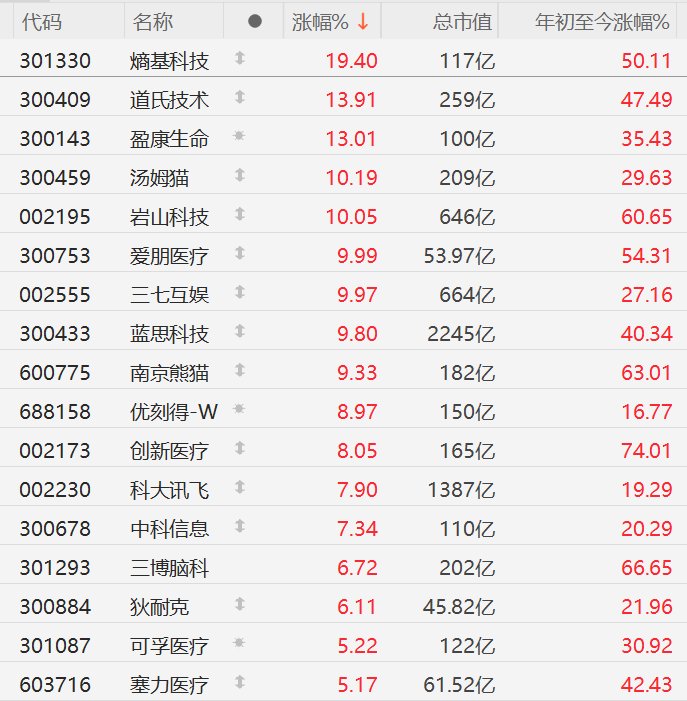
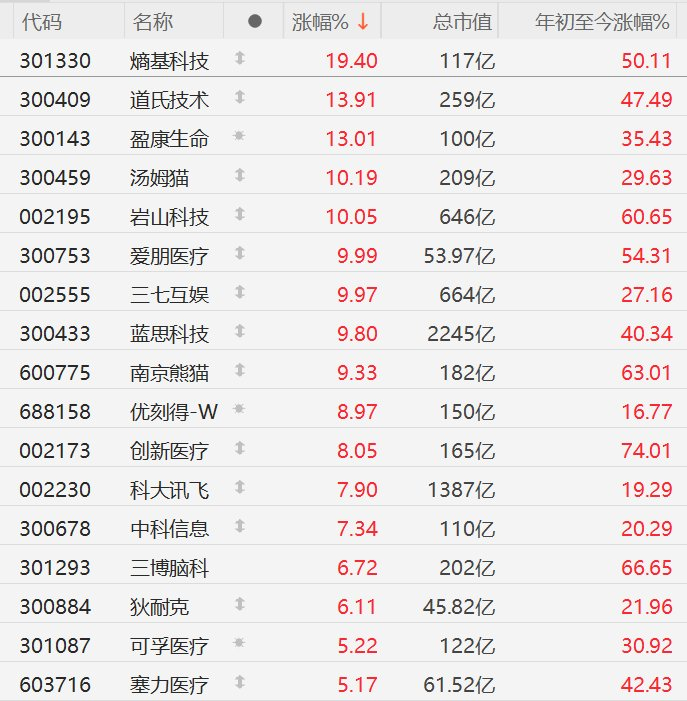
Group 1 - The A-share market saw a strong performance in brain-computer interface concept stocks, with several companies approaching or hitting their daily limit up [1] - Notable gainers included Entropy Technology, which approached a 20% limit up, and Dao's Technology and Yingkang Life, both rising over 13% [1] - Other significant performers included Tom Cat, which increased by over 10%, and Yanshan Technology, which hit a 10% limit up [1] Group 2 - The table lists various companies with their respective stock codes, percentage increase, total market capitalization, and year-to-date performance [2] - Entropy Technology (301330) had a 19.40% increase, with a market cap of 11.7 billion and a year-to-date increase of 50.11% [2] - Dao's Technology (300409) rose by 13.91%, with a market cap of 25.9 billion and a year-to-date increase of 47.49% [2] - Yingkang Life (300143) increased by 13.01%, with a market cap of 10 billion and a year-to-date increase of 35.43% [2] - Other companies like Tom Cat (300459) and Yanshan Technology (002195) also showed significant gains, with year-to-date increases of 29.63% and 60.65% respectively [2]





A股脑机接口概念股走强,爱朋医疗涨超9%
Ge Long Hui A P P· 2026-01-12 06:31
Core Viewpoint - The A-share market has seen a strong performance in brain-computer interface concept stocks, with several companies approaching or hitting their daily price limits [1] Group 1: Stock Performance - Entropy Technology (熵基科技) approached a 20% daily limit increase, with a rise of 19.40% and a market capitalization of 11.7 billion [2] - Dao's Technology (道氏技术) increased by 13.91%, reaching a market cap of 25.9 billion [2] - Yingkang Life (盈康生命) rose by 13.01%, with a market cap of 10 billion [2] - Tom Cat (汤姆猫) saw a 10.19% increase, with a market cap of 20.9 billion [2] - Rock Mountain Technology (岩山科技) hit a 10% daily limit increase, with a market cap of 64.6 billion [2] - Three Seven Entertainment (三七互娱) approached a 10% daily limit increase, with a rise of 9.97% and a market cap of 66.4 billion [2] - Other notable performers include Aipeng Medical (爱朋医疗) at 9.99%, Lens Technology (蓝思科技) at 9.80%, and Nanjing Panda (南京熊猫) at 9.33% [2] Group 2: Year-to-Date Performance - Entropy Technology has a year-to-date increase of 50.11% [2] - Dao's Technology has risen 47.49% year-to-date [2] - Yingkang Life has a year-to-date increase of 35.43% [2] - Tom Cat has increased by 29.63% year-to-date [2] - Rock Mountain Technology has a significant year-to-date increase of 60.65% [2] - Aipeng Medical has a year-to-date increase of 54.31% [2] - Nanjing Panda has a remarkable year-to-date increase of 63.01% [2] - Other companies like Innovation Medical (创新医疗) and Keda Xunfei (科大讯飞) have year-to-date increases of 74.01% and 19.29%, respectively [2]
脑机接口概念震荡走高 道氏技术等多股涨超10%
Xin Lang Cai Jing· 2026-01-12 06:29
Core Insights - The brain-computer interface (BCI) concept is gaining traction, with companies like Dao's Technology, Entropy Technology, and Aipeng Medical seeing stock increases of over 10% [1] - The surge follows a significant performance by Yanshan Technology, which achieved five consecutive trading limits in six days [1] - The National Medical Products Administration (NMPA) has announced plans to publicly consult on two recommended industry standards for medical devices utilizing BCI technology [1] Company Performance - Dao's Technology, Entropy Technology, and Aipeng Medical experienced stock price increases exceeding 10% [1] - Yanshan Technology has shown remarkable stock performance with six days of trading, five of which hit the upper limit [1] - Companies such as Sanqi Interactive Entertainment and Nanjing Panda are approaching trading limits, indicating strong market interest [1] Industry Developments - The NMPA is working on two key standards: one for reliability verification methods for invasive medical devices using BCI technology, and another for design and application specifications for functional reconstruction [1] - The public consultation on these standards reflects a growing regulatory framework supporting the BCI industry [1]


脑机接口行业报告:产业发展迎来黄金期,蓝海市场广阔
CMS· 2026-01-12 06:05
Investment Rating - The report maintains a positive investment rating for the brain-computer interface (BCI) industry, highlighting significant investment opportunities expected in 2026 [2]. Core Insights - The brain-computer interface industry is entering a golden period of development, with a broad blue ocean market. Global strategic layouts are being actively pursued by the US, EU, Japan, and other regions, leading to a growing number of companies and active investment activities [1]. - The BCI technology is at a critical stage of transitioning from technological breakthroughs to practical applications, with the market expected to grow significantly over the next decade. The global BCI market is projected to reach approximately $2.94 billion by 2025 and grow to about $12.4 billion by 2034, with a compound annual growth rate (CAGR) of 17.35% from 2025 to 2034 [6][20]. - The report emphasizes the importance of policy support and technological advancements in driving the growth of the BCI industry, with significant investments and initiatives from various governments [20][30]. Industry Overview - The BCI technology has evolved through three stages: the initial stage (1.0), the development stage (2.0), and the current intelligent and integrated stage (3.0) [20]. - The BCI market is characterized by diverse applications, with at least 30 identified use cases across medical, consumer, and industrial sectors. Medical applications currently dominate, accounting for 56% of the industry, while non-medical applications are rapidly expanding [18][19]. Market Size and Growth - The BCI market is expected to experience accelerated growth in the next decade, driven by the increasing adoption of BCI technologies across various sectors. The report forecasts a significant rise in market size, with a focus on the rapid development of non-invasive BCI technologies [6][20]. - The report highlights that the US and China are leading the global BCI technology and industry development, with major companies like Neuralink and Qiang Brain Technology making significant advancements [6][20]. Investment Recommendations - The report recommends focusing on companies involved in BCI technology, particularly those with strong market positions such as Dao Technology (which has a stake in Qiang Brain Technology) and other related firms in the flexible sensor sector [6][20]. - It also suggests monitoring developments in the medical device sector related to BCI technologies, emphasizing the importance of medical-grade BCI products [6][20].
华创证券:政策加码、临床加速 脑机接口产业化进入关键阶段
智通财经网· 2026-01-12 01:57
Core Insights - The commercialization of brain-computer interfaces (BCIs) is steadily advancing, presenting vast market opportunities in China, where competition is still in its early stages with most companies being small and not yet in a saturated market [1] - Invasive BCIs have significant advantages in signal quality, while non-invasive BCIs offer high safety and ease of use, serving as a complement to invasive types [1] - The current focus of the industry is on the medical field, with potential future expansion into non-medical areas [1] Group 1: Global Developments - Neuralink, a global leader in BCIs, is expected to enter the commercialization phase by 2026, with 12 patients having successfully implanted devices as of September 2025 [2] - Neuralink plans to increase the number of electrodes in its devices to over 30,000 by 2028, aiming for comprehensive brain connectivity [2] - The company has outlined three core product lines: Telepathy for motor disabilities, Blindsight for visual impairments, and Deep for neurological disorders [2] Group 2: Competitive Barriers - Key competitive advantages for Neuralink include flexible electrode arrays, precise implantation robots, and low-power intracranial signal processing systems [3] - The development of a closed-loop technical system through interdisciplinary research and clinical collaboration is essential for domestic companies [3] Group 3: Industry Trends in China - National strategies are guiding the BCI industry, with policies expected to be released in 2025 to support development [4] - Clinical advancements are accelerating, with significant breakthroughs in invasive and semi-invasive BCI systems reported in 2025 [4] - The financing market for BCIs is thriving, with 24 financing events recorded in 2025, marking a 30% increase year-on-year [4] - The supporting industrial chain for BCIs is rapidly forming, with pilot implementations in medical and everyday scenarios [4]
爱朋医疗20260109
2026-01-12 01:41
Summary of Aipeng Medical Conference Call Company Overview - Aipeng Medical is focused on developing advanced medical devices in the field of brain-machine interfaces, particularly in anesthesia monitoring, sleep treatment, and ADHD management. The company has established partnerships with various hospitals and academic institutions to enhance its product offerings and research capabilities [2][4][7]. Key Products and Developments 1. **Anesthesia Depth Monitoring Device** - The device has been implemented in over 100 hospitals and is expected to generate revenue exceeding 10 million yuan by 2025. It collects prefrontal EEG signals to output anesthesia indices during surgery, preventing awareness or excessive anesthesia [2][6]. 2. **Sleep Treatment Solutions** - Aipeng Medical has developed a neural regulation and bionic sleep solution targeting approximately 10 million patients with chronic insomnia. This includes diagnostic tools (PSG and adhesive sleep monitoring) and treatment options (self-controlled sedation and auricular vagus nerve stimulation). The system is valued at hundreds of thousands to millions of yuan per unit and is already in use in several hospitals [2][4][7]. 3. **ADHD Management System** - The company has created a multimodal behavioral management system for over 20 million children with ADHD, incorporating EEG headsets, drones, and robots. This system is currently being utilized in a few hospitals and is supported by a joint laboratory established with Fudan University Children's Hospital [2][4][7]. 4. **Epilepsy Monitoring and Warning System** - Aipeng Medical is researching a semi-implantable real-time monitoring and warning system for epilepsy, with plans to launch a prototype in the second half of 2026 and obtain certification by 2029 [2][10][12]. 5. **Non-Invasive Brain Stimulation Technology** - The company is collaborating with Ruishen An to develop non-invasive deep electrode stimulation technology, with projected revenue exceeding 100 million yuan by 2025 [3][10]. Financial Projections - For 2026, Aipeng Medical anticipates revenue from heart and brain state monitoring to be less than 20 million yuan, while combined revenue from ADHD and sleep systems is expected to reach several tens of millions. The company aims to scale these operations to over 100 million yuan as quickly as possible, with marketing strategies to be adjusted based on clinical discussions and pricing [5][11]. Research and Development Strategy - Aipeng Medical has established an Artificial Intelligence and Brain-Machine Engineering Research Institute, leveraging internal and external expert resources to accelerate product innovation. The internal team includes researchers from prestigious universities and experienced professionals from leading tech companies [4][7][15]. Market Strategy and Commercialization - The company emphasizes the importance of clear application scenarios for the commercialization of brain-machine interface technology. Aipeng Medical aims to build credibility through hospital endorsements and expand into consumer markets, particularly in sleep treatment, by integrating hospital and home care solutions [17][18]. Future Plans - Aipeng Medical plans to continue advancing its non-invasive product lines, including the ADHD training system and sleep treatment solutions. The company is also focused on developing the appetite interference stimulation system and progressing the semi-invasive epilepsy warning device. Additionally, it is exploring embedded neural regulation devices in collaboration with leading domestic companies [18].
双融日报-20260112
Huaxin Securities· 2026-01-12 01:37
Market Sentiment - The current market sentiment score is 90, indicating an "overheated" market condition, which suggests a high level of investor optimism [5][7][18]. Hot Themes Tracking - **Robotics Theme**: The establishment of a national standard organization for humanoid robots and embodied intelligence marks a transition from "technical exploration" to "industrial collaboration" and "scale deployment," which is expected to accelerate technology implementation and ecosystem formation. Related stocks include Sanhua Intelligent Control (002050) and Wolong Electric Drive (600580) [5]. - **Banking Theme**: Bank stocks exhibit high dividend characteristics, with the CSI Bank Index yielding 6.02%, significantly higher than the 10-year government bond yield. In a slowing economy with increased market volatility, bank stocks are seen as important investment targets for long-term funds such as insurance and social security. Related stocks include Agricultural Bank of China (601288) and Ningbo Bank (002142) [5]. - **Brain-Computer Interface Theme**: Neuralink plans to begin large-scale production of brain-computer interface devices in 2026, with a projected global market size of $12.4 billion by 2034 and a CAGR of 17% from 2025 to 2034. Related stocks include Aipeng Medical (300753) and Maipu Medical (301033) [5]. Capital Flow Analysis - The top ten stocks with the highest net inflow include Leo Group (002131) with a net inflow of 178.99 million, Kunlun Wanwei (300418) with 138.48 million, and Sanhua Intelligent Control (002050) with 124.27 million [8]. - The top ten stocks with the highest net outflow include Yanshan Technology (002195) with a net outflow of -349.89 million and Zhongji Xuchuang (300308) with -203.89 million [10]. Industry Insights - The banking sector is highlighted for its stability and high dividend yield, making it a favorable choice for long-term investors during economic slowdowns [5]. - The robotics industry is poised for growth due to new standards that will facilitate collaboration and reduce development costs, indicating a shift towards more scalable applications [5]. - The brain-computer interface market is expected to grow significantly, driven by advancements in technology and increasing demand for innovative medical solutions [5].
【华创医药】华创医疗器械求索系列11:脑机接口行业——政策加码,临床加速,产业化进入关键阶段
华创医药组公众平台· 2026-01-12 00:51
Core Viewpoint - The article discusses the development and commercialization of brain-computer interface (BCI) technology, highlighting its market potential, competitive landscape, and various applications, particularly in the medical field [3][5]. Group 1: Brain-Computer Interface Overview - BCI technology establishes a direct communication pathway between the brain and external devices, with steady progress in commercialization leading to vast market opportunities [3]. - The competitive landscape in China's BCI sector is still in its early stages, with most companies being small and not yet in a saturated market [3]. - There are two main types of BCI products: invasive BCIs, which offer significant signal quality advantages, and non-invasive BCIs, which are safer and easier to operate, serving as a complement to invasive types [3]. - Current applications are primarily in the medical field, with future potential to expand into non-medical areas [3]. - The industry chain has high technological barriers at the upstream level, while the mid and downstream sectors exhibit strong agglomeration effects [3]. Group 2: Global Leader Neuralink's Path to Industrialization - Neuralink, a global pioneer in BCI, is expected to enter the industrial application phase by 2025, with 12 patients having successfully implanted devices [4]. - The company plans to scale production of BCI devices starting in 2026, transitioning from laboratory research to large-scale manufacturing [4]. - Neuralink has outlined a three-step technology iteration plan, aiming to increase the number of electrodes in implants significantly by 2028 to enable comprehensive brain connectivity [4]. - The company has identified three core product lines: Telepathy for motor function recovery, Blindsight for visual perception restoration, and Deep for neurological function recovery [4]. - Neuralink's competitive advantages include advanced electrode technology, precise implantation robotics, and low-power signal processing systems [4]. - The development of Neuralink offers insights for domestic companies, emphasizing the importance of interdisciplinary research, clinical collaboration, and gradual commercialization [4]. Group 3: Factors Driving BCI Industrialization in China - National strategies are guiding the BCI sector, with local policies being introduced to support its development [5]. - Clinical advancements are accelerating, with significant breakthroughs in various BCI applications, including invasive and semi-invasive systems [5][6]. - The financing market for BCI is thriving, with 24 financing events recorded in 2025, marking a 30% year-on-year increase [5]. - The supporting industry chain for BCI technology is rapidly forming, facilitating the practical application of BCI in medical, production, and daily life scenarios [6]. Group 4: Key Companies in the BCI Sector - Notable companies in the BCI field include: - Xinwei Medical (interventional BCI) - Maipu Medical (neurosurgical consumables) - Kefu Medical (bionic implant BCIs) - Meihua Medical (upstream BCI industry) - Sanbo Brain Science (neurological specialty medical group) - Weisi Medical (rehabilitation BCIs) - Mailande (rehabilitation BCIs) - Xiangyu Medical (rehabilitation BCIs) - Chengyitong (comprehensive BCIs) - Aipeng Medical (neuro-regulation BCIs) - Chuangxin Medical (exoskeleton BCIs) [11].
爱朋医疗(300753) - 300753爱朋医疗投资者关系管理信息20260111
2026-01-11 15:10
Company Overview - Aipeng Medical focuses on medical devices, specializing in pain management and upper airway management, while also exploring brain-computer interface innovations [5] - The company has a strategic partnership with Ruishen'an Medical, a leading player in the neuroregulation field in China [5] Product Competitiveness - The "Multimodal ADHD Behavioral Training System" integrates data connectivity between in-hospital and home training environments, addressing both medication and behavioral training as primary treatment options [6] - The system aims to provide a comprehensive training solution, mitigating risks associated with traditional single behavioral training products [6] Clinical Applications - The Persistent Insomnia Anesthesia Treatment System has been implemented in hospitals, showing promising treatment outcomes and attracting interest from sleep and anesthesia specialists [7] - The company’s EEG collection products are essential components of the ADHD treatment system, with relevant pricing established in various provinces [9] Future Investments - Aipeng Medical plans to continue exploring brain-computer interface opportunities aligned with its strategic direction, focusing on sensor technology, signal processing, and clinical applications for mental health disorders [10] - The establishment of an AI and Brain-Computer Engineering Research Institute aims to drive innovation in pain management, anesthesia, and mental health diagnostics [10] Business Progress of Ruishen'an - Ruishen'an has successfully launched several products, including the implantable vagus nerve stimulator and the rechargeable spinal cord stimulator, generating revenue [11] - The first domestic implantation of a closed-loop neurostimulation system for Parkinson's disease is expected to occur by the end of 2025, marking a significant advancement in clinical practice [11]
强脑科技 20 亿融资紧随 Neuralink,脑机接口赛道双线发力
Huafu Securities· 2026-01-10 11:04
Investment Rating - The industry rating is "Outperform the Market," indicating that the overall return of the industry is expected to exceed the market benchmark index by more than 5% in the next 6 months [14]. Core Insights - Strong Brain Technology has completed approximately 2 billion yuan in financing, making it the second-largest in the global brain-computer interface (BCI) sector, following Neuralink. This financing round was led by IDG Capital and Huaden International, with participation from industry chain companies, enabling product scaling through a "capital + manufacturing" model [4][6]. - The company focuses on non-invasive technology, with its core product, the "Super Sensor," capable of capturing brain electrical signals without the need for surgery. This technology has already assisted individuals with disabilities in performing complex movements, with plans to help one million disabled individuals regain mobility and assist ten million patients in rehabilitation over the next 5-10 years [4][6]. - Neuralink, a key player in the BCI field, is set to initiate large-scale production of BCI devices in 2026 and is advancing fully automated surgical solutions. This invasive technology complements Strong Brain Technology's non-invasive approach, collectively driving the commercialization of global BCI technology [5][6]. - The global BCI market is projected to grow rapidly, with an estimated market size of approximately 2.62 billion USD in 2024, expected to reach 2.94 billion USD in 2025, and potentially grow to 12.4 billion USD by 2034, reflecting a compound annual growth rate (CAGR) of 17.35% over the next decade. In China, the BCI market is anticipated to reach 3.2 billion yuan in 2024 and 6.14 billion yuan by 2028 [6]. Summary by Sections Financing and Market Position - Strong Brain Technology has secured around 2 billion yuan in financing, ranking second globally in the BCI sector, just behind Neuralink [4]. - The financing round was led by IDG Capital and Huaden International, with contributions from various industry chain companies [4]. Technology and Product Development - The company's non-invasive "Super Sensor" technology captures brain signals without surgery, aiding individuals with disabilities [4]. - Plans are in place to assist one million disabled individuals and ten million patients in rehabilitation over the next 5-10 years [4]. Market Growth Projections - The global BCI market is expected to grow from 2.62 billion USD in 2024 to 12.4 billion USD by 2034, with a CAGR of 17.35% [6]. - The Chinese BCI market is projected to grow from 3.2 billion yuan in 2024 to 6.14 billion yuan by 2028 [6].