
鱼跃医疗

Search documents
迪安诊断领涨,AI医疗持续火爆!全市场规模最大的医疗器械ETF(159883)近10日吸金超10亿!
Xin Lang Cai Jing· 2026-01-14 02:51
Group 1 - The brain-computer interface has significantly impacted the medical industry this year, with a medical device ETF attracting over 1 billion yuan in the last 10 days, indicating a surge in market interest [1] - Companies like Di'an Diagnostics and Yuyue Medical have seen stock increases of over 10% and 8% respectively, while the medical device ETF (159883) has risen over 3% [1] - Di'an Diagnostics highlighted that AI will drive rapid development in healthcare applications, particularly in primary care and health management, emphasizing the need for high-quality multimodal data [1] Group 2 - Multiple research institutions are optimistic about the medical device industry by 2026, with a focus on overseas market growth, high-value consumables procurement, and the profitability turning point for innovative devices [2] - The overseas market, especially in Europe and the US, is expected to be a major growth driver, with significant growth anticipated in high-value consumables such as orthopedics, electrophysiology, and surgical robots [2] - The application of AI in healthcare is accelerating, supported by national policies, with a clear trend towards commercialization and revenue growth in AI medical applications [2] Group 3 - The Hong Kong medical ETF (159366) is strategically positioned to benefit from AI in healthcare, with a high concentration of CROs and being the largest ETF in its category, offering good liquidity and T+0 support [3] - This ETF focuses on leading companies in the Hong Kong medical sector, allowing investors to share in the growth dividends of these enterprises [3]


趋势研判!2025年中国互联网医院行业发展历程、政策、医院数量、重点品牌及未来趋势:互联网医疗为互联网医院提供核心服务支撑,推动其数量达3756家[图]
Chan Ye Xin Xi Wang· 2026-01-14 01:13
Core Insights - The article discusses the emergence and growth of Internet hospitals in China, highlighting their role in providing convenient and efficient medical services, especially during the COVID-19 pandemic [1][14] - Internet hospitals are seen as a new model in the healthcare system, addressing issues like access to care and hospital transformation [1][14] Industry Overview - Internet hospitals are platforms that integrate online consultations, prescriptions, payments, and drug delivery, connecting patients with healthcare providers [4] - The services offered by Internet hospitals include remote diagnosis, post-hospital management, and health management [4] Industry Development History - The first Internet hospital in China was established in 2015, marking a significant milestone in the integration of healthcare and technology [9] - The COVID-19 pandemic accelerated the growth of Internet hospitals, with over 500 new hospitals established in 2020 alone [1][14] - By October 2022, there were over 2,700 Internet hospitals in China, serving more than 25.9 million patients [1][14] - Projections indicate that by the end of 2024, the number of Internet hospitals will reach 3,340, providing over 100 million consultations annually [1][14] Industry Policies - The Chinese government has increasingly recognized and supported Internet hospitals, leading to a period of policy benefits [11] - Recent policies aim to enhance the integration of artificial intelligence in healthcare, with a goal of widespread implementation by 2030 [11] Industry Value Chain - The upstream of the Internet hospital industry involves medical equipment and information technology, while the midstream consists of solution integrators [12] - The downstream primarily includes patients who utilize these services [12] User Scale and Usage Rate - As of December 2024, the user base for Internet healthcare in China reached 418 million, with a usage rate of 37.7% [13] - By June 2025, the user scale is expected to be 393 million, with a usage rate of 35% [13] Key Companies in the Industry - Notable companies in the Internet hospital sector include Ping An Good Doctor, JD Health, Alibaba Health, and WeDoctor, among others [2][15] - Ping An Good Doctor reported a revenue of 1.278 billion yuan in the first half of 2025, marking a year-on-year growth of 20.23% [15] - JD Health's revenue from health product sales reached 29.331 billion yuan in the first half of 2025, with a growth of 22.67% [17] Challenges Facing the Industry - Issues such as patient information sharing, cross-regional medical insurance reimbursement, and regulatory frameworks remain significant challenges for Internet hospitals [18][19][20] - The complexity of online diagnosis and potential medical risks also pose challenges that need to be addressed [21] Future Trends - The future of Internet hospitals is expected to focus on personalized health management driven by data and AI technologies [22] - Remote medical services will become standardized and integrated into the healthcare system, enhancing accessibility and efficiency [23] - A seamless integration of online and offline services will create a comprehensive healthcare ecosystem centered around patient needs [24]



以“检”之力 护“企”航行——镇江检察以高质效履职“硬举措”提升营商环境“软实力”
Zhen Jiang Ri Bao· 2026-01-13 23:51
经开区检察院成功办理全市首例侵害专精特新"小巨人"企业商业秘密案,对3名离职员工违反保密 协议造成价值3700万元技术被公开的行为依法予以严惩,获受害企业送锦旗致谢;丹徒区检察院办理的 某石油天津分公司修某某受贿案,入选江苏省检察机关助力平等保护优化法治化营商环境典型案例,筑 牢企业防护屏障;京口区检察院解开欠款纠纷"连环债"谜团,追回330万元欠款,助力企业重生……一 个个涉企案例的办理,彰显了全市检察机关依法平等保护各类经营主体的力度与决心。 全市检察机关还加大追赃挽损工作力度,最大限度减少企业经济损失。2025年以来,共在办案中为 企业挽回各类经济损失逾5111.09万元,切实多角度、全方位维护企业合法权益,勾勒出法治安商、检 护前行的温暖底色。 从打造"镇合意·检先行"营商环境服务品牌,到全面提升"365全周期"护企工作法,再到倾力构建公 平有序的法治化营商环境,2025年以来,我市检察机关立足法律监督职能,为企业纾困、为产业赋能、 为创新护航,3件涉企案例入选省级以上典型案例,1个单位、1名个人分获2024年度查处重大侵权盗版 案件有功单位、有功个人,营造更优法治化营商环境的做法被《工人日报》、《检 ...
厉害啦!发布会现场来了一批“人工智能+”!
Yang Zi Wan Bao Wang· 2026-01-13 14:22
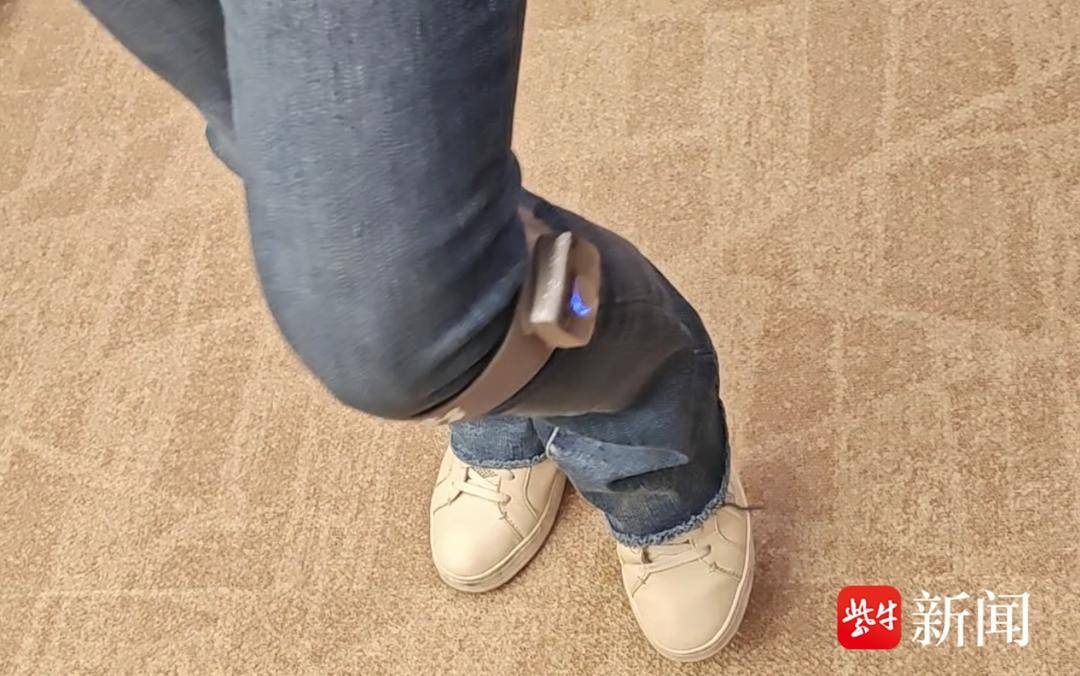
人形机器人、机器狗、学前教育智能体、全球首款Xtand智能髌骨带、全球首款手势操控XR眼镜、动态血糖监测仪、智能灵巧手……1月13日,省政府举 办《江苏省"人工智能+"行动方案》新闻发布会。一批江苏企业研发生产的智能终端产品进行了展示,在互动体验中,人们管中窥豹,直呼"江苏人工智能 +,厉害啦!" 智能髌骨带 记者佩戴体验了全球首款Xtand智能髌骨带。它佩戴在膝盖下方一点,当记者在几秒钟内,从快步走转为快步小跑时,显示灯由绿变蓝,膝盖附近也明显 感受到有力量支撑。迈宝智能科技(苏州)有限公司市场负责人伍洋跟记者介绍,它搭载AI算法和传感器,能准确识别人体运动状态,去自动充气填压,最 终的目标是保护膝盖、髌骨和半月板。其识别率达到99.6%,人体行为模式分析与大数据分析与预测准确率达到99%。 "宁小智"平台的"荣荣" 智能灵巧手 当中科硅纪(南京)机器人有限公司联合创始人王森戴上手套,并动起手指时,桌上摆放的智能灵巧手也同步"复刻"起他的动作,最高负载可以达到20公 斤。它们运用到工业场景,可以做抓取、搬运等操作。据介绍,该公司的Casia Hand系列智能灵巧手,突破了仿筋腱驱动灵巧手构型-驱动-控制技术 ...
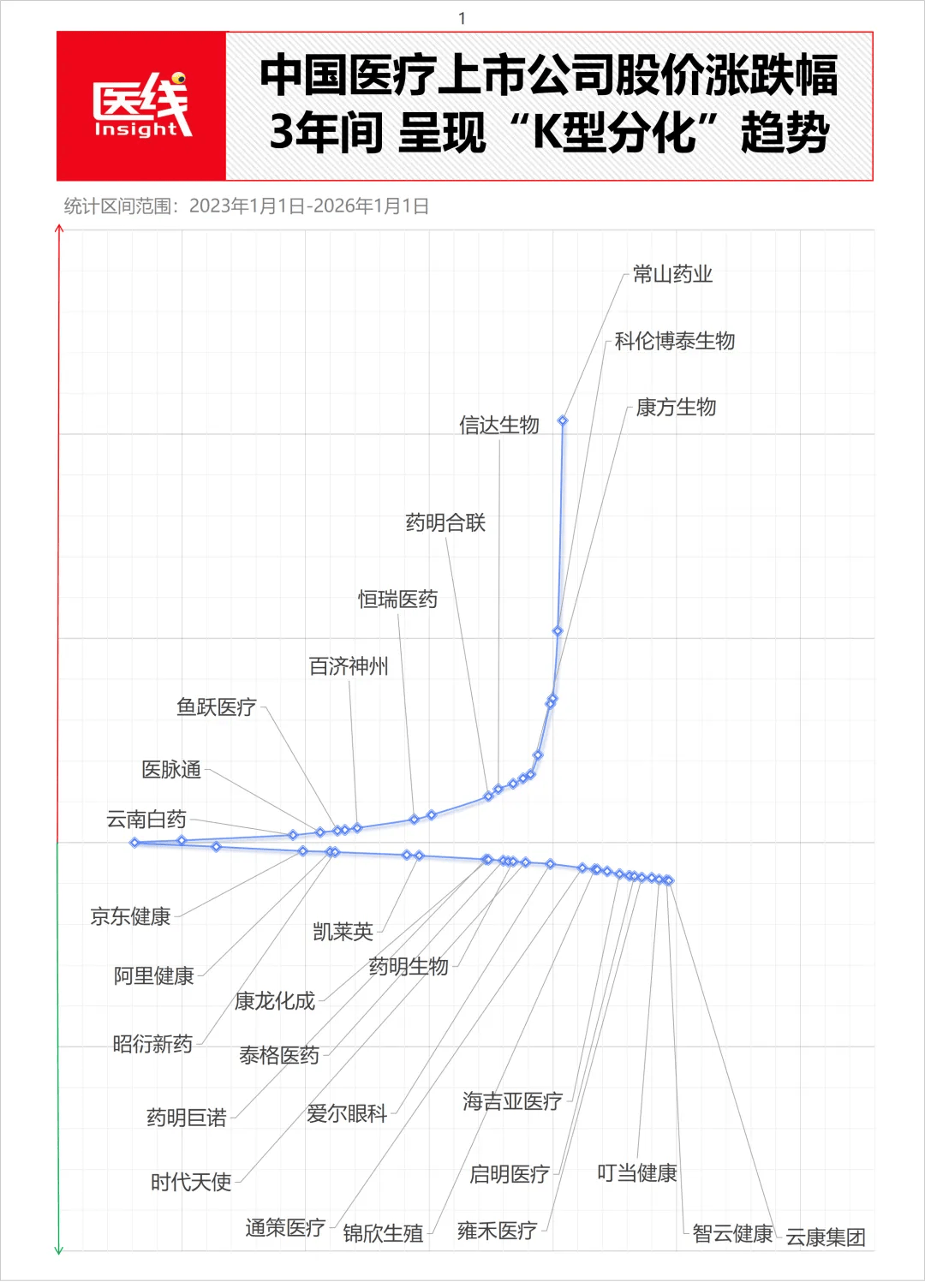
CXO、消费医疗大崩盘:这三年医疗行业发生了什么?
Sou Hu Cai Jing· 2026-01-13 03:48
Core Insights - The Chinese healthcare industry has undergone a significant transformation from 2020 to 2025, transitioning from a "golden era" of investment to a "bubble-clearing period" characterized by a K-shaped divergence in market performance [1][2][4]. Group 1: K-shaped Downward Trends - The collapse of previously successful business models, particularly in CXO, consumer healthcare, and internet healthcare, has led to substantial market value losses, with some companies experiencing declines of over 90% [4][7]. - The downturn is attributed to macroeconomic factors such as U.S. interest rate hikes and geopolitical tensions, as well as microeconomic issues like supply-demand imbalances and the disappearance of growth dividends [8][10]. - The CXO sector, once seen as a perpetual growth engine, has faced a 46.68% decline for WuXi Biologics and 44.47% for Tigermed, revealing the fragility of its business model reliant on continuous global financing [12][10]. - Consumer healthcare has suffered a "Davis double whammy," with companies like Yonghe Medical and Aier Eye Hospital seeing declines of 86.19% and 52.69%, respectively, as consumer spending shifts away from discretionary healthcare services [14][15]. - Internet healthcare companies, including Zhiyun Health and Dingdang Health, have also faced severe declines, with drops of 92.44% and 90.67%, as the market realizes that their revenue largely comes from online drug sales rather than innovative healthcare solutions [19][21]. Group 2: K-shaped Upward Trends - In contrast, companies with strong global rights and hard-core technology have thrived, with Keren Biotechnology and Kangfang Biopharma seeing increases of 518.33% and 166.72%, respectively, marking a shift towards biopharma and global market engagement [29][31]. - The rise of these companies signifies a new era where capital is attracted to firms that can demonstrate robust clinical data and global market potential, moving away from mere concepts [30][31]. - Even within struggling sectors, some companies like WuXi AppTec and Yuyue Medical have shown resilience, with increases of 113.36% and 28.75%, respectively, by focusing on high-tech, high-barrier services [34][35]. Group 3: Challenges Ahead - Despite the emergence of new leaders, significant challenges remain, including the risks associated with licensing agreements that may compromise long-term profitability [36][37]. - The ADC sector is experiencing a rush similar to the past PD-1 craze, raising concerns about market saturation and price competition, which could undermine future profitability [39][40]. - The ongoing "ice age" in the primary market poses a threat to innovation, as funding for early-stage companies has become increasingly scarce, potentially leading to a decline in new drug approvals in the coming years [42][43].
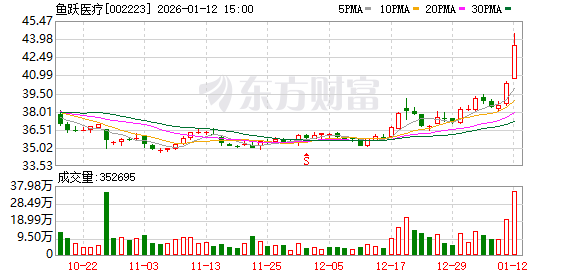
鱼跃医疗:截至2025年12月31日股东总户数为40000多户
Zheng Quan Ri Bao· 2026-01-12 12:48
Group 1 - The core point of the article is that Yuyue Medical has indicated that by December 31, 2025, the total number of shareholders is expected to exceed 40,000 [2]
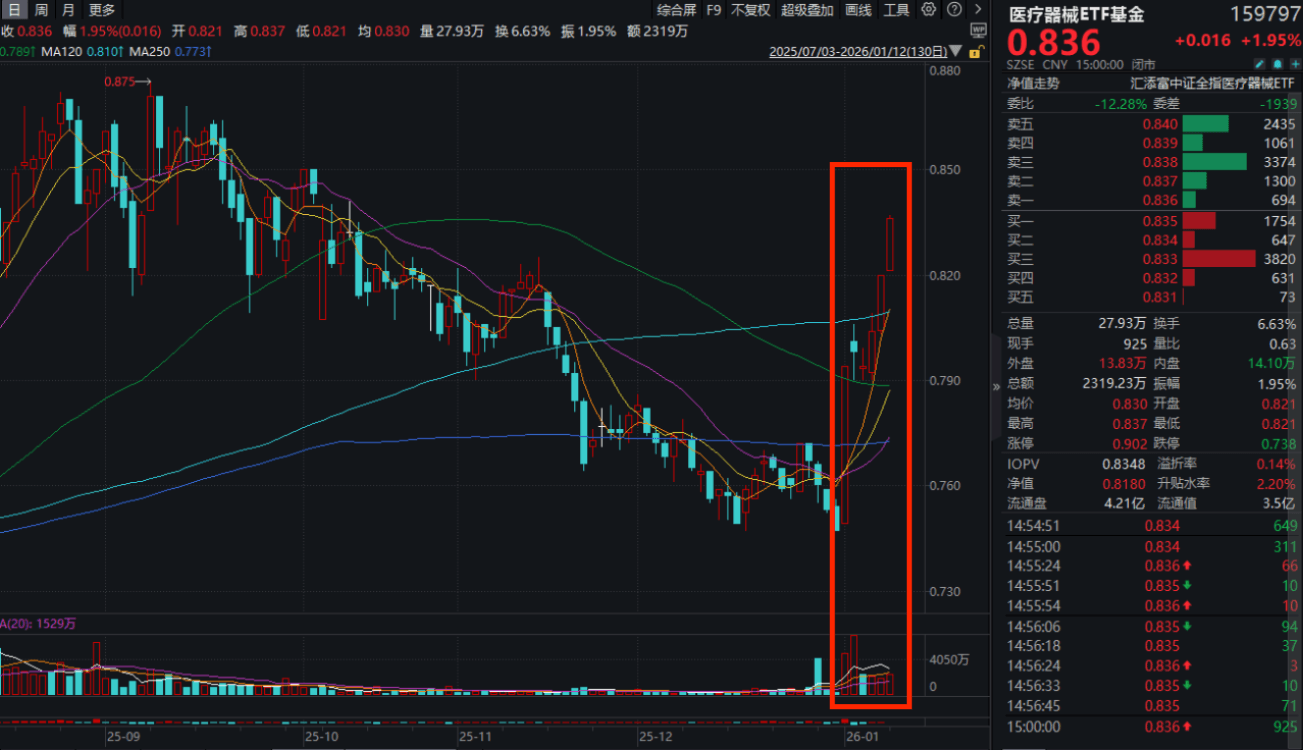
人类首次“太空脑机接口实验”!强脑科技以保密形式提交香港IPO申请!同类费率最低档的医疗器械ETF基金(159797)收涨近2%强势三连阳!
Sou Hu Cai Jing· 2026-01-12 10:18
Group 1: Brain-Computer Interface (BCI) Industry - Strong Brain Technology has submitted a confidential IPO application in Hong Kong, indicating a significant step in the BCI sector [1] - The Tianjin University BCI and Human-Machine Integration Laboratory has developed a comprehensive layout from high-performance devices to system integration, focusing on non-invasive BCI technology [1] - The BCI industry is experiencing a golden period of development, with a projected market size of $2.94 billion by 2025 and expected to grow to approximately $12.4 billion by 2034, reflecting a compound annual growth rate of 17.35% [7] Group 2: Clinical Applications and Innovations - The Tianjin University has launched a series of innovative medical devices for clinical applications, covering areas such as stroke rehabilitation, spinal cord injury assistance, depression treatment, and auditory disorders [1] - The BCI technology has been successfully applied in aerospace, including the development of a brain-machine interaction system for space stations, enhancing astronaut performance and emotional state monitoring [1] Group 3: Market Trends and Investment Opportunities - The BCI sector is characterized by active investment and financing activities, with the U.S., EU, and Japan leading in strategic initiatives [4] - The medical device ETF fund (159797) has shown strong performance, with significant net subscriptions, indicating investor confidence in the medical device sector [5][8] - The ETF fund covers core areas of medical devices, including high-value consumables and in vitro diagnostics, with the top ten weighted stocks accounting for 45.04% of the fund [8]
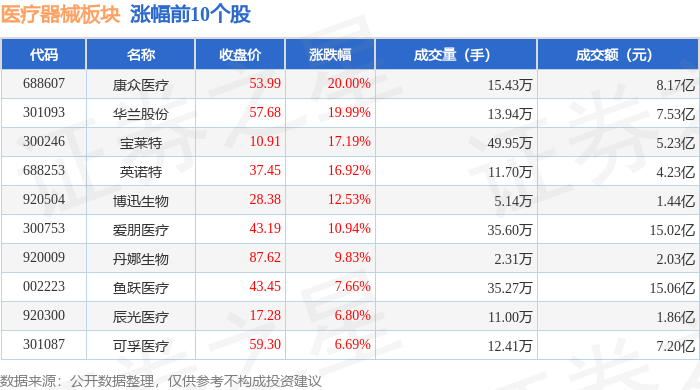
医疗器械板块1月12日涨1.89%,康众医疗领涨,主力资金净流入1.99亿元
Zheng Xing Xing Ye Ri Bao· 2026-01-12 09:04
Market Performance - The medical device sector increased by 1.89% on January 12, with Kangzhong Medical leading the gains [1] - The Shanghai Composite Index closed at 4165.29, up 1.09%, while the Shenzhen Component Index closed at 14366.91, up 1.75% [1] Top Gainers - Kangzhong Medical (688607) closed at 53.99, up 20.00% with a trading volume of 154,300 shares and a transaction value of 817 million [1] - Laijing Co. (301093) closed at 57.68, up 19.99% with a trading volume of 139,400 shares and a transaction value of 753 million [1] - Baolait (300246) closed at 10.91, up 17.19% with a trading volume of 499,500 shares and a transaction value of 523 million [1] Top Losers - Rejing Bio (688068) closed at 188.88, down 8.29% with a trading volume of 26,300 shares and a transaction value of 509 million [2] - Wuzhou Medical (301234) closed at 44.06, down 7.53% with a trading volume of 42,900 shares and a transaction value of 192 million [2] - New Industry (300832) closed at 60.41, down 3.84% with a trading volume of 53,700 shares and a transaction value of 327 million [2] Fund Flow Analysis - The medical device sector saw a net inflow of 199 million from institutional investors, while retail investors experienced a net inflow of 41.84 million [2] - Retail funds showed a net outflow of 241 million, indicating a shift in investment behavior [2] Individual Stock Fund Flow - Lepu Medical (300003) had a net inflow of 167 million from institutional investors, representing 5.74% of total trading [3] - Yuyue Medical (002223) experienced a net inflow of 156 million from institutional investors, with a net outflow of 74.75 million from retail investors [3] - Union Medical (688271) saw a net inflow of 104 million from institutional investors, while retail investors had a net outflow of 53.01 million [3]


浙商证券:AI应用多点开花 看好AI+生物医药投资机会
智通财经网· 2026-01-12 08:02
智通财经APP获悉,浙商证券发布研报称,AI医疗应用在国家战略与市场需求的共振下已迈入商业化落 地的快速阶段。该行认为AI制药核心价值在于大幅提升药物早研效率,看好国内多家AI制药平台服务 能力全球领先。AI制药的高需求将带来较大的落地验证实验及合作需求,建议关注已与AI制药平台有 战略合作的传统CRO公司。此外,早研效率大幅提升将快速传导至临床前、安评以及临床CRO需求。 浙商证券主要观点如下: 该行认为AI制药核心价值在于大幅提升药物早研效率,以英矽智能Pharma.AI为例,其能够使候选药物 从靶点发现到临床前候选药物确认时间从4.5年大幅缩短到12至18个月,早研阶段的投入产出比大幅提 升。该行看好:1)国内多家AI制药平台服务能力全球领先,海外业务拓展持续高速已验证,关注英矽智 能、晶泰科技、泓博医药、维亚生物、成都先导等;2)AI制药的高需求将带来较大的落地验证实验及合 作需求,建议关注已与AI制药平台有战略合作的传统CRO公司,关注皓元医药、美迪西、百诚医药、 阳光诺和、药石科技、药明康德等;3)早研效率大幅提升将快速传导至临床前、安评以及临床CRO需 求,建议关注昭衍新药、美迪西、益诺思、泰格 ...

本周热度变化最大行业为传媒、石油石化:市场情绪监控周报(20260105-20260109)-20260111
Huachuang Securities· 2026-01-11 10:13
- The report introduces a "Total Heat Index" indicator, defined as the sum of browsing, self-selection, and click counts for individual stocks, normalized by their market share on the same day, and multiplied by 10,000. The indicator range is [0,10000][7] - A rotation strategy is constructed based on the weekly heat index change rate (MA2). At the end of each week, the strategy buys the broad-based index with the highest MA2 change rate. If the "Others" group has the highest change rate, the strategy remains in cash. The annualized return since 2017 is 8.74%, with a maximum drawdown of 23.5%. In 2026, the strategy achieved a return of 7.9%[13][16] - A concept-based strategy is developed by selecting the top 5 concepts with the highest weekly heat index change rate. Stocks within these concepts are filtered by excluding the bottom 20% in terms of market capitalization. Two portfolios are constructed: the "TOP" portfolio holds the top 10 stocks with the highest heat index within each concept, while the "BOTTOM" portfolio holds the bottom 10 stocks. The "BOTTOM" portfolio historically achieved an annualized return of 15.71% with a maximum drawdown of 28.89%. In 2026, the "BOTTOM" portfolio returned 6.4%[32][34]