
消费医疗

Search documents
美丽田园医疗健康:内生外延驱动,业绩亮眼高增-20260330
GUOTAI HAITONG SECURITIES· 2026-03-30 08:15
Investment Rating - The investment rating for the company is "Buy" [5] Core Insights - The company has achieved rapid revenue and adjusted profit growth in 2025, completing the integration of Narier and continuing the acquisition of Siyuanli, indicating a strong outlook for market share expansion through both organic and external growth strategies [2][9] - The company reported a revenue of 30.01 billion RMB in 2025, representing a year-on-year increase of 16.7%, and an adjusted net profit of 3.81 billion RMB, up 41.0% year-on-year [9] - The gross profit margin improved by 2.8 percentage points to 49.1%, with all major business segments showing enhanced profitability [9] Financial Summary - Total revenue projections for the company are as follows: - 2024: 25.72 billion RMB - 2025: 30.01 billion RMB - 2026E: 40.13 billion RMB - 2027E: 47.02 billion RMB - 2028E: 53.15 billion RMB - Net profit projections are: - 2024: 2.28 billion RMB - 2025: 3.18 billion RMB - 2026E: 4.50 billion RMB - 2027E: 5.75 billion RMB - 2028E: 7.08 billion RMB - The company’s PE ratio is projected to decrease from 17.34 in 2025 to 6.36 in 2028, indicating increasing valuation attractiveness [4][10] Business Performance - The "Double Beauty + Double Health" model has effectively enhanced member value, with beauty and health services generating 16.58 billion RMB in revenue, accounting for 55% of total revenue, and a gross margin of 41.9% [9] - The medical beauty service segment achieved a revenue of 10.17 billion RMB, up 9.6% year-on-year, with a gross margin of 55.9% [9] - The acquisition of Narier has shown positive results, with single-store revenue increasing from 5.75 million RMB to 8.10 million RMB post-acquisition, and adjusted net profit margin rising from 6.5% to 10.5% [9]
中际旭创,大消息!
Zhong Guo Zheng Quan Bao· 2026-01-22 12:27
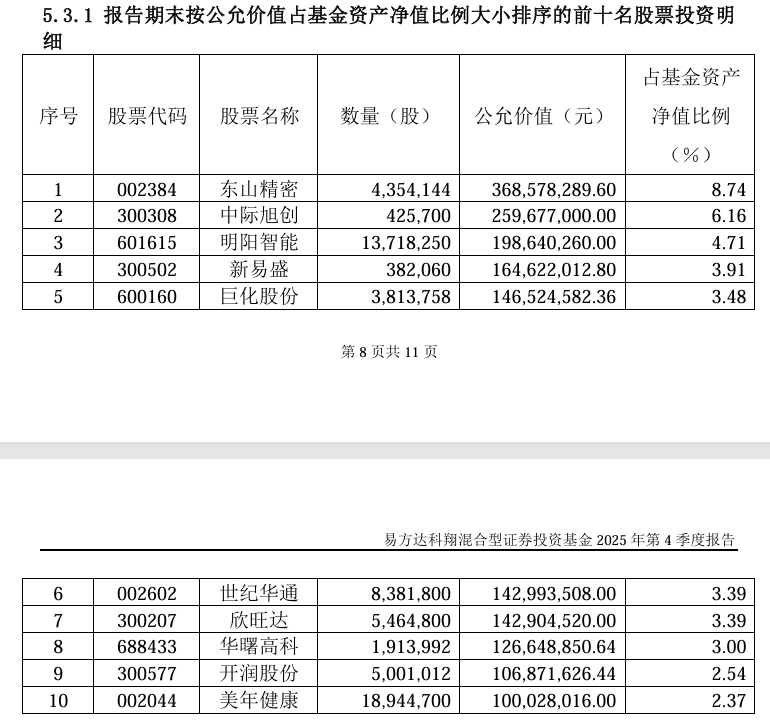
Core Viewpoint - The latest public fund report for Q4 2025 reveals significant changes in the top holdings, with a notable shift towards AI-related stocks and substantial increases in holdings for certain companies, particularly 中际旭创 (Zhongji Xuchuang) [1][4][6]. Group 1: Top Holdings and Changes - The top ten holdings of public funds as of Q4 2025 include 中际旭创, 新易盛, 宁德时代, 腾讯控股, 紫金矿业, 阿里巴巴-W, 寒武纪, 立讯精密, 贵州茅台, and 东山精密 [1]. - 中际旭创 has become the largest holding for public funds, surpassing 宁德时代, with a market value of 784.21 billion yuan [4]. - Compared to Q3 2025, 中际旭创 saw the highest increase in market value, with an increase of 226.02 billion yuan, marking its third consecutive quarter as the most increased stock [2][4]. Group 2: Sector Performance - In addition to technology stocks, sectors such as non-ferrous metals, chemicals, and electrical equipment also saw significant increases in public fund holdings [3][11]. - Stocks in the non-ferrous and chemical sectors, such as 云铝股份 and 天华新能, experienced substantial price increases of 61.65% and 118.53%, respectively, in Q4 2025 [11]. Group 3: Fund Manager Insights - Fund managers are increasingly embracing AI, with significant allocations to AI-related stocks in their portfolios, indicating a strong belief in the sector's growth potential [6][11]. - The overall market valuation for A-shares has risen, yet remains within a reasonable range, making equity assets attractive compared to other asset classes [12]. - The technology sector, particularly driven by AI, is viewed positively by fund managers, with expectations of continued investment opportunities in the coming period [12].


看准医药医疗投资机会 公募机构加速布局
Zheng Quan Ri Bao· 2026-01-21 16:17
Group 1 - Three new healthcare-themed funds were launched on January 21, with fundraising amounts of 168 million, 75.87 million, and 10.01 million RMB respectively [1] - The launch of these funds indicates a growing interest among public fund institutions in the healthcare sector, with several firms filing for similar funds this year [1] - The advantages of the initiator funds include lower fundraising thresholds and a tighter alignment of interests between fund managers and investors, which can enhance management effectiveness [1] Group 2 - The healthcare sector has shown significant internal performance differentiation, with innovative drugs and export-related industries achieving notable excess returns [2] - Fund managers maintain an optimistic outlook for the healthcare industry, anticipating a gradual recovery in overall revenue growth by 2026, with a focus on innovative drug supply chains and medical outsourcing [2] - The innovative drug sector is transitioning from rapid imitation to differentiated innovation, with a marked increase in overseas licensing transactions by domestic pharmaceutical companies since 2020 [2] Group 3 - Investment strategies in the healthcare sector for 2026 will focus on innovation upgrades and domestic demand improvements [3] - The innovative drug and device investment opportunities are expected to continue, but investors will seek greater certainty, making stock selection more critical [3] - The traditional Chinese medicine sector is currently undervalued, presenting long-term investment potential, while certain segments of consumer healthcare and medical devices are beginning to recover [3]
CXO、消费医疗大崩盘:这三年医疗行业发生了什么?
Sou Hu Cai Jing· 2026-01-13 03:48
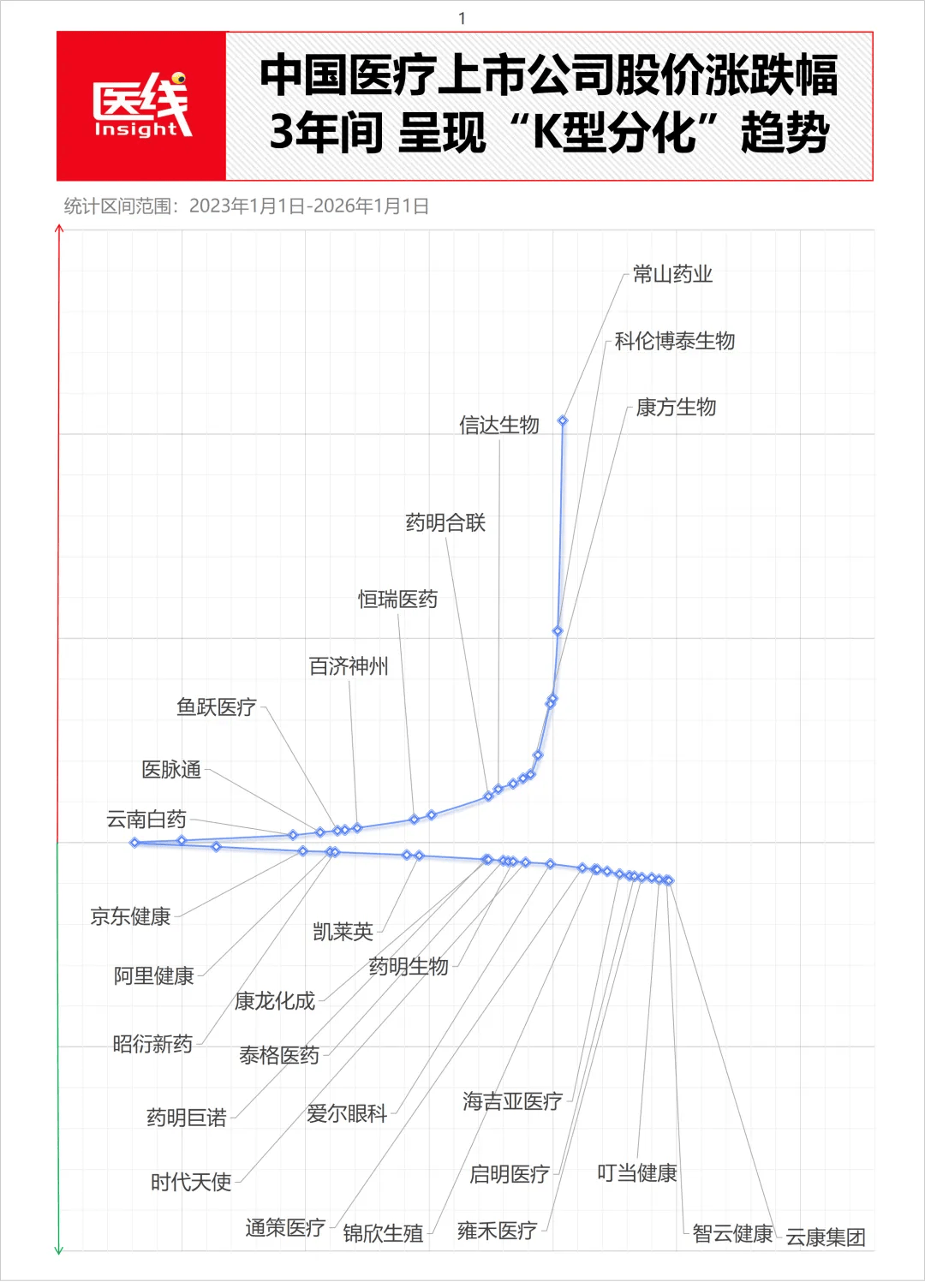
Core Insights - The Chinese healthcare industry has undergone a significant transformation from 2020 to 2025, transitioning from a "golden era" of investment to a "bubble-clearing period" characterized by a K-shaped divergence in market performance [1][2][4]. Group 1: K-shaped Downward Trends - The collapse of previously successful business models, particularly in CXO, consumer healthcare, and internet healthcare, has led to substantial market value losses, with some companies experiencing declines of over 90% [4][7]. - The downturn is attributed to macroeconomic factors such as U.S. interest rate hikes and geopolitical tensions, as well as microeconomic issues like supply-demand imbalances and the disappearance of growth dividends [8][10]. - The CXO sector, once seen as a perpetual growth engine, has faced a 46.68% decline for WuXi Biologics and 44.47% for Tigermed, revealing the fragility of its business model reliant on continuous global financing [12][10]. - Consumer healthcare has suffered a "Davis double whammy," with companies like Yonghe Medical and Aier Eye Hospital seeing declines of 86.19% and 52.69%, respectively, as consumer spending shifts away from discretionary healthcare services [14][15]. - Internet healthcare companies, including Zhiyun Health and Dingdang Health, have also faced severe declines, with drops of 92.44% and 90.67%, as the market realizes that their revenue largely comes from online drug sales rather than innovative healthcare solutions [19][21]. Group 2: K-shaped Upward Trends - In contrast, companies with strong global rights and hard-core technology have thrived, with Keren Biotechnology and Kangfang Biopharma seeing increases of 518.33% and 166.72%, respectively, marking a shift towards biopharma and global market engagement [29][31]. - The rise of these companies signifies a new era where capital is attracted to firms that can demonstrate robust clinical data and global market potential, moving away from mere concepts [30][31]. - Even within struggling sectors, some companies like WuXi AppTec and Yuyue Medical have shown resilience, with increases of 113.36% and 28.75%, respectively, by focusing on high-tech, high-barrier services [34][35]. Group 3: Challenges Ahead - Despite the emergence of new leaders, significant challenges remain, including the risks associated with licensing agreements that may compromise long-term profitability [36][37]. - The ADC sector is experiencing a rush similar to the past PD-1 craze, raising concerns about market saturation and price competition, which could undermine future profitability [39][40]. - The ongoing "ice age" in the primary market poses a threat to innovation, as funding for early-stage companies has become increasingly scarce, potentially leading to a decline in new drug approvals in the coming years [42][43].
消费医疗:你的“第一家店”开错了!数字前门才是真正破局关键!
Sou Hu Cai Jing· 2025-12-26 08:42
Core Insights - The development of consumer medical institutions hinges on having a "digital front door," which serves as the primary point of contact for potential users and significantly impacts brand recognition and operational efficiency [1][3][23] Group 1: Importance of Digital Front Door - A digital front door is essential for consumer medical brands, acting as a central hub that connects potential users to various physical locations, thereby determining the scale and reach of the institution [3][19] - Without a digital front door, institutions risk operating as "small circle businesses," relying on local reputation rather than brand identity, which limits growth and brand influence [5][23] - The digital front door transforms the business model from a one-time transaction to a long-term relationship with users, enhancing customer retention and loyalty [9][15] Group 2: Operational Efficiency and Data Utilization - The digital front door alleviates uncertainty in operations by providing data insights on user behavior, allowing for better resource allocation and operational planning [7][19] - It enables institutions to transition from relying on third-party platforms for customer acquisition to building their own user base, thus converting platform traffic into private assets [13][15] - A well-integrated digital front door connects various backend systems, providing a comprehensive view of the customer journey and facilitating data-driven decision-making [19][21] Group 3: Future of Consumer Medical Institutions - Embracing digitalization is no longer optional for consumer medical institutions aiming for growth; it is a critical factor for survival and competitiveness in the market [21][23] - The effectiveness of a digital front door is measured by its ability to engage users cost-effectively, maintain clear data records, and support strategic decision-making based on analytics [21][23] - Institutions that successfully implement a digital front door can overcome geographical limitations and achieve scalable expansion, while those that fail to do so may remain confined to small operations [23]

20cm速递|关注创业板医药ETF国泰(159377)投资机会,创新药出海与政策支持成焦点
Sou Hu Cai Jing· 2025-12-23 03:00
Core Insights - The innovative pharmaceutical sector is transitioning from narrative to realization, with the total amount of License out expected to exceed $120 billion by 2025 [1] - Policy support for innovative drugs is comprehensive, introducing a dual payment system with commercial insurance and medical insurance [1] - The medical device sector is stabilizing, with high-value consumables and medical equipment showing signs of recovery, and domestic production rates surpassing 87% [1] Group 1: Pharmaceutical Industry - The innovative drug sector is entering a phase where the narrative is being realized, with projections indicating that License out amounts will exceed $120 billion by 2025 [1] - The introduction of a dual payment system for innovative drugs, combining commercial insurance with medical insurance, marks a significant policy shift [1] - The raw material drug sector is at a cyclical low, with most prices stabilizing, and the arrival of the "patent cliff" is expected to create growth opportunities for generic drugs and associated APIs [1] Group 2: Medical Devices and Diagnostics - The medical device sector is experiencing a gradual clearing of policy disruptions, with high-value consumables and medical equipment leading the recovery [1] - The domestic production rate for medical devices has exceeded 87%, indicating a strong trend towards localization [1] - Improvements in the in-vitro diagnostics and low-value consumables sectors are anticipated by 2026 [1] Group 3: Consumer Healthcare - The consumer healthcare sector, including traditional Chinese medicine and biological products, is expected to gradually recover from its low point [1] Group 4: AI and Healthcare - The AI in healthcare sector is seeing a surge in policy announcements, with brain-computer interfaces being highlighted as a key industry in the 14th Five-Year Plan, accelerating the commercialization of non-invasive products [1] Group 5: Investment Products - The Guotai Innovation Pharmaceutical ETF (159377) tracks the Innovation Pharmaceutical Index (399275), which has a daily fluctuation of 20%, focusing on companies with high R&D investment and innovation capabilities [1]

昆山工研院“红蓝讲坛”赋能消费医疗新发展
Xin Hua Ri Bao· 2025-12-12 08:23
Group 1 - The event "Red and Blue New Journey Towards America" successfully gathered around 40 representatives from the medical beauty industry, investment institutions, and industry experts to promote the cultivation of new productive forces in the consumer medical field [1] - The Hu-Kun Aesthetic Medicine and Anti-Aging Industrial Park aims to gather over 20 large-scale enterprises and achieve an annual output value exceeding 5 billion yuan within 3 to 5 years, becoming the first specialized park for reconstructive medicine and anti-aging in China [1] - The park has already attracted 29 high-energy projects with a total investment scale of 3.51 billion yuan [1] Group 2 - Five companies, including Zhiwei Wujie and Aowijia Bio, showcased their innovative products in the consumer medical industry, focusing on areas such as nanocrystal micro-needles and exosome innovative drug devices [2] - Zhiwei Wujie highlighted the complementary nature of its non-invasive introduction technology with other enterprises in the park, emphasizing the advantages of the local industrial ecosystem in enhancing product development and market promotion efficiency [2] - The Kunshan Institute of Technology plans to continue leveraging the "Red and Blue Forum" to expand more industry-academia-research cooperation and service scenarios, aiming to create a closed-loop system for the efficient transformation of consumer medical innovations in Kunshan [2]
财信证券吴号:医药生物板块分化加剧 三大投资主线机遇凸显
Zhong Guo Zheng Quan Bao· 2025-12-08 23:21
Core Viewpoint - The pharmaceutical and biotechnology sector has demonstrated resilience and growth potential in 2023, driven by policy support and industry transformation, leading to a high-quality development phase characterized by innovation and cost control [1][4]. Industry Performance - As of December 8, 2023, the pharmaceutical and biotechnology sector has shown a weighted average increase of 30.64% in market capitalization, ranking 14th among 31 primary industries, but underperforming the CSI 300 index by 3.82 percentage points [2]. - The sector has exhibited significant internal differentiation, with innovation-driven segments outperforming others; for instance, other biological products, chemical preparations, and medical R&D outsourcing saw increases of 57.07%, 54.68%, and 51.87% respectively, while traditional Chinese medicine, vaccines, and blood products lagged behind with increases of only 3.89%, -0.73%, and -10.85% [2]. Market Dynamics - The strong performance of the innovative drug industry chain is attributed to four key factors: exceeding expectations in earnings from leading companies like BeiGene and WuXi AppTec, ongoing supportive policies for innovative drugs and devices, increased activity in domestic innovative drug business development (BD) transactions, and substantial clinical data disclosures at major global conferences [2][4]. Recent Adjustments - Since September 2023, the sector has experienced a temporary pullback, with a maximum drawdown of 12.72% from September 1 to November 21, primarily due to prior gains, unmet expectations in BD transactions, and geopolitical disturbances [3]. Valuation Insights - As of December 8, 2023, the sector's price-to-earnings (P/E) ratio stands at 51.75, with a premium of 267.54% over the CSI 300 index and 63.87% over all A-shares (excluding banks), indicating a relatively high valuation compared to historical levels [3]. Policy Support - The "14th Five-Year Plan" emphasizes support for innovative drugs and medical devices, transitioning from process optimization to comprehensive empowerment across the industry chain, with a focus on key technological breakthroughs in areas like dual antibodies, ADCs, and mRNA [6]. Investment Opportunities - Three main investment themes are highlighted: 1. The innovative drug sector, which is expected to thrive due to policy support and market expansion [7]. 2. The CXO sector, benefiting from increased demand for innovative drug development [7]. 3. Consumer healthcare, which is anticipated to recover as consumption policies promote growth [7]. Technological Integration - The integration of AI technologies into the biopharmaceutical industry is expected to enhance research efficiency and product development, with significant growth potential in AI-driven medical diagnostics and treatment processes [8].
财信证券吴号: 医药生物板块分化加剧 三大投资主线机遇凸显
Zhong Guo Zheng Quan Bao· 2025-12-08 20:48
Core Viewpoint - The pharmaceutical and biotechnology sector has demonstrated resilience and growth potential in 2023, driven by policy support and industry transformation, leading to a high-quality development phase characterized by innovation and cost control [1][4]. Industry Performance - As of December 8, 2023, the pharmaceutical and biotechnology sector has shown a weighted average increase of 30.64% in market capitalization, ranking 14th among 31 primary industries, but underperforming the CSI 300 index by 3.82 percentage points [2]. - The sector has exhibited significant internal differentiation, with innovation-driven segments outperforming others; for instance, other biological products, chemical preparations, and medical R&D outsourcing saw increases of 57.07%, 54.68%, and 51.87% respectively, while traditional Chinese medicine, vaccines, and blood products lagged with increases of only 3.89%, -0.73%, and -10.85% [2]. Factors Influencing Growth - The strong performance of the innovative drug industry chain is attributed to four key factors: exceeding expectations in earnings from leading companies like BeiGene and WuXi AppTec, ongoing supportive policies for innovative drugs and devices, increased activity in domestic innovative drug business development (BD) transactions, and substantial clinical data disclosures at major global conferences [2]. Recent Adjustments - Since September 2023, the sector has experienced a pullback due to prior significant gains, unmet expectations in some BD transactions, and geopolitical disturbances, with a maximum drawdown of 12.72% from September 1 to November 21 [3]. Valuation Insights - As of December 8, 2023, the sector's price-to-earnings (P/E) ratio stands at 51.75, ranking 10th among primary industries, with a premium of 267.54% over the CSI 300 index and 63.87% over all A-shares (excluding banks), indicating a relatively high valuation level historically [3]. Policy Impact - The policy environment has significantly upgraded support for the pharmaceutical and biotechnology industry, with the "14th Five-Year Plan" emphasizing the development of innovative drugs and medical devices, and the "15th Five-Year Plan" extending support to the entire value chain [6]. - The focus on key technological breakthroughs in areas such as dual antibodies, ADCs, and mRNA is expected to drive further differentiation within the industry [6]. Investment Opportunities - Three main investment themes are highlighted: 1. The innovative drug sector, which is expected to thrive due to policy support and strong performance from leading companies [7]. 2. The CXO sector, benefiting from increased demand for innovative drug development and showing significant performance improvements [7]. 3. Consumer healthcare companies, which are anticipated to recover as consumer demand increases, presenting dual potential for valuation recovery and earnings growth [7]. Technological Integration - The integration of AI technologies into the biopharmaceutical industry is expected to enhance research efficiency and product development, with AI applications improving diagnostic processes and overall healthcare delivery [8].

医药生物板块分化加剧 三大投资主线机遇凸显
Zhong Guo Zheng Quan Bao· 2025-12-08 20:27
Core Viewpoint - The pharmaceutical and biotechnology sector has shown resilience and growth potential in 2023, driven by policy support and industry transformation, with a clear focus on innovation and cost control shaping the industry landscape [1][5]. Industry Performance - The pharmaceutical and biotechnology sector has achieved a weighted average increase of 30.64% in market capitalization as of December 8, 2023, ranking 14th among 31 primary industries, but underperforming the CSI 300 index by 3.82 percentage points [1]. - The sector has exhibited significant internal differentiation, with innovation-driven segments outperforming others, such as biopharmaceuticals and medical R&D outsourcing, which saw increases of 57.07%, 54.68%, and 51.87% respectively, while traditional segments like traditional Chinese medicine and vaccines lagged behind [2]. Key Factors for Growth - The strong performance of the innovative drug industry chain is attributed to four core factors: exceeding expectations in earnings from leading companies like BeiGene and WuXi AppTec, continuous implementation of supportive policies, increased activity in domestic innovative drug business development (BD) transactions, and substantial clinical data disclosures at global academic conferences [2][3]. Financial Metrics - For the first three quarters of 2023, the pharmaceutical and biotechnology sector reported total revenue of 18,461.96 billion yuan, a year-on-year decrease of 1.27%, while net profit attributable to shareholders was 1,410.97 billion yuan, down 1.63%. However, the third quarter showed signs of recovery with a revenue increase of 1.21% and a net profit increase of 3.79% [4]. Policy Support - The "14th Five-Year Plan" emphasizes support for innovative drugs and medical devices, transitioning from process optimization to comprehensive empowerment across the industry chain, with a focus on key technological breakthroughs in areas such as dual antibodies, ADCs, and digital medicine [5]. Investment Opportunities - Three main investment themes are highlighted: 1. The innovative drug sector, which is expected to be the strongest investment theme due to policy support and market expansion [6]. 2. The CXO sector, benefiting from improved demand for innovative drug development and showing significant performance improvements [6]. 3. Consumer healthcare companies, which are anticipated to see a recovery in demand and performance due to supportive policies [6]. Technological Integration - The integration of AI technology into the biopharmaceutical industry is expected to enhance research efficiency and product development, with AI applications improving diagnostic processes and overall healthcare delivery [7].