
Snowflake Inc.

Search documents
Databricks融资超10亿美金,全球未上市千亿独角兽再添一员?
Sou Hu Cai Jing· 2025-08-20 13:14
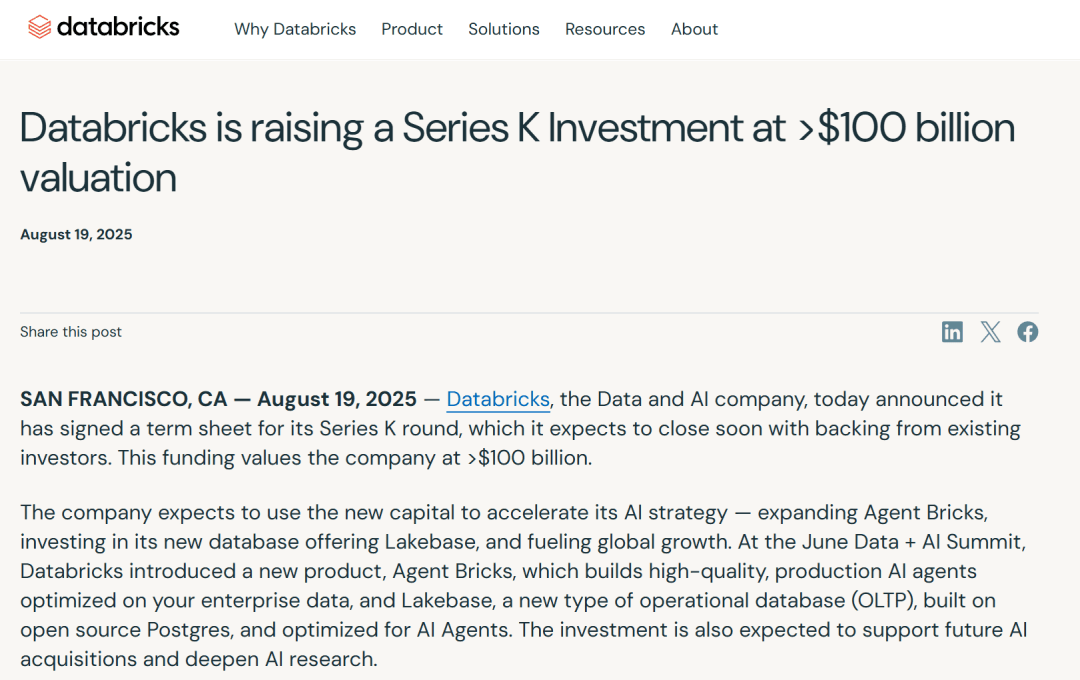
Group 1: Market Overview - The global private equity market is experiencing an unprecedented surge, with the US IPO market contributing to this momentum [1] - Databricks is in the process of raising over $1 billion in a Series K funding round, which is expected to elevate its valuation to over $100 billion [1][3] - Last year, Databricks completed a $10 billion funding round, with a valuation of $62 billion at that time [1] Group 2: Company Profile - Databricks specializes in big data processing and artificial intelligence, helping businesses integrate disparate data resources and utilize machine learning for analysis [3] - The company introduced the "Lakehouse" concept, which streamlines the entire process of data storage, querying, and analysis, enhancing its platform's competitiveness [3] - Databricks combines database capabilities, quantitative research, and AI experimentation, making it a versatile platform for various data types [3][4] Group 3: Financial Performance - Databricks reported an annualized revenue of $3.7 billion as of July this year, with a year-over-year growth rate of 50% [5] - In comparison, its main competitor Snowflake is projected to achieve $4.5 billion in revenue for the fiscal year ending in January, with a growth rate of 25% [5] - Databricks currently employs around 9,000 people and plans to hire an additional 3,000 to strengthen its workforce [5] Group 4: Future Outlook - The CEO of Databricks expressed confidence in the company's potential to become a trillion-dollar enterprise, although significant work remains to achieve this goal [5] - The recent enthusiasm from investors for late-stage funding in tech companies has been notable, especially following the successful IPO of Figma [5]

DeepSeek V3.1发布后,投资者该思考这四个决定未来的问题
3 6 Ke· 2025-08-20 10:51
Core Insights - DeepSeek has quietly launched its new V3.1 model, which has generated significant buzz in both the tech and investment communities due to its impressive performance metrics [1][2][5] - The V3.1 model outperformed the previously dominant Claude Opus 4 in programming capabilities, achieving a score of 71.6% in the Aider programming benchmark [2] - The cost efficiency of V3.1 is notable, with a complete programming task costing approximately $1.01, making it 68 times cheaper than Claude Opus 4 [5] Group 1: Performance and Cost Advantages - The V3.1 model's programming capabilities have surpassed those of Claude Opus 4, marking a significant achievement in the open-source model landscape [2] - The cost to complete a programming task with V3.1 is only about $1.01, which is a drastic reduction compared to competitors, indicating a strong cost advantage [5] Group 2: Industry Implications - The emergence of V3.1 raises questions about the future dynamics between open-source and closed-source models, particularly regarding the erosion and reconstruction of competitive advantages [8] - The shift towards a "hybrid model" is becoming prevalent among enterprises, combining private deployments of fine-tuned open-source models with the use of powerful closed-source models for complex tasks [8][9] Group 3: Architectural Innovations - The removal of the "R1" designation and the introduction of new tokens in V3.1 suggest a potential exploration of "hybrid reasoning" or "model routing" architectures, which could have significant commercial implications [11] - The concept of a "hybrid architecture" aims to optimize inference costs by using a lightweight scheduling model to allocate tasks to the most suitable expert models, potentially enhancing unit economics [12] Group 4: Market Dynamics and Business Models - The drastic reduction in inference costs could lead to a transformation in AI application business models, shifting from per-call or token-based billing to more stable subscription models [13] - As foundational models become commoditized due to open-source competition, the profit distribution within the value chain may shift towards application and solution layers, emphasizing the importance of high-quality private data and industry-specific expertise [14] Group 5: Future Competitive Landscape - The next competitive battleground will focus on "enterprise readiness," encompassing stability, predictability, security, and compliance, rather than solely on performance metrics [15] - Companies that can provide comprehensive solutions, including models, toolchains, and compliance frameworks, will likely dominate the trillion-dollar enterprise market [15]


Will AI's Diversification Beyond Oil & Gas Fuel Its Next Growth Phase?
ZACKS· 2025-08-19 14:10
Core Insights - C3.ai, Inc. is experiencing significant growth in non-oil and gas sectors, with a 48% year-over-year increase in fiscal 2025 revenues, indicating a shift towards diversification as a key driver for enterprise AI adoption [1][9] Industry Expansion - In the manufacturing sector, C3.ai is enhancing its presence with clients like US Steel and Rolls-Royce, focusing on applications such as predictive maintenance and energy optimization, which are yielding measurable efficiency improvements [2] - The public sector is emerging as a vital area for growth, with state and local government revenues more than doubling in fiscal 2025, supported by 71 new agreements across 24 states, showcasing the platform's adaptability [3] - Life sciences are identified as a promising growth area, with major companies like GSK and Sanofi adopting C3.ai's solutions to improve clinical workflows and research data utilization [4] Strategic Alliances - C3.ai has renewed its strategic alliance with Baker Hughes through 2028, which has generated over $0.5 billion in revenues, reinforcing its oil and gas foundation while emphasizing the importance of diversification across 19 industries for long-term growth [5][6] Competitive Landscape - Competitors like Snowflake Inc. and Palantir Technologies Inc. are also expanding into AI-driven applications, with Snowflake reporting that nearly 90% of its top customers are engaging with AI and ML workloads, and Palantir securing a $10 billion agreement with the U.S. Army [7][8]


Figma Stock Downside To $40
Forbes· 2025-08-19 10:20
Core Insights - Figma had a successful IPO, with shares rising from $33 to approximately $80, leading to a market capitalization of around $40 billion, driven by rapid growth and strong retention rates [2] - The current trading multiple of nearly 37 times estimated revenue for 2025 reflects high growth expectations, but any slowdown could lead to a significant re-rating of the stock [3] - A conservative growth scenario suggests Figma's stock could drop to around $44 per share, indicating a potential 50% decrease from current levels [3] Growth Potential and Risks - Figma's revenue increased from less than $100 million in 2021 to $749 million in 2024, with a 46% year-over-year increase in the March quarter, indicating strong growth [3] - Competition from Microsoft, Canva, and AI-driven tools poses a risk to Figma's growth, as these alternatives may attract users away from Figma's platform [5][6] - Figma's long-term success depends on expanding its market beyond designers to include software developers and marketers, which is a more challenging endeavor [6][7] Market Dynamics - Enterprise adoption is still in early stages, with only over 1,000 clients paying $100,000 or more annually, which could limit revenue growth and margin expansion if not addressed [7] - The IPO released a small percentage of shares, with two-thirds still held by insiders under a lockup agreement, which could lead to selling pressure once it expires in early 2026 [8] - Figma's high valuation at 37 times sales suggests that investors are expecting flawless execution, making the stock a high-risk investment [9]



“软件已死,AI当立”?
硬AI· 2025-08-19 03:42
Core Viewpoint - The article discusses the transformative impact of AI on the software industry, suggesting that AI could act as a "force multiplier" for leading suppliers rather than being a disruptive force that undermines existing business models [2][3][4]. Group 1: AI's Role in the Software Industry - AI is seen as a potential "force multiplier" for industry leaders, similar to the transition from on-premises software to cloud computing, which led to the emergence of new leaders and the transformation of established companies like Adobe and Intuit into larger, faster-growing, and more profitable entities [2][4]. - Concerns about AI replacing traditional software have led to significant market reactions, such as SAP's stock dropping 7.1%, resulting in a loss of nearly €22 billion in market value [3]. - High expectations for AI's contribution to revenue stability and growth are anticipated as the pressure from enterprise software renewal cycles eases by 2026 [4]. Group 2: Challenges for AI-native Companies - The debate centers on whether AI-native companies can offer products that are "meaningfully better and cheaper" than existing SaaS solutions [6]. - The entry barriers for enterprise software are significantly higher than for consumer software, primarily due to the critical nature of tasks involved [11]. - AI-native companies face challenges in pricing strategies, particularly in providing value-based pricing models that could threaten traditional seat-based pricing [6][7]. Group 3: Hybrid AI Strategies - Major software companies are adopting hybrid AI model strategies, combining proprietary data-driven models with external large language models (LLMs) to enhance their offerings while maintaining competitive advantages [9]. - This strategy helps mitigate risks from AI-native competitors by locking customers into familiar and integrated ecosystems [9]. - The complexity of enterprise workflows and high data migration costs make it difficult for AI-native products to gain customer trust and adoption quickly [9]. Group 4: Future Indicators to Monitor - Key indicators to watch include the stability of Net Revenue Retention (NRR), which has faced significant pressure in recent years due to pandemic-related demand peaks [15]. - The contribution of AI to revenue growth is crucial, with companies like Adobe projecting $250 million in annual recurring revenue from AI products by the end of 2025 [15]. - Feedback from customers regarding SaaS leaders' innovations and the development momentum of AI-native companies will be essential in assessing their long-term impact on existing profit pools [15].



“软件已死,AI当立”?
Hua Er Jie Jian Wen· 2025-08-19 02:59
Core Insights - The AI wave is reshaping the tech industry, leading to intense debates about the future of traditional software businesses, particularly following the release of OpenAI's GPT-5, which caused significant market sell-offs and concerns about AI replacing traditional software [1][2] Group 1: Market Sentiment and Predictions - The software industry sentiment has turned bearish, with SAP's stock dropping 7.1%, resulting in a market cap loss of nearly €22 billion, marking the largest single-day decline since late 2020 [1] - Goldman Sachs analysts believe that fears regarding AI as a disruptive force are overstated, suggesting that AI could act as a "force multiplier" for leading suppliers rather than a replacement [1][2] - The report anticipates that as enterprise software renewal pressures ease by 2026, AI will contribute positively to key metrics like Net Revenue Retention (NRR), paving the way for sustained growth in the software market [2] Group 2: Competitive Landscape - The debate centers on whether AI-native companies can offer products that are "meaningfully better and cheaper" than traditional SaaS offerings [3] - SaaS giants have established high competitive barriers, making it difficult for AI-native companies to disrupt them, especially in pricing strategies where AI-native firms may threaten traditional seat-based pricing models [3][4] - SaaS leaders are innovating through both organic growth and acquisitions, with notable examples including Salesforce's Agentforce and ServiceNow's acquisitions [3] Group 3: AI Integration Strategies - Major software companies are adopting hybrid AI model strategies, combining proprietary data-driven models with external large language models (LLMs) to enhance their offerings [5][6] - This strategy helps mitigate the risk of being undermined by AI-native newcomers, as it locks customers into familiar and integrated ecosystems [7] - The complexity and critical nature of enterprise software create significant barriers to entry, making it challenging for AI-native products to gain trust and adoption quickly [8] Group 4: Future Indicators to Watch - Key indicators for investors include the stability of NRR, the contribution of AI to revenue growth, customer feedback on SaaS innovations, and the momentum of AI-native companies [10] - For instance, Adobe expects its AI products to contribute $250 million in annual recurring revenue by the end of 2025, which will serve as a critical validation signal for the market [10]
4 Stocks Every AI ETF Is Buying—And They're Not What You Think
MarketBeat· 2025-08-18 21:16
Core Insights - The rise of artificial intelligence (AI) has led investors to seek exposure through AI-focused exchange-traded funds (ETFs) [1] - Some investors prefer to target specific companies for individual investment rather than relying on fund managers [2] Group 1: Snowflake Inc. (SNOW) - Snowflake operates a cloud-based data platform that utilizes AI to provide actionable business insights [3] - SNOW shares are among the top 15 holdings in 25 different ETFs, indicating strong market interest [4] - The company has outperformed the market with a year-to-date return of over 25% [4] - Analyst support is robust, with 36 out of 43 analysts rating SNOW as a Buy, projecting a nearly 15% increase in share price [5] Group 2: Astera Labs Inc. (ALAB) - Astera Labs is a significant player in AI hardware, with increasing demand for its products [6] - The company reported a remarkable second-quarter earnings performance, with EPS more than tripling and revenue increasing by 150% [7] - Analysts forecast earnings growth of 118% for the next year, driven by major partnerships [7] Group 3: Oracle Corporation (ORCL) - Oracle is expanding its AI capabilities within its cloud offerings, including the Fusion suite [9] - The company has experienced a 49% surge in share price year-to-date, with potential for an additional $75 per share upside [10] - Oracle is viewed as a stable investment option for those hesitant to invest in smaller AI firms [10] Group 4: Taiwan Semiconductor Manufacturing Co. (TSM) - TSM is a leading company in the semiconductor industry, included in 117 ETFs as a top position [13] - The stock has risen by over 18% year-to-date, driven by optimism regarding production adjustments in response to tariffs [14] - Analysts unanimously rate TSM as a Buy, indicating confidence in its growth potential [14]



美国股票策略- 情况好转的迹象,尽管程度较低-US Equity Strategy _The Theme-ometer_ Signs of improvement for less..._
2025-08-18 02:52
Summary of Key Points from the Conference Call Industry and Company Overview - The conference call focuses on the US equity strategy, particularly thematic equity stock lists and the REVS framework developed by UBS Securities LLC. This framework assesses stock prices based on macroeconomic regimes, operating environments, valuations, and sentiment. Core Insights and Arguments - **Thematic Equity Assessment**: The REVS framework is utilized to evaluate which themes should be favored or unfavored in the market, providing a tactical framework for 2-6 months [1] - **AI and Technology Themes**: AI-related themes, including Semiconductors, Software, and Robotics, remain at the top of the thematic rankings, supported by positive price momentum and late-cycle growth [5][10] - **Pharmaceuticals and GLP-1 Winners**: These themes have improved in rankings following a disappointing Q2 earnings season, with negative revisions in US Pharma & Biotech slowing considerably [5] - **EU Defense Spending**: This theme is experiencing a decline, with earnings revisions stalling, indicating potential risks for stocks in this sector [5] - **EU Electrification and Renewables**: These sectors are showing signs of improvement, with a reversal of a multi-year downgrade cycle as cost inflation and low asset turnover issues are abating [5] - **US Consumer Themes**: Previously negative, these themes are now showing improvement, particularly in Consumer Cyclicals and Low Income Consumer segments, driven by slowing negative revisions [10] - **Regional Banks**: This theme has underperformed year-to-date but may benefit from potential rate cuts, which could alleviate balance sheet pressures [10] Additional Important Insights - **Country Rankings**: The Asia region, particularly Taiwan, Hong Kong, and South Korea, ranks high due to positive regime and valuation signals. In contrast, Europe is lagging behind the US due to score dispersion and external pressures [5] - **Valuation Concerns**: While some sectors are experiencing high valuations and crowding, the overall sentiment remains supportive for continued investment in AI and technology themes [5][10] - **Market Dynamics**: The report emphasizes the importance of monitoring earnings revisions and sentiment scores, as these factors significantly influence stock performance [10][18] - **Stock Rankings**: Top scoring stocks include Broadcom, Oracle, Meta, and ServiceNow, while bottom scoring stocks include Fuchs SE, Roche, and Ferrari, indicating a clear divide in market performance based on thematic alignment [13][14] Conclusion - The conference call highlights the importance of thematic investing and the REVS framework in navigating the current market landscape. Key themes such as AI, pharmaceuticals, and consumer sectors are poised for potential growth, while caution is advised in areas like EU defense spending and certain luxury goods. Investors are encouraged to focus on earnings revisions and sentiment to identify opportunities and risks in the market.
NICE Grows Through Expanding Portfolio and Strong Partnerships
ZACKS· 2025-08-15 15:11
Core Insights - NICE is experiencing growth due to its strong cloud business, expanding customer base, and AI-driven solutions [1][4] - The company reported cloud revenues of $526.3 million in Q1 2025, a 12% year-over-year increase, contributing to overall revenue growth [2][9] - NICE has expanded its partnership with Salesforce to enhance AI-driven customer experiences through deeper integration [2][3] Financial Performance - For Q2 2025, NICE expects non-GAAP revenues between $709 million and $719 million, indicating a 7% year-over-year growth at the midpoint [7] - Non-GAAP earnings for Q2 are estimated to be between $2.93 and $3.03 per share, suggesting a 13% year-over-year growth at the midpoint [7] - For the full year 2025, NICE projects non-GAAP revenues between $2.92 billion and $2.94 billion, implying a 7% year-over-year growth at the midpoint [8][9] Strategic Partnerships - NICE has extended its partnership with RingCentral to market and sell RingCentral Contact Center powered by NICE CXone Mpower [5] - A strategic collaboration with Snowflake was announced, allowing CXone Mpower to utilize Snowflake Secure Data Sharing for centralized customer interaction data [6] - The company’s diverse portfolio, including solutions like Actimize and CXone, is attracting new customers and enhancing its market position [4]


索罗斯二季度清仓阿斯利康和摩根大通



Ge Long Hui A P P· 2025-08-14 22:39
Core Insights - Soros Fund Management has completely exited positions in AstraZeneca and JPMorgan Chase during the second quarter, indicating a strategic shift in investment focus [1] - The fund has increased its holdings in Nvidia, Snowflake, and KKR, suggesting a bullish outlook on these technology and investment firms [1] - There has been a reduction in positions in Alphabet (Google) and Goldman Sachs, reflecting a cautious approach towards these companies [1] Company Summaries - **AstraZeneca**: Soros Fund Management has fully liquidated its investment in AstraZeneca, signaling a potential reevaluation of the pharmaceutical sector [1] - **JPMorgan Chase**: The complete exit from JPMorgan Chase indicates a significant change in the fund's banking sector strategy [1] - **Nvidia**: Increased investment in Nvidia highlights confidence in the company's growth prospects, particularly in the semiconductor and AI sectors [1] - **Snowflake**: The decision to boost holdings in Snowflake suggests optimism regarding its cloud data platform and market position [1] - **KKR**: The increase in KKR shares indicates a positive outlook on private equity and alternative investment strategies [1] - **Alphabet (Google)**: The reduction in Alphabet shares may reflect concerns over regulatory pressures and market competition [1] - **Goldman Sachs**: A decrease in Goldman Sachs holdings suggests a cautious stance on investment banking and financial services [1]