Astera Labs

Search documents
全球科技业绩快报:AsteraLabs2Q25
Haitong Securities International· 2025-08-06 14:48
Investment Rating - The report provides a strong investment rating for Astera Labs, indicating an outperform expectation over the next 12-18 months [18]. Core Insights - Astera Labs achieved significant revenue growth in FY2Q25, with revenue reaching $191.9 million, a 150% year-over-year increase and a 20% quarter-over-quarter increase, driven by robust demand in AI infrastructure connectivity [6][1]. - The company's strategic focus on AI infrastructure and high-speed connectivity solutions is effectively materializing, with notable performance from its core product lines, particularly the Scorpio PCD switch series and PCIe 6.0 solutions [7][2]. - Astera Labs is positioned to capture a nearly $5 billion market opportunity in scale-up connectivity for AI infrastructure by 2030, supported by deep collaborations with industry giants like NVIDIA and AMD [8][3]. Summary by Sections Earnings Performance - In FY2Q25, Astera Labs reported a gross margin of 75.8% under GAAP, with operating income of $39.8 million and net income of $51.2 million, leading to a diluted EPS of $0.29. On a Non-GAAP basis, gross margin improved to 76.0%, with operating income rising to $75.2 million and net income reaching $78.0 million, resulting in a diluted EPS of $0.44 [6][1]. Product Lines and Strategic Positioning - The Scorpio PCD switch series has shown strong growth due to increasing demand for higher bandwidth and lower latency in data centers. Astera Labs has successfully leveraged its first-mover advantage in PCIe 6.0 solutions, becoming a significant player in the market [7][2]. - The company's integrated connectivity platform, combining chip, hardware, and software, effectively meets the stringent requirements of AI and machine learning workloads [8][3]. Future Outlook - For Q3 2025, Astera Labs projects revenue between $203 million and $210 million, indicating a sequential growth of 6% to 9%. The core growth drivers are expected to be the Scorpio X series and UA Link solutions, benefiting from the long-term trend of AI infrastructure development [9][4].
聊一聊数据中心的Retimer和Redriver
傅里叶的猫· 2025-08-04 11:00
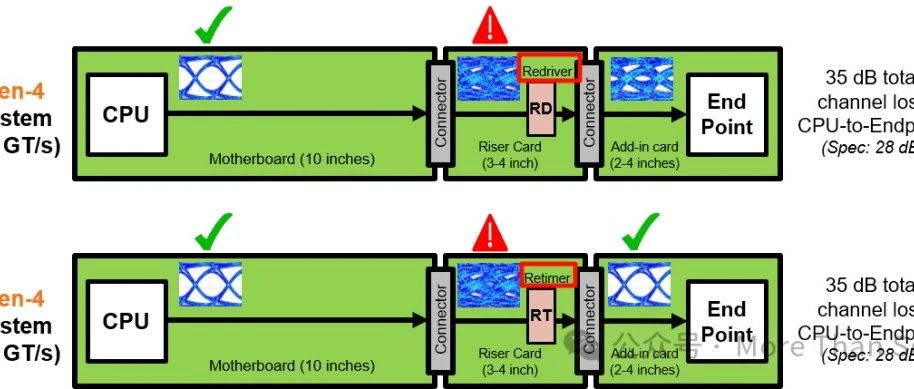
Core Viewpoint - The article discusses the importance of PCIe Retimer technology in enhancing signal integrity and extending transmission distances in high-speed data applications, particularly in data centers and computing systems. Group 1: PCIe Technology Overview - PCIe technology has evolved significantly, with transmission rates increasing from 2.5 GTps in PCIe 1.0 to 64.0 GTps in PCIe 6.0, and PCIe 7.0 expected to reach 128 GT/s by 2025 [7][10]. - The continuous upgrades in PCIe standards have made it a critical component in modern computing platforms [7]. Group 2: Retimer vs Redriver - Retimer technology is a mixed-signal device that can recover and regenerate data signals, improving signal quality compared to Redriver, which simply amplifies signals [12][16]. - Retimer actively participates in the PCIe protocol, while Redriver does not, leading to differences in their capabilities regarding jitter reduction and signal integrity [22][23]. - Retimer can reset the entire jitter budget and provide diagnostic capabilities, whereas Redriver lacks these features and may amplify noise along with the signal [23][27]. Group 3: Market Insights - The PCIe Retimer market is primarily dominated by companies like Astera Labs, which was the first to mass-produce PCIe 5.0 Retimer chips, and 澜起科技, which has launched PCIe 6.0 Retimer chips [36][37]. - The pricing for PCIe 5.0 Retimer chips is estimated at approximately $36 for X8 and $54 for X16 channels, with market potential calculated based on various server configurations [34][32]. - The ratio of GPUs to Retimers in high-performance servers varies, with examples including a 1:1 ratio in DGX A100 servers and a 1:3 ratio in AWS trn2 servers [32][33].


CRDO Eyes Growth: Will Retimer Business Fuel its Revenue Engine?
ZACKS· 2025-07-21 14:16
Core Insights - The PCIe interface is crucial for AI clusters, facilitating high-speed connections among GPUs, CPUs, and endpoints, with increasing demand for faster data transmission and efficient hardware interconnects as AI workloads grow more complex [1][2] - Credo Technology Group's retimer solutions effectively address these demands, enhancing system performance and connectivity by minimizing data transfer bottlenecks [1][3] PCIe Retimer Market Overview - The PCIe Retimer market was valued at $1.2 billion in 2024 and is projected to reach $2.8 billion by 2033, with a CAGR of 11.5% from 2026 to 2033, indicating strong growth potential [5] - Credo's retimer business is positioned as a key growth driver, with expected revenues exceeding $800 million in fiscal 2026, reflecting over 85% year-over-year growth [5][8] Product and Technology Advancements - Credo's retimers and PCIe OSFP-XD AECs enhance PCIe cabling by overcoming limitations of PCB and passive cables, extending reach up to seven meters for in-rack and rack-to-rack applications [2] - The new PCIe Gen6 Retimer family, particularly the 2CAN Retimer, has passed compliance testing and demonstrated strong performance, with live demonstrations confirming its capabilities [3][4] Competitive Landscape - Competitors like Astera Labs and Broadcom are advancing in the PCIe Retimer market, with Astera Labs focusing on next-gen data center infrastructure and Broadcom targeting enterprise and hyperscale data centers [6][8] - Broadcom's portfolio includes advanced technologies aimed at enhancing performance and connectivity across AI-driven infrastructure, further intensifying competition in the market [8][9] Financial Performance and Valuation - CRDO shares have surged 216.6% over the past year, significantly outperforming the Electronics-Semiconductors industry's growth of 27.9% [10] - The forward 12-month price/sales ratio for CRDO is 18.86, higher than the sector's multiple of 8.78, indicating strong market expectations [11]


摩根士丹利:H20 和 MI308 芯片恢复供应;常见问题解答
摩根· 2025-07-16 15:25
Investment Rating - The report assigns an "Attractive" industry view for the semiconductor sector in North America [8]. Core Insights - US AI stocks, including NVIDIA (NVDA), AMD, and AVGO, are expected to receive licenses to ship products to China, which is a significant positive development for 2026 [1][2]. - NVIDIA's management anticipates a recovery in revenue from China, which had previously dropped to below 10% due to export controls, with potential sales rebounding to 11-14% of total sales [4][6]. - The report highlights that NVIDIA's H20 product could represent a $50 billion market opportunity over time, although this figure is more political than a precise forecast [4]. - AMD's exposure to China is believed to be significant, although specific figures were not provided [5]. - The report suggests that the resumption of shipments could lead to an additional $20 billion in revenue for NVIDIA in calendar year 2026, which is above current forecasts [17]. Summary by Sections Section: Market Opportunity - Before export controls, China accounted for approximately 25% of NVIDIA's data center revenue, which fell significantly after the controls were imposed [4]. - The report indicates that the resumption of shipments could help NVIDIA mitigate the risk of China developing its own AI hardware ecosystem [16]. Section: Financial Impact - NVIDIA took a $4.5 billion writedown due to blocked H20 sales, with management indicating that the limitation cost them $8 billion in revenue for the July quarter [6]. - AMD also faced a writedown of $800 million, although the revenue impact was less clearly defined [6]. - The report notes that while the licenses have not yet been granted, the expectation of approval is encouraging, but the timing remains uncertain [10]. Section: Competitive Landscape - The report suggests that AMD may have a higher market share in China compared to NVIDIA, which could lead to increased upside for AMD's AI business [18][19]. - AVGO's exposure to China is relatively small but is part of a larger $60-90 billion market opportunity expected by 2027 [5][20]. Section: Stock Performance and Projections - NVIDIA remains the top pick in the semiconductor sector, with a price target of $170, reflecting a premium valuation due to its growth potential in AI [22]. - The consensus rating distribution shows 89% of analysts rating the stock as "Overweight" [29].
Jitendra Mohan, CEO of Astera Labs
AMD· 2025-07-04 14:30
Partnership & Vision - AMD and Astera Labs share a vision of solving AI's biggest challenges through collaboration [1] - The partnership focuses on driving a new era of open, scalable AI infrastructure through work on UA Link [1] Company Information & Legal - The document is copyrighted to Advanced Micro Devices, Inc in 2025 [1] - AMD trademarks include the AMD Arrow Logo and combinations thereof in the United States and other jurisdictions [1] - Other names mentioned are for informational purposes and may be trademarks of their respective owners [1] Call to Action - Encourages viewers to subscribe to AMD's YouTube channel [1] - Invites viewers to join the AMD Red Team Discord Server [1] - Promotes engagement through Facebook, Twitter, Twitch, LinkedIn, and Instagram [1]


Zacks Profit Secrets: Low-Risk Strategy Produces 127% Average Return
Zacks Investment Research· 2025-06-26 16:46
Market Analysis and Trends - The NASDAQ 100 ETF closed at a fresh all-time high, indicating a positive market trend [1] - Uncertainty surrounding trade wars, particularly with China, caused market panic and corrections, but de-escalation and cooperation are now seen as positive developments [7][8][10] - Historical analysis suggests that geopolitical events like the Israel-Iran conflict tend to cause short-term volatility, but markets often recover quickly [13][14] - The market's trend remains upward, anticipating positive resolutions to conflicts, trade wars, and strong US fundamentals and corporate earnings [19] - Bull markets have historically lasted over 5 years on average, suggesting potential for further gains despite recent rallies [37] Investment Strategy and Portfolio Performance - Zach's Investment Research manages a growth-oriented portfolio focused on companies with positive news events [2][3] - The "Headline Trader" portfolio achieved a 127% average return with 100% open trade winners [5][22] - The firm employs a combination of fundamental and technical analysis to identify stocks primed for outperformance [20] - The firm targets stocks within leading industry groups, as industry group plays a large role in a stock's future performance [22] - A 10-month simple moving average is used as a reliable system to determine market trends and generate buy/sell signals [26][27] - The Zach's Rank system is used to narrow down investment options to stocks with positive earnings estimate revisions [31][32] - Astera Labs (ALAB), a semiconductor company for cloud and AI infrastructure, is being targeted due to its Zach's Rank 2 (Buy) rating, positive earnings surprises (28.41% trailing four-quarter average), and industry ranking in the top 21% [33][34][35] - Full-year earnings estimates for Astera Labs have risen by 7.14% to $1.35 per share, representing over 60% growth relative to last year and 77% higher revenues [36]

The Rise Of Astera Labs: A Leader In Data Center Connectivity And AI Solutions
Seeking Alpha· 2025-06-17 13:12
Group 1 - The article discusses the author's extensive experience in the field of investing, particularly in technology stocks, with a focus on companies involved in Artificial Intelligence (AI) [1] - The author has previously written about major AI companies such as NVIDIA and Advanced Micro Devices, indicating a strong interest in the AI sector [1] - The author's background as a Merchant Seaman and engineer contributes to a unique perspective on investment opportunities in tech stocks [1] Group 2 - There is no specific financial data or performance metrics provided in the articles [2]


Astera Labs and Alchip Announce Strategic Partnership to Advance Silicon Ecosystem for AI Rack-Scale Connectivity
Globenewswire· 2025-06-16 12:30
Core Insights - The strategic partnership between Astera Labs and Alchip Technologies aims to enhance the silicon ecosystem for next-generation AI infrastructure, focusing on delivering validated, interoperable solutions for hyperscalers [1][3] Group 1: Partnership Objectives - The collaboration combines Alchip's custom ASIC development capabilities with Astera Labs' connectivity solutions to empower hyperscalers in deploying complex AI infrastructure [1][2] - The partnership aims to shorten time-to-market and reduce integration risks for hyperscalers facing challenges in scaling AI models [2][3] Group 2: Technological Advancements - The integration of custom silicon and advanced connectivity is reshaping AI infrastructure architecture, enabling efficient implementation of AI workloads at scale [3] - The partnership will advance industry innovation for next-generation AI connectivity standards, including CXL, Ethernet, NVLink Fusion, PCIe, and UALink™, thereby strengthening the overall ecosystem [3] Group 3: Company Profiles - Astera Labs specializes in purpose-built connectivity solutions for AI and cloud infrastructure, focusing on solving data, network, and memory bottlenecks at a rack-scale [4] - Alchip Technologies, founded in 2003, is a leader in silicon design and production services, known for its advanced 2.5D/3DIC design and high-performance ASICs [5]

澜起科技:聚焦高速互连芯片,运力芯片成为增长新引擎-20250529
Guoxin Securities· 2025-05-29 00:45
Investment Rating - The report maintains an "Outperform" rating for the company [5] Core Views - The company focuses on high-speed interconnect chips, with the capacity chips becoming a new growth engine. In 2024, interconnect chips and the server platform accounted for 92% and 8% of revenue, respectively. The company achieved a revenue of 3.639 billion yuan, a year-on-year increase of 59%, and a net profit of 1.412 billion yuan, a year-on-year increase of 213% [1][11][16] - The company is one of the three major DDR5 memory interface chip manufacturers globally, and it has initiated the second-generation iteration of DDR5. The penetration rate of DDR5 continues to rise, with the company’s DDR5 second-generation RCD chip shipments exceeding the first-generation products in 2024 [2][45] - The company’s MXC chip has entered the first batch of compliant suppliers for CXL 2.0, and the company has decided to shift its R&D focus from AI computing chips to PCIe Switch chips [3][12] Summary by Sections Financial Performance - In 2024, the company achieved a revenue of 3.639 billion yuan, with a year-on-year growth of 59%. The net profit reached 1.412 billion yuan, marking a year-on-year increase of 213%. The revenue and net profit for Q1 2025 were 1.222 billion yuan and 525 million yuan, respectively, both setting quarterly records [1][4][16] - The company’s revenue from 2016 to 2024 has a CAGR of 20%, while the net profit has a CAGR of 41% [11][16] Product Development - The company has launched several high-performance capacity chips, including PCIe Retimer, MRCD/MDB, and CKD, which have generated significant revenue growth. In 2024, these new products generated approximately 422 million yuan, an eightfold increase from 2023 [2][24] - The company is actively involved in the development of DDR5 memory interface chips, with the second-generation RCD chip shipments surpassing the first generation in 2024. The third-generation RCD chip is expected to be shipped in Q4 2024 [2][46] Market Position - The company is positioned as a leading provider of interconnect chips and server platforms, with 92% of its revenue derived from interconnect chips in 2024. The gross margin for interconnect chips was 62.7%, slightly above the international comparable company Rambus [24][22] - The global market for memory interface chips is projected to reach 5.7 billion USD by 2031, with the company being one of the three main suppliers in the DDR5 generation [40]
PCIe 6.0硬盘,首次亮相
半导体芯闻· 2025-05-23 10:26
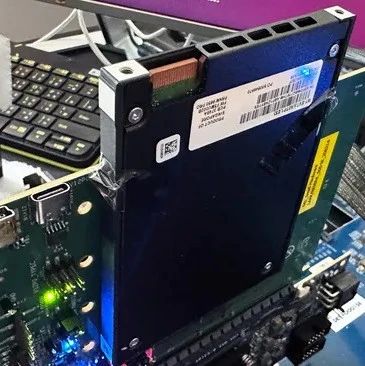
Core Insights - The article discusses the introduction of PCIe 6.0 SSDs, highlighting a specific model from Micron that can achieve read/write speeds of up to 30.25 GB/s, showcasing advancements in storage technology [1][2]. Group 1: PCIe 6.0 Technology - The PCIe 6.0 interface is expected to enhance data transfer speeds significantly, with the Micron 9650 Pro SSD serving as a key testing platform for companies like Astera Labs [1]. - Although Nvidia's Blackwell GPU supports PCIe 6.0, no CPU platforms currently support this technology, limiting its immediate application [2]. - PCIe 6.0 switches can facilitate direct communication between AI GPUs and SSDs, bypassing the CPU, which is crucial for certain AI systems [2]. Group 2: Product Development and Testing - The certification timeline for PCIe 6.0 devices has been postponed to the second half of 2025, affecting the availability of compatible GPUs and SSDs [3]. - The Micron 9650 Pro SSD is currently in the EVT3 stage, indicating it has undergone multiple engineering validation tests, with most hardware issues resolved [3]. - EVT3 is close to the final version, allowing for performance validation and compatibility testing, although it remains in pre-production [3][4]. Group 3: Future Steps and Market Implications - Micron's strategy regarding the certification of the 9650 Pro SSD remains unclear, whether they will wait for PCI-SIG's interoperability testing or initiate their own certification process [4]. - The development process includes DVT (Design Validation Testing) and PVT (Production Validation Testing), which are essential for ensuring product reliability before market release [4].