成都银行

Search documents
银行资负观察第四期:8月同业存单利率或维持高位
China Post Securities· 2025-08-08 10:44
Industry Investment Rating - The industry investment rating is maintained at "Outperform the Market" [1] Core Viewpoints - The report indicates that interbank liquidity has been higher than the same period last year, with fluctuations in funding rates influenced by various factors including tax periods and asset maturities [4][12] - The report highlights that the liquidity indicators for banks show improvement, particularly in the usage of interbank certificates of deposit, which have been positively affected by recent monetary policy adjustments [5][16] - The report suggests that while short-term deposit rate cuts may tighten the liability side for banks, the long-term outlook indicates a decrease in funding costs, with specific banks recommended for attention [6][30] Summary by Relevant Sections Industry Basic Situation - The closing index is at 4459.7, with a 52-week high of 4670.31 and a low of 3132.76 [1] Interbank Liquidity Performance Review - From June 29 to August 5, the interbank funding center was above last year's level, with rapid fluctuations in rates due to various market conditions [12][15] Monitoring of Bank Liquidity Indicators - The usage of interbank certificates of deposit has improved, with most national banks showing better conditions compared to previous periods [5][16] - The excess reserve ratio was recorded at 1.7% in June 2025, higher than the same period in the past two years, indicating a recovery in liquidity [20][21] Investment Recommendations - The report recommends focusing on specific banks such as Bank of Communications and Chengdu Bank due to expected improvements in their performance [6][30] - It also highlights that some joint-stock banks are likely to exceed performance expectations, suggesting attention to China Merchants Bank, Industrial Bank, and CITIC Bank [6][30]
“二永债”发行提速 商业银行有效补充资本
Jin Rong Shi Bao· 2025-08-08 07:59
Core Viewpoint - The issuance of secondary capital bonds and perpetual bonds (collectively referred to as "二永债") by commercial banks has accelerated in the second quarter, reflecting a pressing need for capital replenishment and a proactive response to changing market conditions [1][2][4]. Group 1: Issuance Trends - Major state-owned banks such as Industrial and Commercial Bank of China, Agricultural Bank of China, Bank of China, and China Construction Bank have issued "二永债" since May, with a total issuance of 648.16 billion yuan in the first five months of the year, a 3.63% increase from 625.45 billion yuan in the same period last year [1][2]. - In May alone, the issuance reached a record high of 284.5 billion yuan [1]. - Agricultural Bank of China announced a total issuance of 60 billion yuan in secondary capital bonds, with previous issuances of 50 billion yuan in perpetual bonds [2]. Group 2: Importance of Capital Replenishment - The issuance of "二永债" is a crucial method for banks to supplement their capital, optimize capital structure, and enhance capital adequacy ratios, which is increasingly important due to stricter regulatory requirements [4][5]. - The issuance of these bonds allows banks to diversify their financing channels, reducing reliance on equity financing and lowering overall financing costs [4][6]. - The capital raised through these bonds is intended to support business development and improve risk resistance capabilities, particularly in the context of economic transformation [4][5]. Group 3: Market Conditions and Regulatory Environment - The current market conditions are favorable for banks to issue "二永债," driven by stricter regulatory requirements and the need to support the real economy through increased credit supply [6][7]. - The implementation of Basel III regulations has heightened the need for banks to maintain adequate capital levels, especially under pressures from credit expansion and non-performing asset management [6][7]. - The trend of increasing issuance among smaller banks indicates a broader industry movement towards capital enhancement, with several regional banks also receiving approval for capital tool issuance [6][7].



百亿基金经理收益回暖!张坤规模领衔,王明旭7产品年内亏损
Nan Fang Du Shi Bao· 2025-08-08 07:51
Group 1 - The core viewpoint of the articles indicates a strong recovery in the performance of actively managed equity funds in 2025, with 95% of these funds achieving positive returns and an average return exceeding 15% as of August 7 [2][3] - The pharmaceutical sector has emerged as the biggest winner, with four actively managed equity funds achieving returns that have doubled this year, all focusing on the pharmaceutical industry [4][5] - As of mid-2025, there are 90 fund managers managing over 10 billion yuan, with Zhang Kun from E Fund leading with over 50 billion yuan under management [8][9] Group 2 - The average return of actively managed equity funds has outperformed major stock indices, such as the CSI 300 and the CSI 500, which recorded returns of 4.6% and 10.6% respectively [3] - The average return of the entire market of over 4,500 actively managed equity funds is 15.03%, compared to 11.8% for over 2,500 stock index funds [3] - Despite the overall positive performance, there are still 228 actively managed equity funds with negative returns, with the worst performer, Qianhai Kaiyuan AI A, showing a return of -18.5% [4][6] Group 3 - The top-performing funds in the pharmaceutical sector include Changcheng Pharmaceutical Industry Selection, Bank of China Hong Kong Stock Connect Pharmaceutical, Yongying Pharmaceutical Innovation Selection, and Huashan Pharmaceutical Biotechnology, all achieving significant returns [4][5] - The performance of fund managers varies significantly, with some, like Zhang Wei and Zhang Lu, achieving returns of 65.8% and 53.4% respectively, while others, such as Wang Mingxu, have negative returns [12][13] - The total scale of actively managed equity funds reached 3.39 trillion yuan by mid-2025, although the total number of shares decreased by 198.24 billion compared to the end of the previous year [6][7]

高股息资产显著分化!红利低波ETF(512890)近5个交易日吸金2.4亿元 规模突破220亿创新高
Xin Lang Ji Jin· 2025-08-08 04:19
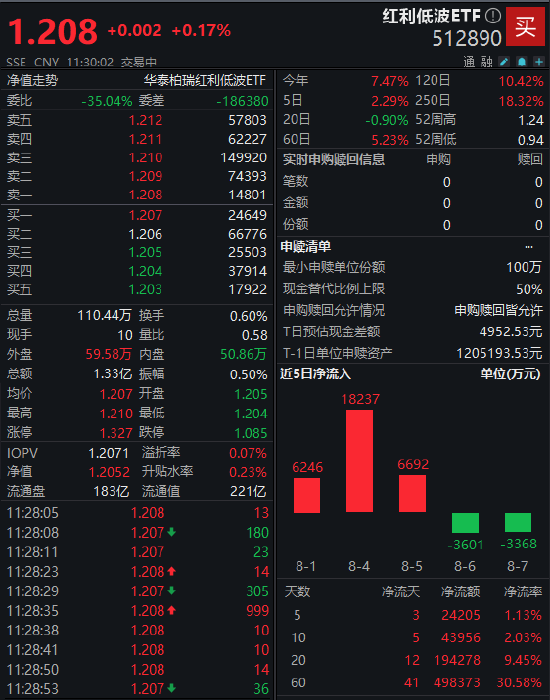
Group 1 - The core viewpoint of the news highlights the strong performance and growing popularity of the Dividend Low Volatility ETF (512890), which has seen significant inflows and a record high in circulation scale [1][4]. - As of August 6, the ETF's circulation scale reached 220.91 billion CNY, marking a historical peak, with a net inflow of 2.4 million CNY over the last five trading days and 19.43 million CNY over the last twenty days [1][2]. - The ETF's price increased by 0.17% to 1.208 CNY during the trading session, reflecting active trading with a half-day transaction volume of 1.33 billion CNY [1][2]. Group 2 - The ETF is managed by experienced fund manager Liu Jun and closely tracks the CSI Dividend Low Volatility Index, focusing on companies with high dividend yields and low volatility [4]. - The ETF provides a convenient investment tool for investors seeking stable returns and low-risk exposure, even for those without stock accounts, through its linked funds [4]. - Recent trends indicate a decline in the latest dividend yield of the Wind All A Index over the past twelve months, attributed to rising stock prices and valuation increases, suggesting a need for a focus on earnings quality and sustainable dividends in high dividend strategies [3].
年内多家上市银行被“加仓”,透露出什么信号?
Mei Ri Jing Ji Xin Wen· 2025-08-07 15:18
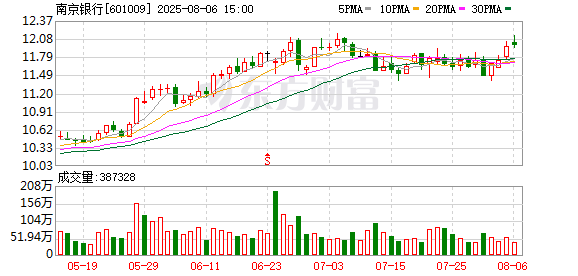
Core Viewpoint - Nanjing Bank's major shareholder, Nanjing Gaoke, has increased its stake back to 9% following the early redemption of "Nanjing Convertible Bonds," which diluted the shareholding ratio [1][2][3] Group 1: Shareholder Actions - Nanjing Gaoke increased its shareholding by purchasing 7.51 million shares from July 24 to August 4, raising its ownership from 8.94% to 9.00% [1][2] - Other banks, including Suzhou Bank and Chengdu Bank, have also seen significant shareholder increases this year, indicating a trend among A-share banks [4][5] - The first major shareholder of Nanjing Bank, BNP Paribas, has also increased its stake, currently holding 16.15% [3] Group 2: Market Implications - The increase in shareholding by major shareholders is seen as a positive signal, enhancing market confidence and indicating optimism about future growth [4][5] - The low valuation of bank stocks suggests potential for recovery, with many bank stocks having risen over 20% this year [5] Group 3: Capital and Dividends - The early redemption of "Nanjing Convertible Bonds" has improved Nanjing Bank's core Tier 1 capital adequacy ratio by 0.57 percentage points to 9.45%, providing more room for growth [2] - Nanjing Bank has maintained a cash dividend payout ratio above 30%, with over 60 billion yuan distributed in cash dividends for the 2024 fiscal year [6]

中金:预计二季度上市银行净利润同比增长1% 政策呵护业绩稳健
Zhi Tong Cai Jing· 2025-08-07 07:15
Group 1 - The core viewpoint of the report indicates that the revenue and net profit of listed banks in Q2 2025 are expected to grow by 0% and 1% year-on-year, showing slight improvement compared to Q1 2025's declines of -2% and -1%, aligning with market expectations [1][2] - The improvement in performance is attributed to a narrowing decline in interest margins and alleviation of pressure on other non-interest income, with the central bank's guidance on loan and deposit pricing seen as a stabilizing factor for bank profitability and a measure to prevent financial system risks [1][2] - The report anticipates that even with further interest rate declines to support the real economy, the net interest margin of listed banks will continue to show a trend of simultaneous decline in both asset and liability rates, providing positive support for net interest income and revenue growth [2] Group 2 - As of the end of June, the total assets of the banking industry grew by 7.9% year-on-year, with large banks, joint-stock banks, city commercial banks, and rural financial institutions showing growth rates of 10.6%, 4.8%, 10.2%, and 5.5% respectively, an increase from 6.6% at the end of March [3] - Loan growth as of June was 7.1%, with large national banks and small to medium-sized banks showing growth rates of 9.2% and 6.1% respectively, slightly down from 7.4% at the end of March, with infrastructure and corporate sectors remaining the primary areas for loan issuance [3] - The report maintains a positive outlook on the stability of bank profits and dividends for the year, noting that some A-shares and H-shares of Chinese banks have dividend yields rising to 4.5%-5.5%, indicating investment value, including state-owned large banks and specific banks like Chengdu Bank and Jiangsu Bank [3]
银行股估值修复逻辑强化!红利低波ETF(512890)近5个交易日资金净流入4.8亿元
Xin Lang Ji Jin· 2025-08-07 04:15
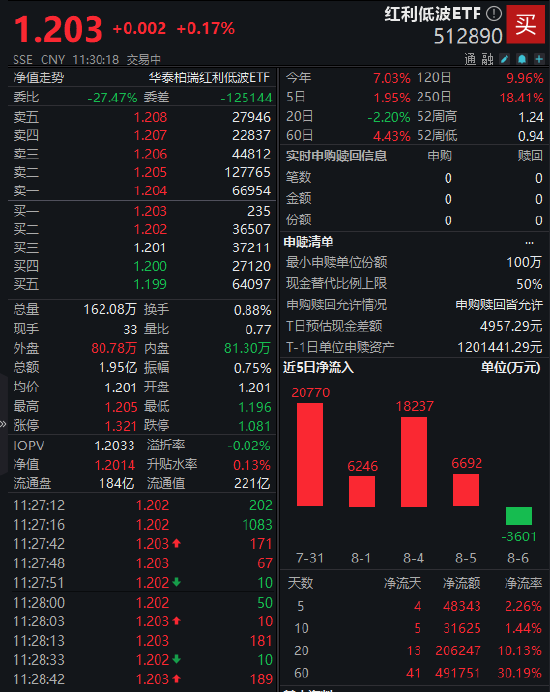
Group 1 - The market experienced fluctuations on August 7, with mixed performance across the three major indices. The total trading volume in the Shanghai and Shenzhen markets reached 1.19 trillion yuan, an increase of 130.7 billion yuan compared to the previous trading day [1] - The Hongtai Baorui Dividend Low Volatility ETF (512890) saw a midday increase of 0.17%, priced at 1.203 yuan, with a turnover rate of 0.88% and a trading volume of 195 million yuan. Over the past five trading days, the net inflow of funds into this ETF was 480 million yuan, and over the past twenty days, it was 2.062 billion yuan [1] - As of August 6, 2025, the circulating scale of the Hongtai Baorui Dividend Low Volatility ETF (512890) was 22.055 billion yuan [1] Group 2 - Major bank stocks showed positive performance, with Chengdu Bank up 0.32%, Industrial Bank up 0.30%, Sichuan Road and Bridge up 0.48%, and Daqin Railway up 0.15%. However, CITIC Bank fell by 0.48%, and Shanghai Rural Commercial Bank decreased by 0.54% [2] - Six A-share listed banks, including Pudong Development Bank and Hangzhou Bank, have reported positive growth in both revenue and net profit for the first half of 2025, with five banks showing a double-digit increase in net profit year-on-year [3] - The current low valuation of bank stocks, combined with high dividend yields and expectations of marginal improvement in fundamentals, presents potential for valuation recovery, particularly for state-owned banks and quality city commercial banks [4]
南京银行再获主要股东增持 年内多家银行被“加仓” 透露什么信号?
Mei Ri Jing Ji Xin Wen· 2025-08-06 14:31
Core Viewpoint - The major shareholder of Nanjing Bank, Nanjing Gaoke, has increased its shareholding to 9% after a previous dilution due to the early redemption of "Nanjing Bank Convertible Bonds" [2][3] Group 1: Shareholding Changes - Nanjing Gaoke increased its shareholding from 8.94% to 9.00% by purchasing 7.5077 million shares between July 24 and August 4, 2023 [2][3] - Following the early redemption of "Nanjing Bank Convertible Bonds," Nanjing Bank's total share capital increased to 12.364 billion shares, leading to a temporary dilution of major shareholders' stakes [3][4] - Nanjing Gaoke's shareholding was previously reduced from 9.05% at the end of June to 8.94% after the bond redemption [4] Group 2: Market Sentiment and Implications - The increase in shareholding by major shareholders, including Nanjing Gaoke, is seen as a positive signal that enhances market confidence and indicates optimism about the bank's future [5][6] - The capital increase from share purchases can alleviate the pressure on capital replenishment and improve the bank's risk resistance capabilities [6][7] - The overall performance of bank stocks has been strong, with many A-share banks experiencing significant price increases, which may influence shareholder buying costs [7] Group 3: Dividend Policies - Nanjing Bank has maintained a stable cash dividend rate of over 30%, with a cash dividend payout exceeding 6 billion yuan for the 2024 fiscal year, representing 31.74% of net profit attributable to ordinary shareholders [8]
10.67亿元主力资金今日撤离银行板块
Zheng Quan Shi Bao Wang· 2025-08-06 09:46
Market Overview - The Shanghai Composite Index rose by 0.45% on August 6, with 24 out of the 28 sectors experiencing gains. The top-performing sectors were defense and military industry, and machinery equipment, with increases of 3.07% and 1.98% respectively [1] - The banking sector saw a decline of 0.14% [1] Capital Flow Analysis - The main capital outflow from the two markets totaled 9.652 billion yuan, with seven sectors experiencing net inflows. The machinery equipment sector led with a net inflow of 4.367 billion yuan, followed closely by the defense and military industry with a net inflow of 4.283 billion yuan [1] - The pharmaceutical and biological industry had the largest net outflow, totaling 9.049 billion yuan, followed by the telecommunications sector with a net outflow of 2.949 billion yuan [1] Banking Sector Performance - In the banking sector, there were 42 stocks, with 11 rising and 26 falling. The sector experienced a net outflow of 1.067 billion yuan [2] - The top three banks with the highest net outflow were Minsheng Bank, China Construction Bank, and Industrial and Commercial Bank of China, with outflows of 263.15 million yuan, 213.00 million yuan, and 174.41 million yuan respectively [2][3] - The individual stock performance showed that Changshu Bank had the highest net inflow of 41.12 million yuan, followed by Hangzhou Bank and Chongqing Rural Commercial Bank with inflows of 32.14 million yuan and 22.64 million yuan respectively [2][3]


广发基金包揽前7月20亿元以上规模权益基金跌幅前3名
Sou Hu Cai Jing· 2025-08-06 08:20
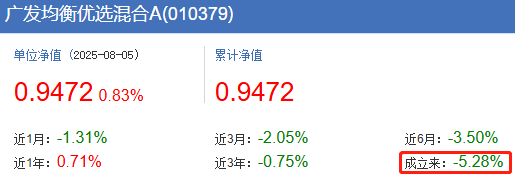
Core Viewpoint - In the first seven months of the year, three funds managed by GF Fund have recorded the largest declines among actively managed equity funds with assets over 2 billion yuan, indicating significant underperformance in the current market environment [1][6]. Fund Performance Summary - The three underperforming funds are: - GF Value Advantage Mixed Fund: -10.9% performance [1][6] - GF Balanced Preferred Mixed A: -7.79% performance [1][6] - GF High-end Manufacturing Stock A: -7.00% performance [1][6] - The GF Balanced Preferred Mixed A fund has experienced a cumulative loss of 5.28% since its inception on January 11, 2021, while the GF Balanced Preferred Mixed C has a cumulative loss of 7% [2]. Fund Management and Strategy - Both GF Value Advantage Mixed and GF Balanced Preferred Mixed A are managed by Wang Mingxu, who has extensive experience in investment management [1]. - The investment strategy of these funds focuses on undervalued blue-chip stocks, including major holdings in companies like Midea Group and Kweichow Moutai [1]. High-end Manufacturing Fund Insights - The GF High-end Manufacturing Stock A fund, managed by Zheng Chengran, has maintained a focus on the renewable energy sector since 2022, with top holdings in companies such as Sungrow Power Supply and LONGi Green Energy [4]. - Despite its early establishment, the GF High-end Manufacturing Stock A fund has a positive cumulative return, while the GF High-end Manufacturing Stock C has seen a cumulative loss exceeding 45% since its inception on September 16, 2020 [4][5].