
中国联通

Search documents
港股通央企红利ETF天弘(159281)跌0.10%,成交额4260.78万元
Xin Lang Cai Jing· 2025-11-24 07:14
Core Viewpoint - The Tianhong CSI Hong Kong Stock Connect Central State-Owned Enterprises Dividend ETF (159281) experienced a slight decline of 0.10% in its closing price on November 24, with a trading volume of 42.6078 million yuan [1]. Group 1: Fund Overview - The Tianhong CSI Hong Kong Stock Connect Central State-Owned Enterprises Dividend ETF was established on August 20, 2025, with an annual management fee of 0.50% and a custody fee of 0.10% [1]. - As of November 21, the fund had a total of 267 million shares and a total size of 272 million yuan [1]. - The fund's performance benchmark is the adjusted return of the CSI Hong Kong Stock Connect Central State-Owned Enterprises Dividend Index [1]. Group 2: Liquidity and Performance - Over the last 20 trading days, the ETF recorded a cumulative trading amount of 1.006 billion yuan, with an average daily trading amount of 50.3229 million yuan [1]. - The current fund manager, He Yuxuan, has managed the fund since its inception, achieving a return of 1.74% during the management period [1]. Group 3: Top Holdings - The ETF's top holdings include: - COSCO Shipping Holdings (0.85% holding, 218,000 shares, market value of 2.9175 million yuan) - Orient Overseas International (0.40% holding, 10,500 shares, market value of 1.3717 million yuan) - China Foreign Transport (0.33% holding, 270,000 shares, market value of 1.1396 million yuan) - China National Petroleum (0.32% holding, 162,000 shares, market value of 1.0973 million yuan) - CITIC Bank (0.32% holding, 175,000 shares, market value of 1.1136 million yuan) - CNOOC (0.29% holding, 58,000 shares, market value of 1.0041 million yuan) - China Shenhua Energy (0.29% holding, 30,500 shares, market value of 982,600 yuan) - China Pacific Insurance (0.29% holding, 164,000 shares, market value of 1.0107 million yuan) - China Unicom (0.28% holding, 104,000 shares, market value of 952,800 yuan) - Agricultural Bank of China (0.27% holding, 189,000 shares, market value of 933,900 yuan) [2].


国资委部署下半年国企改革重点 将推2到3家央企集团层面实施股权多元化
Mei Ri Jing Ji Xin Wen· 2025-11-24 04:09
Core Insights - The State-owned Assets Supervision and Administration Commission (SASAC) held a video conference to summarize the first half of the year and outline key tasks for the second half, emphasizing the continuous growth of state-owned enterprises (SOEs) and central enterprises (CEs) in revenue and profit [1] - In the first half of the year, the revenue of SOEs reached 25.7 trillion yuan, a year-on-year increase of 10.6%, while total profit amounted to 1.6509 trillion yuan, up 22.6% [1] - The meeting provided a detailed roadmap for the next steps in SOE reform, including mixed ownership reform, mergers and acquisitions, and market value management [1] Mixed Ownership Reform - Mixed ownership reform has become a key focus, with significant events occurring in the first half of the year, such as China Unicom's board nominations including executives from major private companies like Baidu, JD.com, Alibaba, and Tencent [2] - The railway sector also saw progress, with Tencent and Geely Holdings acquiring a 49% stake in a subsidiary of China Railway [4] - The SASAC plans to advance mixed ownership reform at the group level, with 2-3 central enterprises expected to implement diversified equity structures [4] Strategic Restructuring of Central Enterprises - The SASAC reported progress in the restructuring of central enterprises, including the merger of Wuhan University of Posts and Telecommunications and the China Academy of Telecommunications Technology to form a new entity focused on 5G technology [6][7] - The SASAC aims to promote strategic restructuring in five key sectors: equipment manufacturing, coal, electricity, telecommunications, and chemicals, concentrating state capital in strategic industries [7][8] Value Management and Shareholder Returns - SASAC emphasized the importance of value management to enhance shareholder returns, advocating for a focus on intrinsic value and the integration of quality assets [9] - The meeting outlined a roadmap for improving value management practices, including monitoring listed companies and encouraging mergers to enhance value [9][10] - The SASAC also suggested linking executive compensation to stock performance to align management interests with shareholder value [10]

工信部颁发移动通信转售业务经营许可 阿里京东小米等15家企业入围
Mei Ri Jing Ji Xin Wen· 2025-11-24 04:09
Core Viewpoint - The recent issuance of operating licenses for mobile communication resale businesses to 15 companies, including Alibaba, JD.com, and Xiaomi, marks a significant step towards the commercialization of mobile communication resale in China, which is expected to enhance service innovation and provide consumers with more choices in mobile communication services [1][2]. Industry Overview - The Chinese government has long encouraged private investment in the telecommunications sector, with policies dating back to 2010 aimed at promoting private capital participation in telecom infrastructure [2]. - The Ministry of Industry and Information Technology (MIIT) officially launched pilot programs for mobile communication resale in 2013, transitioning to formal commercialization on May 1, 2018 [2]. Business Model - Mobile communication resale, often referred to as virtual operator business, allows companies to purchase basic telecom services from operators like China Unicom and repackage them for resale to consumers [4]. - This model creates a wholesale and retail relationship between enterprises and telecom operators, enabling companies to tailor services to their brand and customer needs [4]. Consumer Benefits - Increased competition from multiple enterprises entering the market is expected to better meet diverse consumer demands and provide more affordable options [4]. - While the immediate impact on the market may be limited, long-term prospects suggest potential disruptive innovations in business models and services within the telecommunications sector [4]. Challenges Ahead - The MIIT has outlined specific conditions for companies seeking to operate in the mobile communication resale market, including the requirement for commercial contracts with basic telecom providers covering various operational aspects [5]. - Potential challenges for these businesses include profitability pressures due to intense competition, the need to effectively integrate resale services with existing business models, and compliance with real-name registration requirements that may increase operational costs [5][6]. Regulatory Measures - The MIIT plans to implement management measures post-commercialization, including annual reporting and credit constraints, to ensure compliance and protect user rights and network security [6].





全国过半用户用上百兆宽带 降费举措年内将全部落实
Mei Ri Jing Ji Xin Wen· 2025-11-24 04:09
Core Insights - The article discusses the significant advancements in China's telecommunications industry, particularly the implementation of policies aimed at reducing costs and increasing internet speeds for users [1][2][3]. Group 1: Policy Implementation - As of July 1, 2023, the three major telecom operators in China have eliminated domestic mobile data "roaming" fees, allowing users to enjoy nationwide data without additional charges [2][3]. - The average mobile data tariff has decreased by 46.2% compared to the end of 2017, reflecting the government's push for lower costs in the telecommunications sector [1][2]. - By the end of June 2023, 53.4% of users had internet speeds of 100 Mbps or higher, an increase of 13.5 percentage points since the beginning of the year [1]. Group 2: User Experience and Feedback - The effectiveness of the cost reduction measures will ultimately be assessed through user bills, which will provide a direct indication of the benefits experienced by consumers [3]. - The Ministry of Industry and Information Technology (MIIT) is closely monitoring user feedback to ensure that the implementation of the new policies meets consumer expectations and addresses any complaints [3]. Group 3: Future Developments - The cancellation of "roaming" fees and other cost-reduction measures are seen as preparatory steps for the upcoming 5G era, which is expected to significantly enhance network speeds and capacity [5]. - The commercial rollout of 5G is anticipated to begin in mid-2019, with expectations of increased data usage and the continuation of data speed limits due to finite network resources [5].



中国宏桥(01378.HK)跻身恒生国指唯一铝业股,资源龙头吸引力持续上升
Sou Hu Cai Jing· 2025-11-24 03:41
Core Viewpoint - China Hongqiao (01378.HK) has been actively signaling its value to the capital market, highlighted by a recent placement of 400 million shares raising nearly HKD 11.7 billion, aimed at optimizing its capital structure and advancing domestic and overseas projects [1] Group 1: Market Position and Index Inclusion - China Hongqiao was included in the Hang Seng China Enterprises Index, effective December 8, which reflects the overall performance of Chinese enterprises listed in Hong Kong [1][2] - The inclusion is significant as the index consists of a fixed number of 50 constituents, and China Hongqiao's market capitalization was nearly double that of the other two newly added stocks, indicating a strong competitive position [2][3] - The company’s weight in the index will be 0.91%, and its proportion in the Hang Seng Index will increase from 0.52% to 0.63% following the change [3] Group 2: Growth and Investment Appeal - China Hongqiao has demonstrated accelerated growth as an industry leader during favorable market conditions, attracting various investment styles from both institutional and retail investors [2][3] - The company is one of only two materials sector firms in the index, underscoring its representative and significant role within the industry [2] - Following its inclusion, China Hongqiao is expected to attract more passive investment flows, enhancing market attention and trading activity [5] Group 3: Future Outlook - Historical performance of newly included stocks in the index shows substantial price increases post-inclusion, with examples like Zijin Mining seeing over a 60% rise since its addition [5] - With a solid fundamental base and positive market sentiment, China Hongqiao is anticipated to be included in more indices, leading to greater institutional investment inflows and accelerating the value discovery process [5]
平安证券(香港)港股晨报-20251124
Ping An Securities Hongkong· 2025-11-24 02:26
Market Overview - The Hong Kong stock market experienced significant fluctuations, with the Hang Seng Index closing at 23,831 points, down 145 points or 0.61% [1][5] - The market turnover decreased to 82.799 billion, with net inflows of 484 million from the Stock Connect [1][5] - The US stock market saw all three major indices rise, with the Dow Jones up 1.08% and the S&P 500 up 0.98% [2] Investment Opportunities - The report emphasizes the importance of selecting undervalued sectors and companies in the current market environment, particularly in technology and state-owned enterprises [3] - Key sectors to focus on include artificial intelligence, semiconductors, and industrial software, which are expected to benefit from long-term growth opportunities [3] - The report suggests that companies in the upstream non-ferrous metals sector may benefit from expectations of interest rate cuts by the Federal Reserve [3] Company Highlights - JD Health saw a significant drop of 8.6% due to concerns over semiconductor demand and tech stock sell-offs [1] - Xiaomi Group's stock increased by 1.01% after the company repurchased 13.5 million shares for 508 million HKD [1] - Tencent Holdings and Alibaba are highlighted as key players in the technology sector, with Tencent recently repurchasing shares and Alibaba launching new AI products [12][9] Sector Performance - The report notes that local real estate, software, and 5G concept sectors experienced the largest declines, while gold stocks performed well [1] - The semiconductor industry is projected to see explosive growth, with China's AI chip market expected to grow from 142.537 billion to 1,336.792 billion by 2029, reflecting a compound annual growth rate of 53.7% [9] - The report recommends focusing on leading companies in the domestic semiconductor foundry industry, such as Hua Hong Semiconductor and SMIC [9]
工信部启动卫星物联网商用试验,卫星产业ETF放量大涨近2%,光库科技、国机精工领衔
Sou Hu Cai Jing· 2025-11-24 02:13
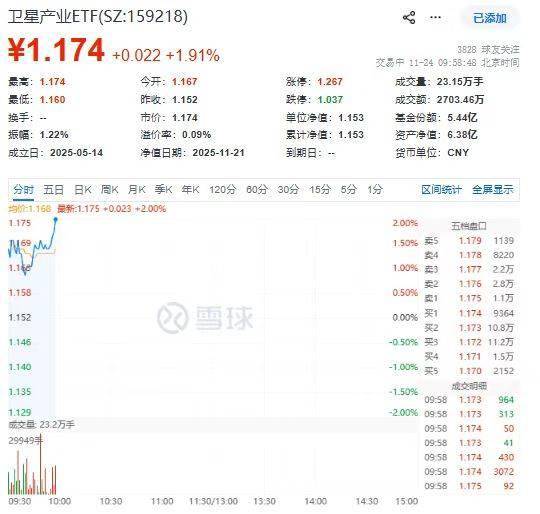
Core Insights - The satellite communication sector is experiencing a strong rally, with the satellite industry ETF (159218) rising by 1.91% as of November 24, 2023, driven by significant gains in constituent stocks such as Guangku Technology and New Ray Energy [1][2] Policy Developments - The Ministry of Industry and Information Technology officially launched commercial trials for satellite IoT services on November 22, 2023, aiming to enhance market supply and support the development of commercial aerospace and low-altitude economies [1] - A clear top-level design for the satellite communication industry has been established, with a target set to exceed 10 million satellite communication users by 2030, as outlined in the guidance issued in August 2023 [1] Market Dynamics - The satellite communication market in China is projected to exceed 80 billion CNY in 2023, with an expected compound annual growth rate of approximately 15% from 2024 to 2029, potentially surpassing 200 billion CNY by 2029 [2] - Institutional investors have been actively increasing their positions in satellite communication stocks, with eight stocks receiving net purchases exceeding 100 million CNY in November 2023 [2] Industry Maturity - The satellite communication market is reaching a maturity point, as all three major telecom operators in China have received licenses for satellite mobile communication services, which will enhance applications in emergency, maritime, and remote area communications [1]

卫星物联网商用试验正式启动!千亿市场规模可期(附概念股)
Zhi Tong Cai Jing· 2025-11-24 01:56
Core Viewpoint - The launch of commercial trials for satellite IoT in China marks a significant step towards enhancing the satellite communication market, stimulating industry growth, and supporting emerging sectors like commercial space and low-altitude economy [1][2][3] Industry Summary - The Ministry of Industry and Information Technology announced the start of a two-year commercial trial for satellite IoT, aimed at enriching market supply and establishing a regulatory framework [1] - The satellite IoT business connects various IoT devices through satellite communication, providing low-speed data services for a wide range of applications, including agriculture and emergency communications [1][2] - The satellite communication market in China is projected to exceed 80 billion yuan in 2023, with an expected annual growth rate of approximately 15% from 2024 to 2029, potentially reaching over 200 billion yuan by 2029 [2] - The commercial trial is expected to create significant demand for satellite launches, driving growth in satellite manufacturing and rocket launch industries [1][3] Company Developments - China Telecom has made advancements in satellite internet technology, enabling mobile devices to connect directly to satellites, with coverage extending to 25 million mobile terminals [4] - China Mobile has received a license to operate satellite mobile communication services, enhancing applications in emergency communication and remote area connectivity [5] - China Unicom successfully launched four low-orbit satellites, including the first domestic satellite with 3GPP narrowband IoT capabilities, marking a significant step in low-orbit satellite IoT development [5]

我国“5G+工业互联网”进入规模化应用新阶段
Ke Ji Ri Bao· 2025-11-24 00:56
Core Insights - The 2025 China 5G+ Industrial Internet Conference was held in Wuhan, focusing on the integration of the physical and digital economies through "5G+ Industrial Internet" [1] - The Ministry of Industry and Information Technology plans to implement actions to enhance the integration of industrial internet and artificial intelligence, optimize the industrial internet architecture, and promote the construction of 5G factories [1] Group 1: 5G Integration in Industries - Significant achievements in the automotive sector include the establishment of the first flexible production line for 5G automotive welding, reducing new model production line adjustment time by 90% [2] - Major home appliance manufacturers have deployed 5G-A industrial bases to create world-class 5G-A dark factories [2] - The latest data shows that 5G applications have been integrated into 86 out of 97 categories of the national economy, with over 138,000 cases and 64,000 deployed industry-specific virtual private networks [2] Group 2: Standards and Global Leadership - China has taken the lead in formulating the world's first industrial 5G international standards and has established over 100 national and industry standards [3] - The "5G+ Industrial Internet" is accelerating transformation, enhancing both quality and efficiency in factories [3] Group 3: AI Applications in Industrial Internet - Artificial intelligence is reshaping the entire value chain of enterprises, driving cost reduction and efficiency improvements [4] - Nearly 90% of automotive companies have adopted AI in their operations, with over 65% planning to establish dedicated AI positions [4] - AI technologies are being applied across various industries, including pharmaceuticals, steel, and home appliances, optimizing efficiency and quality [4] Group 4: Future Directions - The Ministry of Industry and Information Technology emphasizes the importance of intelligence, greening, and integration in advancing the industrial internet [5] - Future efforts will focus on deepening the penetration of AI into all operational aspects of enterprises, promoting customized production and precision service models [5]
向智跃升 向新拓展 我国“5G+工业互联网”进入规模化应用新阶段
Ke Ji Ri Bao· 2025-11-23 23:49
Group 1: Core Insights - The 2025 China 5G+ Industrial Internet Conference was held in Wuhan, focusing on the integration of the physical and digital economies through "5G+ Industrial Internet" [1] - The Ministry of Industry and Information Technology plans to implement actions for the integration of industrial internet and artificial intelligence, optimizing the industrial internet architecture and accelerating the construction of 5G factories [1][5] - Significant achievements in the automotive manufacturing sector include the establishment of the first flexible production line for 5G automotive welding, reducing new model production line adjustment time by 90% [2] Group 2: Industry Developments - 5G technology has been integrated into 86 out of 97 categories of the national economy, with over 138,000 cases and 64,000 deployed industry-specific virtual private networks [2] - China Unicom reported the establishment of 1,260 advanced 5G factories, contributing to the enhancement of traditional industries and the emergence of new business models [2] - The development of industrial 5G international standards has been led by China, with over 100 national and industry standards established [3] Group 3: AI Integration - Artificial intelligence is transforming the "5G+ Industrial Internet" landscape, enhancing efficiency across the entire value chain in industries such as automotive, pharmaceuticals, and home appliances [4] - Generative AI has improved design efficiency by over 8%, with nearly 90% of automotive companies adopting AI for operational assistance [4] - AI applications are becoming prevalent in various sectors, optimizing processes in steel production and supply chain management in the home appliance industry [4]
