
华熙生物

Search documents
美妆公司业绩分化 敏感肌技术研发成竞争焦点丨美妆财报观察
2 1 Shi Ji Jing Ji Bao Dao· 2025-08-24 01:33
Core Insights - The domestic beauty industry in China is entering a phase of deeper development, with market competition shifting from channel expansion to R&D innovation and precise positioning [1][2] - The performance of domestic beauty companies shows significant divergence, reflecting the competitive landscape and the impact of consumer awareness and purchasing power on functional skincare products [1][3] Company Performance - Shanghai Jahwa reported revenue of 3.48 billion yuan, a year-on-year increase of 4.7%, and a net profit of 270 million yuan, up 11.7% [2] - Marubi achieved revenue of 1.769 billion yuan, a 30.83% increase, with a net profit of 186 million yuan, growing by 5.21% [2] - Up Beauty Holdings expects revenue between 4.09 billion and 4.11 billion yuan, a growth of 16.8% to 17.3%, with net profit projected between 540 million and 560 million yuan, an increase of 30.9% to 35.8% [2] Market Trends - The functional skincare market in China is projected to reach approximately 48.743 billion yuan in 2024, with Betaini holding an 11.71% market share at 5.707 billion yuan [3] - The sensitive skin market is becoming a hot sector, with an expected consumer base nearing 100 million and a market size of around 45 billion yuan, reflecting a compound annual growth rate of 21.7% over the past three years [4] Innovation and Consumer Demand - There is a growing emphasis on "skin-specific care" rather than a one-size-fits-all approach, with brands focusing on personalized solutions for different skin types [5] - The sensitive skin market faces challenges in achieving effective and gentle whitening solutions, as traditional ingredients often irritate sensitive skin [5] - Brands that can address advanced needs such as whitening and anti-aging while ensuring scientific validation will be better positioned to capture market share in this expanding sector [5]


美妆公司业绩分化 敏感肌技术研发成竞争焦点
2 1 Shi Ji Jing Ji Bao Dao· 2025-08-24 01:29
Core Viewpoint - The domestic beauty industry in China is entering a phase of deeper development, with a shift in competition from channel expansion to technological innovation and precise positioning [1] Group 1: Industry Performance - In the first half of 2025, domestic beauty companies showed significant performance differentiation, with overall strong results [2] - Shanghai Jahwa achieved revenue of 3.48 billion yuan, a year-on-year increase of 4.7%, and a net profit of 270 million yuan, up 11.7% [2] - Marubi Biotech reported revenue of 1.769 billion yuan, a 30.83% increase, and a net profit of 186 million yuan, up 5.21% [2] - Shiseido's revenue is expected to be between 4.09 billion and 4.11 billion yuan, with a year-on-year growth of 16.8% to 17.3%, and a net profit forecast of 540 million to 560 million yuan, up 30.9% to 35.8% [2] Group 2: Market Trends - The sensitive skin market is becoming a hot sector, with the consumer base expected to approach 100 million by 2024, and a market size of approximately 45 billion yuan, with a compound annual growth rate of 21.7% over the past three years [4] - The market for sensitive skin products is projected to exceed 200 billion yuan, indicating significant growth potential [4] - Companies are increasingly focusing on the needs of sensitive skin consumers, moving beyond basic repair to include multiple functions such as whitening and anti-aging [4][5] Group 3: Strategic Adjustments - Some companies, like Betaini, are still in a strategic adjustment phase, with a first-quarter revenue of 949 million yuan, down 13.51%, and a net profit decline of 83.97% [3] - Betaini's main brand, Winona, experienced a revenue decline of 5%, but remains a leader in the sensitive skin segment [3] - The competitive landscape is shifting towards brands that can effectively address the dual needs of efficacy and gentleness for sensitive skin consumers [5]
【投资视角】启示2025:中国医疗美容行业投融资及兼并重组分析(附投融资事件、产业基金和兼并重组等)
Qian Zhan Wang· 2025-08-24 01:13
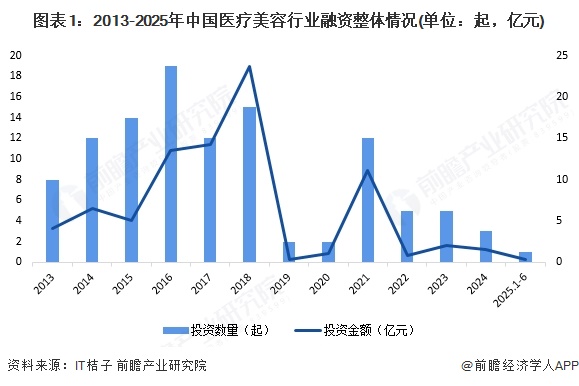
Group 1 - The core viewpoint of the article highlights the fluctuating investment and financing trends in China's medical beauty industry, with a peak in 2016 and a decline thereafter [1][17] - Investment events peaked in 2016 with 19 occurrences and an investment amount of 1.353 billion RMB, while the highest investment amount was recorded in 2018 at 2.374 billion RMB [1] - By 2024, only 3 investment events occurred with a total investment of 150 million RMB, and as of June 5, 2025, only 1 event with an investment of 30 million RMB was reported [1] Group 2 - The majority of investment rounds in the medical beauty industry are concentrated in early stages, particularly angel and A-round financing [2] - The industry encompasses various fields such as medical beauty raw materials, equipment, and service platforms, indicating strong innovation and technical barriers [2] Group 3 - Investment activities are primarily concentrated in Beijing and Guangdong, with 49 and 23 financing events respectively, followed by Sichuan and Shanghai with 12 and 9 events [4] - The focus on these regions is attributed to the concentration of resources and opportunities in the medical beauty sector [4] Group 4 - The investment direction is primarily focused on the construction of medical beauty platforms [6] Group 5 - The main investment entities in the medical beauty industry are capital organizations, accounting for 73% of the total, while industrial entities like Gree Electric and Xiaomi Group make up 27% [5] Group 6 - There are few industry investment funds specifically targeting medical beauty, with only 2 private funds identified [13] Group 7 - Recent years have seen a trend of horizontal acquisitions among midstream enterprises in the medical beauty industry as a means to expand scale [15] - Notable acquisition events include 康哲药业 acquiring 旭俐医疗 with a 100% stake and 新氧 acquiring 奇致激光 [16] Group 8 - Overall, the investment and financing landscape in China's medical beauty industry has shown fluctuations, with a concentration of activities in Beijing and Guangdong, primarily driven by capital investment institutions [17]




胶原蛋白还在风口
新财富· 2025-08-22 13:01
Core Viewpoint - The controversy surrounding the product "可复美胶原棒" from 巨子生物 has raised significant concerns about the credibility of its ingredient claims, leading to a sharp decline in its stock price and market value [1][2]. Group 1: Company Response and Market Impact - 巨子生物's stock price dropped significantly after allegations of ingredient falsification were made, resulting in a market value loss equivalent to that of 贝泰妮 [1]. - The company issued multiple statements attempting to clarify the situation, but these efforts have not alleviated public skepticism regarding the reliability of its ingredient claims [1][21]. - Following the controversy, the management expressed confidence in maintaining their revenue guidance for 2025, despite acknowledging the need for brand repair and additional investments [21][25]. Group 2: Industry Trends and Consumer Behavior - The cosmetic industry has entered a "成分红利期," where companies leveraging key ingredient research can gain market advantages [4]. - There is a growing consumer interest in the origins and efficacy of cosmetic ingredients, leading to the emergence of a "成分党" group that prioritizes ingredient transparency over traditional marketing [5][8]. - The effectiveness of ingredient marketing is now under scrutiny, as consumers become more knowledgeable and critical of ingredient claims, potentially undermining the previous success of such marketing strategies [7][8]. Group 3: Historical Context and Crisis Management - Historical examples of brand crises illustrate the importance of timely and transparent responses to consumer concerns, with successful cases demonstrating effective damage control strategies [29][30]. - The response from 巨子生物 has been criticized for being vague, which has further damaged its reputation among consumers who expect more concrete actions regarding ingredient integrity and industry standards [30].
2万一支的童颜针,爱美客的新摇钱树?
和讯· 2025-08-22 10:56
Core Viewpoint - The domestic medical beauty industry is undergoing significant changes, with major players experiencing a decline in performance due to market shifts and increased competition from new regenerative materials like collagen and "童颜针" (youthful needle) [4][7][14]. Group 1: Industry Performance - The three major companies in the medical beauty sector, including 华熙生物, 爱美客, and 昊海生科, reported substantial declines in revenue and net profit, with 爱美客's revenue dropping by 21.59% to 12.99 billion yuan and net profit decreasing by 29.57% to 7.89 billion yuan in the first half of 2024 [7][8]. - 爱美客's core products, including "嗨体" and "濡白天使," saw revenue declines of 23.79% and 23.99%, respectively, despite maintaining high gross margins of over 90% [6][7]. Group 2: Market Trends - The introduction of "童颜针," particularly the imported product 艾塑菲, has gained rapid popularity, with sales reaching 20,000 units and contributing over 800 million yuan in revenue within two months of its launch [5][17]. - The shift towards regenerative materials is evident, as "童颜针" offers longer-lasting effects and a different mechanism compared to traditional hyaluronic acid fillers, which are facing price declines due to increased competition [16][17]. Group 3: Strategic Moves - 爱美客's acquisition of REGEN, a Korean medical beauty company, for 1.386 billion yuan marks the largest cross-border acquisition in the domestic medical beauty industry, aiming to enhance its product portfolio and market presence [5][9]. - The ongoing dispute between 江苏吴中 and 爱美客 over the distribution rights of 艾塑菲 highlights the competitive landscape and the challenges of dependency on agency models in the medical beauty sector [19][20]. Group 4: R&D and Innovation - 爱美客 has increased its R&D investment to 1.57 billion yuan, representing 12.05% of its revenue, indicating a focus on enhancing its competitive edge through innovation [8]. - The company holds 182 valid patents, including 53 invention patents, showcasing its commitment to developing proprietary technologies [8].

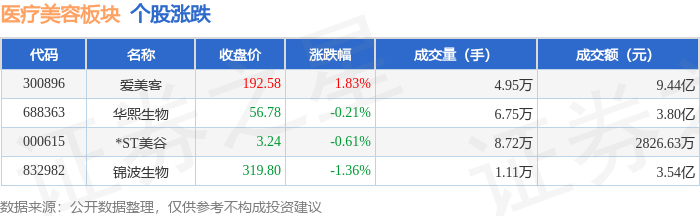
医疗美容板块8月22日涨0.94%,爱美客领涨,主力资金净流出1537.43万元
Zheng Xing Xing Ye Ri Bao· 2025-08-22 08:46
证券之星消息,8月22日医疗美容板块较上一交易日上涨0.94%,爱美客领涨。当日上证指数报收于 3825.76,上涨1.45%。深证成指报收于12166.06,上涨2.07%。医疗美容板块个股涨跌见下表: 从资金流向上来看,当日医疗美容板块主力资金净流出1537.43万元,游资资金净流入1006.26万元,散 户资金净流入531.18万元。医疗美容板块个股资金流向见下表: 以上内容为证券之星据公开信息整理,由AI算法生成(网信算备310104345710301240019号),不构成投资建议。 | 代码 | 名称 | 收盘价 | 涨跌幅 | 成交量(手) | 成交额(元) | | --- | --- | --- | --- | --- | --- | | 300896 | 爱美客 | 192.58 | 1.83% | 4.95万 | 9.44 G | | 688363 | 华熙生物 | 56.78 | -0.21% | 6.75万 | 3.80 Z | | 000615 | *ST美谷 | 3.24 | -0.61% | 8.72万 | 2826.63万 | | 832982 | 锦波生物 | 319.80 ...
“医美茅”双雷引爆:爱美客上市以来业绩首降,并购韩国企业埋下16亿元商誉“定时炸弹”
Hua Xia Shi Bao· 2025-08-22 08:14
Core Viewpoint - Aimeike, once hailed as the "beauty medical leader," is experiencing its first performance decline since its IPO, reflecting both industry-wide changes and internal challenges [2][3][4] Financial Performance - In the first half of 2025, Aimeike reported revenue of 1.299 billion yuan, a year-on-year decline of 21.59%, and a net profit of 789 million yuan, down 29.57% [3][4][6] - The company's revenue growth rate has decreased significantly from 104.13% in 2021 to 5.45% in 2024, culminating in a sharp drop in 2025 [4][6] Market Environment - The decline is attributed to macroeconomic pressures, including weak consumer spending and increasing consumption stratification, which have particularly impacted high-ticket items [7][8] - The average price of hyaluronic acid has dropped from 384 yuan to 330 yuan, indicating a shift in consumer behavior towards more cost-effective options [7] Core Products - Aimeike's two main products, "Haitai" and "Ruhbai Angel," saw significant revenue declines of 23.79% and 23.99%, respectively, together accounting for over 90% of total revenue [8][9] - The gross profit margins for these products have also decreased, raising concerns about their market competitiveness and potential lifecycle decline [9][10] Competitive Landscape - The market is becoming increasingly competitive, with new entrants and price wars threatening Aimeike's previously dominant position [10][14] - The approval of multiple similar products has intensified competition, leading to a potential reduction in profit margins [10][14] Strategic Moves - To address its product line limitations, Aimeike attempted to acquire South Korean company REGEN for $190 million (approximately 1.386 billion yuan), but this has led to legal disputes and potential financial liabilities [15][16][17] - The acquisition has significantly increased the company's goodwill from 278 million yuan to 1.594 billion yuan, raising concerns about financial risks [17][18] Future Outlook - Experts express concerns about Aimeike's ability to recover growth amidst declining core product sales and increasing competition [10][18] - The company needs to diversify its product offerings and enhance its R&D capabilities to mitigate risks associated with its current reliance on a few key products [10][18]
华熙生物:让“液体黄金”走进生活日常
Da Zhong Ri Bao· 2025-08-21 23:34
Core Viewpoint - The article highlights the advancements and innovations in the production and application of hyaluronic acid by Huaxi Biological Technology Co., Ltd., showcasing its transition from a high-cost medical ingredient to a widely used component in various consumer products through technological breakthroughs [1][2][3]. Group 1: Technological Innovations - Huaxi Biological achieved a 90% reduction in production costs of hyaluronic acid through microbial fermentation, breaking international monopolies and enabling industrial-scale production [3]. - The introduction of enzyme cutting technology in 2011 allowed for precise control of molecular weight, leading to the development of products with different functionalities and earning national recognition [3]. - The adoption of synthetic biology technology in 2020 further enhanced production efficiency by three times and enabled zero-carbon production [3][5]. Group 2: Industry Position and Market Demand - Huaxi Biological has established a complete industrial chain from raw material development to end-user applications, positioning itself as a leader in the global hyaluronic acid market [5][7]. - The company has diversified its product offerings across four main business segments: raw materials, pharmaceuticals, skincare products, and functional foods, which collectively support its growth [7]. - The inclusion of sodium hyaluronate in the new food raw material directory by the National Health Commission in 2021 has spurred the development of new products like "Water Muscle Spring" hyaluronic acid drinking water [7]. Group 3: Global Expansion and Brand Development - Huaxi Biological is leveraging its innovative strategies to penetrate international markets, enhancing product competitiveness and brand recognition [7][8]. - The company is not only selling raw materials but also exporting standards and expanding its market presence in regions like Europe, Japan, and the United States [7]. - The growing global demand for health and wellness products, driven by aging populations, is facilitating the expansion of hyaluronic acid applications in everyday life [7][8].
最差半年报!爱美客业绩双降、溶液/凝胶类产品销售额均大幅下滑 肉毒毒素项目延期、高溢价收购致商誉激增
Xin Lang Zheng Quan· 2025-08-21 09:24
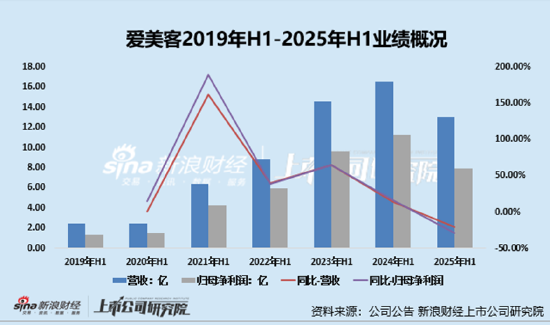
Core Viewpoint - In the first half of 2025, Aimeike reported its worst interim results since its listing, with both revenue and net profit declining significantly, indicating potential underlying issues in product iteration and competitive barriers [1][2]. Financial Performance - Aimeike's revenue for the first half of 2025 was 1.299 billion yuan, a year-on-year decrease of 21.59%, while the net profit attributable to shareholders was approximately 789 million yuan, down 29.57% year-on-year [1][2]. - The company's revenue and net profit have been on a downward trend since the first half of 2023, with revenue figures of 1.459 billion yuan, 1.657 billion yuan, and 1.299 billion yuan for the first halves of 2023, 2024, and 2025 respectively, showing changes of 64.93%, 13.53%, and -21.59% [2]. - The gross profit margin and net profit margin also declined, with gross profit margin at 93.44%, down 1.47 percentage points year-on-year, and net profit margin at 60.9%, down 6.78 percentage points year-on-year [1][9]. Product Performance - The two main business segments, solution products (including "Haitai") and gel products (including "Ruhua Tianzi"), both experienced revenue declines, with solution products generating 744 million yuan (down 23.79%) and gel products generating 493 million yuan (down 23.99%) [1][6]. - These two segments account for over 90% of Aimeike's revenue, highlighting potential risks related to product innovation and competitive positioning [1]. Inventory and Operational Efficiency - Aimeike's inventory situation is concerning, with inventory size reaching 82 million yuan, a year-on-year increase of 42.69%, and inventory turnover days extending to 163.77 days, an increase of 49 days compared to the previous year [9]. Market Dynamics and Competitive Landscape - The injection beauty market in China is primarily driven by hyaluronic acid and botulinum toxin products, with high entry barriers due to regulatory requirements, which historically provided Aimeike with a competitive edge [10]. - However, increasing competition and a growing number of approved hyaluronic acid products have diminished Aimeike's first-mover advantage, prompting the company to seek growth through acquisitions and product line expansions [10][11]. Acquisition Strategy - Aimeike has pursued aggressive acquisitions to expand its product offerings, including a notable acquisition of a Korean botulinum toxin company and a recent acquisition of REGEN Biotech, which includes the well-known "童颜针" product [12][13]. - The high premium paid for acquisitions reflects a broader trend of growth anxiety among Chinese medical beauty companies, raising concerns about goodwill risks associated with such strategies [13].
医疗美容板块8月21日涨1.37%,锦波生物领涨,主力资金净流入45.74万元
Zheng Xing Xing Ye Ri Bao· 2025-08-21 08:38
Group 1 - The medical beauty sector increased by 1.37% on August 21, with Jinbo Biological leading the gains [1] - The Shanghai Composite Index closed at 3771.1, up 0.13%, while the Shenzhen Component Index closed at 11919.76, down 0.06% [1] Group 2 - The medical beauty sector saw a net inflow of 457,400 yuan from main funds, while retail investors experienced a net outflow of 859,410 yuan [2] - Specific stock performances included Huaxi Biological with a net inflow of 7,907,300 yuan, while *ST Meigu and Aimeike had net outflows of 3,103,300 yuan and 4,346,600 yuan respectively [2]
