
英大信托

Search documents
绿色信托多元服务低碳转型
Jing Ji Ri Bao· 2026-02-03 04:00
Core Viewpoint - The release of the top ten green trust cases by the China Trust Industry Association highlights the role of trust mechanisms in supporting green transition projects, showcasing their characteristics of asset independence, risk isolation, and long-term sustainability [1][3] Group 1: Green Trust Development - Green trust is becoming a core tool for revitalizing green assets and empowering low-carbon transitions due to its unique advantages of flexible systems and diverse services [1][3] - The development of green trust is seen as a necessary choice for the trust industry to return to its roots, reshape business logic, and find growth points [1][3] Group 2: Case Examples - The ten cases include four asset service trusts, such as Kunlun Trust's carbon capture project and Huaxin Trust's clean energy hydroelectric project, and four asset management trusts, including Wukuang Trust's zero-emission wastewater project [2] - Two charity trust cases focus on biodiversity and endangered species protection, demonstrating the diverse applications of green trust [2] Group 3: Policy and Market Support - The rapid development of green trust is supported by an improving policy framework and increasing market demand, with new guidelines clarifying classification and disclosure standards [3] - The guidelines introduce a quantitative standard for recognizing green projects, addressing previous ambiguities in business definitions and operational standards [3] Group 4: Opportunities for Trust Companies - Trust companies have significant opportunities to enhance their competitiveness by leveraging their unique functions in financing services, carbon finance, and family trusts [4] - They can explore green trust loans, green asset securitization, and green equity investments to support green industry development [4] - In the carbon finance sector, trust companies can focus on carbon asset management services to enhance market liquidity and financial attributes [4]
从信托年报透视行业格局 营收头尾差距大 前十名贡献六成净利
Jin Rong Shi Bao· 2026-02-03 01:45
Core Insights - The trust industry is experiencing significant performance divergence, with the top ten trust companies accounting for nearly 60% of the total net profit, highlighting a trend of "ice and fire" within the sector [1] - Regulatory policies, such as the "three classifications of trusts," are prompting companies to shift their focus towards standardized products, leading to varying degrees of success in their business transformations [1][2] - The overall revenue and profit of the trust companies have shown positive growth, indicating a potential industry recovery [2] Group 1: Financial Performance - The total operating revenue of the 50 disclosed trust companies reached 708.71 billion yuan, a year-on-year increase of 15.87%, with 28 companies reporting positive growth [2] - The total profit amounted to 382.964 billion yuan, reflecting a year-on-year growth of 13.64%, with 29 companies achieving positive profit growth [2] - The first half of 2025 saw operating revenue of 343.62 billion yuan, a 3.34% increase from the previous year, indicating a recovery trend [2] Group 2: Company-Specific Performance - Notable performers include CITIC Trust, with an operating revenue of 63.26 billion yuan and a growth rate of 81.84%, and Industrial Trust, which saw a staggering revenue growth of 796.52% [3] - Conversely, some companies like Huachen Trust and Changcheng Trust reported revenues below 1 billion yuan, with Wukuang Trust posting a loss of 2.15 billion yuan [3] Group 3: Industry Dynamics - The revenue disparity among trust companies is attributed to inherent resource differences and varying strategic choices in their transformation paths, leading to a shift from homogeneous competition to differentiated operations [4] - The significant divergence in net profit reflects a broader trend of increasing inequality within the industry, with leading firms continuing to thrive while others face profitability challenges [5][6] - The return on equity (ROE) for the industry improved from 4.61% to 5.06%, with several companies exceeding 10% ROE, indicating a disparity in capital utilization efficiency [7][8]
营收头尾差距大 前十名贡献六成净利
Jin Rong Shi Bao· 2026-02-03 01:43
Core Insights - The trust industry is experiencing significant performance divergence, with the top ten trust companies accounting for nearly 60% of the total net profit, highlighting a trend of "ice and fire" within the sector [1][4] - The shift towards standardized products and the impact of regulatory policies are driving trust companies to focus on core business areas, leading to varying degrees of success in their transformation efforts [1][5] Financial Performance - The total operating revenue of the 50 disclosed trust companies reached 708.71 billion yuan, a year-on-year increase of 15.87%, with 28 companies (56%) reporting positive revenue growth [2] - The total profit amounted to 382.964 billion yuan, reflecting a year-on-year growth of 13.64%, with 29 companies (58%) achieving positive profit growth [2] - The first half of 2025 saw operating revenue of 343.62 billion yuan, a 3.34% increase from the previous year, indicating a recovery trend in the industry [2] Profitability Disparities - The top-performing trust companies, such as CITIC Trust and Yingda Trust, reported substantial profit increases, with CITIC Trust's net profit growing by 112.72% [6] - Conversely, some companies like Huachen Trust and Changcheng Trust faced significant revenue declines, with Wukuang Trust reporting a loss of 2.15 billion yuan [3][6] - The overall net profit margin and return on equity (ROE) have shown a notable increase, with the industry ROE rising from 4.61% to 5.06% [6] Capital Utilization and Risk Management - The disparity in profitability reflects differences in capital utilization capabilities among trust companies, with leading firms diversifying investments to mitigate risks and enhance returns [7] - Smaller firms are constrained by limited investment options and ongoing risk resolution processes, impacting their overall profitability [7]
信托工具多元服务绿色转型
Xin Lang Cai Jing· 2026-02-01 22:23
Core Viewpoint - Green trust is becoming a core tool for activating green assets and empowering low-carbon transformation, supported by the flexible system and diverse services it offers [1] Group 1: Green Trust Development - The development of green trust is a necessary choice for the trust industry to return to its roots, reshape business logic, and find growth points [1] - The release of the top ten green trust cases by the China Trust Industry Association reflects the industry's active exploration and aims to inspire more capital and professional forces to participate in green development [1][3] Group 2: Case Examples - The ten cases include four asset service trusts, four asset management trusts, and two charitable trusts, showcasing the diverse roles that trust mechanisms can play in supporting green transition projects [2] - Specific examples include projects related to carbon capture, renewable energy, and biodiversity conservation, highlighting the comprehensive service capabilities of trusts in supporting green development [2][3] Group 3: Policy and Market Demand - The rapid development of green trust is driven by the continuous improvement of the policy system and market demand, with new guidelines clarifying classification and disclosure standards [3] - The guidelines address previous ambiguities in business definitions and operational standards, providing actionable norms for trust companies [3] Group 4: Opportunities for Trust Companies - Trust companies have significant opportunities to enhance their competitiveness by leveraging their unique functions in financing services, carbon finance, and family trusts [4] - They can explore various financing channels such as green trust loans, green asset securitization, and green equity investments to support the development of green industries [4]
中石油、国家电网“油电联姻”新进展
Sou Hu Cai Jing· 2026-01-29 15:43
Core Viewpoint - The acquisition of 100% equity of Yingda Futures by Zhongyou Capital for 1.129 billion yuan marks a significant step in the collaboration between China National Petroleum Corporation (CNPC) and State Grid Corporation of China, enhancing Zhongyou Capital's financial capabilities and aligning with the broader energy transition goals of both companies [1][2]. Group 1: Acquisition Details - Zhongyou Capital announced plans to acquire 100% equity of Yingda Futures for 1.129 billion yuan, with the transaction approved by the State-owned Assets Supervision and Administration Commission [1]. - The acquisition price represents an 8.3% premium over Yingda Futures' net asset value of approximately 1.043 billion yuan as of March 2025 [1]. - The transfer of 3.79 million A-shares (3.00% of total shares) from CNPC to State Grid Yingda Group is also part of this transaction, pending regulatory approval [1]. Group 2: Strategic Implications - For State Grid Yingda, divesting the non-core asset Yingda Futures aligns with its strategy to streamline operations [2]. - The acquisition allows Zhongyou Capital to complete its financial license portfolio, enhancing its capabilities in hedging and risk management related to its core oil and gas business [2]. - Zhongyou Capital's diverse financial interests include stakes in various financial institutions, which will be bolstered by this acquisition [2]. Group 3: Industry Context - The collaboration between CNPC and State Grid has intensified since last year, with significant investments aimed at developing a new energy system [3]. - Predictions indicate that China's oil consumption may peak around 2025, prompting CNPC to transition towards a comprehensive energy supplier model that includes oil, gas, and renewable energy [3]. - CNPC aims to achieve a balanced energy portfolio by 2035, with a focus on clean energy generation exceeding 20 billion kilowatt-hours in 2025 [4].

慈善信托在透明规范中发挥作用
Jin Rong Shi Bao· 2026-01-29 01:04
Core Viewpoint - The financial regulatory authority has initiated a path for the trust industry to return to its core mission and focus on high-quality development, emphasizing risk prevention and compliance [1] Group 1: Regulatory Developments - The Financial Regulatory Authority released guidelines to strengthen supervision and prevent risks in the trust industry, marking the beginning of a high-quality development journey [1] - The Ministry of Civil Affairs and the Financial Regulatory Authority issued the "Charity Trust Information Disclosure Measures," which consists of 26 articles aimed at enhancing the transparency and effectiveness of charity trusts [2][3] Group 2: Industry Transformation - The trust industry is focusing on reducing financing and channel trusts while enhancing its core business, with a significant emphasis on risk management and compliance [1] - Charity trusts have seen a substantial increase in registration, with 2,799 trusts registered and a total asset scale of 10.705 billion yuan as of January 28, 2026 [2] Group 3: Information Disclosure Requirements - The new measures require timely public disclosure of key information related to charity trusts, including registration details and financial management, to ensure transparency [3][4] - The measures encourage public and media oversight of charity trust information disclosure, promoting accountability and transparency in operations [3][4] Group 4: Performance of Trust Companies - Several trust companies, including CITIC Trust and Shanghai Trust, reported stable performance in 2025, with CITIC Trust achieving 6.326 billion yuan in revenue and expanding its service offerings [6] - Shanghai Trust's asset management scale reached nearly 1.4 trillion yuan, with over 13,000 active wealth accounts totaling 100 billion yuan [6] - Kunlun Trust reported a 439.75% increase in net profit, focusing on energy trust development and successfully registering a new charity trust project at the beginning of 2026 [6]
信托业2025成绩单
2 1 Shi Ji Jing Ji Bao Dao· 2026-01-28 23:30
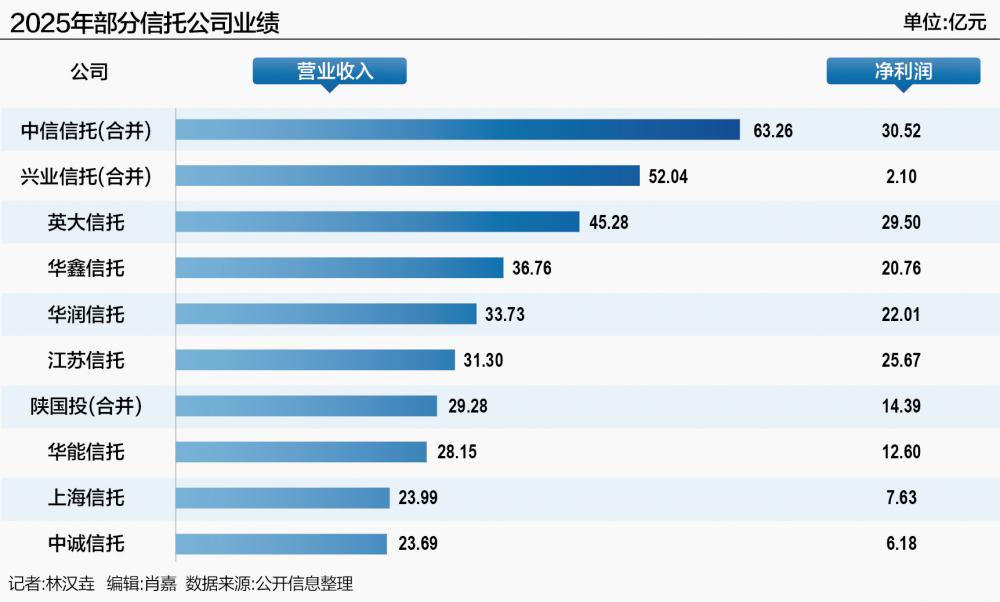
Core Insights - The trust industry is experiencing growth in both revenue and net profit for 2025, but internal differentiation among companies is intensifying [1][3][4] Revenue and Profit Overview - In 2025, 50 trust companies reported a total revenue of 70.871 billion yuan and a net profit of 31.418 billion yuan, with nearly 60% of companies achieving positive net profit growth [1][5] - The top five companies account for over 30% of the total revenue, indicating a significant head effect, with the leading company, CITIC Trust, generating 6.326 billion yuan in revenue, representing 8.93% of the total [3][4] - The revenue of the top ten companies constitutes 51.85% of the total revenue of the 50 companies, while half of the companies reported revenues below 1 billion yuan [3][4] Profitability Differentiation - The net profit margin varies significantly among companies, with 16 companies exceeding a 50% net profit margin, while 7 companies reported margins below 10%, the lowest being 2.87% [7] - CITIC Trust led in net profit with 3.052 billion yuan, followed closely by Yingda Trust and Jiangsu Trust [5][6] Business Model Transformation - The trust industry is shifting from homogeneous competition to differentiated operations, driven by inherent resource endowments and strategic transformation paths [4][8] - Companies with different backgrounds, such as bank-affiliated trusts and financial holding group trusts, are leveraging their unique advantages to enhance their competitive edge [4][8] Trust Business vs. Proprietary Business - Trust business revenue decreased to 36.568 billion yuan, down 8.76% year-on-year, continuing a downward trend [8][9] - In contrast, proprietary business revenue saw significant growth, supported by a recovering capital market and improved investment management capabilities [9][10] Asset Management Growth - By mid-2025, the total trust asset management scale reached 32.43 trillion yuan, a year-on-year increase of 20.11%, ranking third in the asset management industry [9][10]

信托业2025成绩单:营收净利整体双增,前五强揽下三成营收
2 1 Shi Ji Jing Ji Bao Dao· 2026-01-28 10:48
Core Insights - The trust industry is experiencing revenue and profit growth in 2025, but internal differentiation is intensifying [1][2] - Nearly 60% of the 50 trust companies reported positive net profit growth, with total revenue reaching 70.87 billion yuan and net profit at 31.42 billion yuan [1][2] Revenue Analysis - The top five trust companies account for over 30% of the industry's total revenue, indicating a significant head effect [1][5] - The total revenue of the 50 trust companies is 70.87 billion yuan, with the top five companies generating 32.60% of this total [5][6] - The revenue of the trust business continues to decline, contrasting sharply with the substantial growth in proprietary business income [1][9] Profit Analysis - The total net profit for the 50 trust companies is 31.42 billion yuan, with nearly 60% achieving positive growth [7] - CITIC Trust leads with a net profit of 3.05 billion yuan, followed by Yingda Trust and Jiangsu Trust [7][8] - There is a notable disparity in net profit margins, with 16 companies exceeding 50% and 7 companies below 10% [7][8] Business Transformation - The industry is shifting from homogeneous competition to differentiated operations, with varying paths of transformation among companies [1][6] - Companies with different backgrounds are leveraging their core advantages to establish unique development paths [6][11] - The proprietary business income is significantly increasing, while trust business income is declining, reflecting a structural adjustment in profit models [10][11] Asset Management Growth - The total trust asset management scale reached 32.43 trillion yuan, growing by 20.11% year-on-year, ranking third in the asset management industry [11][12] - The growth in asset management scale indicates the industry's strong position and potential for development [12]
近六成信托公司2025年利润正增长
Xin Lang Cai Jing· 2026-01-27 21:04
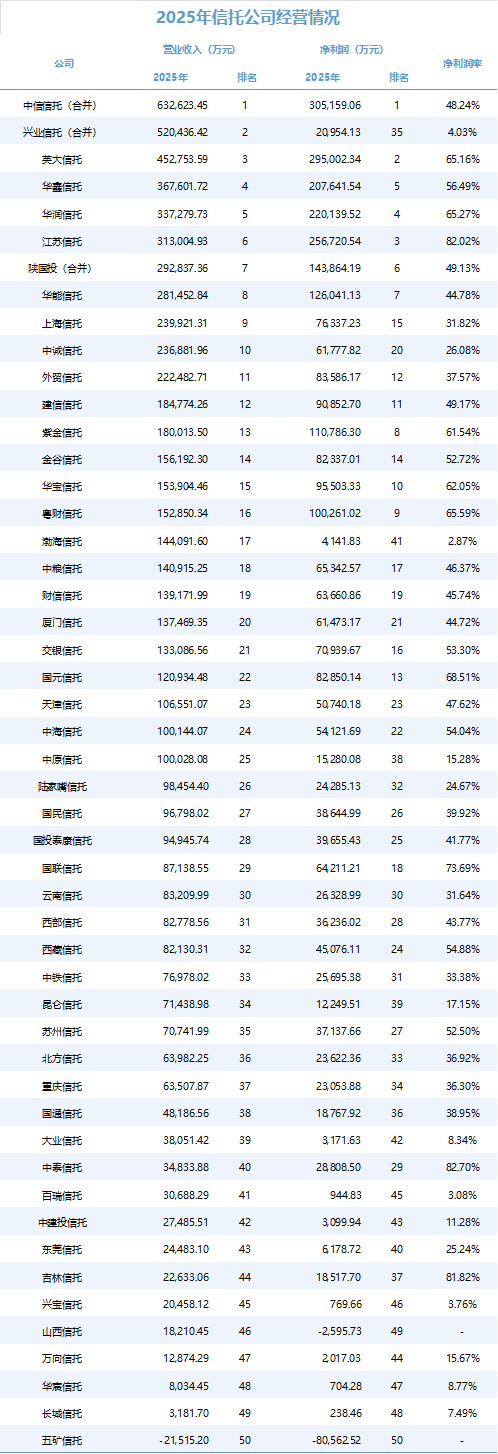
Core Insights - The trust industry in China has shown improved profitability in 2025, despite a decline in trust business revenue, with significant growth in proprietary business income [1][2] Group 1: Financial Performance - The total operating revenue of 50 disclosed trust companies reached 70.871 billion yuan, a year-on-year increase of 15.87%, with 28 companies (56%) reporting positive revenue growth [1] - The total profit of the trust industry was 38.2964 billion yuan, up 13.64% year-on-year, with 29 companies (58%) achieving positive profit growth [2] - The net profit of the industry reached 31.418 billion yuan, reflecting a 14.23% increase year-on-year, with 28 companies (56%) reporting positive net profit growth [2] Group 2: Revenue Breakdown - Trust business revenue totaled 36.568 billion yuan, a decline of 8.76% year-on-year, with only 18 companies (36%) reporting positive growth in this segment [3] - Proprietary business income surged by 73.06% year-on-year, totaling 31.375 billion yuan, becoming the main driver of industry profitability [3][4] Group 3: Market Dynamics - The top five companies by proprietary business income are: Industrial Trust, CITIC Trust, Jiangsu Trust, China Resources Trust, and Huaxin Trust, with significant growth rates observed in several firms [4] - The industry is experiencing a structural shift, with investment income playing a crucial role in revenue for some companies, and asset service trusts emerging as a new growth driver [5][6] Group 4: Future Outlook - The capital market recovery in 2025 has provided a favorable environment for proprietary business growth, supported by enhanced investment management capabilities of trust companies [5] - The wealth management sector is evolving, with companies like Shanghai Trust expanding their service offerings and client base, indicating a trend towards high-quality development in family trusts and personalized services [6]
2025年信托行业净利润314.18亿,增14.23%,固有业务收入暴增73.06%
Jin Rong Jie· 2026-01-27 12:02
Core Insights - The trust industry in China has shown significant improvement in profitability and structural adjustments in revenue, with inherent business becoming the main growth engine as of 2025 [1] Industry Overview - The total operating revenue of the trust industry reached 70.87 billion yuan in 2025, a 15.87% increase from 61.16 billion yuan in 2024 [2] - Total profit amounted to 38.30 billion yuan, reflecting a year-on-year growth of 13.64%, while net profit rose to 31.42 billion yuan, with a growth rate of 14.23% [2] - The revenue structure has notably diversified, with trust business revenue declining by 8.76% to 36.57 billion yuan, while inherent business revenue surged by 73.06% to 31.38 billion yuan, accounting for nearly 50% of total industry revenue [2] Revenue Performance - Among 50 trust companies, 28 reported positive revenue growth, with the top five companies being CITIC Trust, Industrial Trust, Yingda Trust, Huaxin Trust, and China Resources Trust [3] - Industrial Trust exhibited the highest growth rate at 796.52%, followed by CITIC Trust at 81.84% and Yingda Trust at 53.14% [3] - The industry is experiencing increasing revenue differentiation, with bank-affiliated trust companies leveraging parent bank resources for synergy [3] Trust Business Analysis - Trust business revenue totaled 36.57 billion yuan, down 8.76%, but 18 companies achieved positive growth, indicating early signs of industry transformation [4] - The top five companies in trust business revenue were Yingda Trust, CITIC Trust, Jianxin Trust, Huaxin Trust, and Foreign Trade Trust [4] - Institutions demonstrating strong risk resistance have successfully transitioned from non-standard to standard business models, with asset management in standard products becoming a core growth driver [4] Inherent Business Growth - Inherent business revenue soared by 73.06% to 31.38 billion yuan, becoming the main driver of industry profitability, with 33 companies reporting positive growth [5] - The top five companies in inherent business revenue included Industrial Trust, CITIC Trust, Jiangsu Trust, China Resources Trust, and Huaxin Trust [5] - Significant growth in fair value changes and investment income supported this increase, with Yingda Trust and CITIC Trust seeing fair value changes rise by 1179.12% and 1095.87%, respectively [5] Profitability Metrics - The total profit of the industry grew by 13.64%, with 29 companies achieving positive growth, while net profit increased by 14.23% with 28 companies reporting positive growth [7] - The top five companies by total profit were Yingda Trust, CITIC Trust, Jiangsu Trust, Huaxin Trust, and China Resources Trust [7] - The concentration of net profit among the top ten companies remained stable, accounting for 59.24% of the total industry net profit [7] Capital and Efficiency - By the end of 2025, the average net asset balance of the trust industry reached 12.76 billion yuan, a 5.68% increase [8] - The return on equity (ROE) improved to 5.06%, with the top five companies in ROE being Yingda Trust, Jingu Trust, Huaxin Trust, Zijin Trust, and Yuecai Trust [8] - The differences in ROE among institutions are primarily due to capital utilization capabilities, with leading firms diversifying investments to mitigate risks and enhance returns [8]