Ozon

Search documents
Ozon发货方式大调整!UNI物流被终止,超全Ozon发货指南轻松搞定物流难题!
Jin Tou Wang· 2026-02-24 07:31
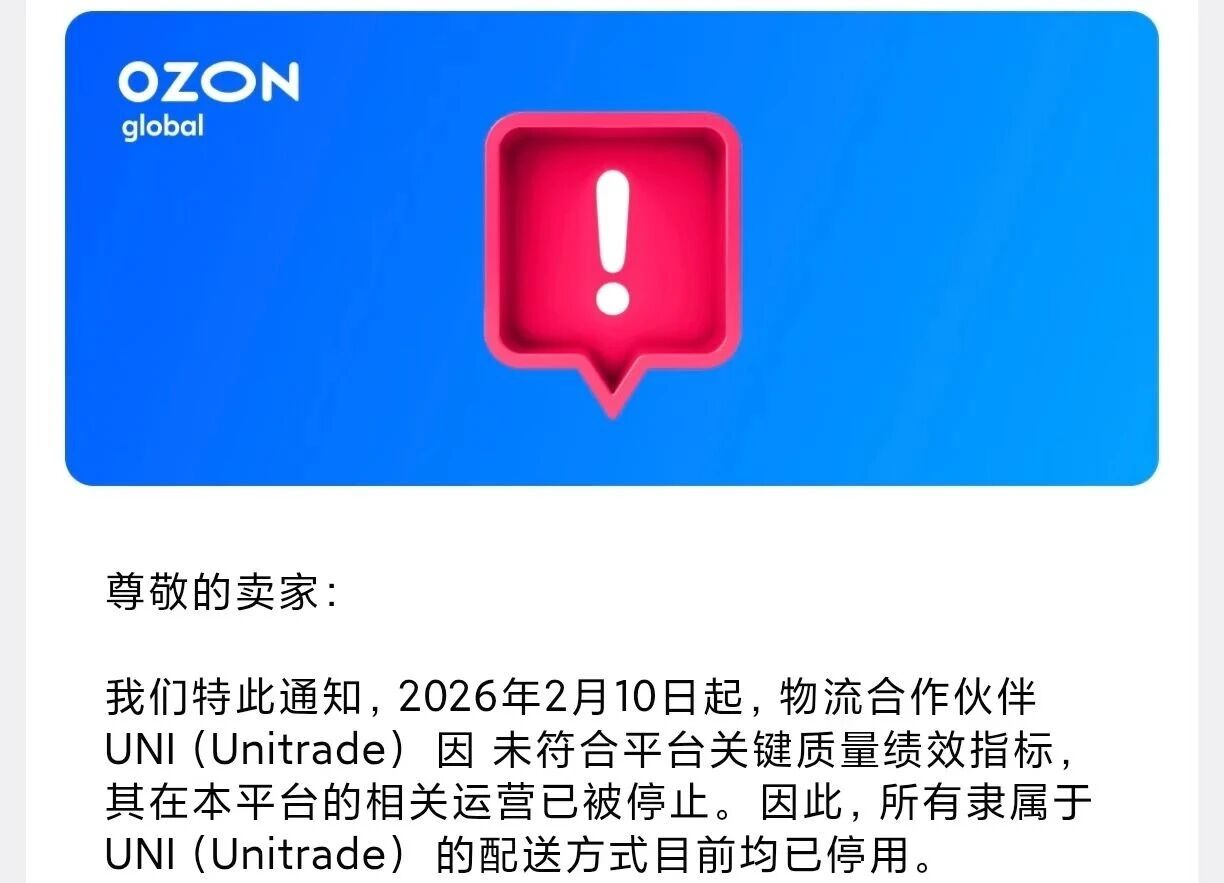
近日,俄罗斯电商巨头Ozon发布官方公告,宣布因物流服务商UNI(Unitrade)未能持续达标平台关键绩效指标,正式终止双方合作关系。 自2026年2月10日起,所有隶属UNI的配送方式即刻停用,卖家暂停创建或交付新订单。 UNI事件为所有跨境卖家敲响了警钟: 在平台治理迈向精细化的当下,物流合作伙伴的选择逻辑亟需重构。价格优势不再是单一的决定性因素,履约稳定性、服务合规性以及与平台标准的契合 度,才是维系店铺长期运营生命线的核心要素。 Ozon发货实操:新规背景下的物流策略重构 面对突发变局,卖家需重新审视平台多元化的发货模式,结合资金状况、货品属性及运营阶段,制定精准的切换方案。 此次决策并非无迹可寻。据行业统计,UNI物流在合作期内频发丢件、无故延误、违规二次收费及恶意拒赔等严重事故,波及近百名卖家的上万笔订单,对 平台用户体验造成了难以挽回的负面冲击。 Ozon此次果断清理门户,旨在肃清低效服务商,捍卫平台履约口碑。尽管UNI官方将此次变动解释为"春节期间的临时性系统优化",但在平台日趋严苛的服 务质量管控背景下,其被淘汰已成定局。 基于UNI事件的前车之鉴,建议卖家从以下维度构建极具竞争力的物流策 ...

深圳跨境电商“无票免税”登记模块上线;亚马逊FBA库存处置新规
Sou Hu Cai Jing· 2026-02-09 08:46
Group 1 - Shenzhen's cross-border e-commerce "no-invoice tax exemption" registration module launched on February 1, allowing companies to handle registration electronically under the 9610 supervision model [2] - Shopee will upgrade its GMV (Gross Merchandise Volume) metric to "sales revenue" starting February 3, 2026, reflecting actual sales performance by excluding seller subsidies [3] - USPS introduced a new "DDP" (Delivered Duty Paid) service for international shipping, allowing senders to prepay import duties for packages sent to Canada, Germany, and the UK [4] Group 2 - Amazon will implement new FBA inventory removal and disposal fees effective February 15, 2026, charging per item processed instead of batch orders, while keeping rates unchanged [5] - Mercado Libre announced an upgrade to its US forwarding warehouse policy, allowing Chinese sellers to access sales permissions in five Latin American countries with simplified logistics [7] - Lazada will launch the Seller Promo+ Advantage (SPA) program on February 9, 2026, offering various benefits to participating merchants while increasing commission rates for non-participants [8] Group 3 - AliExpress requires Spanish sellers to complete the EU VAT registration by March 31, 2026, or risk losing sales permissions [9] - JD.com will launch its European retail platform Joybuy in March 2026, providing support for UK brands in the Chinese market [10] - Shopee Singapore will tighten its late shipment rate assessment, lowering the penalty threshold from 10% to 5% starting March 10, 2026 [11] Group 4 - Ozon will adjust its logistics and sales fee structure starting April 6, 2026, simplifying pricing and optimizing regional delivery efficiency [12] - Walmart introduced a "post-purchase review" program for third-party sellers, allowing them to incentivize buyers to leave product reviews [13] - eBay will implement a new refund voucher system for US sellers starting in 2026, providing formal tax documents for refunds [14] Group 5 - Shopee Brazil will adjust service fees and open free shipping services to all sellers starting March 1, 2026, while also introducing buyer incentives [14] - SpeedPAK announced its logistics arrangements for the 2026 Spring Festival, detailing service suspensions and resumption dates [15] - TikTok Shop in the US launched a "picture-text trailer" feature in February, allowing merchants to create sales content directly from product images [16] Group 6 - Amazon will introduce a "high return rate product" label on certain product pages starting February 16, 2026, to enhance transparency regarding return rates [17] - eBay launched a "Time Away" vacation setting tool for sellers to manage their store during the Spring Festival, allowing for pre-set vacation periods and sales options [19]

2026年跨境电商趋势早报:在全球浪潮中破浪前行,探寻发展新蓝海市场
Sou Hu Cai Jing· 2026-01-17 16:45
Core Insights - The global e-commerce landscape is rapidly evolving, with cross-border e-commerce significantly altering international trade dynamics, presenting both challenges and opportunities for businesses and consumers [1] Group 1: Policy Environment - The policy environment is a crucial external factor affecting cross-border e-commerce, with varying regulations across countries creating both challenges and opportunities for enterprises [3] - In Southeast Asia, particularly Vietnam, 63% of consumers prefer purchasing New Year goods through e-commerce platforms, highlighting the market's growth potential [4] - Amazon has upgraded compliance requirements, increasing the on-time delivery compliance rate to 95%, which raises expectations for supplier efficiency [5][6] Group 2: Market Trends - The U.S. has become the largest online market for Korean cosmetics, holding a 51% global share, indicating a significant opportunity for cross-border e-commerce businesses to enhance procurement and marketing strategies [7] - eBay UK has adjusted customer service channels, which may impact consumer communication with the platform, while also launching a climate transition plan aiming for net-zero emissions by 2045 [7] Group 3: Logistics Challenges - Logistics remains a critical aspect of cross-border e-commerce, with long distances and multiple stages leading to high costs and delays, particularly during special circumstances like the pandemic [15] - Companies are exploring new logistics models, such as overseas warehouses, to improve delivery times and customer satisfaction [15] Group 4: Technological Innovation - Technological advancements, including AI, big data, and blockchain, are transforming cross-border e-commerce operations, enhancing customer service and operational efficiency [17][19] - AI technologies are increasingly used for smart customer service and personalized shopping experiences, while big data helps businesses understand consumer needs and market trends [17][19]






【行业资讯】上周俄罗斯电商圈发生了哪些大事?(0103-0109)
Sou Hu Cai Jing· 2026-01-12 11:44
Group 1 - The core trend in the Russian e-commerce market is the stabilization of regional consumption, with self-pickup points in towns with populations under 10,000 accounting for 40% of the total, covering 14.6 million users, which is twice the size of Moscow's user base [1][5] - Local brands are gaining significant influence, comprising 67% of the top 100 best-selling brands on the platform, with products rich in national cultural elements performing well [1][5] - The average order value has increased by approximately 33% due to the widespread adoption of post-payment models, with the overall average order value rising 1.5 times [1][5] Group 2 - Personal care small appliances have seen strong demand, with portable water flossers selling 2,462 units monthly, followed closely by sonic electric toothbrushes at 2,471 units, and nose and ear hair trimmers at 4,503 units [2][3] - The practical small appliance sector is led by manual air pressure water pumps with 7,359 units sold monthly, while high-end cleaning products like robotic vacuum cleaners have also seen significant sales [3] Group 3 - Ozon's cross-border business from China has experienced rapid growth, with daily order volume surpassing 2 million and daily sales exceeding 200 million RMB, marking a 60-fold increase compared to 2022 [4] - Electronics account for the highest share of cross-border sales at 44%, while home goods and clothing categories have seen growth rates between 160% and 220% [4] Group 4 - The Russian e-commerce market is undergoing a strategic evaluation, with some targets from the 2025 e-commerce development strategy being met, such as 80% of the population aged 12 and above shopping online [10][11] - However, challenges remain, including the low global market share of Russian e-commerce at only 2% and unmet logistics delivery time targets [11] Group 5 - The integration of live streaming with e-commerce platforms is becoming prominent in Russia, with a projected global market size of $32 billion by 2025 [12] - Local platforms are developing hybrid sales formats that combine influencer impact with platform transaction advantages, incorporating gamified interactions [12] Group 6 - The demand for home goods is the highest for New Year gifts in Russia, with approximately 32% of the population likely to receive such items, followed by cosmetics and perfumes at 24% [17] - Digital electronics and appliances rank third and fourth in gift likelihood, with average prices of 10,360 RUB and 13,450 RUB respectively [17]

加速生态集聚,助力更多“河北造”闯全球
Xin Lang Cai Jing· 2026-01-04 23:12
Core Viewpoint - The establishment of the Global Cross-Border E-commerce "Three Centers" in Langfang aims to accelerate the internationalization of Hebei products by providing comprehensive support and services for cross-border e-commerce [1][2]. Group 1: Infrastructure and Services - The "Three Centers" will include a global cross-border e-commerce ecosystem center, a transaction service center, and a digital supply chain center, focusing on one-stop support for businesses [1]. - The centers have already attracted major international e-commerce platforms like Amazon and Shopee, creating an ecosystem that combines platform empowerment, enterprise incubation, talent training, and industry connections [1][2]. - A dedicated 800 square meter space has been established as a cross-border e-commerce product display center, showcasing over 500 Hebei specialty products to facilitate global business connections [3][4]. Group 2: Logistics and Supply Chain - The centers are leveraging the logistics advantages of Beijing Daxing International Airport to reduce costs and improve delivery times for Hebei products [2]. - A new air cargo route from Daxing Airport to Moscow has been tested, and land transport routes are being developed to streamline logistics for cross-border e-commerce [2][3]. - The centers have attracted Russian e-commerce platforms like Ozon and Wildberries to enhance the supply chain for cross-border e-commerce, with plans for integrated services in warehousing and transportation [2][3]. Group 3: Market Expansion and Support - The "Three Centers" are part of a broader initiative under the 14th Five-Year Plan to promote cross-border e-commerce and support the integration of local industries [2][5]. - A B2B platform has been launched to facilitate online transactions, attracting 71 companies and listing over 2,600 products, serving as a key online window for Hebei products to enter global markets [4]. - Continuous collaboration with local counties is planned to establish outbound bases and collection warehouses, aiming to enhance market share in Europe, Southeast Asia, and Russia [5].
2026跨境电商突破口:供应链与选品智胜,谁主沉浮?
Sou Hu Cai Jing· 2026-01-04 10:11
Core Insights - The global e-commerce landscape in 2026 is characterized by intense competition, with a focus on product selection accuracy and supply chain resilience as key determinants of long-term success [1][5][13] Group 1: Market Structure - The e-commerce platform landscape has stabilized into a structure of "one superpower and multiple strong players," with Amazon leading due to its extensive logistics network and market penetration [2] - New entrants like Temu and Shein leverage extreme efficiency and social media dynamics to create competitive advantages, while TikTok Shop has transformed the "discovery-to-purchase" process [2][3] Group 2: Product Selection - Product selection has evolved from a trial-and-error approach to a data-driven process that integrates data science, social psychology, and trend analysis [7] - Successful sellers utilize a multi-dimensional data approach, extending their analysis beyond traditional e-commerce metrics to include social media trends [7] - The core challenge in product selection lies in balancing the immediacy of trends with the lag in supply chain responsiveness, necessitating a layered product selection matrix [7] Group 3: Supply Chain Management - Supply chain strength is critical for sustained profitability, with modern competition focusing on stability, responsiveness, quality control, and cost advantages [8][9] - The ability to quickly respond to market trends is essential, requiring sellers to compress the supply chain cycle to days or even hours [9] - Top sellers often develop a multi-tiered, networked supplier system to ensure both stability for core products and flexibility for new trends [9] Group 4: Efficiency Tools - Efficient tools are essential for professional sellers to reduce costs and enhance productivity, allowing them to focus on strategic decision-making rather than data collection [10] - Tools that facilitate rapid product sourcing and supply chain assessment are becoming increasingly valuable in the fast-paced e-commerce environment [10][12] Group 5: Future Competitiveness - Future competition in cross-border e-commerce will be systemic and ecological, requiring a comprehensive capability that integrates market insights, product selection, supply chain management, and brand building [12] - The integration of human experience, data insights, and tool efficiency will be crucial for creating a reliable operational system that supports product offerings [12][13]
俄罗斯电商平台“招商”中国卖家
经济观察报· 2025-12-31 03:07
Core Insights - The article highlights the growing interest of Chinese businesses in the Russian market, which is perceived as a nearby incremental market amidst increasing competition in the European and American markets [2][4]. Market Space - The Russian market has been described as a "market vacuum" between 2022 and 2023, where products could sell easily [4]. - Ozon, a major e-commerce platform in Russia, reported that by 2025, the daily order volume from Chinese sellers exceeded 2 million, with a year-on-year growth of 2.5 times [5]. - During the recent "Black Friday" sales, Chinese sellers generated over 20 million orders, with a total GMV growth of 4 times compared to the previous year [5]. Consumer Behavior - Russian consumers are beginning to show more discerning preferences, moving from a "just have products" mentality to a more selective approach [7]. - There is a notable shift in product categories, with increased interest in home goods and apparel, as younger Russians are reducing their use of carpets, leading to a rise in demand for advanced cleaning products [7]. Logistics and Efficiency - The logistics efficiency in Russia is highlighted as a key advantage, with a typical supply chain cycle from China to Russia taking 30 to 45 days [12]. - Ozon has established numerous logistics centers across China to support this efficiency, covering all major transport routes to Russia [14]. Currency and Pricing - Currency fluctuations pose significant risks for sellers, but Ozon has implemented a pricing mechanism that allows sellers to price in RMB, mitigating exchange rate risks [17]. - This pricing strategy provides a stable revenue environment for Chinese sellers [17]. Returns Management - A new policy set to launch in 2026 will allow Chinese sellers to resell returned goods directly from Ozon's warehouses in Russia, transforming returns from a loss into potential sales [19]. Regulatory Changes - The Russian government is cracking down on "gray customs" practices, which could increase compliance costs for sellers [22]. - Starting in 2026, the tax exemption for cross-border small packages will gradually decrease, impacting the competitive landscape [22]. Brand Development - There is a growing trend among Russian consumers towards brand recognition, with a willingness to pay a premium for better service and quality [22]. - Chinese brands are increasingly adopting advanced marketing techniques, including AI-generated models for product promotion, to adapt to local market preferences [25]. Regional Influence - The Russian market serves as a gateway to the broader Russian-speaking region, with significant trade growth expected with Central Asian countries [28]. - Ozon aims to double its GMV and order volume by 2026, supported by enhanced logistics and marketing strategies [28].

俄罗斯电商平台“招商”中国卖家
Sou Hu Cai Jing· 2025-12-30 15:51
Core Insights - The Russian e-commerce platform Ozon is experiencing significant interest from Chinese sellers, with a recent event in Hangzhou attracting over 5,000 attendees, indicating a growing market opportunity for cross-border e-commerce [3] - The Russian market is seen as a "nearby" growth area for Chinese businesses, especially as competition in Western markets intensifies [3] Market Space - The appeal of the Russian market for Chinese sellers stems from a "market vacuum" that existed between 2022 and 2023, where products could sell easily [4] - Ozon, established in 1998, is one of Russia's earliest e-commerce platforms, often referred to as the "Amazon of Russia" [5] - By 2025, Ozon's daily order volume from Chinese sellers is projected to exceed 2 million, with a 2.5 times year-on-year growth [6] Consumer Behavior - Unique consumer preferences in Russia have emerged, with products like "violent hair dryers" and "portable steam cleaners" becoming bestsellers due to specific local needs [7][8] - The demand for wired vacuum cleaners remains high, with an annual import volume of approximately 2.2 million units, half of which are sold by Chinese companies [9][10] - As the market matures, Russian consumers are becoming more discerning, focusing on brand and after-sales service, which raises the entry barrier for new sellers [12][13] Logistics and Efficiency - Logistics efficiency is crucial in Russia, with a typical supply chain cycle of 30 to 45 days from China to Russia, significantly lower than other markets like Latin America [19] - Ozon has invested in logistics infrastructure across multiple Chinese cities, establishing 15 logistics routes to enhance delivery efficiency [20] - Ozon operates over 4 million square meters of logistics facilities in Russia, with more than 50 fulfillment centers and 78,000 pickup points, reflecting a preference for self-pickup among Russian consumers [22] Currency and Payment - Currency fluctuations pose a significant risk for sellers, with past volatility affecting consumer purchasing behavior [24] - Ozon has implemented a pricing mechanism in RMB, allowing sellers to avoid currency risk and providing a stable revenue environment [25][26] Returns and Compliance - The issue of returns remains a challenge in cross-border e-commerce, with high costs associated with returning goods [27][28] - A new policy set to launch in 2026 will allow Chinese sellers to resell returned goods from Ozon's warehouses, turning potential losses into sales opportunities [29] Market Regulation - The Russian government is cracking down on "gray customs" practices, which could impact many small sellers who rely on low-cost logistics [30][31] - Future tax and compliance costs will change the competitive landscape, shifting focus from low-cost distribution to brand building [33] Brand Development - Younger Russian consumers are increasingly valuing brand recognition and quality, leading to a shift in market dynamics [33] - Sellers are adopting new technologies for marketing, such as AI-generated models, to reduce costs and enhance product localization [34] - Ozon plans to launch an "Ozon Alliance Program" in 2026 to integrate with local social media platforms, helping sellers drive traffic from outside the platform [36] Regional Influence - Russia serves as a strategic hub for reaching the broader Russian-speaking market, including Central Asia, where consumer habits are influenced by their experiences in Russia [38] - Ozon aims to double its GMV and order volume by 2026, supported by enhanced logistics and promotional strategies [38]

俄罗斯跨境电商迈向2.0,2026年如何玩转这个高增市场?| 出海参考
Tai Mei Ti A P P· 2025-12-29 11:07
Core Insights - The Russian cross-border e-commerce market is experiencing structural changes, entering a 2.0 era with significant growth potential and evolving consumer behavior [2][12] - The collaboration between local e-commerce platforms and Chinese cross-border merchants is driving rapid growth, with projections indicating that the Russian e-commerce market will reach $165 billion by 2025, more than double the 2022 figure [2][3] Market Growth and Potential - Russia's e-commerce market has maintained over 20% growth annually for the past three years, with a projected penetration rate of 24% by 2025, compared to 20% in 2024 [3][4] - The market is expected to reach a size comparable to that of Southeast Asia and Latin America, with a GDP ranking consistently between 9th and 11th globally, indicating a strong economic foundation [4][5] Infrastructure and Logistics - The development of digital infrastructure in Russia has led to the emergence of major platforms like Ozon and Yandex, which have invested in comprehensive logistics systems [5][10] - Ozon has established 10 fulfillment centers in China and is enhancing its logistics capabilities through partnerships with postal services, optimizing last-mile delivery through nearly 80,000 self-pickup points (PUDO) [7][10] Competitive Landscape - Ozon has surpassed AliExpress to become the largest cross-border e-commerce platform in Russia, with a significant increase in the number of Chinese sellers on its platform, growing from 1,000 in 2022 to 20,000 in 2024 [6][8] - The competitive focus is shifting towards brand differentiation, supply chain efficiency, and user experience as the market matures [12] Regulatory Environment - New regulations are being introduced, including a gradual reduction of the tax exemption for cross-border packages under €200 starting in 2026, which will impact the cost structure for cross-border e-commerce [8] - Compliance is becoming essential for market entry, transforming it from a cost consideration to a critical factor for long-term investment in the Russian market [8] Consumer Behavior and Demand - There is a notable gap in local consumer supply across various categories, including electronics and fashion, presenting growth opportunities for Chinese merchants [4][11] - Consumer preferences are evolving towards brand-oriented and differentiated products, necessitating a robust service ecosystem for brands entering the Russian market [11][12]

【行业资讯】上周俄罗斯电商圈发生了哪些大事?(1213-1219)
Sou Hu Cai Jing· 2025-12-22 11:08
Group 1: Ozon's Initiatives - Ozon has launched the FBO (Fulfillment by Ozon) model in Kazakhstan, transitioning from a "traffic entry" to a "complete e-commerce infrastructure service provider" [1] - Sellers using Ozon's warehouses in Almaty and Astana will enjoy full storage fee waivers until July 1, 2026, and the sales commission has been reduced by approximately 50% to a range of 5%-13% [1] - Ozon has integrated logistics costs into a transparent price range (212-3050 tenge), covering the entire process from warehousing to last-mile delivery [1] - The platform has enhanced local operational support, allowing sellers to sign contracts directly with local entities and settle in tenge with no minimum withdrawal limit [1] Group 2: Ozon's Offline Expansion - Ozon will charge a deposit of 30,000 rubles (approximately 2400 RMB) for new offline pickup points (PВЗ) starting December 15 [2] - These pickup points are designed to be located in residential areas and are part of Ozon's focus on developing offline retail formats [2] - The deposit will be refunded within 10 working days after the pickup point becomes operational, provided the seller meets all requirements [2] Group 3: Regional Product Promotion - Ozon has established a dedicated sales area for products from the Karachay-Cherkess region, showcasing around 2700 items from local manufacturers [3] - The number of such regional specialty areas has rapidly increased, nearing 8500 by September 2025, doubling from the previous year [3] Group 4: E-commerce Trends in Russia - Over 82% of Russians hold at least one e-commerce platform card, with 73% citing discounts as the main reason for obtaining it [8] - A significant trend of "emotional shopping" has emerged, with 58% of Russians shopping to improve their mood, leading to an 80% increase in order volume on Ozon [9] - E-commerce platforms are becoming the preferred channel for holiday gift purchases, with over 54% of consumers planning to buy gifts online [10] Group 5: Market Dynamics and Competition - The Russian E-commerce Market Participants Association has raised concerns about unfair competition from foreign sellers, particularly those from China, and has proposed measures to level the playing field [7] - Wildberries has responded to proposals for unified tax burdens on online and offline retail, emphasizing its role as a significant taxpayer and supporter of small businesses [6] Group 6: Advertising and Sales Growth - The Russian e-commerce advertising market is projected to exceed 900 billion rubles by 2025, with e-commerce expected to account for 63% of the advertising market [13] - There has been a notable surge in graphics card sales in Russia, particularly in St. Petersburg, with sales increasing ninefold year-on-year due to rising demand driven by AI developments [14]