可负担性

Search documents
可负担性之争!民调与特朗普唱反调,美联储降息前景迷雾重重
Di Yi Cai Jing Zi Xun· 2026-02-26 00:11
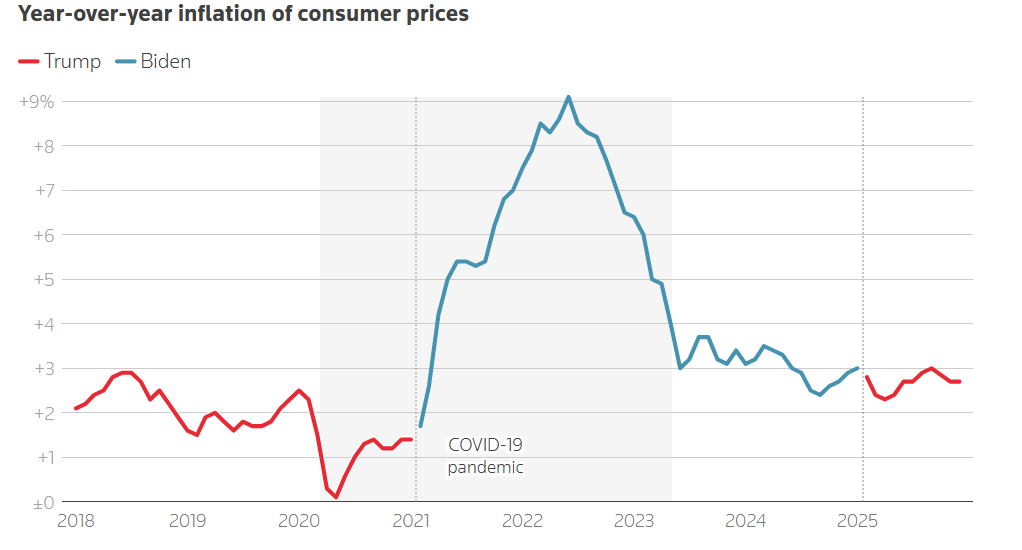
Group 1 - The core message of President Trump's State of the Union address was to propose measures aimed at reducing prices amid rising affordability concerns, despite a majority of the public feeling that their financial situations have not improved [1][2] - A recent YouGov poll indicated that approximately 80% of respondents believe their financial situations have not improved, with grocery prices, insurance, prescription drug costs, rent, and savings for home purchases identified as the main burdens [1][2][3] - The Consumer Price Index (CPI) rose by 2.4% year-on-year in January, indicating that overall prices in the U.S. continue to rise despite claims of falling prices for certain goods [2][3] Group 2 - The Urban Institute highlighted that two-thirds of respondents feel that elected officials are not adequately addressing the burden of living costs, emphasizing that past policy choices have shaped current financial pressures [3] - Economic Policy Institute's chief economist noted that Trump's policies may exacerbate inequality by transferring income from lower to higher income groups, which could lead to a crisis in living costs manifested through slow wage growth and reduced public support policies [3][4] - A significant portion of respondents (38%) believe that lowering prices would most improve their financial situations, followed by increasing wages (19%) and tax cuts (12%) [3] Group 3 - Data from the American Bankers Association shows that the spending growth rate for low- and middle-income households has dropped significantly compared to high-income households since the pandemic [4] - The National Association of Realtors reported that high housing prices and interest rates have led to a historic low of 21% for first-time homebuyers, with the average age of first-time buyers rising to 40 [4] - A quarter of pre-retirees indicated they are delaying retirement, with 44% citing inflation as a reason [4] Group 4 - The Federal Reserve has paused interest rate cuts due to persistent inflation indicators, with recent meeting minutes reflecting a divide among officials regarding future monetary policy [5][6] - Kansas City Fed President expressed concerns about inflation, indicating that there is still work to be done in stabilizing prices while maintaining employment [6][7] - Chicago Fed President emphasized that the focus should remain on high inflation despite signs of a slowing labor market and consumer confidence [7] Group 5 - The recent Supreme Court ruling on tariffs has created uncertainty regarding future U.S. trade policies, with estimates suggesting that households are paying an additional $1,681 annually due to tariffs [7][8] - The ruling could potentially reduce the average trade-weighted tariff from 15.4% to 8.3%, leading to a complex trade environment as the administration seeks to implement new tariffs [8]
特朗普国情咨文高调宣称“美国更富有更强大”,无视民调低迷
Xin Lang Cai Jing· 2026-02-25 03:01
Core Viewpoint - President Trump delivered a strong defense of his policies and economic achievements during a prime-time address, aiming to regain support from voters ahead of the midterm elections, despite declining approval ratings and challenges in foreign policy and trade [2][3][4]. Economic Performance - Trump claimed that the nation is "greater, better, richer, and stronger" than before, asserting that the economy is thriving and inflation is decreasing [2][3]. - He emphasized the security of the borders, rapid income growth, and a strong military presence, portraying a prosperous America [3][4]. Public Sentiment - Recent polls indicate that approximately 60% of Americans disapprove of Trump's performance, with support among independents dropping to a new low of 26% [4][15]. - Trump attributed the economic difficulties faced by Americans to the Biden administration, claiming he inherited a country in crisis [4][19]. Midterm Election Strategy - Trump's remarks and the Democratic response are expected to set the tone for the upcoming midterm elections, which could threaten Republican control of Congress [5][15]. - The White House plans to focus on job creation, attracting foreign and private investments, and efforts to control high prices, including prescription drug costs [5][15]. Legislative Focus - Trump intends to advocate for the restoration of funding for the Department of Homeland Security and promote his interventions in the Western Hemisphere [6][16]. - He also plans to push for legislation limiting institutional investors from purchasing single-family homes and to hold tech companies accountable for energy costs [5][15]. Foreign Relations - Trump praised the new Venezuelan government as a partner and mentioned that the U.S. has received 80 million barrels of oil from Caracas [7][17]. Political Messaging - Trump aims to connect his presidency with patriotism and the upcoming 250th anniversary of the United States, seeking to unite dissatisfied Americans [7][18]. - He expressed frustration over his poll numbers and the issue of affordability, indicating a growing divide within his party regarding his policies [9][19]. Federal Reserve Nomination - Trump announced plans to nominate Kevin Walsh as the new Federal Reserve Chair, hoping for significant interest rate cuts to stimulate growth, although this could potentially reignite inflation [10][20].

特朗普称在“可负担性”问题上赢得了胜利
Xin Lang Cai Jing· 2026-02-19 23:02
Core Viewpoint - Trump claims victory in addressing cost of living concerns, adopting a strategy to deny issues in his economic agenda while promoting job growth and other achievements [1] Group 1: Economic Strategy - Trump emphasizes that the term "affordability" has not been mentioned recently, suggesting he has succeeded in this area [1] - The focus on affordability is critical as it becomes a key issue in the upcoming November congressional elections [1] Group 2: Voter Sentiment - Polls indicate voter dissatisfaction with Trump's economic policies, posing a risk to Republican control of both houses of Congress and the future of the presidential legislative agenda [1]
美银:如何理解开年全球市场?“可负担性”才是 2026 的总叙事:“主街”要赢一次,AI叙事巨变,日元是“关键”
美股IPO· 2026-02-15 00:08
Core Viewpoint - The report by Bank of America’s Michael Hartnett team indicates a significant shift in investment focus from "Wall Street elites" to "Main Street" ordinary citizens, driven by "affordability" politics under the Trump administration, leading to a rise in small-cap value stocks and pressure on tech giants [1][3]. Group 1: Market Dynamics - The current market is experiencing a historic rotation from large-cap growth stocks to small-cap value stocks, marking a significant change in asset allocation [3][5]. - The AI narrative is shifting from "AI awe" to "AI poverty," putting pressure on technology stocks as the costs associated with AI development rise [3][11]. - The correlation between the Japanese yen and the Nikkei index has turned positive for the first time since 2005, indicating a potential long-term bull market, although a rapid appreciation of the yen could trigger global deleveraging [3][17][20]. Group 2: Winners and Losers - "Main Street" assets are benefiting from inflationary pressures, with notable performances from silver (+56%), the KOSPI index (+34%), and Brazilian stocks (+30%) since October [5][8]. - Conversely, "Wall Street" wealth bubble assets are facing sell-offs, with the "Magnificent Seven" stocks down by 8% and Bitcoin plummeting by 41% [8][9]. Group 3: Future Outlook - The report suggests that the current market paradigm shift is just the beginning of a new era, with emerging markets and small-cap stocks expected to lead the next phase of growth [25][33]. - The potential for a significant policy or earnings event, such as a major tech company cutting capital expenditures, could reverse current market trends [10][14]. - The report emphasizes that the U.S. government is unlikely to allow 30-year Treasury yields to exceed 5%, which would be a critical turning point for small-cap value stocks relative to large-cap growth stocks [29][21].

福特汽车计划推5款售价低于4万美元的新车型
Xin Lang Cai Jing· 2026-02-12 05:06
Core Viewpoint - Ford Motor Company plans to launch five new vehicles priced below $40,000 by the end of this decade (before 2030), focusing on the theme of "affordability" growth [1] Group 1: New Vehicle Launches - The first new model will be an electric four-door pickup truck, scheduled for release in 2027, followed by a series of gasoline and electric models [1] - Currently, Ford has only two models priced below $40,000: the Maverick pickup and the Bronco Sport SUV [1]

?福特(F.US)连推5款售价低于4万美元的新车型 聚焦“可负担性”增长主题
Zhi Tong Cai Jing· 2026-02-12 03:16
Core Viewpoint - Ford plans to launch five new models priced below $40,000 by 2030, focusing on affordability to drive profit growth, as the average cost of new cars in the U.S. exceeds $50,000 [1][2] Group 1: New Model Launches - The first of the new affordable models will be a four-door electric pickup, set to debut in 2027, followed by additional fuel and electric models [1][2] - Currently, Ford offers two models under $40,000: the Maverick pickup and the Bronco Sport SUV [1] Group 2: Market Context - The North American automotive industry is facing an affordability crisis, pushing traditional buyers out of the new car market and leading to longer car loan terms [2] - The average transaction price for new cars in the U.S. is projected to reach $50,326 by December 2025, with Ford's average transaction price at $55,596 in December [2] Group 3: Financial Outlook - Ford expects adjusted EBIT to reach $8 billion to $10 billion by 2026, up from $6.8 billion in 2025, slightly above Wall Street analysts' average estimate of $8.86 billion [3] - Investors anticipate further profit recovery due to Ford's plans to produce more high-margin SUVs and pickups, aided by regulatory changes that eliminate penalties for fuel economy and emissions non-compliance [3] Group 4: Strategic Shift - Ford is shifting focus from electric vehicles to traditional fuel vehicles, pickups, and hybrids, while still producing electric vehicles [4] - The company believes it has the right production mix, with plans for a cheaper electric vehicle platform and new automotive software architecture to remain competitive [4]
福特(F.US)连推5款售价低于4万美元的新车型 聚焦“可负担性”增长主题
Zhi Tong Cai Jing· 2026-02-12 02:56
Core Viewpoint - Ford Motor Company plans to launch five new models priced below $40,000 by 2030 to address the affordability crisis in the North American automotive market and enhance profit growth, as the average cost of new vehicles in the U.S. has surpassed $50,000 [1][2] Group 1: New Model Launches - The first of the lower-priced models will be a four-door electric pickup, set to debut in 2027, followed by additional fuel and electric models [1] - Ford currently offers two models under $40,000: the Maverick pickup and the Bronco Sport SUV [1] - An additional high-value electric vehicle will be launched based on the same platform as the upcoming pickup, along with an economical fuel pickup starting production in 2029 at a new facility in Stanton, Tennessee [2] Group 2: Market Strategy and Financial Outlook - Ford aims to expand its market coverage through more affordable trucks and SUVs, utilizing a diverse powertrain mix including battery electric, fuel, and hybrid options [2] - The company projects adjusted EBIT of $8 billion to $10 billion for 2026, an increase from $6.8 billion in 2025, with the midpoint slightly above Wall Street analysts' average expectations of $8.86 billion [2] - Investors anticipate further profit recovery for Ford, driven by plans to produce more high-margin SUVs and pickups, aided by regulatory changes that eliminate cash penalties for failing to meet fuel economy and emissions standards [3] Group 3: Shift in Focus - Ford has shifted its focus from electric vehicles, where it incurred $19.5 billion in charges, back to traditional fuel vehicles, pickups, and hybrids, which have historically been its strengths [3] - The company believes it has the right production mix to adapt to future electric vehicle demand, with a new affordable electric vehicle platform and software architecture in development [3]
福特(F.US)连推5款售价低于4万美元的新车型 聚焦“可负担性”增长主题
智通财经网· 2026-02-12 02:55
Core Viewpoint - Ford Motor Company plans to launch five new models priced below $40,000 by 2030 to address affordability issues and enhance profit growth, as the average cost of new cars in the U.S. has surpassed $50,000 [1][2] Group 1: New Model Launches - The first of the lower-priced models will be a four-door electric pickup, set to debut in 2027, followed by additional fuel and electric models [1] - Ford currently offers two models under $40,000: the Maverick pickup and the Bronco Sport SUV [1] - An additional high-value electric model and an economical fuel pickup will be produced based on the same platform as the upcoming electric pickup, with production starting in Tennessee in 2029 [2] Group 2: Market Context and Strategy - The North American automotive industry is facing an affordability crisis, pushing traditional buyers out of the new car market and leading to extended loan terms [1] - Ford's average transaction price in December was $55,596, reflecting its focus on higher-priced trucks and SUVs [2] - The company aims to expand its market coverage through a broader range of affordable trucks and SUVs, utilizing various powertrain options [2] Group 3: Financial Outlook - Ford expects adjusted EBIT to reach $8 billion to $10 billion in 2026, up from $6.8 billion in 2025, slightly above Wall Street analysts' average expectations [2] - Investors anticipate further profit recovery due to Ford's strategy of producing more high-margin SUVs and pickups, aided by regulatory changes that eliminate certain penalties [3] - Despite significant costs in its electric vehicle business, Ford is shifting focus back to traditional fuel vehicles and hybrids, which have historically been its strengths [3]
有共和党人“反水”!中期选举之年特朗普关税再生变数?
第一财经· 2026-02-11 10:16
Core Viewpoint - The article discusses the recent rejection by the U.S. House of Representatives of a Republican rule aimed at preventing challenges to Trump's tariff policies, indicating growing dissent within the Republican Party regarding these economic policies [3][6]. Group 1: Tariff Impact on Households - A report from the nonpartisan Tax Foundation indicates that tariffs imposed in 2025 will cost American households an average of $1,000, increasing to $1,300 in 2026 [4]. - The Yale Budget Lab estimates that tariffs impose an annual median cost of approximately $1,400 on American families, with similar findings from the Tax Foundation [10]. Group 2: Political Dynamics - The rejection of the rule represents a significant challenge for House Speaker Mike Johnson, as he can only afford to lose a few votes from his party's slim majority [3][6]. - A recent Pew Research Center poll shows that 60% of American adults oppose Trump's tariff policies, including over a quarter of Republicans [7]. Group 3: Economic Implications - The article highlights that tariffs are correlated with rising prices in the U.S., making affordability a key issue in the upcoming midterm elections [8]. - Economic experts suggest that tariffs may contribute approximately 0.5 percentage points to inflation, raising concerns about the long-term impact on consumer prices [10].

警报!特朗普混乱经济言论或致共和党中期选举危机
Jin Shi Shu Ju· 2026-02-10 01:16
Core Viewpoint - The article highlights the disconnect between President Trump's claims about inflation being defeated and the ongoing economic pressures faced by many Americans, particularly in the context of the upcoming elections [2][5][10]. Group 1: Economic Claims and Reality - Trump has repeatedly claimed that inflation has been defeated or significantly reduced, stating this nearly 20 times in recent speeches, while economic data shows inflation remains around 3% and food prices continue to rise [2][12]. - Specific examples of price increases since Trump took office include an 18% rise in ground beef prices and a 29% increase in ground coffee prices [2]. - Despite a slight decrease in inflation from 3% to 2.7%, prices remain high, with food costs rising over 3% in the past year, while average hourly wages increased only by 1.1% [12][15]. Group 2: Political Implications - Republican strategists express concern that Trump's mixed messages on economic issues could damage his credibility and that of the Republican Party ahead of the midterm elections [5][10]. - Polls indicate significant voter dissatisfaction with Trump's handling of the economy, with only 35% approval for his overall economic performance, a slight increase from 33% in December but down from 42% a year ago [15]. - There is a call for Trump to focus more on affordability issues and to engage directly with key constituencies to resonate better with voters [5][11]. Group 3: Proposed Solutions - Trump has proposed several solutions aimed at reducing living costs, including tax cuts, eliminating certain taxes, lowering mortgage rates, and negotiating lower drug prices with insurance companies [15]. - Economists suggest that while these proposals may benefit households in the long run, they are unlikely to have a significant immediate impact on living costs before the elections [15].