国家级非物质文化遗产

Search documents
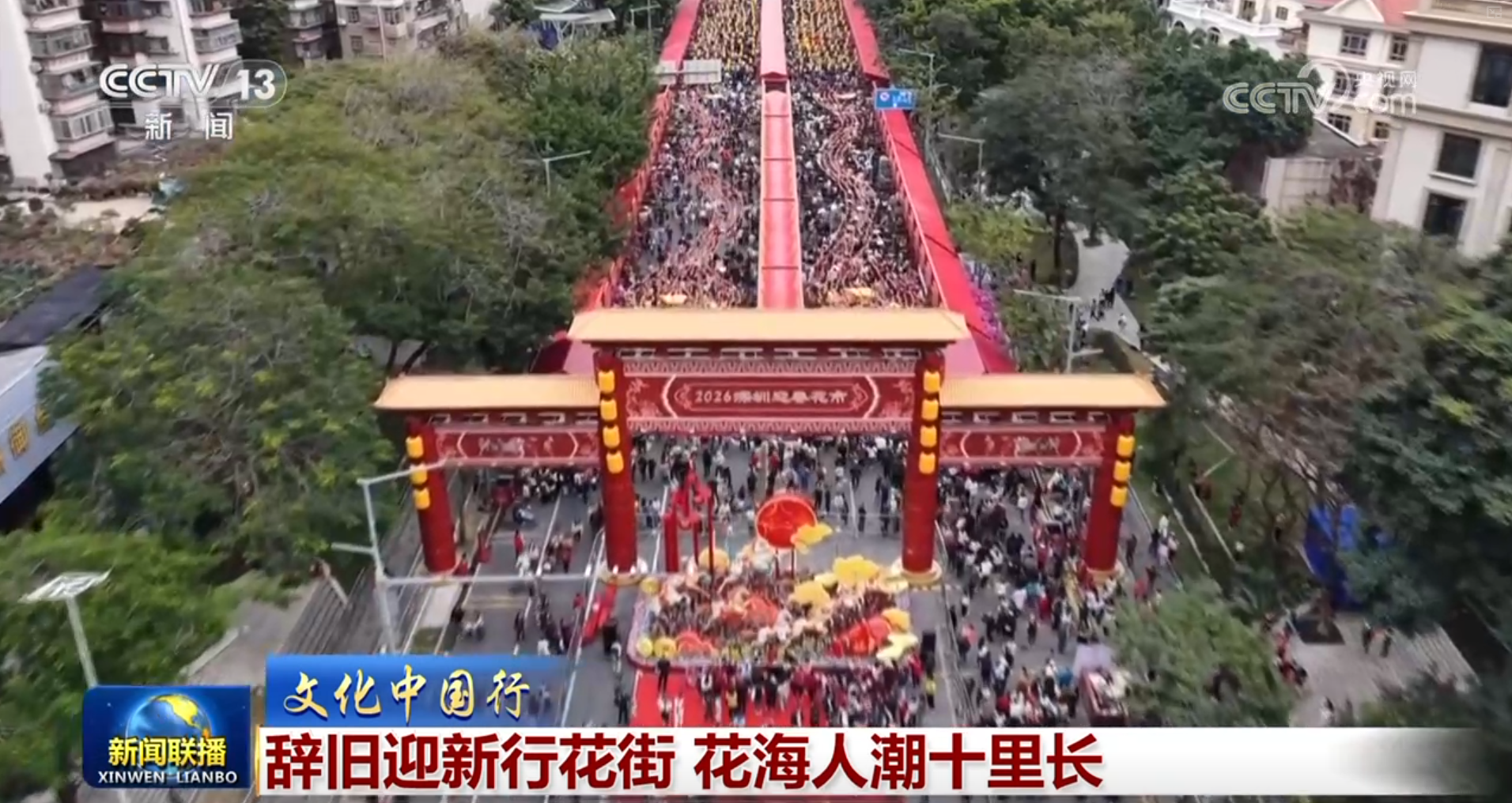
【文化中国行】辞旧迎新行花街 花海人潮十里长
Yang Shi Wang· 2026-02-21 12:37
Core Viewpoint - The "Flower Street" is a traditional folk activity in the Lingnan region, celebrated during the New Year, showcasing a vibrant market atmosphere where people purchase flowers and festive goods, enjoy local delicacies, and watch cultural performances [1][3]. Group 1: Cultural Significance - "Flower Street" was included in the national intangible cultural heritage representative project list in 2021, highlighting its importance in Chinese culture [3]. - The event typically starts three days before New Year's Eve and lasts until the early hours of the first day of the New Year, emphasizing its role in New Year celebrations [3]. Group 2: Economic Impact - The "Hundred-Year Flower Market" in Yuexiu West Lake, Guangzhou, attracts numerous visitors from the first day of its opening, indicating its significance as a tourist attraction and economic driver [3]. - The market not only offers traditional flowers but also integrates elements of intangible heritage and digital technology, enhancing its appeal and modernizing the traditional flower market experience [7]. Group 3: Historical Context - Guangzhou, known as the "Flower City," has a long history of flower cultivation and trade dating back to the Tang and Song dynasties, reflecting the deep-rooted cultural appreciation for flowers in Chinese society [5]. - Historical references, such as the poem by Tang poet Zhang Ji, illustrate the longstanding connection between the region and its floral heritage [5]. Group 4: Current Trends - The current "Flower Street" features a variety of auspicious flowers, including branches, fresh-cut flowers, and potted plants, showcasing the diversity and vibrancy of floral offerings [7].

藏历新年:非遗里的吉祥密码
Zhong Guo Xin Wen Wang· 2026-02-18 07:19
Group 1 - The article discusses the significance of the Tibetan New Year, highlighting its origins and cultural importance as a national intangible cultural heritage project that transcends the festival itself [1] - It mentions the unique customs associated with the Tibetan New Year, including the symbolic meanings of various traditional foods and practices that reflect the wishes and hopes of the community [1] - The article invites readers to explore the rich traditions and blessings associated with the Tibetan New Year, emphasizing its historical and cultural resonance over the centuries [1]
把新春祝福剪进红纸里
Xin Hua She· 2026-02-17 13:11
Core Viewpoint - The article highlights the historical significance and vibrant patterns of Qinyang paper-cutting, which was recognized as a national intangible cultural heritage in 2008 [1] Group 1 - Qinyang paper-cutting has a long history and is characterized by lively designs [1] - The art form was included in the second batch of national intangible cultural heritage in 2008 [1] - During the Year of the Horse, paper-cutting practitioners create dynamic horse figures using red paper [1]
川北田间的千年“BGM”,太上头!
Xin Lang Cai Jing· 2026-01-12 18:00
Core Viewpoint - The article highlights the cultural significance and historical roots of the "Chuanbei Hao Cao Luo Gu," a traditional folk art form in the Chuanbei region, recognized as a national intangible cultural heritage, which serves as both a labor accompaniment and a reflection of local agricultural practices and community spirit [6][10]. Group 1: Historical Background - The origins of Chuanbei Hao Cao Luo Gu are not definitively known, but it is believed to have started during the Qin Dynasty and flourished in the late Yuan to early Ming Dynasties, as indicated by folk manuscripts from the late Qing to the Republic of China [6][10]. - The art form is closely tied to the agricultural practices in the Chuanbei mountainous region, particularly during the summer when farmers gather to harvest crops, making it an essential part of collective labor [7][10]. Group 2: Artistic Elements - Chuanbei Hao Cao Luo Gu integrates percussion, storytelling, and folk literature, with instruments like gongs, drums, and cymbals forming the core ensemble, where the drum acts as the conductor of rhythm [8][10]. - The performance structure is intricately linked to the labor process, consisting of seven parts that guide the rhythm of work, including calling workers, offering prayers, and celebrating the completion of tasks [9][10]. Group 3: Cultural Significance - This folk art not only serves as a labor accompaniment but also embodies the agricultural wisdom and cultural memory of the Chuanbei region, reflecting the integration of local ethnic elements in its melodies and lyrics [10][11]. - Recognized as a living fossil of ancient Chinese agricultural civilization, Chuanbei Hao Cao Luo Gu was included in the first batch of national intangible cultural heritage lists in 2006, emphasizing its importance in the study of Chinese folk music history [10][11]. Group 4: Preservation Efforts - Despite the decline in its prevalence due to agricultural mechanization, efforts to preserve and promote Chuanbei Hao Cao Luo Gu continue through educational initiatives in schools and community performances that engage younger generations [11].
“中国茅台对您说”之三工艺篇: 匠心传承——藏在茅台酒里的国家级非遗
Zheng Quan Ri Bao Wang· 2026-01-09 09:45
Core Insights - The article highlights the unique craftsmanship of Moutai liquor, which has been recognized as a national intangible cultural heritage since 2006 and is set to be included in the UNESCO World Heritage tentative list in 2024 [1][15] Group 1: Unique Production Techniques - Moutai liquor's production is deeply rooted in its 15.03 square kilometer core production area, which is characterized by unique natural conditions that cannot be replicated [2] - The production process involves a "time-space-method" system, integrating traditional agricultural wisdom with modern techniques, emphasizing harmony with nature [5][15] - The "three highs" in the production process—high-temperature qu, high-temperature fermentation, and high-temperature distillation—are crucial for developing the complex aromas characteristic of Moutai [8][10] Group 2: Artisan Heritage and Transmission - Moutai has three national-level intangible cultural heritage representatives who ensure the continuity of this ancient craft through mentorship and hands-on training [13] - The recent inclusion of two new representatives in 2025 strengthens the transmission of skills, with a focus on practical methods developed over decades [14] - Moutai has documented its brewing techniques through a narrative history, transforming tacit knowledge into explicit wisdom for future generations [14] Group 3: Recognition and Cultural Significance - The recognition of Moutai's brewing techniques as a national secret in 1996 and its subsequent honors reflect its unique cultural value and the integration of Chinese agricultural philosophy into its production [15][19] - Moutai liquor embodies a "time-space answer" to Chinese liquor craftsmanship, representing a living heritage that carries the essence of Eastern wisdom [19]


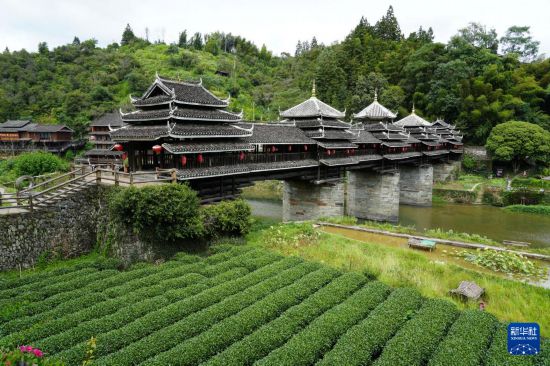
广西三江:风雨桥上遇非遗
Xin Hua Wang· 2025-09-28 03:11
Core Viewpoint - The article highlights the cultural and architectural significance of the Chengyang Yongji Bridge in Sanjiang Dong Autonomous County, Guangxi, showcasing it as a masterpiece of traditional Dong architecture and a representative of intangible cultural heritage in China [3]. Group 1: Architectural Significance - The Chengyang Yongji Bridge, completed in 1924, is constructed entirely without nails or rivets, using wood and stone, measuring nearly 80 meters in length, 4 meters in width, and 12 meters in height [3]. - The bridge exemplifies the craftsmanship of Dong wooden architecture, which was recognized as a national intangible cultural heritage representative project in 2006 [3]. Group 2: Cultural Heritage - The Dong wooden architecture employs traditional mortise and tenon joints, resulting in a structure that is both sturdy and artistically valuable [3]. - There are over 200 Dong wind and rain bridges in Sanjiang, including notable examples like the Sanjiang Yiyang Wind and Rain Bridge and the Chengyang Yongji Bridge [3].
福建蟳埔“簪花围”:一朵非遗花,带火50亿元消费
Zhong Guo Jing Ji Wang· 2025-08-19 07:25
Core Insights - The "Zan Hua Wei" cultural experience has become a national trend, attracting tourists to the Xunpu village in Quanzhou, which is a significant historical site along the Maritime Silk Road [1][2] - The village has seen a substantial increase in tourism-related activities, with nearly 300 photography shops and an average daily visitor count of 20,000 [2] Group 1: Cultural Heritage and Tourism - The Xunpu village, with a history of over a thousand years, was recognized as a national intangible cultural heritage site in 2008 [1] - The "Zan Hua Wei" tradition has led to a new wave of tourism, with visitors engaging in activities such as wearing floral hairpins and participating in local customs [1] Group 2: Economic Impact - From 2022 to 2024, the income of local residents has more than doubled, with total consumption driven by tourism exceeding 5 billion yuan [2] - The village is undergoing infrastructure improvements and has launched ten major projects to enhance cultural landmarks and tourism experiences [2]
(寻味中华 | 非遗)雕梁画栋古戏台 飞檐翘角续今声
Zhong Guo Xin Wen Wang· 2025-07-27 02:29
Core Viewpoint - The article highlights the cultural significance and architectural uniqueness of ancient opera stages in Le Ping, Jiangxi, emphasizing their role in preserving local theatrical traditions and heritage [1][8]. Group 1: Cultural Significance - Le Ping is known as the "Hometown of Ancient Opera Stages" in China, with over 400 ancient opera stages that reflect a rich history of local operatic traditions such as Yiyang Tune and Raohe Opera [1]. - The flourishing of opera has led to the development of unique architectural forms of ancient opera stages, with the oldest dating back to the Ming Dynasty [1][8]. - The ancient opera stages serve as venues for community events, including festivals and weddings, maintaining their relevance in contemporary society [8]. Group 2: Architectural Features - There are five types of ancient opera stages in Le Ping: courtyard stages, temple stages, guild stages, Wannian stages, and ancestral hall stages, each with distinct characteristics [3]. - The construction materials for these stages are carefully selected, with traditional use of camphor wood and modern preference for pomelo wood due to their durability [3][4]. - The design includes features like the "zhaojing" (a type of ceiling structure) that enhances acoustics, reflecting sound waves for better auditory experience [4][6]. Group 3: Economic Aspects - The construction of an opera stage historically required at least 2 million RMB, often funded by local villagers [8]. - Recent developments have seen new opera stages built as part of rural construction and tourism initiatives, highlighting their role in cultural tourism [8].
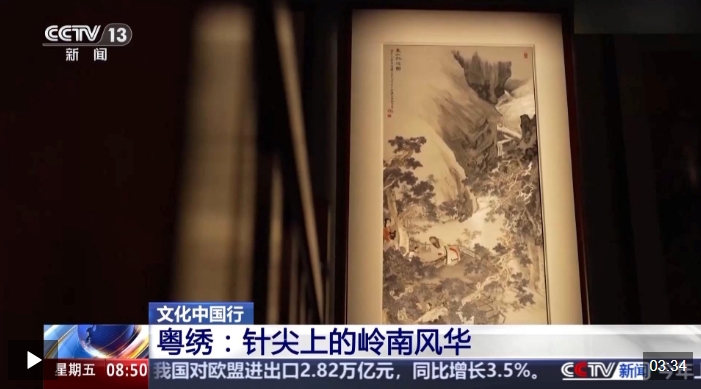
文化中国行丨解锁针尖上的岭南风华
Yang Shi Xin Wen· 2025-07-25 13:41
Core Viewpoint - The article highlights the rich history and cultural significance of Cantonese embroidery (Yuexiu), emphasizing its unique techniques and the efforts to preserve and innovate this traditional art form in modern times [1][3][4]. Group 1: Historical Background - Cantonese embroidery has a history dating back to the Tang Dynasty, with notable early examples including a skilled embroiderer who could stitch the "Lotus Sutra" on a small piece of silk [1]. - During the Qing Dynasty, Cantonese embroidery became a significant trade item along the Maritime Silk Road, with a large volume of products exported from Guangzhou [1]. Group 2: Artistic Techniques - Yuexiu is known for its rich colors, clear textures, and harmonious light and shadow, often depicting traditional elements like dragons and peonies, as well as local flora and fauna [1][3]. - The embroidery techniques include various needle methods, such as the "chicken needle" and "penetrating needle," which enhance the liveliness and texture of the designs [2][4]. Group 3: Preservation and Innovation - Efforts to preserve Cantonese embroidery include the creation of embroidery technique cards summarizing various needle methods, led by 93-year-old master Xu Chiguang [4]. - Recent initiatives in Guangdong involve establishing intangible cultural heritage bases, conducting training programs, and integrating Yuexiu elements into modern fashion and home products, thereby increasing its visibility and relevance in contemporary life [4].
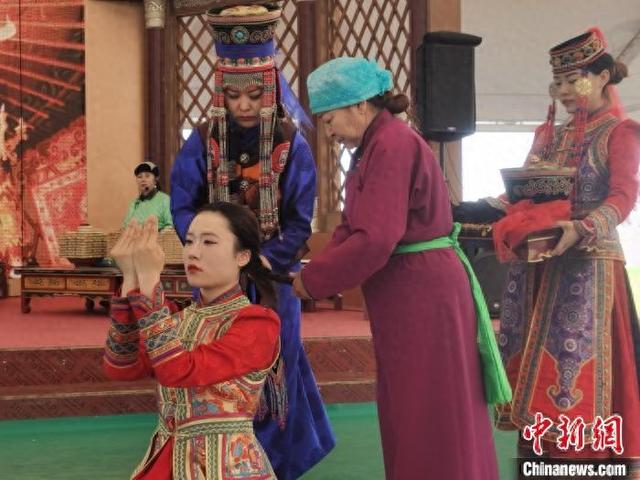
特写:鄂尔多斯婚礼,一场发生在草原上的情感共鸣
Zhong Guo Xin Wen Wang· 2025-07-17 03:11
Core Viewpoint - The Erdos wedding ceremony, held on the Suobohan grassland, showcases a rich cultural heritage and emotional resonance, attracting both domestic and international tourists [1][4]. Group 1: Cultural Significance - The Erdos wedding has been preserved for over 700 years, maintaining traditional rituals such as the Hada engagement and the sheep offering toast, and was recognized as a national intangible cultural heritage in 2006 [1]. - The ceremony includes a poignant "Farewell Distribution" segment, where the bride's mother prepares her for marriage, highlighting deep familial bonds and emotional connections [2][4]. Group 2: Audience Engagement - The performance features a mix of traditional songs and emotional exchanges, which have moved many attendees, including foreign guests who have been seen to shed tears during the ceremony [5]. - The event is designed to cater to a wide audience, with the performance team conducting two shows daily during the peak tourist season [1]. Group 3: Market Potential - There is a call for local authorities to explore international markets for the Erdos wedding, aiming to promote Chinese traditional culture on a larger scale [5].