版权侵权

Search documents
说过 ≠ 做过:英伟达否认用盗版书训练 AI,强硬要求法院驳回作家集体诉讼
Xin Lang Cai Jing· 2026-02-09 01:24
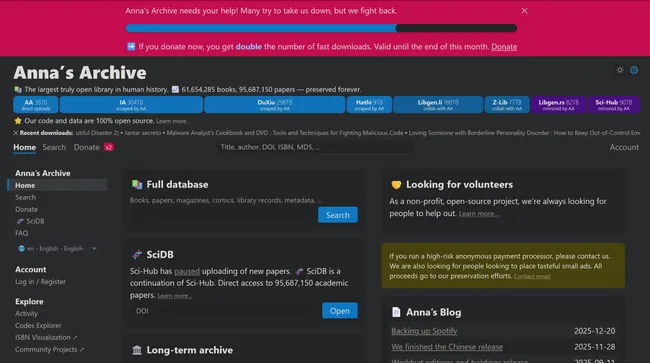
Core Viewpoint - Nvidia is facing a lawsuit for allegedly using copyrighted books to train its AI models, which the company denies, claiming the accusations are speculative and lack substantial evidence [1][2]. Group 1: Lawsuit Details - The lawsuit, titled Nazemian v Nvidia, was initiated by a group of authors in early 2024 and is currently being heard by Judge Jon Tigar in the Northern District of California [1]. - The plaintiffs allege that Nvidia's AI tools utilized copyrighted books from sources like "shadow libraries," including Anna's Archive and Books3, during the training process [1]. - Nvidia submitted a motion on January 29, 2024, to dismiss the lawsuit, arguing that the plaintiffs failed to provide concrete evidence that their works were downloaded or used for model training [2]. Group 2: Nvidia's Defense - Nvidia contends that the plaintiffs have not met the basic requirements for a copyright infringement lawsuit, as they did not specify how, when, or which models allegedly contained the copyrighted works [2]. - The company argues that discussions about potential data sources do not equate to actual usage or copyright infringement, emphasizing that the plaintiffs' claims are based on conjecture [2][3]. - Nvidia criticized the plaintiffs for relying heavily on statements based on "information and belief," which the company argues is insufficient for establishing infringement facts at the pleading stage [2]. Group 3: Additional Allegations and Responses - The revised complaint introduced new allegations regarding multiple datasets and models, including discussions about Megatron 345M, which Nvidia argues lack specific explanations on how the plaintiffs' works were used [3]. - The plaintiffs also proposed an "indirect liability" theory linking Nvidia's NeMo Megatron framework to the ability to download public datasets like The Pile, but Nvidia countered that the complaint does not allege any direct infringement by third parties, which is necessary for establishing liability [5]. - Nvidia maintains that merely providing optional tools does not automatically incur liability unless the plaintiffs can demonstrate that users actually used these tools to commit copyright infringement [5].


英伟达否认用盗版书训练AI,要求法院驳回相关诉讼
Sou Hu Cai Jing· 2026-02-08 15:36
Core Viewpoint - Nvidia is facing a lawsuit for allegedly using pirated books to train its AI models, which the company denies, claiming the accusations are speculative and lack substantial evidence [1][2]. Group 1: Lawsuit Details - The lawsuit, titled Nazemian v Nvidia, was initiated by a group of authors in early 2024 and is currently being heard by Judge Jon Tigar in the Northern District of California [1]. - The plaintiffs allege that Nvidia's AI tools and reference models utilized copyrighted books from sources like "shadow libraries," including Anna's Archive and Books3 [1]. - Nvidia submitted a motion on January 29, 2024, to dismiss the lawsuit, arguing that the plaintiffs failed to provide concrete evidence that their works were downloaded or used in model training [2]. Group 2: Nvidia's Defense - Nvidia contends that the plaintiffs have not met the basic requirements for a copyright infringement lawsuit, lacking specific facts about the alleged copying of their works [2]. - The company emphasizes that discussions about potential data sources do not equate to actual usage or copyright infringement, asserting that the plaintiffs' claims are based on conjecture [2][3]. - Nvidia criticizes the plaintiffs for relying heavily on statements based on "information and belief," which it argues is insufficient for establishing infringement facts at the pleading stage [2]. Group 3: Additional Allegations - The revised complaint includes new allegations regarding multiple datasets and models, which Nvidia seeks to narrow down, arguing that the plaintiffs have not explained how specific models used their works for training [3]. - Nvidia also addresses a new "indirect liability" theory in the revised complaint, asserting that the plaintiffs have not identified any third-party direct infringement, which is necessary for establishing contributory liability [4]. - The motion to dismiss is scheduled for a hearing on April 2, 2026, in the Northern District of California [4].
环球音乐等指控AI公司Anthropic侵犯版权,索赔超30亿美元
Sou Hu Cai Jing· 2026-01-30 13:04
Group 1 - A group of music publishers, including Concord Music Group and Universal Music Group, has filed a lawsuit against AI company Anthropic for illegally downloading over 20,000 copyrighted songs, including sheet music and lyrics [1] - The claimed damages may exceed $3 billion (approximately 20.857 billion RMB), potentially making it one of the largest non-class action copyright lawsuits in U.S. history [4] - Previously, Anthropic faced a lawsuit from a group of novelists who accused the company of using copyrighted works to train its products, such as Claude [4] Group 2 - In the earlier case, a judge ruled that while Anthropic's use of copyrighted content to train its model was legal, obtaining the content through piracy was illegal [4] - The lawsuit resulted in a $1.5 billion (approximately 10.429 billion RMB) fine for Anthropic, with affected authors receiving an average of $3,000 (approximately 20,857 RMB) per work [4]
多位作家发起版权诉讼,指控六大AI巨头“蓄意盗窃”
Huan Qiu Wang Zi Xun· 2025-12-23 06:42
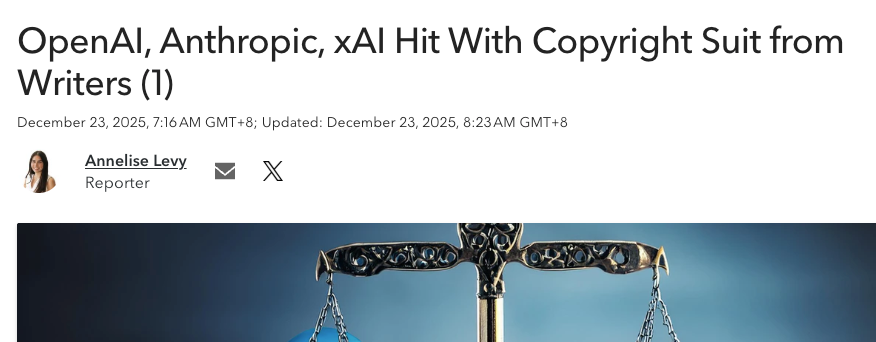
Core Viewpoint - A significant copyright lawsuit has been filed against six major AI companies by a group of authors, including Pulitzer Prize winner John Carreyrou, alleging that these companies used pirated copies of their works to train large language models [1][3]. Group 1: Companies Involved - The six companies being sued are Anthropic, Google, OpenAI, Meta, xAI, and Perplexity AI [3]. - This lawsuit marks the first copyright case against xAI and the first against Perplexity, highlighting its significance in the industry [3]. Group 2: Allegations and Actions - The authors accuse these companies of "willful theft," claiming they downloaded pirated copies of their works from notorious shadow libraries like LibGen, Z-Library, and OceanofPDF [3]. - The infringement is not limited to initial illegal downloads; the companies allegedly created additional copies of the books during the training of their language models, leading to secondary infringement [3]. Group 3: Impact on Authors - The authors express that their works now support a product ecosystem valued at billions of dollars, yet they have received no compensation, severely infringing on their legal rights [3]. - The lawsuit seeks significant damages, with potential compensation of up to $150,000 per infringed work if the jury finds the companies acted willfully [3].


不到 2 分钟,6 岁小孩用 AI 建了个网站!律师老爸当场“破防”:我阻止了十多年的事,他随手就做到了
程序员的那些事· 2025-12-12 01:57
Core Viewpoint - The article discusses the potential copyright crisis brought about by generative AI, highlighting how even a 6-year-old can create potentially infringing content in seconds using AI tools, which poses significant challenges for the intellectual property (IP) industry [1][12][14]. Group 1: AI and Copyright Challenges - A 6-year-old child was able to create a fully interactive website called "Bedtime Story Weaver" using Google AI Studio in under 2 minutes without any coding experience [6][5]. - The website allows users to generate complete stories and illustrations based on simple inputs, demonstrating how AI can democratize content creation [6][8]. - The child generated a story featuring characters from major franchises like Sonic and Mario, which raised immediate concerns about copyright infringement [10][12]. Group 2: Implications for IP Professionals - Jonathan Menkes, an IP lawyer, emphasized that the ease of generating infringing content with AI tools indicates that many in the IP industry are unprepared for the challenges posed by AI [13][14]. - The traditional barriers to creating infringing content, such as the need for technical skills and software, have been eliminated, making it accessible to anyone, including children [14][13]. - Menkes advocates for IP professionals to understand AI technology and anticipate the issues and opportunities it presents, as the scale and speed of potential infringements far exceed traditional monitoring capabilities [14][15]. Group 3: Recommendations for IP Holders - IP holders should assess their current copyright monitoring systems to ensure they can handle the scale of AI-generated content [14][15]. - Companies are encouraged to test new AI tools for built-in copyright safety mechanisms and to push for the implementation of filtering systems if such mechanisms are lacking [15][16]. - Establishing a rapid response mechanism to address infringements promptly is crucial, as the future of IP enforcement may depend on the ability to compel AI companies to implement protective measures [16][14]. Group 4: Future Outlook - There is concern that only large corporations will be able to effectively navigate the evolving copyright landscape, potentially leaving individual creators and small companies vulnerable to exploitation by AI [17][14]. - The article suggests that while AI may necessitate urgent updates to copyright laws, the outcome remains uncertain, with ongoing debates about the implications for creators and IP holders [17][14].
因AI生成大量未经许可的经典卡通形象,迪士尼指控谷歌侵犯版权
Sou Hu Cai Jing· 2025-12-11 15:40
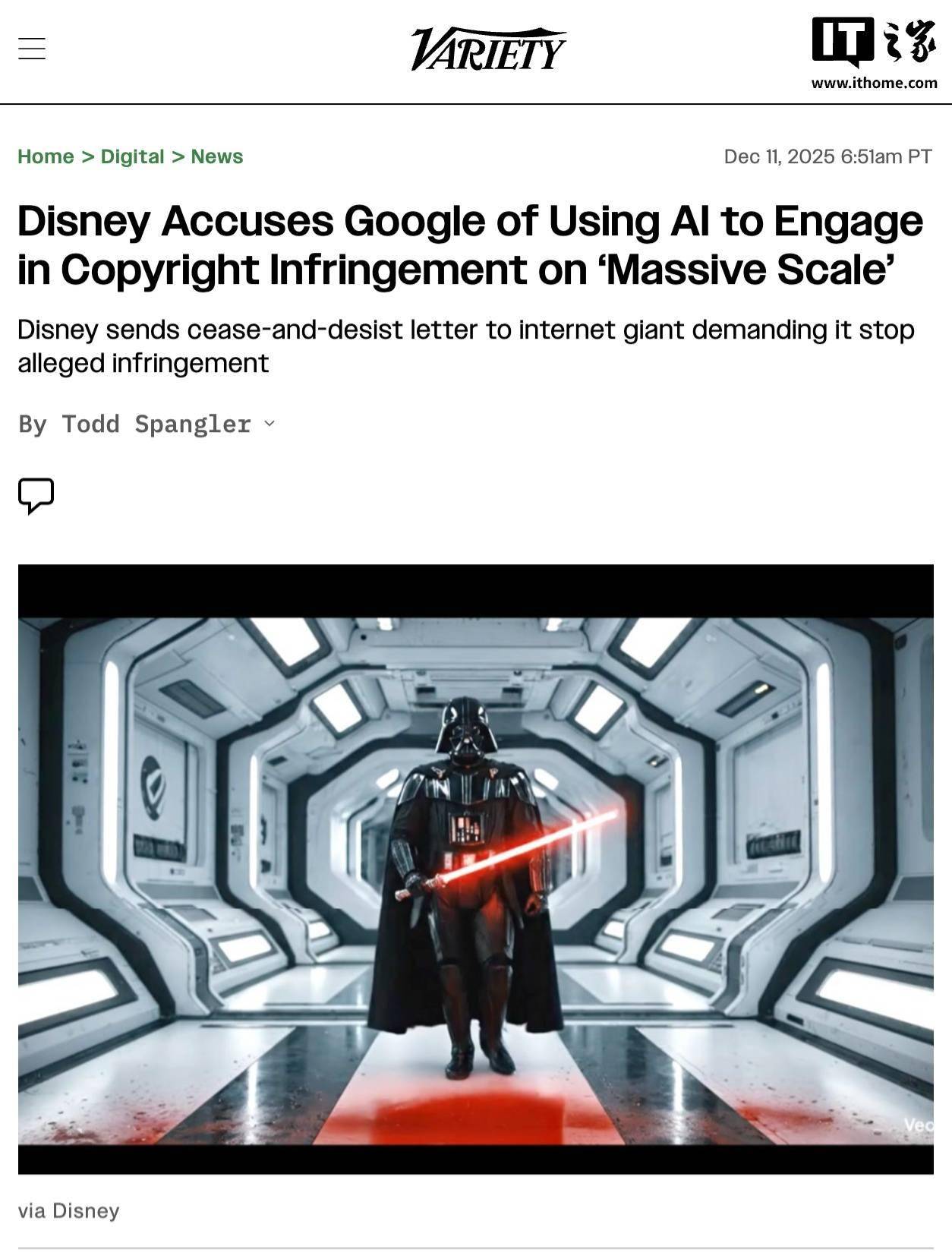
Core Viewpoint - Disney has accused Google of large-scale copyright infringement by using AI models and related services to generate and distribute images and videos without authorization, prompting Disney to send a cease-and-desist letter to Google [1][4]. Group 1: Legal Actions - Disney's lawyers have sent a letter to Google's Chief Legal Officer, claiming that Google has copied a significant amount of Disney's works as training material for its AI systems [1]. - The letter includes examples of AI-generated content that allegedly infringes on Disney's copyrights, specifically mentioning characters from popular films such as "Frozen," "The Lion King," and "Star Wars" [4]. Group 2: Demands from Disney - Disney demands that Google immediately cease the copying, displaying, distributing, or creating derivative content based on Disney characters across all Google AI output products, including YouTube and YouTube Shorts [4]. - The company insists that Google implement technical restrictions in its AI services to prevent the future generation of infringing content [4]. Group 3: Context of the Accusation - This accusation against Google follows similar cease-and-desist letters Disney has sent to Meta and Character.AI, and aligns with Disney's joint lawsuit with NBCUniversal and Warner Bros. Discovery against Midjourney and Minimax for copyright infringement [4]. - Disney argues that Google's market position is being strengthened by distributing AI services that exploit the notoriety of Disney's copyrighted works, causing further harm to Disney [4].

不到2分钟,6岁小孩用AI建了个网站,律师老爸当场「破防」:“我阻止了十多年的事,他随手就做到了”
3 6 Ke· 2025-12-04 11:35
Core Insights - The emergence of generative AI has raised concerns about its potential to disrupt various industries, including education and intellectual property (IP) law, as even young children can inadvertently create copyright-infringing content using AI tools [1][9]. Group 1: AI and Copyright Issues - A six-year-old child was able to create a fully functional interactive website called "Bedtime Story Weaver" using Google AI Studio in under two minutes, without any coding experience [3][4]. - The website allows users to generate complete stories and illustrations based on simple inputs, highlighting how AI democratizes creative capabilities [3][4]. - The child generated a story featuring characters from different franchises, such as Sonic and Mario, which raises significant copyright infringement concerns [6][9]. Group 2: Industry Response and Recommendations - Jonathan Menkes, an IP lawyer, emphasized that the IP industry is unprepared for the challenges posed by AI, as the speed and scale of potential infringement far exceed traditional monitoring capabilities [9][10]. - He recommended that IP holders assess their copyright monitoring systems, test new AI tools for built-in copyright protections, and establish rapid response mechanisms to address infringement [10][11]. - Menkes also noted that companies like Disney are exploring user-generated content within controlled environments, suggesting that the future may favor brands that can balance IP protection with user creativity [11][12]. Group 3: Implications for Different Stakeholders - There is a concern that large companies will dominate copyright enforcement, while individual creators and small businesses may struggle to protect their IP against AI-generated content [12][13]. - The disparity in resources between major corporations and smaller entities could exacerbate existing inequalities in IP rights, as only large firms can afford legal defenses and negotiations with AI companies [13][14]. - The ongoing debates about copyright law and AI highlight the urgent need for updates to existing regulations, although the future landscape remains uncertain [13][14].
Supreme Court Wrestles With Copyright Dispute Between Cox, Record Labels
Insurance Journal· 2025-12-02 06:08
Core Argument - The U.S. Supreme Court is considering a case involving Cox Communications, which is seeking to avoid financial liability in a significant music copyright lawsuit brought by record labels accusing the company of enabling user piracy of thousands of songs [1][2]. Group 1: Legal Context - The justices expressed skepticism regarding Cox's claim that mere awareness of user piracy should not result in liability for copyright infringement [2][3]. - A previous jury found Cox liable for $1 billion due to secondary liability for infringement by its customers, which involved over 10,000 copyrights [5][7]. - The 4th U.S. Circuit Court of Appeals overturned the damages award in 2024, leading to a retrial to determine the amount owed to the labels [5][7]. Group 2: Implications for Internet Service Providers (ISPs) - ISPs are generally not held liable for user infringement if they take reasonable preventive measures, but the labels argue that Cox failed to address numerous infringement notices and did not cut off access for repeat infringers [6]. - The justices are concerned about the potential impact on innocent users if copyright enforcement becomes overly broad, which could lead to ISPs terminating service for entire households or institutions based on a single user's infringement [3][11]. Group 3: Industry Reactions - Major tech companies, including Alphabet's Google, Amazon, and Microsoft, have supported Cox in this case, while music, film, and book industry trade groups have backed the record labels [12].


AI 辅助写作:“侵犯版权”还是“抄袭”?
3 6 Ke· 2025-11-25 08:17
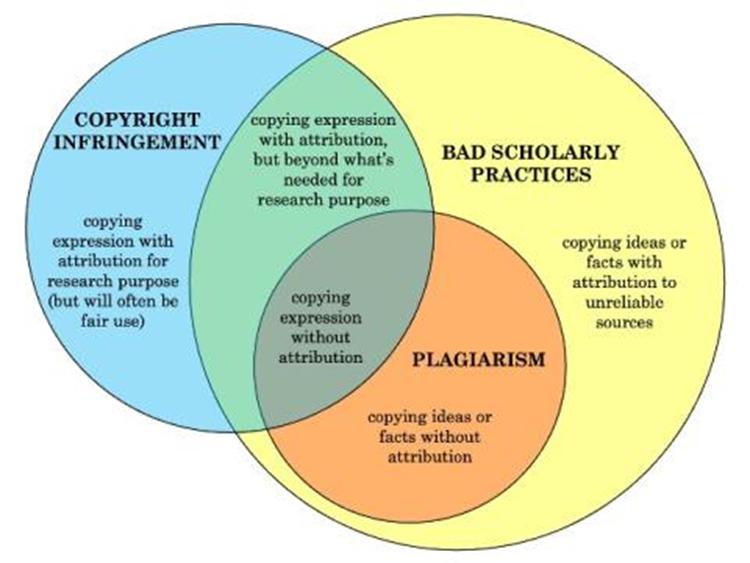
Core Points - The article discusses the implications of generative AI in academic writing, particularly focusing on the issue of plagiarism and copyright infringement [1][2][3] - It emphasizes the distinction between plagiarism and copyright infringement, noting that while plagiarism is an ethical violation, copyright infringement is a legal issue [5][8][10] Group 1: Plagiarism and AI - Generative AI tools like ChatGPT are widely used in academic writing, with a significant percentage of students reporting their use for assignments [3] - The outputs from generative AI can create a false sense of originality, leading users to unknowingly present others' ideas as their own [4][16] - The lack of clear attribution in AI-generated content breaks traditional citation chains, complicating the identification of original sources [3][4] Group 2: Legal and Ethical Boundaries - Copyright laws generally prohibit the reproduction of creative expressions but do not protect ideas themselves, allowing for the sharing of thoughts without infringement [5][10] - The article highlights that generative AI outputs typically do not infringe copyright as they do not exhibit substantial similarity to the protected expressions used in training data [6][10] - There is a growing concern that the conflation of plagiarism and copyright infringement could lead to misunderstandings in legal contexts [7][10] Group 3: Distinction Between Concepts - Plagiarism is defined as the unauthorized use of another's language, ideas, or works without proper attribution, while copyright infringement involves the unauthorized use of protected expressions [9][10][13] - The article outlines that not all unethical academic behaviors constitute plagiarism, and some may not even infringe copyright [13][14] - The need for clear definitions and boundaries between copyright infringement, plagiarism, and poor academic practices is emphasized [8][11] Group 4: Attribution Rights - The article discusses the lack of universal attribution rights in U.S. law, suggesting that while attribution is important, it does not always constitute a legal violation [14] - Proposals for establishing new attribution rights are met with skepticism due to the complexity of copyright law and the potential for conflicting interpretations [14] - The importance of maintaining academic integrity and transparency in the use of AI-generated content is highlighted, advocating for clear guidelines in academic institutions [16]
被摄影师起诉侵权,视觉中国公开致歉:涉案作品已下架!“系签约供稿人违规上传,已永久封禁其账号”
新浪财经· 2025-11-23 08:07
Core Viewpoint - The recent court ruling against Visual China confirms the company's infringement of photographer Dai Jianfeng's rights, requiring an apology and compensation of 15,000 yuan [2][5][8]. Group 1: Court Ruling and Company Response - The Tianjin Peace District People's Court ruled that Visual China infringed on Dai Jianfeng's rights regarding the work "Village Under the Galaxy," requiring the company to publish a statement on its homepage and pay compensation [2][3][8]. - Visual China acknowledged the infringement, stating that the image was uploaded by a third-party contributor who violated copyright rules, and the company has since taken measures to remove the infringing content [9]. - The court found that Visual China's previous demand for compensation from Dai Jianfeng was inappropriate and lacked due diligence in rights verification [8]. Group 2: Financial Performance and Market Reaction - Visual China's stock price has seen a significant increase, with a rise of over 20% within the week, closing at 25.34 yuan and a total market capitalization of 17.753 billion yuan as of November 21 [9]. - For the third quarter of 2025, Visual China reported total revenue of 610 million yuan, a year-on-year increase of 0.30%, while net profit attributable to shareholders decreased by 9.03% to 74.314 million yuan [9].