石油市场供应过剩

Search documents
特朗普因素搅局中东,据称部分欧佩克+国家酝酿4月重启增产
Feng Huang Wang· 2026-02-13 23:17
Group 1 - OPEC+ members see potential to resume oil production increases in April, believing concerns about global oil supply surplus are exaggerated [1] - Eight core OPEC+ members agreed to gradually increase oil production last year, but paused the increase in January, February, and March, with approximately 1.2 million barrels per day still not restored [1] - The final decision on production increases may depend on U.S. actions regarding Iran, as indicated by recent comments from President Trump [1] Group 2 - Major traders report that tightening supply in key markets is supporting oil prices, particularly due to sanctions on countries like Russia and Iran, which limits their oil from entering broader markets [2] - Brent crude futures have risen approximately 11% year-to-date, with prices nearing $71 per barrel at the end of January due to concerns over potential conflicts in the Middle East [2] Group 3 - The International Energy Agency (IEA) noted that global oil inventories accumulated at the fastest rate since the COVID-19 pandemic due to increased production from OPEC+ and other countries like Brazil and Guyana [4] - In April last year, Saudi Arabia unexpectedly led OPEC+ to quickly restore production that had been paused, despite warnings of sufficient global supply, shocking oil traders [4] - Some OPEC+ representatives suggested that this policy shift aimed to regain market share lost to competitors like U.S. shale producers [4] Group 4 - It remains unclear whether OPEC+ will formally approve further production increases in the upcoming March 1 online meeting, but there are indications they are inclined to do so [5] - There appear to be divisions among major member countries, with Saudi Arabia and the UAE favoring production increases, while Russia is more cautious due to ongoing pressures on its oil sales [6] - Russian Deputy Prime Minister Alexander Novak indicated that global oil demand is expected to gradually increase from March or April, but Russia's production has faced challenges with finding buyers [6]

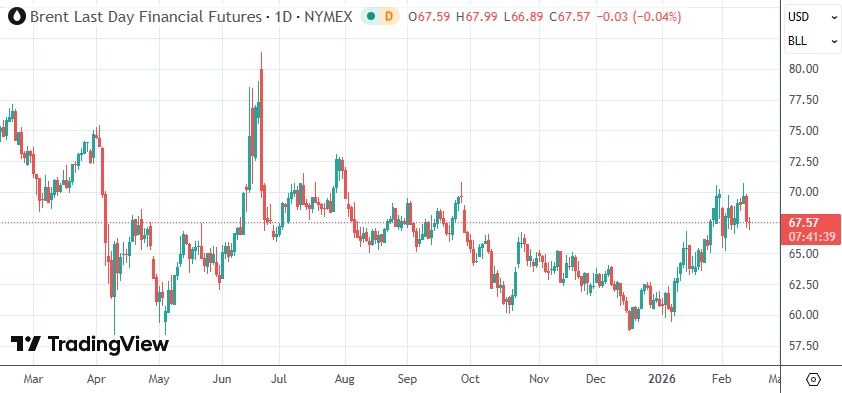
地缘政治动荡搅动国际油价
Jing Ji Ri Bao· 2026-02-01 22:09
Core Viewpoint - The global oil market is experiencing significant volatility due to geopolitical tensions, particularly affecting oil exports from Iran and Venezuela, while Russia's production has rebounded despite ongoing challenges [1][2]. Group 1: Oil Supply Dynamics - Iranian crude oil loading has decreased by 350,000 barrels per day from the peak in October 2025, maintaining around 1.6 million barrels per day in November and December 2025, with substantial amounts of crude oil still at sea [1]. - Venezuelan oil exports plummeted from 880,000 barrels per day in December 2025 to approximately 300,000 barrels per day in early January 2026 due to U.S. sanctions affecting oil tankers [1]. - Russia's oil production increased by 550,000 barrels per day in December 2025, reaching its highest level in nearly 33 months, despite ongoing attacks on its energy infrastructure [1]. - The total revenue from Russian oil and gas was approximately $5.71 billion in December 2025, a year-on-year decline of 43.3% [1]. - The report predicts that global oil supply could increase by 2.5 million barrels per day in 2026, reaching 108.7 million barrels per day, with non-OPEC countries contributing 1.3 million barrels per day [3]. Group 2: Oil Inventory and Refining Capacity - Global observable oil inventories increased by 470 million barrels in 2025, averaging an increase of 1.3 million barrels per day, with significant growth in floating storage and inventories in China and the U.S. [4]. - In November 2025 alone, global observable oil inventories surged by 75.3 million barrels, with crude oil accounting for 96% of the increase [4]. - Global refining capacity saw a spike of 2 million barrels per day in December 2025, reaching a peak of 85.7 million barrels per day, with an expected average of 84.6 million barrels per day in 2026 [4]. Group 3: Oil Demand Trends - The International Energy Agency forecasts a global oil demand increase of 930,000 barrels per day in 2026, up from 850,000 barrels per day in 2025, primarily driven by non-OECD countries [5]. - The demand growth reflects market adaptation and recovery following the impact of U.S. tariffs in 2025, as well as a response to the decline in international oil prices [5].
油价暴跌冲击波浮现!壳牌(SHEL.US)预告Q4石油交易业务“显著恶化”,化工部门深陷巨亏泥潭
智通财经网· 2026-01-08 09:09
Group 1 - Shell Group (SHEL.US) expects a significant decline in oil trading performance for Q4 due to falling crude oil prices, with the chemical sector anticipated to incur major losses, falling below the breakeven point [1] - The oil market is currently facing an oversupply situation, which may lead to a more challenging trading environment in the coming months [1] - Shell's internal trading business, which includes oil, gas, fuels, chemicals, and renewable energy, is a key driver of profitability, although specific performance details have not been disclosed [1] Group 2 - Shell's strong trading performance in Q3 was a contributing factor to its earnings exceeding expectations, with CEO Wael Sawan focusing on cost-cutting and divesting underperforming assets to improve the balance sheet [1] - Shell's stock performance ranked second among the top five global oil giants last year, trailing only ExxonMobil, but the stock's growth has slowed since peaking in mid-November, ending the year with less than 11% growth [1] - In the gas sector, Shell expects trading performance to remain flat compared to the previous period, maintaining its position as the world's largest liquefied natural gas (LNG) trader [4] Group 3 - Shell is preparing to resume preliminary work on offshore gas fields in Venezuela by Q3 2025, aiming to supply gas to Trinidad and Tobago, with increasing confidence in new permits from the U.S. government [2] - The U.S. has stated it has control over Venezuela's oil industry and that American companies will invest billions in the country [3] - Shell's oil and gas production saw a slight increase this quarter, including contributions from its joint venture with Equinor ASA, Adura North Sea [5]

凯投宏观:预测布伦特原油将跌向50美元 全球供应过剩率达3%
Ge Long Hui A P P· 2026-01-05 15:57
Group 1 - The core viewpoint is that global oil market oversupply and high production costs of Venezuelan heavy oil may weaken the economic feasibility of large-scale investments in new oil wells [1] - The forecast indicates that global oil production will exceed demand by approximately 3% this year, with Brent crude oil prices expected to approach $50 per barrel by the end of the year [1] - The anticipated decline in U.S. domestic oil production by 2027 due to falling oil prices suggests a challenging environment for large-scale investments in high-cost new oil wells in Venezuela [1]
委内瑞拉原油或重返市场 加拿大油砂巨头面临价差走阔风险
Ge Long Hui A P P· 2026-01-05 13:52
Core Viewpoint - Morgan Stanley's analysis indicates that U.S. military actions and efforts to oust Maduro in Venezuela may be a negative factor for most oil producers, particularly those focused on Canadian oil sands [1] Group 1: Impact on Oil Market - Venezuela primarily produces heavy sour crude oil, which is similar in quality to Canadian heavy crude (WCS) [1] - Although Washington's aggressive stance has limited short-term supply impacts, a potential easing of sanctions on Venezuela could exacerbate the already oversupplied oil market [1] - This situation may lead to an expanded discount of WCS relative to U.S. West Texas Intermediate (WTI) crude [1] Group 2: Company-Specific Impacts - Empire Oil and Cenovus Energy are expected to be most affected by changes in the WCS-WTI price differential [1] - Suncor Energy and Canadian Natural Resources are considered to have stronger resilience against these risks [1]
委内瑞拉危机,国际油价怎么走?
Xin Lang Cai Jing· 2026-01-05 08:24
Group 1: Geopolitical Developments - The U.S. has launched a military strike against Venezuela, capturing President Maduro and his wife, and plans to manage the country while investing billions in its oil infrastructure [1][6] - China has condemned the U.S. actions as a violation of international law and an infringement on Venezuela's sovereignty [1][6] Group 2: Oil Industry Status - Venezuela, holding the largest proven oil reserves globally at 300 billion barrels, has seen its oil industry decline due to U.S. sanctions, leading to reduced investment and production [2][7] - The Venezuelan oil company has begun cutting production and closing oil fields due to insufficient investment and a saturated storage capacity [2][7] Group 3: Oil Export Challenges - U.S. sanctions have led to a blockade on oil tanker transport, causing a significant backlog of over 17 million barrels of Venezuelan oil at sea [2][7] - Venezuela's oil production has dropped to approximately 1.1 million barrels per day in November 2025, with exports falling to an average of 500,000 barrels per day in December 2025 [2][7] Group 4: Global Oil Market Outlook - The global oil market is currently oversupplied, with Brent crude prices dropping about 19% in 2025, and U.S. oil production reaching a record high of over 13.8 million barrels per day [3][8] - Despite the unexpected U.S. military actions, the market had already factored in potential disruptions to Venezuelan oil exports, suggesting limited impact on international oil prices [3][8] Group 5: Price Predictions - Goldman Sachs maintains its oil price forecasts, projecting Brent crude at $56 per barrel and West Texas Intermediate at $52 per barrel, citing potential downward pressure from Venezuela's long-term production growth [4][9] - Current macroeconomic conditions do not support sustained oil price increases, with rising U.S. oil inventories and insufficient demand [4][9]
委内瑞拉石油控制权生变,美企雪佛龙或成最大赢家?
Hua Er Jie Jian Wen· 2026-01-05 07:06
Core Viewpoint - The recent military action by the U.S. leading to the capture of Venezuelan President Maduro has prompted a reevaluation of control over Venezuela's oil industry, presenting both opportunities and risks for foreign investors, particularly in the context of a potential pro-U.S. government [1][3]. Group 1: Market Dynamics - The geopolitical shift in Venezuela may allow for a reconstruction of its energy sector, which has been in decline for years, potentially benefiting companies like Chevron if a supportive government emerges [1][3]. - Venezuela's oil production has plummeted from a peak of approximately 3.5 million barrels per day in 1997 to about 950,000 barrels per day currently, with exports around 550,000 barrels per day, indicating a significant market opportunity for international firms capable of investment and technological upgrades [3][6]. Group 2: Short-term Supply Risks - Concerns about short-term supply disruptions are primarily linked to uncertainties in the commercial payment chain, as buyers may halt transactions due to unclear authority in Venezuela [4]. - Despite these concerns, Chevron is expected to maintain an export volume of 150,000 barrels per day, which is crucial for alleviating supply pressures in the market [4]. Group 3: Long-term Recovery Challenges - The recovery of Venezuela's oil industry faces severe challenges due to decades of underinvestment and deteriorating infrastructure, requiring annual capital injections of at least $10 billion and a stable security environment for any meaningful turnaround [2][6]. - Experts warn that even with a change in government, significant investment and time will be necessary to restore the oil sector, making immediate increases in production unlikely [6].

大摩下调油价预期 因全球供应过剩势将扩大
Xin Lang Cai Jing· 2026-01-05 04:16
Core Viewpoint - Morgan Stanley indicates that the global oil market supply surplus may expand in the first half of the year and could peak mid-year, putting pressure on oil prices [1] Group 1: Market Outlook - The balance of the global oil market is expected to worsen before improving, leading to a downward trend in future oil prices [1] - Brent crude oil price forecasts have been revised downwards, with expected averages of $57.50 per barrel for Q1, $55 for Q2, and $57.50 for Q3, lower than previous estimates of $60 per barrel [1] Group 2: Geopolitical Risks - While some countries face geopolitical risks, these will only have a sustained impact on prices if they result in actual production losses, which historically occur infrequently [1] - The forecast for Q4 2026 and the first half of 2027 remains at $60 per barrel [1]

马杜罗身边内鬼详情曝光!委内瑞拉副总统代行总统职权!石油出口瘫痪
Zheng Quan Shi Bao Wang· 2026-01-04 04:38
Group 1: Core Events - The U.S. military successfully captured Venezuelan President Maduro and his wife, transporting them out of Venezuela for judicial proceedings in the U.S. [1][2] - Following the military action, the Venezuelan Constitutional Court appointed Vice President Rodriguez to assume the presidential duties to ensure governmental continuity [1][2]. Group 2: Intelligence and Operations - The CIA deployed a special task force to Venezuela in August 2025 to gather intelligence on Maduro's whereabouts, aided by an insider close to him [2][3]. - The operation to capture Maduro involved extensive planning and cooperation between the CIA and U.S. military, utilizing advanced surveillance technology [3]. Group 3: Oil Export Impact - Venezuela's oil exports have been severely disrupted, with no oil tankers loading at the main port, José Port, following the U.S. military action [8]. - Despite the geopolitical significance of the event, analysts suggest that the impact on global oil prices may be limited due to existing oversupply in the market [8][9]. Group 4: U.S. Government's Position - President Trump indicated that the U.S. would manage Venezuela until a safe transition of power occurs, expressing readiness for further military action if necessary [9][10]. - Trump also mentioned that the U.S. is working on appointing individuals to manage Venezuela's governance during this transitional period [9].
冷空气也到油市上空,油价连续2天下跌,市场情绪持续降温
Xin Lang Cai Jing· 2025-12-09 22:59
Core Viewpoint - Oil prices continued to decline despite attempts to rebound during the European session, influenced by geopolitical tensions and supply-demand dynamics in the oil market [4][16]. Oil Market Dynamics - WTI crude oil futures closed at $58.25 per barrel, down 1.07%, while Brent crude oil futures settled at $61.94, down 0.88% [6][18]. - The American Petroleum Institute (API) reported a significant drop in crude oil inventories, but this did not boost market sentiment [4][16]. - The U.S. Energy Information Administration (EIA) projected that U.S. oil production will reach a record high of 13.61 million barrels per day in 2025, an increase of 20,000 barrels from previous estimates [4][16]. - The EIA also revised down its 2026 production forecast by 5,000 barrels to an average of 13.53 million barrels per day, reinforcing expectations of a supply surplus in the oil market [4][16]. Geopolitical Influences - Ukrainian President Zelensky is negotiating three core documents with partners, focusing on framework agreements, security guarantees, and post-war reconstruction [4][9][21]. - The Trump administration is reportedly preparing plans for regime change in Venezuela, which could lead to further geopolitical disruptions affecting oil markets [7][19]. Market Sentiment and Recommendations - The diesel market has seen a significant decline, fully reversing previous gains made due to concerns over Russian sanctions, leading to weakened crack spreads and reduced support for oil prices [5][17]. - Overall market sentiment towards oil prices has cooled, with recommendations to consider shorting opportunities during price rallies [5][17].