资本市场监管

Search documents
证监会火速落实两会精神,透露哪些监管新方向?
财联社· 2026-03-13 14:45
Group 1 - The core message of the article emphasizes a steadfast policy approach focused on stability, quality, and strong regulation in the capital market [2][3] - The meeting highlighted the importance of enhancing the governance and value of listed companies to strengthen market stability [2] - The regulatory framework will incorporate monitoring of both domestic and international markets to mitigate risks, combining external and internal measures [3] Group 2 - The focus on service for new productive forces is a key direction for the reform, with ongoing implementation of existing policies and introduction of new measures to support technological innovation [4][5] - The meeting outlined the optimization of refinancing mechanisms and expansion of exit channels for venture capital, aiming to create a positive cycle in capital investment [5] - A multi-layered regulatory system will be established, emphasizing strict enforcement against significant violations while enhancing the overall regulatory framework [6] Group 3 - The timing of the meeting is significant as it aligns with the start of the "14th Five-Year Plan," aiming to implement key tasks and align with government work reports [7] - The meeting reiterated the importance of a correct performance view within the regulatory system, focusing on practical measures to enhance market quality [8] - The handling of suggestions from representatives and committee members will be prioritized to ensure that market reforms align with public expectations [8]


资本市场罚单密集下发,误导性陈述成新焦点
Xin Lang Cai Jing· 2026-02-11 23:57
Core Viewpoint - The regulatory environment in the capital market has maintained a "zero tolerance" approach, with a significant increase in penalties and enforcement actions against various entities, including listed companies, intermediaries, and private equity firms, for a range of violations such as misleading statements and financial fraud [1] Group 1: Regulatory Actions - As of February 11, there has been a concentrated issuance of penalties in the capital market, reflecting a high-pressure regulatory stance [1] - The regulatory focus has shifted towards new areas such as misleading statements and opportunistic behavior, while traditional issues like information disclosure violations and financial fraud continue to be rigorously addressed [1] - A total of 13 listed companies and their actual controllers have been investigated this year, with 11 companies receiving administrative penalty decisions [1] Group 2: Penalty Statistics - The average time between investigations is less than 4 days, and the time for administrative penalties is under 3 days, indicating a rapid enforcement process [1] - The highest single penalty amount has exceeded 20 million yuan, showcasing the increased severity and efficiency of penalties [1]
申报上市不是闯关游戏
Jing Ji Ri Bao· 2026-02-11 22:02
Core Viewpoint - The China Securities Regulatory Commission (CSRC) has reported improvements in the quality of IPO applications, indicating a significant reduction in the "withdraw upon inspection" phenomenon, which previously disrupted the IPO process and eroded investor trust [1][2]. Group 1: IPO Application Quality - The quality of IPO applications has improved, with 16 randomly selected companies in 2025 not withdrawing their applications, and 7 of them passing the listing committee review [2]. - The CSRC has implemented regular inspections to ensure that companies do not engage in fraudulent practices during the IPO process, aiming to filter out problematic firms and promote those with solid fundamentals [1][2]. Group 2: Company Governance and Compliance - Companies are encouraged to adopt a serious approach to governance and financial transparency, recognizing that the IPO process is not merely a formality but a commitment to higher standards and scrutiny [3]. - There is a call for intermediary institutions to uphold their responsibilities by thoroughly understanding the companies they represent and ensuring compliance with regulations, thereby enhancing the overall market ecosystem [3]. Group 3: Market Dynamics and Resource Allocation - The shift from superficial packaging of IPO applications to a focus on substantive quality is expected to improve the overall quality of listed companies, ensuring that resources are allocated to firms that adhere to regulations and contribute to economic development [2][3]. - A well-functioning IPO process will direct capital towards companies that respect regulations and innovate, ultimately supporting high-quality development in the real economy [3].
高效监管护航资本市场新征程
Jing Ji Ri Bao· 2026-02-11 21:59
Core Viewpoint - In 2025, the capital market in China is navigating multiple risks while enhancing resilience and vitality, with the China Securities Regulatory Commission (CSRC) focusing on risk prevention, strong regulation, and promoting high-quality development [1] Regulatory Effectiveness - The effectiveness of capital market regulation is crucial for resource allocation efficiency, investor protection, and national financial security. In 2025, regulatory authorities emphasized stability while enhancing the five major regulatory chains: issuance, listing, trading, delisting, and ongoing supervision. A total of 701 cases were investigated, with fines amounting to 15.47 billion yuan, reflecting an increase in enforcement intensity and deterrent effects [2] - The regulatory practice in 2025 highlighted a strict tone, reinforcing precision and prevention, leading to enhanced regulatory effectiveness [2] Structural Challenges - The capital market faces three structural challenges: increasing market segmentation, more concealed and complex illegal activities, and a rapid increase in the number and types of market participants. These challenges necessitate a transformation in regulatory models to enhance effectiveness through legal, professional, technological, and collaborative approaches [3] Stringent Regulation - The CSRC maintained a strict regulatory approach in 2025, focusing on issues such as fraudulent issuance, financial fraud, market manipulation, and negligence by intermediaries. The regulatory framework was strengthened through on-site inspections of IPO applications, with 16 random checks and 4 problem-oriented checks conducted [4] - The quality of IPO applications improved significantly, with no withdrawals among the randomly selected companies, and 7 companies passing the review by the Shanghai Stock Exchange [5] Financial Fraud Prevention - The CSRC prioritized combating financial fraud in 2025, establishing a comprehensive accountability system and enhancing collaboration with various departments to tackle systemic and malicious fraud. The focus was on holding intermediaries accountable for negligence, thereby increasing the costs of illegal activities [5] Insider Trading and Market Manipulation - The regulatory authorities adopted a high-pressure approach against insider trading and market manipulation, utilizing technology to enhance detection and enforcement capabilities. In 2025, significant cases affecting small investors were swiftly addressed [6] Delisting Mechanism - A strict delisting mechanism was implemented in 2025, ensuring that companies involved in financial fraud or major violations were delisted, thus facilitating a market environment that favors quality companies [6] Legal Framework for Investor Protection - The legal framework supports investor rights through various avenues for compensation in cases of financial fraud or fraudulent issuance. This approach shifts investor protection from reactive to proactive measures [7] Institutional Innovation - Enhancing regulatory effectiveness requires both immediate enforcement and long-term institutional foundations. Recent cases signal a commitment to stringent regulation and precise enforcement [8] Future Regulatory Directions - The CSRC's 2026 work meeting outlined five key areas for regulatory focus: enhancing trading and information disclosure oversight, combating financial fraud, promoting investor protection, ensuring industry accountability, and leveraging technology for improved regulatory capabilities [9] Regulatory Team Development - The CSRC emphasized the importance of a competent regulatory team to maintain a high-pressure enforcement environment, focusing on significant cases of financial fraud and market manipulation [10] Capital Market Development - The capital market is at a critical stage of reform aimed at high-quality development, with a focus on zero tolerance for severe violations, precise regulation, technological empowerment, and collaborative governance [11][12]
IPO现场检查筑牢资本市场入口防线
Zheng Quan Ri Bao· 2026-02-11 16:21
Group 1 - The core viewpoint emphasizes the importance of on-site inspections by regulatory authorities as a key measure to ensure the quality of IPO companies and prevent fraudulent activities in the capital market [1][2] - As of the end of 2025, 16 randomly selected companies did not withdraw their IPO applications, with 7 companies having passed the listing committee review, indicating a significant improvement in the IPO ecosystem [1] - On-site inspections are a regulatory enforcement tool granted to the China Securities Regulatory Commission (CSRC), complementing written reviews of IPO applications [1] Group 2 - On-site inspections are essential for strengthening the entire IPO regulatory chain, ensuring the quality of IPO companies, and fostering a positive environment where fraudulent activities are discouraged [2] - The inspections have effectively eliminated the "pass-through mentality" among companies, promoting compliance as a fundamental aspect of their operations [2] - Challenges remain in the on-site inspection process, necessitating a more scientific approach to coverage and effectiveness, with a focus on high-risk industries and the use of technology to enhance regulatory capabilities [2] Group 3 - The healthy development of the capital market begins with stringent entry standards and is sustained through regulatory norms [3] - On-site inspections are viewed as a new starting point for regulating corporate development and purifying the market environment, with expectations for continued effectiveness in promoting high-quality development in the capital market [3]
开年以来19家会计所被罚33次,中兴财光华连遭客户流失
Di Yi Cai Jing· 2026-02-11 10:25
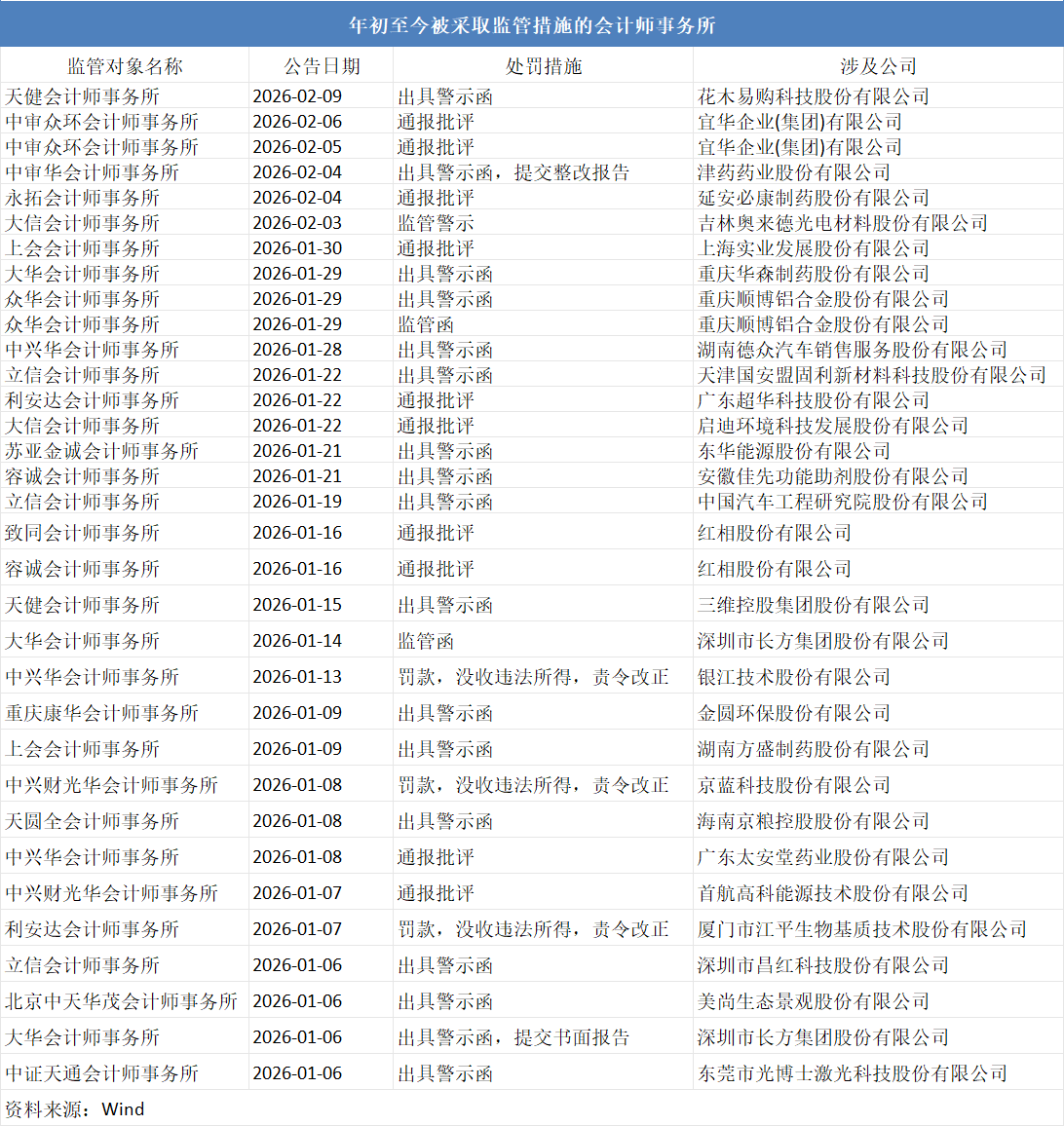
Core Viewpoint - The recent penalties imposed on accounting firms in China have led to a chain reaction, with numerous A-share companies severing ties with these firms due to issues related to financial misconduct and inadequate auditing practices [1][2][8]. Group 1: Penalties and Regulatory Actions - As of early 2026, 19 accounting firms have faced regulatory measures totaling 33 instances, with notable firms like Tianjian and Zhongshunzhong being penalized for inadequate auditing procedures [2][3]. - Zhongshunzhong was criticized for issuing false audit reports for Yihua Group, leading to penalties for both the firm and its registered accountants [3][4]. - Daxin and Yongtuo accounting firms have also been penalized this month for various violations, including issuing misleading audit reports for companies like Aolaide and Yan'an Bikon [3][4][6]. Group 2: Consequences of Penalties - Following penalties, several accounting firms have experienced significant client losses, with companies like ST Lifan and ST Wanfang announcing changes in their auditing firms after issues arose with Zhongxing Caiguanghua [10][11]. - Yongtuo has faced a similar fate, losing multiple A-share clients after being implicated in financial misconduct involving several companies [11]. Group 3: Regulatory Environment and Future Implications - The regulatory environment is tightening, with the China Securities Regulatory Commission (CSRC) emphasizing a "zero tolerance" approach towards financial fraud and the complicity of third-party firms [12][13]. - The CSRC aims to enhance the accountability of accounting firms, ensuring they fulfill their roles as gatekeepers in the capital market by improving audit quality and compliance [13].
40天22家会计所被点名!监管重拳移向资本市场“新焦点”
2 1 Shi Ji Jing Ji Bao Dao· 2026-02-10 12:53
Core Viewpoint - The regulatory focus on accounting firms has intensified, with 22 firms named by the China Securities Regulatory Commission (CSRC) within 40 days, indicating a shift towards stricter accountability for intermediaries in the capital market [1][2][3]. Regulatory Actions - From January 1 to February 9, 2026, 22 accounting firms were named by the CSRC, with three firms—Zhongxinghua, Zhongxing Caiguanghua, and Lianda—receiving severe administrative penalties [2][3]. - An average of one warning letter was issued every two days, with 21 firms receiving such letters during the same period [2][3]. Focus on Accountability - The increased scrutiny aims to enforce audit responsibilities and enhance the quality of listed companies, thereby purifying the market ecosystem [1][3]. - The regulatory actions signify a new phase of stringent oversight on accounting firms, which are now viewed as critical gatekeepers in the capital market [3][4]. Key Issues Identified - Common deficiencies among the penalized firms include inadequate response to revenue fraud risks and a lack of professional skepticism [5][6]. - Audit procedures were often superficial, failing to gather sufficient and appropriate evidence, with significant lapses in the execution of core audit processes [6][8]. Systemic Problems - Warning letters have highlighted systemic issues within the industry, including failures in internal governance and quality control mechanisms [8][9]. - The regulatory focus has shifted towards the overall operational integrity of accounting firms, emphasizing the need for unified management and independence in auditing practices [9][10]. Conclusion - The regulatory environment is evolving towards a model that combines specific accountability for individual audit failures with broader systemic reforms aimed at enhancing the overall quality and integrity of the auditing profession [10].
极速罚单彰显监管“快准严”
Bei Jing Shang Bao· 2026-02-09 16:54
Group 1 - The core viewpoint of the articles emphasizes the rapid and efficient regulatory environment in the capital market, showcasing a "fast, accurate, and strict" approach to handling violations [1][2][3] - Regulatory actions have become more streamlined, with cases like Rongbai Technology receiving a pre-penalty notice just 19 days after being investigated, indicating a significant shift towards quicker enforcement [1] - The use of big data and technology has enhanced the precision of regulatory oversight, allowing for the swift identification of abnormal trading and false information [2] Group 2 - The regulatory environment has adopted a "zero tolerance" stance towards violations, with over 20 listed companies facing investigations or penalties this year alone [2] - The penalties imposed on companies and their executives serve as a strong deterrent, with examples such as Rongbai Technology and the severe penalties against *ST Chang Pharmaceutical for financial fraud [2] - The combination of administrative fines, criminal accountability, and civil compensation is creating a closed loop that makes it increasingly difficult for violators to evade consequences [2] Group 3 - For ordinary investors, the "fast, accurate, and strict" regulatory approach provides tangible protection by preventing the escalation of losses and ensuring accountability for claims [3] - High-pressure regulation compels listed companies and their executives to focus on core business operations and governance, thereby mitigating risks from speculative practices [3] - The Chairman of the China Securities Regulatory Commission has highlighted the importance of improving investigation quality and deepening enforcement reforms, which are reflected in the current regulatory practices [3]

监管持续发威,一夜之间4家A股公司被立案或处罚
Di Yi Cai Jing Zi Xun· 2026-02-08 12:22
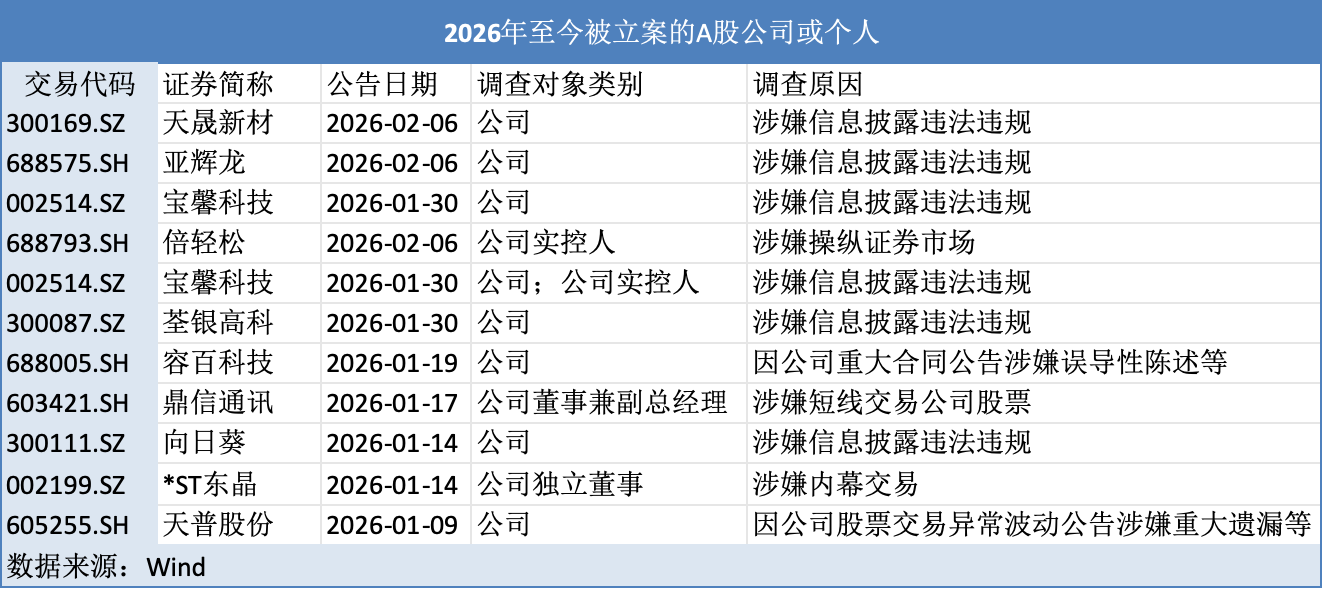
Core Viewpoint - The regulatory scrutiny on listed companies in China's A-share market has intensified, with multiple companies facing investigations and penalties for violations related to information disclosure and financial misconduct [2][10]. Group 1: Recent Investigations and Penalties - Two A-share companies, Tian Sheng New Materials and Yahui Long, were recently announced to be under investigation for suspected information disclosure violations [2][6]. - ST Funi was fined 6.5 million yuan for financial fraud involving collusion with a third-party company, which led to inflated profits of approximately 35.8 million yuan in 2020 [3][4]. - Rongbai Technology was fined 9.5 million yuan for misleading statements regarding a major contract, with the investigation concluding within a month [5][6]. Group 2: Overview of Violations - A total of eight A-share companies and four individuals have been investigated since the beginning of 2026, with the majority facing issues related to information disclosure violations [6][7]. - Specific cases include Baoxin Technology and its actual controller being investigated for information disclosure violations, and the independent director of *ST Dongjing being investigated for insider trading [7][8]. Group 3: Regulatory Environment - The regulatory environment has become increasingly stringent, with a significant number of companies being penalized for financial misconduct in 2025, particularly in the area of information disclosure violations [10][12]. - The China Securities Regulatory Commission (CSRC) has emphasized the need for a comprehensive system to combat financial fraud, indicating a shift towards proactive governance rather than reactive measures [12][13].





一夜之间4家A股公司被立案或处罚!监管持续发威,年初至今多家公司被查
Di Yi Cai Jing· 2026-02-08 10:44
Core Viewpoint - The regulatory scrutiny on A-share companies has intensified, with multiple companies being investigated and penalized for violations related to information disclosure and financial misconduct since 2026 [1][15]. Group 1: Recent Investigations and Penalties - Eight A-share companies and four related individuals have been investigated since 2026, with recent cases including Tian Sheng New Materials and Aihui Long, both facing allegations of information disclosure violations [1][9]. - ST Fuhua was fined 6.5 million yuan for financial fraud involving collusion with a third-party company, which led to inflated profits of approximately 35.8 million yuan in 2020 [3][4]. - Rongbai Technology was fined a total of 9.5 million yuan for misleading statements regarding a major contract with Ningde Times, which was deemed to lack accurate reflection of the actual terms [6][7]. Group 2: Specific Cases and Financial Impact - ST Fuhua's financial misconduct resulted in a reported revenue of 740 million yuan in 2020, a year-on-year increase of 169.36%, but the company still recorded a net loss when excluding the inflated profits [5][4]. - The inflated profits from ST Fuhua's subsidiary accounted for 120.18% of the total profit disclosed for that period, indicating severe discrepancies in financial reporting [4]. - The investigation into Rongbai Technology revealed that the announced sales figures were based on estimates and lacked contractual guarantees, leading to regulatory action [6][8]. Group 3: Broader Regulatory Trends - The regulatory environment has become increasingly stringent, with a notable increase in investigations into financial misconduct and information disclosure violations among A-share companies [15][19]. - In 2025, a total of 87 A-share companies were investigated, with over 40% being ST companies, highlighting a trend of heightened scrutiny in the market [16]. - The China Securities Regulatory Commission (CSRC) has emphasized a comprehensive approach to tackling financial fraud, involving collaboration with judicial authorities to enhance enforcement and accountability [18][19].