人造太阳

Search documents
我国科研人员实现“人造太阳”关键核心材料制备
Xin Hua She· 2025-10-28 08:48
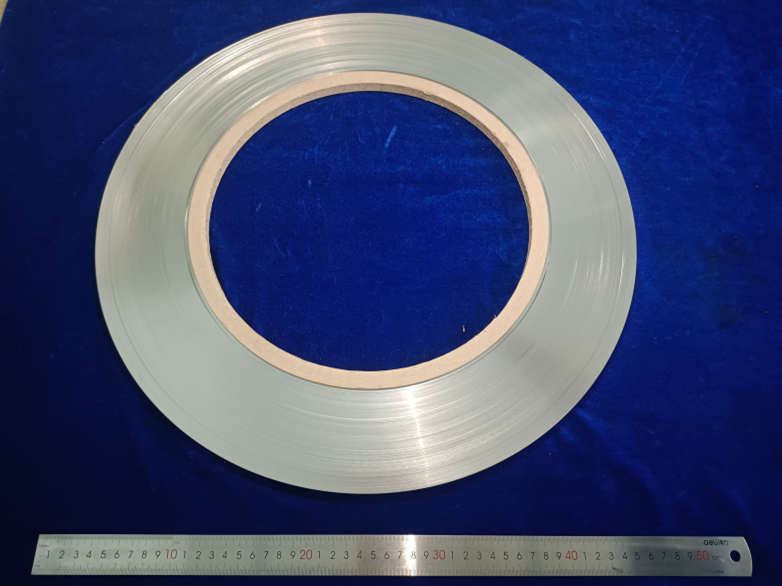
Core Insights - The research team at the Institute of Metal Research, Chinese Academy of Sciences, has successfully achieved industrial-scale production of high-purity ton-level Hastelloy alloy using self-developed purification technology, which is crucial for the production of second-generation high-temperature superconducting tapes [1][3] - The second-generation high-temperature superconducting tapes are essential for creating powerful magnetic fields necessary for controlled nuclear fusion, and the production of these tapes has previously relied on imported Hastelloy alloys, which are expensive and have uncertain supply times [1] - The newly developed Hastelloy alloy has purity levels that meet or exceed those of imported materials, addressing the supply chain issues faced by the industry [1] Production and Technical Achievements - The research team has overcome key technical challenges in processing, successfully rolling the Hastelloy alloy into ultra-thin metal substrates with a thickness of only 0.046 mm, a width of 12 mm, and a length exceeding 2000 meters, achieving a surface roughness of less than 20 nanometers [3] - The metal substrates produced have excellent thermal stability and mechanical properties, and validation work has been conducted with relevant enterprises, leading to the successful large-scale production of nearly one kilometer of high-temperature superconducting tapes [3] - A framework cooperation agreement has been established with relevant enterprises for the supply of 20 tons of metal substrates, with plans for further collaboration to optimize the production process [3]

10.28犀牛财经早报:科创板科创成长层3家未盈利企业上市 “人造太阳”关键核心材料实现国产工业化制备
Xi Niu Cai Jing· 2025-10-28 01:59
Group 1: Securities Firms Performance - Several listed securities firms have reported their Q3 results, showing that leading firms remain stable while smaller firms are experiencing rapid growth [1] - The A-share market has seen active trading and a significant increase in margin financing, providing a boost to various business operations of securities firms [1] - The securities sector is expected to present new investment opportunities due to multiple factors including policy, funding, performance, and valuation [1] Group 2: New Listings and Market Developments - Three unprofitable companies, He Yuan Bio, Xi'an Yicai, and Bibete, have successfully listed, marking the growth of the Sci-Tech Innovation Board [2] - The total number of companies on the Sci-Tech Innovation Board has reached 592, with 11 companies listed this year, raising a total of 16.95 billion yuan, a 54% increase year-on-year [2] Group 3: Commodity Market Trends - The copper futures market has seen a continuous inflow of funds, with a total capital of 48.758 billion yuan, making it the second-largest commodity futures market after gold [1] - Shanghai copper futures prices have surpassed 88,300 yuan per ton, while London Metal Exchange copper prices have exceeded $10,000 per ton, approaching historical highs [1] Group 4: Corporate Financial Results - Dongyangguang reported a net profit of 906 million yuan for the first three quarters, a year-on-year increase of 189.8% [7] - Xintai's net profit for the first three quarters reached 581 million yuan, reflecting a year-on-year growth of 13.93% [8] - Aier Eye Hospital's Q3 net profit was 1.064 billion yuan, down 24.12% year-on-year [8] - Huazheng Technology reported a net profit of 3.099 billion yuan for the first three quarters, a year-on-year increase of 51.17% [9] Group 5: Market Indices and Economic Indicators - The three major U.S. stock indices have reached new highs, with the Nasdaq rising by 1.86% and the S&P 500 by 1.23% [10] - The market anticipates further interest rate cuts from the Federal Reserve, contributing to the rise in stock indices [10] - Long-term U.S. Treasury yields have declined, with the 10-year yield falling below 4% [10]
“人造太阳”关键核心材料,取得重要进展!
中国能源报· 2025-10-28 01:15
Core Viewpoint - The article highlights the successful industrialization of high-purity ton-level Hastelloy C276 metal substrate for second-generation high-temperature superconducting tapes, crucial for controlled nuclear fusion, also known as "artificial sun" [1][3]. Group 1: Industrialization and Technological Breakthrough - The research team at the Institute of Metal Research, Chinese Academy of Sciences, has developed a purification technology that overcomes the bottleneck in the metal substrate technology for second-generation high-temperature superconducting tapes [1][3]. - The successful production of the high-purity Hastelloy C276 metal substrate marks a significant step towards reducing reliance on imported materials, which are expensive and have uncertain supply times [3][4]. Group 2: Material Properties and Performance - The produced metal substrate has a thickness of only 0.046 mm, width of 12 mm, and length exceeding 2000 meters, with a surface roughness of less than 20 nanometers, indicating exceptional smoothness [4]. - The tensile strength of the material at liquid nitrogen temperatures exceeds 1900 MPa, capable of supporting a weight of 190 tons over an area the size of a fingernail, demonstrating outstanding mechanical properties [4]. - Even after being subjected to 900 degrees Celsius for 5 minutes and then cooled to room temperature, the tensile strength remains above 1200 MPa, showcasing excellent thermal stability and mechanical performance [4].

“人造太阳”关键核心材料实现国产工业化制备
Yang Shi Xin Wen· 2025-10-28 00:02
Core Insights - The research team at the Chinese Academy of Sciences has successfully industrialized the production of high-purity ton-level Hastelloy C276 metal substrates, overcoming technical bottlenecks in the manufacturing of second-generation high-temperature superconducting tapes for controlled nuclear fusion [1][2]. Group 1: Technological Breakthrough - The team developed a purification preparation technology that allows for the production of metal substrates essential for the superconducting tapes used in controlled nuclear fusion, often referred to as "artificial sun" [1]. - The new metal substrate is crucial for creating the strong magnetic fields necessary to confine plasma at temperatures exceeding one hundred million degrees Celsius [1]. Group 2: Material Properties - The produced Hastelloy C276 alloy has significantly lower contents of carbon, manganese, sulfur, phosphorus, oxygen, and nitrogen compared to imported materials, achieving purity levels that meet or exceed those of imported counterparts [1]. - The metal substrate has a thickness of only 0.046 millimeters, a width of 12 millimeters, and a length exceeding 2000 meters, with a surface roughness of less than 20 nanometers [2]. - The tensile strength of the material at liquid nitrogen temperatures exceeds 1900 MPa, capable of supporting a weight of 190 tons over an area the size of a fingernail, and retains a tensile strength above 1200 MPa even after being subjected to 900 degrees Celsius for 5 minutes [2].
聚变能技术从科研向工程实践和应用迈进,“人造太阳”加速商业化意味着什么?
Ren Min Ri Bao· 2025-10-22 05:26
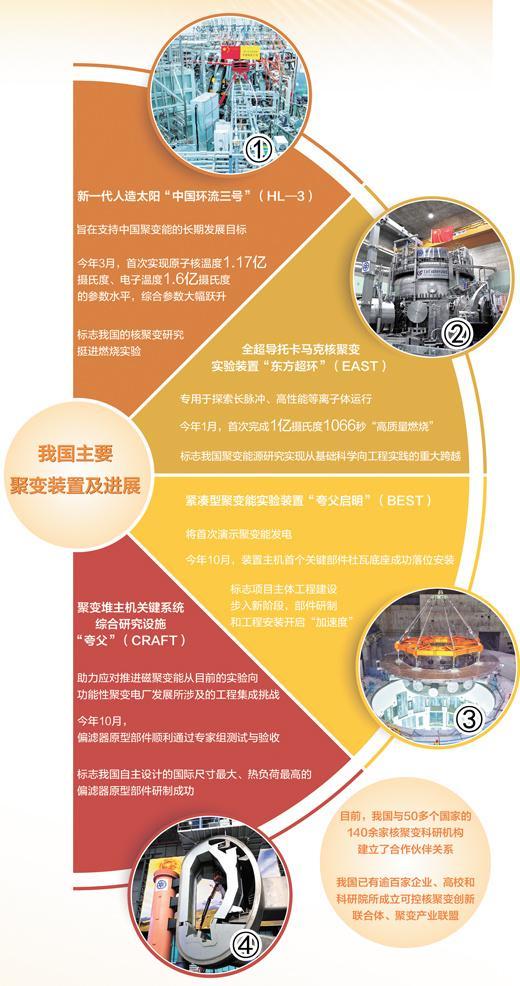
Core Insights - The commercialization of fusion energy is a hot topic, with significant advancements in technology and policy support in China [1][5][8] - China is transitioning its fusion research facilities from experimental tools to industrial hubs, enhancing global collaboration [2][3][9] - Despite progress, challenges remain in technology and industrial ecosystem for the commercialization of fusion energy [5][7] Group 1: Technological Advancements - China's "China Fusion Engineering Test Reactor" (HL-3) achieved a nuclear temperature of 117 million degrees Celsius and an electron temperature of 160 million degrees Celsius, marking a significant leap in fusion parameters [2] - The "East" (EAST) facility set a world record by maintaining a plasma temperature of 100 million degrees Celsius for 1066 seconds [3] - New devices like the "Xuanlong-50U" and "Jing Tian Magnet" have made breakthroughs in plasma current and magnetic field strength, respectively [4] Group 2: Policy and Strategic Initiatives - The Chinese government has prioritized controlled nuclear fusion in its carbon neutrality goals, with multiple policy documents supporting research and development [1][8] - Local initiatives, such as the fusion energy industrial cluster in Hefei, aim to attract upstream and downstream enterprises, creating a billion-yuan industry [8] Group 3: Global Collaboration and Market Dynamics - China is a key partner in the ITER project, contributing to the design and manufacturing of critical components, enhancing its global standing in fusion energy [9] - The establishment of the "Controlled Nuclear Fusion Innovation Alliance" aims to integrate research and market advantages, fostering collaboration among state-owned enterprises, private companies, and research institutions [9] Group 4: Future Outlook - The timeline for achieving commercial fusion energy includes milestones such as the start of burning experiments by 2027 and the construction of China's first engineering test reactor by 2035 [7][10] - The vision for fusion energy is to provide a clean and sustainable energy source, contributing to global energy innovation and environmental harmony [10]
“人造太阳”加速商业化意味着什么
Ren Min Ri Bao· 2025-10-20 07:48
Core Insights - The commercialization of fusion energy technology is accelerating from scientific research to engineering practice and application, as highlighted in the recent international conference held in Chengdu, China [2][3] Group 1: Technological Advancements - China's fusion research facilities are transitioning from experimental tools to industrial hubs, providing a solid hardware foundation for engineering and commercialization breakthroughs [3] - The "Chinese Circulation No. 3" (HL-3) achieved significant milestones, including reaching nuclear temperatures of 117 million degrees Celsius and electron temperatures of 160 million degrees Celsius, marking a leap in fusion parameters [3] - The "East" (EAST) facility set a world record by maintaining a plasma state at 1 million degrees Celsius for 1066 seconds, showcasing over 200 core technologies developed independently [4] - The "Kua Fu" (CRAFT) facility successfully tested a prototype component that addresses critical engineering challenges in fusion reactor operations [4][5] Group 2: Global Trends and Investments - Globally, nearly 40 countries are advancing fusion plans, with over 160 fusion devices in operation, under construction, or planned, and private investments exceeding $10 billion [6] - Italy and the U.S. are making significant investments in fusion energy, with Italy aiming for its first plasma by 2030 and the U.S. Department of Energy funding new collaborative projects [6] Group 3: Challenges to Commercialization - The commercialization of fusion energy faces multiple challenges, including technological hurdles related to plasma stability, material durability, and fuel sustainability [7] - The industry ecosystem must address supply chain maturity, economic viability, investment sustainability, and regulatory adaptability [7] Group 4: Policy and Ecosystem Development - China is building an ecosystem to support the engineering and industrialization of fusion energy through policy guidance and international cooperation [8] - Recent policies have prioritized controlled nuclear fusion as a key area for low-carbon technology development, with significant investments in research and infrastructure [8] Group 5: International Collaboration - China has established partnerships with over 140 fusion research institutions across 50 countries, contributing to the global fusion energy landscape [9] - The formation of the China Fusion Energy Company aims to enhance collaboration between research institutions and enterprises, fostering innovation and market vitality [9] Group 6: Future Outlook - The vision for fusion energy is to provide abundant, clean energy, with expectations for significant advancements in experimental and commercial fusion reactors by 2035 and beyond [10]
聚变能研发进入新阶段,“人造太阳”离我们有多远?
Xin Hua She· 2025-10-19 07:09
Core Insights - The concept of creating a "man-made sun" for limitless clean energy is a significant human aspiration, but achieving controlled nuclear fusion remains a complex challenge due to the extreme conditions required for fusion reactions [1][2]. Group 1: Challenges of Nuclear Fusion - Nuclear fusion requires creating conditions similar to those in the sun, specifically heating deuterium-tritium plasma to over 100 million degrees Celsius, which is 6 to 7 times the temperature at the sun's core [2]. - The complexity of controlled nuclear fusion encompasses various scientific fields, including plasma physics, nuclear engineering, and materials science, making it one of the most intricate energy systems conceived by humanity [2]. Group 2: Current Global Developments - Global research on fusion energy has entered a new phase characterized by parallel pathways and rapid iterations, with two main technological routes: magnetic confinement and inertial confinement [3]. - The International Thermonuclear Experimental Reactor (ITER) is the largest global fusion research project, aiming to demonstrate the feasibility of magnetic confinement fusion by 2040 to 2050 [3]. Group 3: China's Role in Fusion Energy - China has established itself as a significant player in the fusion energy sector, with the International Atomic Energy Agency's fusion research and training collaboration center recently established in Chengdu [4]. - The "Chinese Circulation No. 3" project aims to achieve temperatures exceeding 100 million degrees Celsius by 2025, marking a major advancement in China's controlled nuclear fusion technology [4][5]. - The EAST facility in Hefei has set a world record by achieving 1000 seconds of high-quality burning at 100 million degrees Celsius, indicating progress in fusion research [5].
“人造太阳”加速商业化意味着什么(瞰前沿·大国重器)
Ren Min Wang· 2025-10-18 21:58
Core Insights - The commercialization of fusion energy is accelerating globally, with significant advancements in China's fusion research and technology [4][8][10] - China is transitioning its fusion research facilities from experimental tools to industrial hubs, supported by government policies and international collaboration [4][10][11] Group 1: Technological Advancements - China's "Artificial Sun," the HL-3, achieved a nuclear temperature of 117 million degrees Celsius and an electron temperature of 160 million degrees Celsius, marking a significant leap in fusion research [4] - The EAST facility set a world record by maintaining a plasma state at 1 million degrees Celsius for 1066 seconds, showcasing over 200 core technologies developed independently [5] - The "Kua Fu" facility completed the installation of its main components, addressing critical engineering challenges for future commercial fusion reactors [5][6] Group 2: Industry and Policy Support - The Chinese government has prioritized controlled nuclear fusion as a key area for achieving carbon neutrality and advancing green technologies [4][10] - Various local governments are establishing fusion energy industrial clusters, such as in Anhui and Sichuan, to attract related enterprises and foster a billion-yuan industry scale [10][11] Group 3: Global Collaboration and Investment - Nearly 40 countries are advancing fusion plans, with over 160 fusion devices in operation, under construction, or planned, and private investments exceeding $10 billion [8] - China is a key partner in the ITER project, contributing to the design and manufacturing of critical components, and has established collaborations with over 140 fusion research institutions worldwide [11] Group 4: Future Outlook and Challenges - The timeline for achieving commercial fusion energy includes milestones such as starting burning experiments by 2027 and developing the first engineering test reactor by around 2035 [9] - Despite significant progress, challenges remain in technology, industrial ecosystem maturity, and regulatory frameworks that need to be addressed for successful commercialization [9][10]
聚变能的研发,走到了哪一步?
Zhong Guo Zheng Quan Bao· 2025-10-18 14:47
Core Insights - The development of fusion energy is progressing towards a new stage, with multiple pathways and rapid iterations being explored globally [4][5] - Achieving controlled nuclear fusion is considered one of the most complex energy systems conceived by humanity, requiring extreme conditions that are difficult to replicate on Earth [3][5] Industry Developments - The main technological routes for fusion energy are magnetic confinement and inertial confinement, with devices like Tokamaks and stellarators being key to magnetic confinement [5] - The International Thermonuclear Experimental Reactor (ITER) is the largest global fusion research project, aiming to demonstrate the feasibility of magnetic confinement fusion by 2040 to 2050 [5] China's Role - China has significantly enhanced its international standing in fusion energy, establishing a research and training collaboration center in Chengdu under the International Atomic Energy Agency [7] - The country has made notable advancements in controlled nuclear fusion technology, including achieving temperatures exceeding 100 million degrees Celsius in its "Chinese Circulation No. 3" project [8] - China is committed to international collaboration in advancing sustainable energy innovation and aims to contribute to a cleaner and more sustainable world [8]
“人造太阳”挺进燃烧实验,“终极能源”商业化加速
Sou Hu Cai Jing· 2025-10-18 13:59
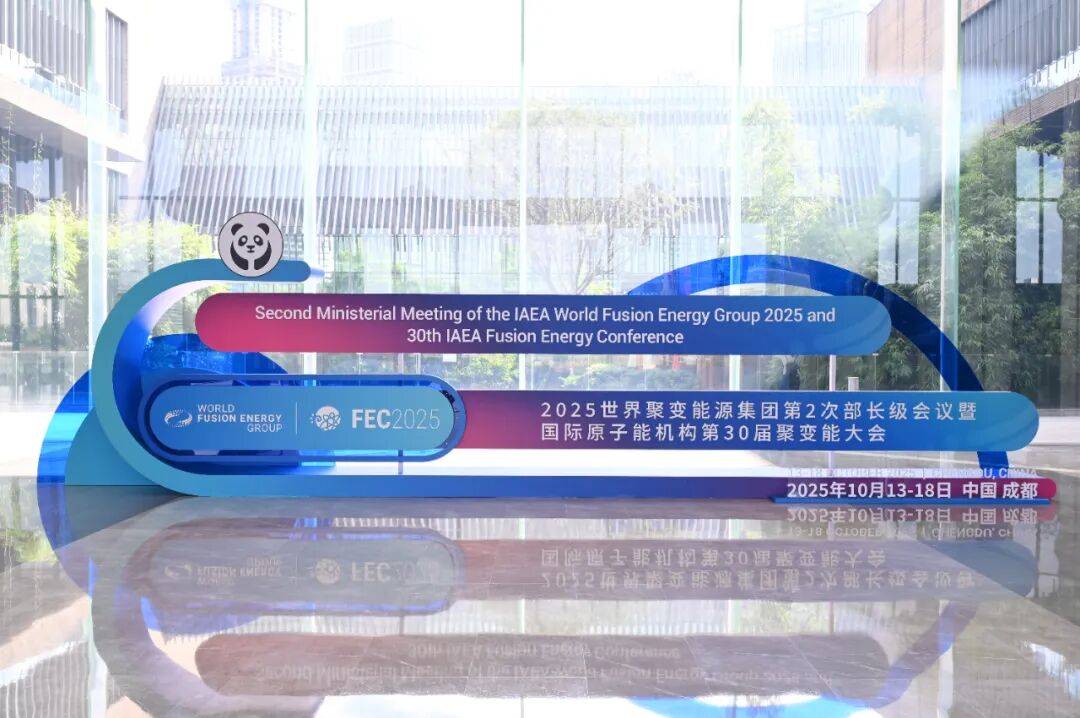
Core Insights - The 2025 World Fusion Energy Group's second ministerial meeting and the 30th International Atomic Energy Agency Fusion Energy Conference were held in Chengdu, highlighting the significance of controllable nuclear fusion as the "ultimate energy" for humanity, which could reshape the global energy landscape and international cooperation [1] - China is strategically positioning itself to lead in the nuclear fusion sector through systematic industrial layout and national strategic planning, transitioning from a technology follower to a leader [3][5] National Layout - China's nuclear industry development is rooted in national planning, which supports steady industrial progress and reflects strategic considerations for moving from technology catch-up to industry leadership [3] - The country is leveraging early technological accumulation and deep participation in the International Thermonuclear Experimental Reactor (ITER) project to transition from a follower to a leader in the global fusion field [5] - Key locations for controllable nuclear fusion development in China include Shanghai, Chengdu, Hefei, and Langfang, with various critical devices being developed collaboratively [5][7] Industry Growth - China's nuclear technology application sector has a complete innovation chain, covering nearly 40 subfields, with an estimated output value growing from 300 billion yuan in 2015 to nearly 700 billion yuan in 2022, reflecting an annual growth rate of over 15% [8] - Sichuan province is a major hub for nuclear industry and technology utilization, with significant innovation and application potential, particularly in the development of the "China Circulation No. 3" and electromagnetic-driven fusion devices [9][10] Regional Development - Sichuan's support for the nuclear industry, especially in nuclear technology applications, is characterized by targeted policies aimed at fostering high-quality development in the nuclear medical industry by 2030 [10] - The province's approach to industrial layout is differentiated, allowing regions to develop specialized fields based on local resources, creating a comprehensive ecosystem in the nuclear industry [10] Chengdu's Role - Chengdu's strategic positioning aligns with the development of the fusion industry, as it has been designated as a center for economic, technological innovation, and international exchange [11][12] - The city hosts leading research institutions and has cultivated local enterprises that excel in specific fields, contributing to a robust industrial ecosystem [12][13] - The recent international fusion energy conference in Chengdu has further solidified the city's role in the nuclear industry, with the establishment of a global fusion energy research and training collaboration center [12][15] Future Plans - A comprehensive development plan for the controllable nuclear fusion industry has been released, focusing on technology research, results transformation, and the establishment of a global technology research hub [15] - The plan aims to create a closed-loop industrial chain and foster new business models, contributing to Chengdu's vision of becoming a model for sustainable urban development and achieving the "ultimate energy solution" for humanity [15]