智能化

Search documents
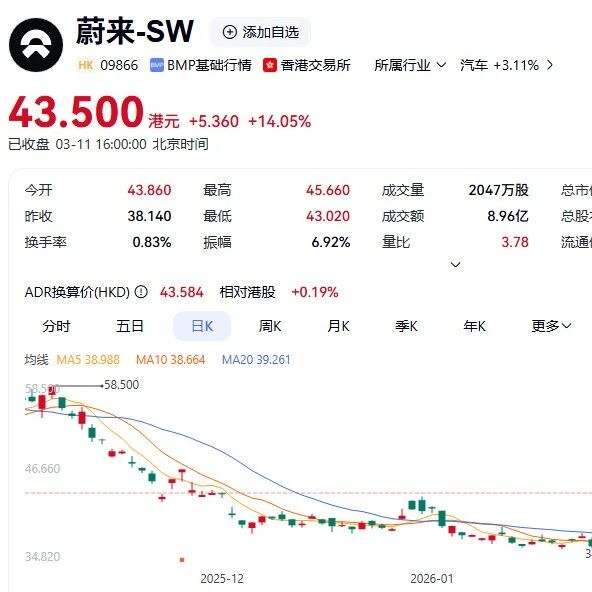
蔚来市值重回1000亿港元!港股整车上市企业市值剧烈波动
证券时报· 2026-03-11 13:57
Core Viewpoint - The article discusses the significant fluctuations in the market capitalization of Hong Kong-listed automotive companies, highlighting NIO's recent stock price surge and its implications for the broader market [1][7]. Group 1: NIO's Performance - NIO's stock price increased by 14.05% on March 11, 2026, leading to a year-to-date gain of 6.2%, and its market capitalization surpassed 100 billion HKD [2][3]. - The surge in NIO's stock is attributed to a substantial year-on-year increase in Q4 2025 sales and the company's first quarterly profit, with 124,807 electric vehicles delivered, marking a 71.7% increase [5]. - NIO reported a net profit of approximately 280 million CNY in Q4 2025, a significant turnaround from a net loss of about 7.11 billion CNY in Q4 2024 and a loss of 3.48 billion CNY in Q3 2025 [5]. Group 2: Market Trends - The fluctuations in NIO's stock and market capitalization reflect broader volatility among Hong Kong-listed automotive companies, with significant disparities in performance since 2026 [8]. - From 2021 to 2023, the market capitalization of new energy vehicle companies, particularly NIO, Xpeng, and Li Auto, has shown considerable variation, with Li Auto surpassing NIO and Xpeng in market value during different periods [10][11]. - As of March 11, 2026, the market capitalizations of NIO, Li Auto, and Xpeng all exceeded 100 billion HKD, indicating a competitive landscape among these companies [11]. Group 3: Industry Dynamics - The automotive industry in China has undergone significant structural changes due to the acceleration of electrification and smart technology, leading to the emergence of new players and challenges for traditional manufacturers [12]. - Despite the volatility, some leading companies like Geely and BYD have maintained strong market positions, with stock price increases exceeding 50% since the beginning of 2023, outperforming other competitors [12]. - BYD remains the market leader in terms of market capitalization among Hong Kong-listed automotive companies, reflecting its strong sales performance [12].

徐工机械20260310
2026-03-11 08:11
Summary of Conference Call for XCMG Machinery Industry Overview - The core growth driver is the mining machinery sector, with a revenue target of 40 billion RMB by 2030, where overseas sales will account for 60%, new energy products for 50%, and aftermarket services for 40% [2][4][5]. - The company anticipates a 15%-20% growth in exports by 2026, with international revenue exceeding 50% [2][3]. - The domestic market is expected to recover, with an estimated 10% growth in domestic sales in 2026, driven by renewal demand and major projects like the Yaxia Hydropower Station expected to start in Q3 [2][3]. Financial Goals - The company aims to improve gross margin by 1-2 percentage points and net profit margin by over 1 percentage point by 2026, while strictly reducing accounts receivable [2][3][21]. - Cash flow is expected to improve further in 2026 [3]. Market Dynamics - The geopolitical situation in the Middle East has led to a three-month inventory buffer, with limited long-term impact on growth [2][11]. - The company has established relationships with top global mining clients, including Vale and FMG, and expects significant orders for electric and intelligent equipment [6][7]. Product and Market Strategy - The mining machinery segment is projected to grow by 25%-30% in 2026, with a focus on enhancing product competitiveness and market share [4][5]. - The company plans to focus on three growth areas: new energy products, globalization, and aftermarket services [5][9]. - New energy products are expected to account for 50% of mining machinery revenue by 2030, with aftermarket services targeted to reach 40% [5][9]. Customer Structure - The customer base has shifted from primarily domestic clients to include major international mining companies, with a significant portion of orders coming from electric and large-tonnage intelligent equipment [7][8]. - By 2026, overseas revenue from mining machinery is expected to exceed 50%, with domestic business primarily focused on coal mines in regions like Inner Mongolia and Xinjiang [7]. Aftermarket Services - The company aims to increase its aftermarket revenue share from 25% to 40% through investments in spare parts centers and service personnel [9][8]. - Positive customer feedback and market system development indicate progress towards achieving these goals [9]. Capital Expenditure and Market Sentiment - The company remains optimistic about the mining sector's capital expenditure cycle, with sufficient orders to sustain growth through 2027 [10][19]. - The overall sentiment in the market is improving, with expectations of continued project openings and equipment demand [19]. Risks and Mitigation - The company has proactively increased inventory in anticipation of potential geopolitical uncertainties affecting sales in the Middle East [11]. - Short-term impacts from geopolitical tensions are expected to be manageable, with long-term growth prospects remaining strong [11]. Competitive Landscape - The company recognizes the competitive challenges in overseas markets but believes that adapting to local business cultures will mitigate risks of "involution" seen in domestic markets [13]. - The penetration rate of Chinese engineering machinery companies in overseas markets remains low, particularly in high-end markets like Europe and North America, but there is significant growth potential in emerging markets [12]. Future Outlook - The company is positioned to leverage the recovery in the domestic market and the growth in international sales to improve overall performance [22]. - With a focus on cost control and operational efficiency, the company aims to achieve better growth in the upcoming market cycle compared to previous periods [22].

机械设备行业简评:挖掘机出口持续向好,龙头募资投向全球化和智能化
Donghai Securities· 2026-03-10 14:12
Investment Rating - The industry investment rating is "Overweight" indicating that the industry index is expected to outperform the CSI 300 index by 10% or more over the next six months [7]. Core Insights - The report highlights a positive trend in excavator exports, with a year-on-year increase of 37.2% in February 2026, despite a domestic sales decline of 42% due to the Chinese New Year holiday affecting workdays [6]. - The domestic demand for excavators is anticipated to recover gradually, supported by major projects in sectors such as mining and water conservancy, which are expected to release demand dividends [6]. - The loader segment also shows growth, with domestic sales increasing by 11.5% in January-February 2026, driven by the commencement of significant domestic projects [6]. - The report emphasizes the importance of companies like Zoomlion, which raised RMB 60 billion through convertible bonds to support global expansion and innovation in technology [6]. - The report suggests focusing on leading companies with strong brand recognition and efficient cost structures, such as Sany Heavy Industry, Zoomlion, LiuGong, Shantui, and Hengli Hydraulic, as they are well-positioned for growth in both domestic and international markets [6]. Summary by Sections Excavator Market - In February 2026, a total of 17,226 excavators were sold, a decrease of 10.6% year-on-year, with domestic sales at 6,755 units, down 42% [6]. - Year-to-date (January-February) domestic sales were 15,478 units, down 9.19%, while exports reached 20,456 units, up 38.8% [6]. Loader Market - In February 2026, 9,540 loaders were sold, marking a year-on-year increase of 9.28%, with domestic sales at 3,863 units, down 14.3%, and exports at 5,677 units, up 34.4% [6]. - Year-to-date (January-February) domestic sales were 9,156 units, up 11.5%, and exports were 12,143 units, up 43.9% [6]. Company Developments - Zoomlion's issuance of convertible bonds aims to enhance its global competitiveness and support innovation in new technologies, with 50% of the funds allocated for global development and the other 50% for high-quality development strategies [6].




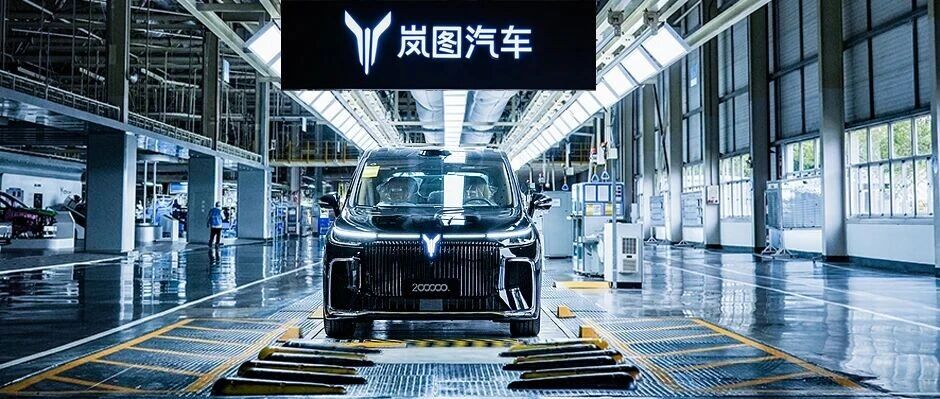
岚图“双杀”三月:梦想家冠军版+港股上市
第一财经· 2026-03-10 13:11
Core Viewpoint - Lantu's recent product launch and upcoming IPO represent a strategic culmination of five years of planning, positioning the company as a leader in the high-end new energy vehicle market [1][3][15]. Product Launch - The Lantu Dreamer Champion Edition, priced at 309,000 yuan, aims to redefine the 300,000 yuan MPV market with high-end technology standards typically found in vehicles priced at 400,000 yuan [3][6]. - The vehicle features advanced configurations such as Huawei's ADS4 intelligent driving system, HarmonyOS cockpit, and a high-performance chassis comparable to luxury models [3][6]. Market Strategy - Lantu's strategy involves not just selling a new vehicle but also claiming the definition of the 300,000 yuan MPV market, leveraging its established reputation and technology [6][8]. - The company has achieved significant sales milestones, with 200,000 units sold and an average selling price exceeding 400,000 yuan, indicating strong demand from premium consumers [6][8]. Financial Performance - Lantu's financial projections show a compound annual growth rate (CAGR) of 73% in sales from 50,300 units in 2023 to 150,200 units in 2025, with revenue expected to grow from 12.75 billion yuan to 34.86 billion yuan during the same period [8][12]. - The company is on track to achieve a net profit of 1.02 billion yuan in 2025, marking its first annual profit, with a stable gross margin of 20.9% [8][12]. Technological Collaboration - Lantu's partnership with Huawei is characterized as a deep symbiotic relationship, integrating Huawei's intelligent driving solutions with Lantu's proprietary architecture for enhanced vehicle performance [9][12]. - The company is also focusing on in-house technology development, holding 1,874 authorized patents and 5,405 pending applications across various automotive technology fields [9]. IPO and Market Positioning - Lantu is set to be listed on the Hong Kong Stock Exchange on March 19, 2023, under the stock code 07489.HK, marking it as the first high-end new energy stock from a central state-owned enterprise [15][16]. - The IPO is expected to enhance Lantu's market presence, supported by its profitable business model and unique positioning in the competitive landscape of new energy vehicles [15][16]. Product Matrix - Lantu's product lineup spans from 300,000 to 700,000 yuan, with the Dreamer Champion Edition targeting the 300,000 yuan segment, while future models aim to capture higher price points and market segments [12][13]. - This comprehensive product strategy reflects Lantu's understanding of consumer needs, ensuring that it can cater to a wide range of budgets while maintaining a strong brand identity [13][16].
【商用车】2026年2月轻型商用车市场预测研究报告
乘联分会· 2026-03-10 08:44
Industry Insights - The Ministry of Industry and Information Technology, along with five other departments, has jointly issued interim measures for the recycling and comprehensive utilization of used power batteries from new energy vehicles, aiming to establish a standardized, safe, and efficient recycling system [3] - The Ministry of Industry and Information Technology has revised two vehicle access review requirements, effective from 2027, to address challenges posed by the electrification, intelligence, and connectivity of the automotive industry. This revision raises the technical and safety thresholds, potentially accelerating industry consolidation and directing resources towards leading companies with strong technological capabilities [5] Product Trend Analysis - Factors driving new energy light trucks include: 1. Policy incentives such as "trade-in" programs, local subsidies, and road rights advantages. For instance, a subsidy of 35,000 yuan per vehicle for scrapping old trucks is available, with policies extending until 2026. New energy urban cold chain delivery trucks also receive a subsidy of 35,000 yuan per vehicle [8] 2. Technological upgrades with the rise of pure electric platforms [8] Current Challenges - The industry is facing challenges that require traditional light truck companies to transform comprehensively across technology, products, services, and operations, evolving from manufacturing-oriented enterprises to technology and service-oriented enterprises [18] Industry Restructuring and Opportunities - The penetration rate of new energy light trucks is expected to continue increasing, potentially reaching 50% by 2030, with applications expanding into intercity, specialized, and county-level markets [19] Sales Forecast - The light commercial vehicle market is projected to maintain stability amid structural adjustments, with sales expected to reach approximately 2.933 million units in 2026, reflecting a slight increase of 1.0% year-on-year. Growth will primarily stem from the deepening of new energy transitions and expansion into overseas markets [23]
周观点 | 比亚迪发布全新闪充技术 小鹏发布第二代VLA【国联民生汽车 崔琰团队】
汽车琰究· 2026-03-09 05:59
Market Performance - The automotive sector underperformed the market this week, with A-share automotive stocks declining by 2.76%, ranking 16th among Shenwan sub-industries, compared to the CSI 300's decline of 1.07% [2][28]. - Among sub-sectors, passenger cars increased by 0.85%, while automotive services, parts, commercial vehicles, motorcycles, and others decreased by -3.24%, -3.64%, -3.76%, and -3.96% respectively [2][28]. Key Insights - The article suggests focusing on core stocks including Geely Automobile, Xpeng Motors, BYD, Bertel, Top Group, New Spring, Weichai Power, China National Heavy Duty Truck Group H, and Jingu Co. [2][7]. - BYD announced a new generation of blade battery and flash charging technology, achieving the fastest charging speed in global mass production, charging from 10% to 70% in 5 minutes and from 10% to 97% in 9 minutes, showcasing its leadership in electrification [2][7]. Electrification and Smart Technology - Huawei launched a new generation of dual-light path image-level 896-line lidar, marking a significant advancement in perception capabilities [3][7]. - Xpeng Motors introduced its second-generation VLA, eliminating the "language translation" step and enabling direct generation of action commands from visual signals, representing a breakthrough in the industry [3][7]. Policy and Market Recovery - Various local governments have begun implementing 2026 vehicle trade-in subsidies, which are expected to stabilize and boost automotive sales [3][8]. - The weak demand for passenger vehicles in January and February was attributed to delayed subsidy policies and a lack of new model launches, but improvements in these areas are anticipated to support demand recovery in March [3][8]. Investment Recommendations - For passenger vehicles, the article recommends focusing on companies like Geely, Xpeng, and BYD, while suggesting attention to Jianghuai Automobile [4][9]. - In the parts sector, it highlights companies such as Bertel, Xpeng, and Horizon Robotics for their smart technology advancements, and suggests monitoring companies like Qianli Technology and Xiaoma Zhixing [4][9]. - For commercial vehicles, it recommends Weichai Power and China National Heavy Duty Truck Group, driven by trade-in policies and export growth [4][15]. Motorcycle Market - The motorcycle market is seeing growth in mid-to-large displacement models, with companies like Spring Power and Loncin General being recommended as leaders in this segment [5][25].


行业聚焦:全球海底过滤分离器市场规模及主要企业排名情况
QYResearch· 2026-03-09 01:57
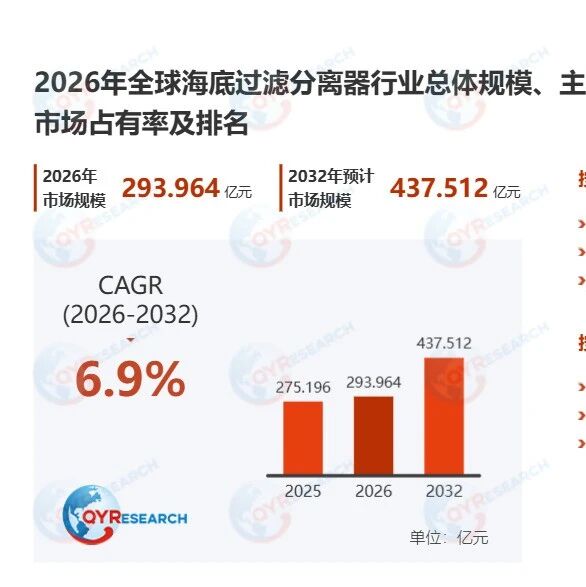
Industry Chain Analysis - The subsea filter separators are critical control devices in subsea production systems, relying on advanced materials science, deep-water structural engineering, and precision fluid separation technology [1][3] - Key materials include duplex stainless steel, super duplex stainless steel, nickel-based alloys (e.g., Inconel), high-strength low-alloy steel, and specialized corrosion-resistant coatings, which are essential for high-pressure and high-temperature environments [1][2] - The upstream supply chain is characterized by high specialization and technical concentration, with components such as filter media, cyclone separation structures, and high-pressure sealing components being crucial [2][3] Midstream: System Engineering Design and Deep-water Integration Capability - The midstream phase is where the value of subsea filter separators is primarily created, involving structural design, pressure vessel manufacturing, fluid path optimization, and system testing [4] - Custom design is necessary based on the fluid characteristics from oil and gas wells, with significant variations in fluid properties across different oil fields [4] - The manufacturing process adheres to strict international standards, emphasizing "zero failure" and extended service life due to high installation costs on the seabed [4] Downstream: Drivers of Deep-water Oil and Gas Development - The demand for subsea filter separators is driven by deep-water and ultra-deep-water oil and gas development, as exploration shifts towards deeper marine areas [5][6] - These separators protect the production system from solid particles and impurities, enhancing operational stability [6] - The demand is concentrated among large international oil companies and national energy enterprises, with significant project order values but long project cycles [7] Global Market Size and Structure - According to QYResearch, the global market for subsea filter separators is projected to reach 27.5 billion yuan by 2025 and 43.75 billion yuan by 2032, with a CAGR of 6.9% from 2026 to 2032 [9] Development Trends, Opportunities, and Challenges - The evolution of technology is focused on increasing pressure ratings and enhancing fatigue resistance and corrosion life for ultra-deep-water projects [11] - Market opportunities arise from the recovery of capital expenditures in deep-water oil and gas projects, particularly in regions like Brazil and the Gulf of Mexico [12][13] - The industry faces challenges due to its dependence on oil and gas investment cycles, high R&D costs, and the need for extensive customization, which complicates mass production [15][16] Cost Structure and Profit Model - Subsea filter separators are high-cost, low-volume customized engineering devices, with material costs, especially for high-end corrosion-resistant alloys, being significant [17] - The profit model is primarily project-based, with long order cycles but substantial individual order values, supplemented by after-sales maintenance and technical services [17] Entry Barriers - Entering the subsea filter separator industry requires deep expertise in marine engineering, material development, and a proven track record of reliability [18] - Companies must gain recognition from international oil companies and pass stringent supplier qualification audits, with project execution capability and global service networks being critical competitive factors [18]
连续八年全国第一,宁波何以NB?
吴晓波频道· 2026-03-08 00:30
Core Viewpoint - Ningbo, despite its low profile compared to other cities, is a manufacturing powerhouse with a strong foundation in specialized manufacturing, evidenced by its status as the city with the highest number of national manufacturing champions for eight consecutive years [8][9]. Group 1: Manufacturing Strength - Ningbo has the largest port in the world, Ningbo-Zhoushan Port, with a cargo throughput exceeding 1.4 billion tons last year, ranking first globally for 15 years [7]. - The city's GDP reached 1.6 trillion yuan, ranking 12th among Chinese cities and second in Zhejiang province [7]. - Ningbo is home to 11 companies listed in the Hurun China 500, ranking 10th among all cities [7]. - The number of high-tech enterprises in Ningbo exceeds 10,000, maintaining the highest growth rate in Zhejiang for four consecutive years [7]. Group 2: Specialized Manufacturing Champions - Ningbo has a significant number of national manufacturing champions, which are defined as companies that focus on specific manufacturing sectors with advanced technology and a leading market share globally [8]. - These champions play a crucial role in the global supply chain, often operating in niche markets that are not widely recognized but are essential for various industries [9][17]. Group 3: Innovation and R&D - Over 90% of R&D platforms, talent, and investment in Ningbo come from enterprises, with more than 80% of invention patents generated by these companies [25]. - The local government supports innovation through platforms like the Yongjiang Laboratory and various industry funds to enhance competitiveness [26][31]. Group 4: Industrial Ecosystem and Collaboration - Ningbo's industrial clusters provide a complete local supply chain, which reduces R&D and production costs, fostering deep specialization in key technologies [23]. - The collaboration among leading enterprises drives the transformation and upgrading of local industries, with many companies acting as "chain masters" to support smaller firms [24]. Group 5: Challenges and Future Plans - Ningbo faces structural challenges with a lack of large-scale leading enterprises, which limits its ability to compete with other major cities in the Yangtze River Delta [38]. - The local government aims to develop a "361" modern industrial system by 2027, targeting three trillion-level industrial clusters and six hundred billion-level clusters [34]. - Efforts are underway to attract leading enterprises and enhance the robotics industry, with several local companies already recognized among the top in China for robotics components [39][40].






比亚迪的守擂之年
2 1 Shi Ji Jing Ji Bao Dao· 2026-03-06 23:04
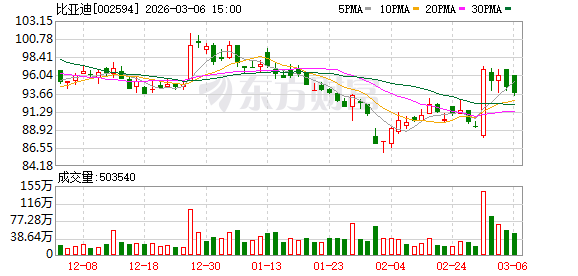
Core Insights - BYD is facing increasing competition and challenges in maintaining its market share as competitors like Geely are rapidly closing the technology gap [2][3][10] - The company is undergoing a strategic shift from aggressive market expansion to focusing on product adaptation and customer retention [3][4][12] Sales Performance - In January and February 2026, BYD's sales dropped to 210,000 and 190,200 units, representing year-on-year declines of 30% and 41.1% respectively [2] - Geely's sales during the same period were 270,000 and 206,000 units, indicating a competitive threat to BYD's market position [2] Product Strategy - BYD is focusing on the 100,000 to 200,000 yuan market segment, which is under pressure from competitors like Geely and Wuling [3][14] - The company plans to launch new models to reclaim market share in the budget electric vehicle segment [3][14] Technological Innovation - BYD's internal strategy involves a cycle of mass production, reserve, and pre-research for technological advancements [4][12] - The company aims to introduce significant technological upgrades by 2026, as indicated by its leadership [4][12] Market Dynamics - The competitive landscape is shifting, with traditional Japanese brands losing market share from 20.6% to below 10% between 2021 and 2025 due to slow electrification [7] - BYD's growth has been supported by favorable government policies, including tax exemptions for electric vehicles [9] Pricing and Cost Strategy - BYD has successfully positioned itself in the entry-level market by offering competitive pricing and superior fuel efficiency compared to traditional gasoline vehicles [5][6] - The company has implemented a strategy of price reductions and enhanced configurations to maintain its market position [6][11] High-End Market Strategy - BYD is focusing on high-end market segments, with plans to launch new brands and models to compete with luxury vehicles [18][20] - The company has seen significant growth in its high-end brands, with total sales reaching 396,500 units in 2025, doubling their market share [18][19] International Expansion - BYD's overseas sales surpassed 100,000 units in February 2026, marking a 41.4% increase and accounting for 52.6% of total sales [21] - The company aims to achieve 1.3 million overseas sales in 2026, reflecting a strategic pivot towards international markets [21]
人类还没到用嘴开车的时候
远川研究所· 2026-03-06 13:16
Core Viewpoint - The article discusses the evolution of voice assistants in the automotive industry, highlighting both advancements and risks associated with their increasing integration into vehicle functionalities [11][12][20]. Group 1: Evolution of Voice Assistants - Over the past decade, automotive companies have transitioned from physical buttons to voice-controlled systems, aiming to create a more streamlined and modern user experience [12][15]. - The shift towards voice assistants is driven by the desire to reduce mechanical complexity and enhance the aesthetic appeal of vehicles, aligning with the trend of smart technology [15][18]. - Despite the advancements, incidents such as misinterpretation of voice commands raise concerns about the reliability of these systems, particularly in critical driving situations [7][22]. Group 2: Risks and Challenges - The reliance on voice assistants for essential functions like headlights and wipers introduces new risks, as these systems may not always respond accurately, potentially compromising safety [22][24]. - The lack of integration between voice assistants and driving systems can lead to dangerous situations, as the voice system may operate independently without real-time data from the vehicle's driving domain [27][28]. - The automotive industry faces pressure to balance innovation with safety, as regulatory bodies are beginning to impose stricter guidelines on the use of voice and touch controls in vehicles [34][36]. Group 3: Regulatory Landscape - Recent proposals from regulatory authorities emphasize the need for physical controls for safety-critical functions, indicating a shift back towards traditional interfaces in response to the risks posed by over-reliance on voice technology [34][36]. - The upcoming regulations may require that essential functions like lights and wipers have dedicated physical buttons, ensuring that safety is prioritized over technological advancements [35][37].