盈利增长

Search documents
美银:四季度盈利有望获支撑维持中国宏桥(01378)“买入”评级 目标价上调至35港元
智通财经网· 2025-10-31 02:32
Core Viewpoint - Bank of America maintains a "Buy" rating for China Hongqiao's subsidiary Shandong Hongqiao, raising the target price from HKD 26.00 to HKD 35.00 based on strong revenue and profit growth [1] Group 1: Company Performance - For the first three quarters of 2025, Shandong Hongqiao reported total revenue of CNY 116.93 billion, a year-on-year increase of 6.23%, and a net profit of CNY 19.37 billion, up 23.13% year-on-year [1] - In Q3, net profit reached CNY 6.9 billion, reflecting an 18% year-on-year increase and a 14% quarter-on-quarter increase, aligning with expectations; the gross margin expanded by 3 percentage points to 26% [1] Group 2: Industry Outlook - The aluminum industry in China is expected to remain resilient in Q4 due to low inventory, stable upstream supply, and seasonal demand from the power grid, with aluminum prices slightly strengthening [2] - Current spot aluminum prices have risen above CNY 21,000 per ton, while alumina prices remain in the range of CNY 2,800–2,900 per ton, with aluminum profit margins expanding to over CNY 5,000 per ton [2] Group 3: Future Projections - Bank of America has adjusted its aluminum price forecasts, raising the 2025 expectation to CNY 20,600 per ton (+CNY 100 per ton) and the 2026 long-term forecast to CNY 21,000 per ton [2] - The bank has increased its profit forecasts for China Hongqiao for 2025-2027 by 5%-23%, projecting a net profit of CNY 26 billion for 2025 (up 17% year-on-year) and CNY 30 billion for 2026 (up 15% year-on-year) [2] Group 4: Investment Rationale - Reasons for maintaining the "Buy" rating include a constructive outlook on aluminum prices, attractive dividend yield (6%-7% under a 63% payout ratio), and the expected contribution from the Ximangdu project, which is anticipated to start production by the end of 2025 [3] - The ongoing share buyback program is expected to support the stock price, with the current target price corresponding to a 10x P/E ratio for 2026, which remains attractive compared to Chinese copper companies (12-16x) and gold companies (16-17x) [3]
【常熟银行(601128.SH)】业绩增长韧性强,可转债转股可期——2025年三季报点评(王一峰/赵晨阳)
光大证券研究· 2025-10-30 23:07
Core Viewpoint - The report highlights that Changshu Bank has shown steady growth in net profit and revenue for the first three quarters of 2025, despite a slowdown in revenue growth compared to the first half of the year [4][5]. Revenue and Profitability - For the first three quarters of 2025, Changshu Bank achieved a revenue of 9.05 billion, representing a year-on-year growth of 8.2%, and a net profit attributable to shareholders of 3.36 billion, with a year-on-year increase of 12.8% [4][5]. - The weighted average return on equity (ROAE) was 15.02%, reflecting a slight increase of 0.06 percentage points year-on-year [4]. Growth Rates - The year-on-year growth rates for revenue, pre-provision profit, and net profit were 8.2%, 10.1%, and 12.8%, respectively, showing a decline of 1.9, 2, and 0.7 percentage points compared to the first half of 2025 [5]. - The net interest income and non-interest income growth rates were 2.4% and 35.3%, respectively, with changes of 1.6 and -22 percentage points compared to the first half of 2025 [5]. Asset and Loan Growth - As of the end of Q3 2025, the year-on-year growth rates for interest-earning assets and loans were 11.6% and 7.1%, indicating a steady increase in loan growth [6]. Deposit Trends - By the end of Q3 2025, the year-on-year growth rates for interest-bearing liabilities and deposits were 11.4% and 9.7%, with changes of +1.9 and -0.2 percentage points compared to the end of Q2 2025 [7]. Net Interest Margin - The net interest margin (NIM) for the first three quarters was 2.57%, narrowing by 1 basis point and 14 basis points compared to the first half of 2025 and 2024, respectively [8]. Non-Interest Income - Non-interest income for the first three quarters was 1.98 billion, growing by 35% year-on-year, but its proportion of total revenue decreased to 21.9% [9]. Asset Quality - As of the end of Q3 2025, the non-performing loan ratio and attention ratio were 0.76% and 1.58%, remaining stable compared to mid-year [10]. - The loan loss provision for Q3 was 230 million, which was a decrease of 70 million year-on-year, indicating a slowdown in provision accumulation [10]. Capital Adequacy - By the end of Q3 2025, the core tier 1, tier 1, and total capital adequacy ratios were 11.14%, 11.19%, and 13.66%, showing an increase of 0.41, 0.41, and 0.06 percentage points compared to Q2 2025 [11].



Cardinal Health Surges After Reporting Strong Q1 Financial Results
Yahoo Finance· 2025-10-30 15:33
Core Insights - Cardinal Health delivered strong first-quarter results for fiscal 2026, exceeding both earnings and revenue expectations while raising full-year guidance [1][6] Financial Performance - Non-GAAP earnings per share (EPS) reached $2.55, surpassing the consensus estimate of $2.21 by 16% [2][9] - Revenue totaled $64.0 billion, exceeding estimates of $59.79 billion by 7% [2][9] - Non-GAAP operating earnings increased by 37% to $857 million, while GAAP operating earnings rose 18% to $668 million, indicating effective margin expansion [3][9] Segment Performance - The Pharmaceutical and Specialty Solutions segment, which constitutes 92% of total revenue, grew by 23% year over year to $59.2 billion, driving overall performance [2][5] - Global Medical Products saw modest growth of 2%, while the Other segment surged by 38%, highlighting successful diversification efforts [2] Guidance and Future Outlook - Full-year fiscal 2026 non-GAAP EPS guidance was raised to a range of $9.65 to $9.85, with a midpoint of $9.75 suggesting approximately $7.20 of EPS generation in the remaining three quarters [6] - Free cash flow guidance is set at $3.0 billion to $3.5 billion, indicating expectations for strong operational cash conversion into shareholder returns [6] - An accelerated share repurchase program of $375 million was initiated, reflecting management's confidence in the company's valuation [6] Strategic Moves - The acquisition of Solaris Health is anticipated to close in early November, expected to enhance specialty pharmaceutical services and contribute to earnings growth [7] Leadership Commentary - CEO Jason Hollar expressed satisfaction with the company's strong operational and financial performance, emphasizing consistent execution across all segments [10]

苏农银行(603323)2025年三季报点评:盈利增长韧性高 风险抵补能力强
Xin Lang Cai Jing· 2025-10-30 12:37
Core Viewpoint - Su Nong Bank reported stable revenue and resilient profit growth in the first three quarters of 2025, with a slight increase in net profit and a decrease in return on equity [1][2]. Revenue and Profitability - The bank achieved operating income of 3.22 billion, a year-on-year increase of 0.1%, and a net profit attributable to shareholders of 1.71 billion, up 5% year-on-year [1]. - The annualized weighted average return on equity was 12.03%, down 0.88 percentage points year-on-year [1]. - Revenue growth rates for net interest income and non-interest income were -3.8% and 7.9%, respectively, with changes of -0.9 and +2.4 percentage points compared to the first half of the year [2]. Asset and Loan Growth - As of the end of Q3 2025, the growth rates for interest-earning assets and loans were 9.7% and 8.7%, respectively, showing improvements of 3.5 and 4.5 percentage points from the end of Q2 2025 [3]. - New loans in Q3 amounted to 1.6 billion, with significant increases in corporate loans, while retail and bill loans showed minor changes [3]. Deposit Growth and Structure - The growth rates for interest-bearing liabilities and deposits were 8.7% and 7.1%, respectively, with increases of 6.4 and 2.9 percentage points from mid-year [4]. - In Q3, deposits increased by 4 billion, with a notable rise in time deposits, indicating a continued trend towards more stable funding sources [4]. Net Interest Margin (NIM) and Cost Management - The bank's net interest margin faced pressure, with a decrease of 3 basis points compared to the first half of the year and 12 basis points year-on-year [5]. - The cost of interest-bearing liabilities decreased by 3 basis points, suggesting potential for further reduction in funding costs [5]. Non-Interest Income and Asset Quality - Non-interest income reached 1.16 billion, growing by 7.9% year-on-year, with a significant increase in fee and commission income [6]. - The bank maintained a low non-performing loan ratio of 0.9% and a high provision coverage ratio of 355.9%, indicating stable asset quality [6]. Capital Adequacy - As of the end of Q3 2025, the bank's core tier 1, tier 1, and total capital adequacy ratios were 10.76%, 10.76%, and 12.88%, respectively, with a slight decline from mid-year [7]. - The bank's capital adequacy provides a solid foundation for future growth and expansion [7]. Earnings Forecast and Valuation - The bank benefits from its local market position and is expected to continue growing, although challenges remain due to subdued financing demand and pressure on net interest margins [8]. - Adjusted earnings per share forecasts for 2025-2027 are 1.00, 1.05, and 1.11, with corresponding price-to-book and price-to-earnings ratios indicating potential for investment [8].

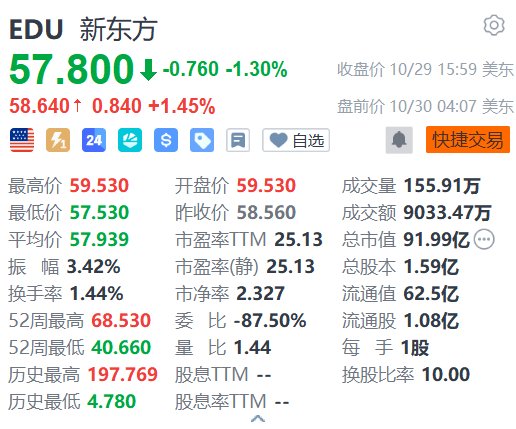
美股异动丨新东方盘前涨超1% 绩后获多家机构看好
Ge Long Hui· 2025-10-30 08:53
Core Viewpoint - New Oriental (EDU.US) reported a 6.1% year-over-year increase in net revenue for Q1, reaching $1.523 billion, exceeding expectations, indicating a potential end to the challenging downturn cycle for FY2025 [1] Financial Performance - The adjusted performance of New Oriental is projected to have over a 10% upward adjustment compared to Bloomberg's expectations, suggesting a return to profitability growth [1] - The company's capital return rate has surpassed 5%, reflecting strong financial health [1] Business Segments - The K12 business segment is expected to accelerate growth by the end of November 2026, driven by a more favorable competitive environment, strong customer retention rates, and improvements in the Xi'an market [1] - The overseas business is also showing positive trends, supported by an increase in child registrations and robust performance in Asian markets, with management noting consistent quarterly improvements since May [1] Analyst Ratings - Morgan Stanley has raised New Oriental's target price from $60.4 to $68.8, maintaining an "outperform" rating [1]
大行评级丨小摩:上调新东方目标价13% 重申“增持”评级
Ge Long Hui· 2025-10-30 06:03
Core Viewpoint - Morgan Stanley has raised the target price for New Oriental (9901.HK) by 12.8%, from HKD 47 to HKD 53, while maintaining an "Overweight" rating, indicating a positive outlook for the company [1] Financial Performance - The adjusted performance of New Oriental is expected to exceed Bloomberg's estimates by over 10%, suggesting the end of a challenging downturn for the fiscal year 2025 [1] - The company's capital return rate is strong, currently exceeding 5% [1] Market Reaction - Despite an initial decline in the company's stock price in the US market, Morgan Stanley believes that New Oriental is on the path to profitability growth with a clear outlook [1]
Caterpillar’s Stock Up 12% After Impressive Q3 Earnings
Yahoo Finance· 2025-10-29 15:16
Core Insights - Caterpillar Inc. reported strong third-quarter earnings, exceeding both earnings and revenue expectations, indicating resilient demand in its heavy equipment business despite margin pressures and cost challenges [1][2]. Financial Performance - Adjusted EPS was $4.95, surpassing the consensus estimate of $4.52 by 43 cents [2][7]. - Revenue reached $17.64 billion, exceeding expectations of $16.77 billion by $870 million, reflecting a 10% increase year-over-year [2][7]. - Operating income declined by 3% year-over-year to $3.052 billion, highlighting margin compression that needs monitoring [2][5][8]. Segment Performance - The Energy & Transportation segment led sales with $8.397 billion, a 17% year-over-year increase, driven by strong demand in power generation and industrial applications [3]. - Construction Industries generated $6.76 billion in sales, up 7%, while Resource Industries contributed $3.11 billion with a modest 2% growth [3]. Cash Flow and Financial Health - Operating cash flow remained robust at $3.7 billion, indicating strong earnings quality [4]. - The company held $7.5 billion in cash, providing flexibility for capital deployment and shareholder returns [4]. Margin and Cost Analysis - Operating margin contracted to 17.3%, down 220 basis points from 19.5% in the previous year, due to unfavorable manufacturing costs and increased selling, general, and administrative expenses [5][7]. - The effective tax rate increased, further impacting bottom-line performance [5].

Why Rambus Stock Sank Today
Yahoo Finance· 2025-10-28 20:25
Core Viewpoint - Rambus stock declined 8.7% despite a solid quarterly report, contrasting with gains in the S&P 500 and Nasdaq Composite [1][2]. Financial Performance - Rambus reported non-GAAP adjusted earnings per share (EPS) of $0.63 on revenue of $178.5 million, meeting earnings expectations but exceeding sales forecasts of $176 million [4]. - Adjusted revenue was $179.5 million, reflecting a year-over-year increase of approximately 22%, driven by strong demand in the DDR5 memory solutions category [5]. Future Guidance - The company projects fourth-quarter sales between $184 million and $190 million, with adjusted operating costs expected to be between $99 million and $103 million. Adjusted EPS for Q4 is anticipated to range from $0.64 to $0.71 [6]. Market Sentiment - Despite the positive revenue performance, investor concerns about potential growth deceleration in the current quarter have led to a negative market reaction. The stock has nearly doubled this year, but raised expectations may have contributed to the sell-off [7].

Armstrong World Industries(AWI) - 2025 Q3 - Earnings Call Transcript
2025-10-28 15:02
Financial Data and Key Metrics Changes - The company reported record-setting third quarter net sales and earnings results, achieving a year-over-year top-line growth of 10% [4][5] - Consolidated adjusted EBITDA increased by 6%, while adjusted net earnings per share rose by 13% [5][20] - Free cash flow grew significantly, with a double-digit increase both in the quarter and year-to-date [5][20] Business Line Data and Key Metrics Changes - In the Mineral Fiber segment, net sales increased by 6% year-over-year, driven by strong average unit value (AUV) growth and positive sales volume contributions [8][17] - The Architectural Specialties segment saw a net sales increase of 18%, supported by acquisitions and solid organic growth [12][19] Market Data and Key Metrics Changes - The company noted stabilizing market conditions, with no anticipated softening in discretionary renovation activity, contrary to earlier expectations [28][90] - The office market showed signs of improvement, with declining vacancy rates for Class A offices and increased demand for renovations in Class B spaces [30][31] Company Strategy and Development Direction - The company remains focused on operational efficiency, commercial execution, and growth initiatives to navigate a dynamic macroeconomic environment [7][8] - Investments in digital growth initiatives like PROJECTWORKS and Kanopi are expected to drive volume and contribute to margin expansion [15][16] Management Comments on Operating Environment and Future Outlook - Management expressed confidence in achieving strong results for the remainder of 2025, with expectations for continued double-digit growth in net sales and adjusted EBITDA [27][35] - The company anticipates a full-year adjusted EBITDA margin of approximately 43% for the Mineral Fiber segment, the highest since 2019 [10][25] Other Important Information - The company announced a 10% increase in its quarterly dividend, marking the seventh consecutive annual increase since the inception of its dividend program [24] - The acquisition of Geometrik, a Canadian wood ceiling manufacturer, was completed for $7.5 million, enhancing the company's product offerings and geographic diversification [14][23] Q&A Session Summary Question: Can you talk about the benefit that you're seeing from the new products? - Management noted that innovation at the high end of the portfolio is driving double-digit growth in both the Mineral Fiber and Architectural Specialties segments [39][40] Question: What is the outlook for Architectural Specialties margins? - Management expects to maintain organic margins around 20% while continuing to focus on growth opportunities [43][44] Question: Can you elaborate on the timing-related cost headwinds? - Management highlighted that higher SG&A costs were driven by increased incentive compensation and atypical medical claims, which are not expected to persist [50][51] Question: What is the outlook for the education and healthcare segments? - Management indicated that both segments remain stabilized, with positive trends in healthcare and robust opportunities in data centers [54][55] Question: How do you view the potential for Mineral Fiber margins to exceed pre-pandemic levels? - Management emphasized that continued focus on pricing, productivity, and innovation will support margin expansion beyond pre-pandemic levels [92][93]

短期波动后,A股港股还会继续向上吗?|第413期直播回放
银行螺丝钉· 2025-10-28 14:03
Core Viewpoint - The article discusses the significant rise in A-shares and Hong Kong stocks over the past year, exploring the reasons behind this increase, the current valuation of RMB assets, and the potential for future market growth [1][18]. Group 1: Market Trends - In a bull market, fluctuations are normal, and corrections are common even during significant upward trends [3][4]. - Historical data shows that even during major bull markets, such as in 2007, there were multiple corrections exceeding 10% [5][9]. - The index tends to rise over the long term, with past crises only causing temporary fluctuations [9]. Group 2: Recent Performance - As of mid-September 2024, A-shares and Hong Kong stocks have risen significantly from a historical low valuation of 5.9 stars to around 4.1-4.2 stars [15][19]. - The past year has seen A-shares and Hong Kong stocks leading global markets, with the MSCI World Index rising by 22.98% and the Hang Seng Index increasing by 55.93% [21]. Group 3: Reasons for Market Growth - The first reason for the recent rise is valuation improvement, as the previous bear market had driven valuations to extremely low levels, with A-shares and Hong Kong stocks being 50% lower than the global average [19][20]. - The second reason is the improvement in liquidity, aided by favorable policies and market conditions, including the Federal Reserve's interest rate cuts and domestic supportive measures [26][28]. Group 4: Earnings Growth - There are signs of improvement in earnings, particularly in the technology and pharmaceutical sectors, which have shown significant growth [30][32]. - The technology sector in Hong Kong saw a remarkable earnings growth of 128.92% year-on-year in Q1 2025, although growth rates slowed to 51.24% in Q2 [32]. - Consumer sectors in A-shares have shown stable earnings growth, but the growth rate has slowed recently [34][38]. Group 5: Future Market Outlook - If the Federal Reserve continues to lower interest rates and domestic conditions remain accommodative, there is potential for further market growth, especially if earnings continue to improve [40].