
卫星互联网

Search documents
2025卫星互联网产业生态大会将于12月4日至5日举办
Guo Ji Jin Rong Bao· 2025-12-03 06:02
Core Insights - The "2025 Satellite Internet Industry Ecosystem Conference" will be held in Shanghai on December 4-5, focusing on showcasing industry policies, promoting ecological cooperation, and deepening international exchanges [1] - The conference will feature a main forum, three thematic sub-forums, and two investment matching activities, highlighting the latest developments and systematic layout of Shanghai's satellite internet industry [1] Group 1: Technological Framework - Satellite internet is a strategic emerging field that countries are competing to develop, with Shanghai aiming to create a globally influential "Satellite Internet City" [2] - Shanghai is advancing key technological breakthroughs in satellite design, communication payloads, ground terminal equipment, and operational services to achieve self-control in critical areas [2] - The city is establishing a sustainable and self-controlled technological closed loop, focusing on network architecture, spatial perception, testing validation, and space safety through innovation labs and testing platforms [2] Group 2: Capacity System - Shanghai is constructing a leading satellite internet industry cluster through a "2+X" model, with major clusters in Songjiang and Pudong, and additional support from regions like Qingpu and Minhang [3] - The conference will include a signing ceremony for ecological partners in the satellite internet industry chain, promoting collaboration across research, manufacturing, testing, and operations [3] - A demand roadmap will be released, covering satellite manufacturing, constellation networking, terminal development, and application scenarios in urban governance, emergency communication, and public services [3] Group 3: Institutional Framework - The conference will address institutional measures to ensure long-term support for the industry, emphasizing talent development and capital support [4] - Shanghai is implementing a dual engine of "talent + capital," providing financial rewards for high-end talent and fostering partnerships between leading companies and educational institutions [4] - A financial service matrix for the satellite internet industry will be launched to create a stable and predictable capital support system [5]
“朱雀三号”首飞在即,资金抢筹!卫星ETF(159206)盘中净申购超5800万份!
Sou Hu Cai Jing· 2025-12-03 02:45
Group 1 - The core viewpoint of the news highlights the significant growth and interest in the Satellite ETF (159206), which has seen a net subscription of over 58 million units, reaching a new high in both scale and share count [3][4][6] - The Satellite ETF has achieved a latest scale of 1.654 billion yuan and a total share count of 1.345 billion units, marking a record since its inception [4][6] - Recent net inflows into the Satellite ETF exceeded 100 million yuan over the past five days, indicating strong investor interest [4] Group 2 - The upcoming maiden flight of the Zhuque-3 rocket represents a milestone for China's commercial space industry, potentially making China the second country to master reusable rocket technology [6] - The commercial space sector is experiencing a rapid development phase, driven by policy, technology, and capital, with significant advancements across various segments including satellite manufacturing [6] - Huatai Securities notes that the commercial space sector is at a turning point with supportive policies, performance improvements, and technological advancements, particularly in satellite internet and related industries [6]

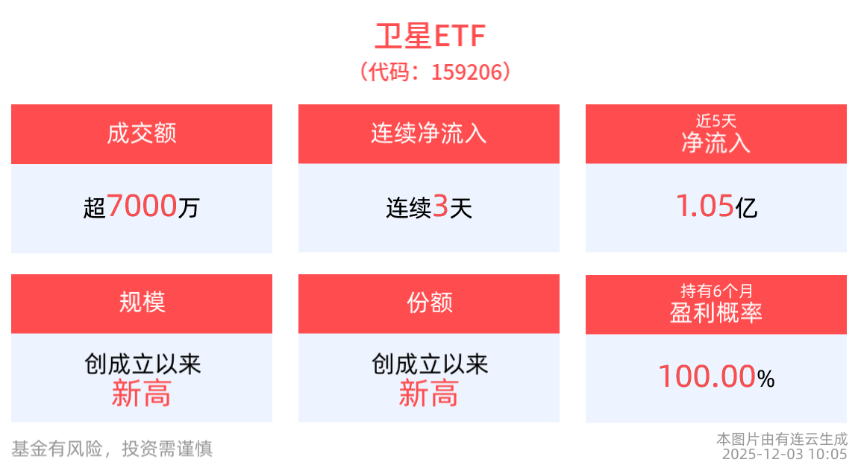
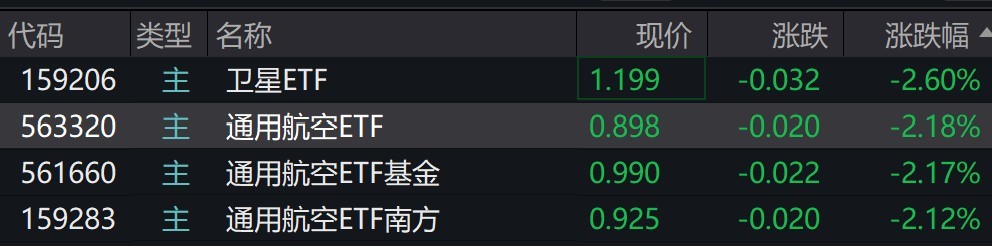
卫星、通用航空概念股走低,相关ETF跌超2%
Mei Ri Jing Ji Xin Wen· 2025-12-03 02:38
卫星、通用航空概念股走低,华力创通跌超5%,航天电子、电科芯片、振芯科技、中科星图跌超3%。 受盘面影响,卫星、通用航空相关ETF跌超2%。 (文章来源:每日经济新闻) | 代码 | 类型 名称 | 现价 | 涨跌 | 涨跌幅 | | --- | --- | --- | --- | --- | | 159206 | 主 卫星ETF | 1.199 | -0.032 | -2.60% | | 563320 | 主 通用航空ETF | 0.898 | -0.020 | -2.18% | | 561660 | 主 通用航空ETF基金 | 0.990 | -0.022 | -2.17% | | 159283 | 主 通用航空ETF南方 | 0.925 | -0.020 | -2.12% | 有机构分析称,近年来,我国商业航天在政策牵引、技术突破与市场驱动下,以全产业链协同创新,完成了历史性的跨越。商业航天司牵头 推进"卫星互联网"等重大基础设施建设,2027年前将形成大规模星座组网,上游卫星制造、中游发射订单有望增长。并且,统一监管缩短审 批周期,批量生产、批次发射成为常态,卫星单颗成本有望下降。商业航天司的成立不仅 ...
卫星互联网指数盘中下跌2%,成分股普跌
Mei Ri Jing Ji Xin Wen· 2025-12-03 02:13
每经AI快讯,12月3日,卫星互联网指数盘中下跌2%,成分股呈现普跌态势。亚光科技领跌,跌幅达 5.89%,航天环宇、航宇微、航天宏图跌幅分别为4.47%、4.03%和3.93%,航天智装、上海沪工等多股 跌幅超3%。 ...


音频 | 格隆汇12.3盘前要点—港A美股你需要关注的大事都在这
Ge Long Hui A P P· 2025-12-03 01:08
Group 1 - The National Development and Reform Commission and other departments encourage local governments to utilize computing power vouchers, model vouchers, and data vouchers to provide convenience and discounts in computing power, algorithms, and data [1] - The Shanghai Cyberspace Administration has guided platforms like Xiaohongshu and Bilibili to self-check and clean up over 40,000 pieces of illegal and harmful information related to the real estate market [1] - Major US stock indices closed higher, with Intel rising over 8% and Boeing soaring over 10% [1] - WTI January crude oil futures fell over 1.14%, closing at $58.64 per barrel [1] - The US SEC chairman plans to introduce new capital market regulations in January to encourage more companies to go public [1] - Amazon has launched its latest AI chip, challenging Nvidia and Google [1] - The scale of US money market assets has surpassed $8 trillion for the first time [1] - The OECD has raised China's economic growth forecast for 2025 to 5% [1] Group 2 - A-share new account openings in November reached 2.38 million, a month-on-month increase of 3% but a year-on-year decrease of 12% [1] - Hong Kong's total value of residential sale and purchase agreements in November increased by 1.2% month-on-month but decreased by 9.8% year-on-year [1] - The order volume for effective drugs against influenza has surged nearly 9 times, indicating that the flu is at a moderate epidemic level nationwide [1] - Dragon Power Technology is communicating with customers regarding the reasons for the price increase of lithium iron phosphate [1] - Tianfu Communication's directors and executives plan to reduce their holdings by no more than 0.0611% of shares [1]




2025卫星互联网产业生态大会将于12月4日至5日在上海举办;谷歌的TPU未来两年产量将出现爆炸式增长,2027年产量将上调至约500万块——《投资早参》
Mei Ri Jing Ji Xin Wen· 2025-12-03 00:20
3、 江西省人民政府办公厅印发《江西省加快脑机接口技术和产业发展若干措施》。其中提出,支持脑 机接口医疗器械纳入创新产品推荐目录,加快脑机接口整机产品迭代应用和规模化推广。遴选脑机接口 创新应用项目,定期发布创新应用典型案例,推动开放应用场景。积极推进"人工智能+"行动,推动人 工智能技术加速脑机接口研发。依托省科技成果转移转化中心,组织脑机接口科技成果对接活动,加快 创新成果落地。 脑机接口行业作为融合多学科前沿技术的高成长赛道,在政策强力支持、医保支付落 地与技术持续突破的驱动下,正迈向规模化应用关键阶段。 每经记者|杨建 每经编辑|彭水萍 (一)重要市场新闻 1、美股三大指数集体收涨,道指涨0.39%,纳指涨0.59%,标普500指数涨0.25%,热门科技股涨跌不 一,英特尔涨超8%,苹果涨超1%,英伟达涨近1%,博通跌超1%;加密储备概念涨幅居前,Strategy、 康特科技涨超5%,阿斯麦涨近2%,Coinbase涨超1%。波音涨超10%,创4月份以来最大单日涨幅。纳 斯达克中国金龙指数跌0.65%,中概股多数下跌,理想汽车涨近1%。 2、比特币大幅反弹,重回9万美元上方,报9.12万美元,涨超5% ...
薪智:2025卫星互联网产业典型企业人才与薪酬分析报告
Sou Hu Cai Jing· 2025-12-02 22:41
Core Insights - The report focuses on the talent and compensation analysis in the satellite internet industry, highlighting the industry's strategic importance and growth potential as it transitions into a phase of scale expansion and commercialization [1][4]. Group 1: Industry Overview - The satellite internet industry constructs space-based network infrastructure through satellite constellations, providing broadband communication services globally, especially in remote areas [11]. - China's satellite internet industry has developed a complete supply chain, including satellite manufacturing, rocket launching, and ground terminal equipment, and is experiencing significant growth driven by technological advancements and policy support [11][12]. Group 2: Compensation Characteristics - The industry exhibits characteristics of high-level scarcity, technical premium, and scale-driven compensation, with a notable demand for senior management and technical talent [15][17]. - Senior management positions, such as directors, earn significantly higher total cash compensation compared to lower-level positions, with directors in large enterprises earning approximately 979,916 yuan, which is 79.4% higher than their counterparts in smaller firms [19][23]. - Compensation levels are strongly correlated with company size, with larger firms offering higher salaries across all levels, indicating a competitive advantage in attracting top talent [20][23]. Group 3: Graduate Compensation Trends - Graduate compensation is driven by high educational qualifications, with master's degree holders from key institutions earning starting salaries of 25,900 yuan per month in 2024, reflecting a 62.9% increase from 2022 [26][27]. - The salary gap between graduates from key universities and those from ordinary institutions is widening, with the starting salary for key university graduates being 35% higher than that of ordinary university graduates [27][29]. - Regional strategies are reshaping the compensation landscape, with cities like Suzhou and Changsha attracting talent through competitive salaries and favorable policies, despite lower living costs compared to major cities like Shanghai [29][31]. Group 4: Job Market Dynamics - The demand for technical positions is high, with many roles requiring at least three years of experience, pushing graduates to gain practical experience through internships [30]. - The job market shows significant fluctuations, with recruitment data indicating a "V-shaped" recovery pattern, followed by a decline in hiring activity in subsequent months [40][48].

晚报 | 12月3日主题前瞻
Xuan Gu Bao· 2025-12-02 14:28
Group 1: Cloud Computing - Amazon Web Services (AWS) is hosting its annual cloud computing event in Las Vegas, which is significant for Amazon as AWS accounts for one-fifth of its sales and often contributes over half of its profits [1] - AWS is expected to unveil a new multimodal model capable of processing text, speech, images, and video, which aligns with its AI and cloud strategy [1] - Analysts from Morgan Stanley are optimistic about AI investment growth, indicating strong demand for AI capabilities that exceed supply, which is expected to enhance core business operations [1] Group 2: Electric Vehicle Charging Infrastructure - Shanghai's transportation and development authorities issued a notice to enhance safety management of public electric vehicle charging facilities, mandating compliance with national safety standards [2] - By August 2026, all new or updated public charging facilities in Shanghai must use products certified under mandatory product certification [2] - The National Development and Reform Commission aims to establish 28 million charging facilities nationwide by the end of 2027, significantly increasing charging capacity to meet the needs of over 80 million electric vehicles [2] Group 3: Brain-Computer Interface Technology - The Jiangxi provincial government has introduced measures to accelerate the development of brain-computer interface technology, including support for medical devices and project funding [3] - The brain-computer interface industry is expected to reach a global market size of $40 billion by 2030 and exceed $145 billion by 2040, driven by policy support and technological advancements [3] - Domestic companies are making significant progress in areas such as device miniaturization and signal transmission, presenting investment opportunities in the mid to long term [3] Group 4: Artificial Intelligence - The 2025 Volcano Engine Original Power Conference is scheduled for December 18-19, where significant updates on AI models and tools will be announced [4] - ByteDance has established a comprehensive AI ecosystem, focusing on model development, platform integration, and application deployment, with a strong emphasis on hardware [4] - Analysts believe ByteDance's full-stack approach in cloud infrastructure, large models, and applications positions it well for future AI advancements [4] Group 5: Satellite Internet - The "2025 Satellite Internet Industry Ecosystem Conference" will be held in Shanghai, focusing on collaboration across various sectors of the satellite internet industry [5] - The satellite internet sector in China is rapidly developing, with expectations for commercial applications to begin in 2025, supported by policy and technological innovations [5] - The integration of satellite internet with 5G/6G technologies is anticipated to create a unified global communication network, fostering innovation in smart transportation and urban management [5] Group 6: Bamboo as a Plastic Alternative - The National Development and Reform Commission held a meeting to promote the "Bamboo Instead of Plastic" initiative, outlining progress and future strategies [6] - The bamboo industry is projected to exceed 1 trillion yuan in total output value by 2035, becoming a key solution for plastic pollution [6] - The initiative aims to enhance technology, expand application areas, and transition from traditional bamboo products to high-value, high-tech offerings [6] Group 7: Data and Digital Talent Development - Several government departments have issued opinions to strengthen the development of data-related academic disciplines and digital talent, promoting the use of resources like computing power and data vouchers [7]
2025卫星互联网产业生态大会将于12月4日至5日在沪举办
Zheng Quan Shi Bao Wang· 2025-12-02 12:40
人民财讯12月2日电,据上海经信委,"星聚生态.链启未来——2025卫星互联网产业生态大会"定于12月 4日至5日在上海举办。为进一步强化跨链协同,大会期间将举行上海卫星互联网产业链生态伙伴签约仪 式,推动研发、制造、测试、运营和应用各环节形成产业网络,共同打造更具开放性与延展性的生态合 作格局。大会还将重磅发布上海卫星互联网产业项目与应用场景需求:项目方向覆盖卫星制造、星座组 网、终端研发及发射服务等关键环节;应用场景聚焦城市治理、应急通信、行业拓展、惠民服务等多维 领域。 ...
龙虎榜复盘丨福建股、航天持续走强,机构整体呈现买多卖少
Xuan Gu Bao· 2025-12-02 11:22
Group 1 - Institutional buying activity saw 32 stocks listed, with 21 experiencing net buying and 11 net selling on the day [1] - The top three stocks with the highest institutional purchases were Aerospace Development (CNY 167 million), Shunhao Co., Ltd. (CNY 150 million), and Guofeng New Materials (CNY 119 million over three days) [1] Group 2 - Shunhao Co., Ltd. reported a net purchase of CNY 150 million by three institutions today [2] - The company invested CNY 110 million in Beijing Trajectory Technology Co., Ltd. in June 2025, acquiring a 19.30% stake, focusing on satellite-based computing services [2] - The "Tianshutian Calculation" business of Trajectory Technology is expected to have clear commercial value in the next five years, while the "Dizhutian Calculation" business may gradually compete with ground data centers in 5-10 years [2] Group 3 - The Fujian Provincial Development and Reform Commission released measures to promote the development of computing infrastructure on December 1 [3] - A press conference was held by the Fujian Provincial Government to discuss the implementation of policies supporting cross-strait integration development [3] Group 4 - The successful first flight of Blue Arrow Aerospace's Zhuque-3 rocket has garnered significant market attention, marking a potential milestone for China's space industry [4] - If successful, China would become the second country after the United States to master reusable rocket technology [4] Group 5 - Fujian High-speed's subsidiary is involved in the "Maritime Silk Road" satellite development and launch, actively promoting the construction of a satellite constellation to serve the Southeast coast and the Belt and Road Initiative [5] Group 6 - Tongyu Communication plans to invest CNY 30 million by the end of 2024 to acquire a stake in Hongqing Technology, a key player in satellite core components [6] - The company aims to strengthen its upstream component layout for satellite internet [6]


