卫星ETF

Search documents
未知机构:盘前03061昨晚美股震荡调整盘中因为传美国考虑出台法规-20260306
未知机构· 2026-03-06 02:20
Summary of Conference Call Notes Industry Overview - The notes reflect the current state of the U.S. stock market, particularly focusing on the impact of geopolitical tensions and regulatory considerations on technology and energy sectors [1][2][3][4][5][6][7][8]. Key Points and Arguments 1. **U.S. Stock Market Volatility**: The U.S. stock market experienced fluctuations due to rumors of new regulations requiring global approval for AI chip purchases, leading to a significant drop in chip stocks [1]. 2. **Geopolitical Tensions**: Ongoing tensions in the Middle East have created uncertainty, with fluctuating oil prices impacting market sentiment. Initial spikes in oil prices were followed by a recovery after news of potential U.S. measures to stabilize the market [2][3][5][6]. 3. **Government Policy Response**: The recent government work report from the two sessions was largely in line with expectations, lacking new initiatives to alleviate geopolitical concerns. This resulted in a significant outflow of capital from the market, indicating a cautious investor sentiment [7]. 4. **Market Dynamics**: The A-share market followed global trends with moderate performance, suggesting limited buying interest. The market is expected to take 2-3 weeks to digest recent volatility, with no immediate expectations for a rebound [7]. 5. **Sector Rotation**: The market is experiencing a rotation between cyclical and technology stocks, with a focus on computing power and related sectors. Recent performance in mechanical and electrical equipment, as well as public utility ETFs, has been positive [7][8]. 6. **Investment Strategies**: There is a potential shift in investor focus towards mid-term asset impacts, with interest in oil and agricultural ETFs. The notes suggest that recent volatility has allowed for speculative sentiment to be digested, creating opportunities in certain sectors [8]. 7. **Technology Sector Outlook**: The technology sector is expected to see increased investment, particularly in ETFs that have experienced significant declines. Recommendations include the Science and Technology Innovation 100 ETF and others that have shown potential for recovery [8]. Additional Important Content - The notes highlight the importance of monitoring geopolitical developments and their potential impact on market dynamics, particularly in the energy and technology sectors [2][3][4][5][6][7][8]. - The mention of specific ETFs indicates a strategic approach to investment, focusing on sectors that may benefit from current market conditions and investor sentiment [8].
量化择时周报:两会来临,短期关注政策驱动
ZHONGTAI SECURITIES· 2026-03-01 13:25
Investment Rating - The industry investment rating is "Increase" with an expectation of a relative increase of over 10% compared to the benchmark index in the next 6 to 12 months [17]. Core Insights - The market is currently in an upward trend, with the core observation variable being the change in profit effect, which is at 1.91%, indicating a potential for continued market growth [5][8]. - The upcoming Two Sessions (Lianghui) period is expected to drive short-term policy focus, historically associated with stable market performance [5][8]. - The market has shown resilience despite geopolitical tensions in the Middle East, which may suppress risk appetite [5][8]. Summary by Sections Market Overview - The overall market (WIND All A Index) has shown an increase of 2.75% and reached a new high, with small-cap stocks (CSI 1000) rising by 4.34% and mid-cap stocks (CSI 500) by 4.32% [2][7]. - The steel sector has performed particularly well, with an increase of 11.8%, while the media sector has declined by 4.44% [2][7]. Timing System Analysis - The distance between the 20-day and 120-day moving averages is 6.28%, indicating a positive market trend, with the short-term average above the long-term average [2][5]. - The market trend line is positioned around 6812 points, suggesting a favorable environment for continued investment [5][8]. Sector Allocation - The industry trend configuration model suggests waiting for a reversal signal in the real estate chain (Construction Materials ETF code 159745.SZ) during the Two Sessions window, which may present short-term opportunities [6][15]. - The TWO BETA model continues to recommend the technology sector, particularly focusing on commercial aerospace (Satellite ETF code 563230.SH) for rebound opportunities [6][15]. - The performance trend model highlights the importance of focusing on the computing-related industry chain (Semiconductor Equipment ETF code 159516.SZ, Communication ETF code 515880.SH) as well as non-ferrous metals (Industrial Non-ferrous ETF code 560860.SH, Rare Earth ETF code 516150.SH) and chemicals (Chemical ETF code 159870.SZ) [6][15]. Valuation Metrics - The PE ratio of the WIND All A Index is near the 90th percentile, indicating a high valuation level, while the PB ratio is at the 50th percentile, suggesting a moderate valuation level [9][11]. - Based on the short-term trend assessment, an 80% allocation in absolute return products based on the WIND All A Index is recommended [9].
量化择时周报:两会来临,短期关注政策驱动-20260301
ZHONGTAI SECURITIES· 2026-03-01 12:42
Quantitative Models and Construction Methods 1. Model Name: Timing System Signal - **Model Construction Idea**: The model uses the distance between the short-term and long-term moving averages of the WIND All A Index to determine market trends and timing signals [2][7][13] - **Model Construction Process**: 1. Define the short-term moving average (20-day) and long-term moving average (120-day) of the WIND All A Index 2. Calculate the distance between the two moving averages: $ Distance = \frac{Short\text{-}term\ MA - Long\text{-}term\ MA}{Long\text{-}term\ MA} $ 3. If the absolute value of the distance is greater than 3%, it indicates a significant trend signal [2][7][13] - **Model Evaluation**: The model effectively identifies market trends and provides actionable timing signals [2][7][13] 2. Model Name: Industry Trend Allocation Model - **Model Construction Idea**: This model identifies industry allocation opportunities based on medium-term reversal expectations and performance trends [6][8][15] - **Model Construction Process**: 1. Monitor medium-term reversal signals for specific industries, such as the real estate chain 2. Use performance trend analysis to identify industries with strong growth potential, such as technology, semiconductors, and chemicals 3. Recommend ETF products corresponding to these industries for allocation [6][8][15] - **Model Evaluation**: The model provides clear industry allocation guidance and captures sectoral opportunities effectively [6][8][15] 3. Model Name: Position Management Model - **Model Construction Idea**: This model determines the recommended equity allocation ratio based on valuation levels and market trends [9] - **Model Construction Process**: 1. Assess the PE and PB valuation levels of the WIND All A Index 2. Combine valuation levels with short-term market trends to determine the recommended equity allocation ratio 3. For example, with the current PE at the 90th percentile and PB at the 50th percentile, the model suggests an 80% equity allocation [9] - **Model Evaluation**: The model provides a systematic approach to position management, balancing valuation and trend considerations [9] --- Model Backtesting Results 1. Timing System Signal - Moving average distance: 6.28% (absolute value > 3%) - Market trend line: 6812 points - Profitability effect: 1.91% (significantly > 0) [2][7][13] 2. Industry Trend Allocation Model - Recommended sectors: - Real estate chain (e.g., Building Materials ETF: 159745.SZ) - Technology (e.g., Satellite ETF: 563230.SH) - Semiconductors and communication (e.g., Semiconductor Equipment ETF: 159516.SZ, Communication ETF: 515880.SH) - Metals and chemicals (e.g., Industrial Metals ETF: 560860.SH, Rare Earth ETF: 516150.SH, Chemical ETF: 159870.SZ) [6][8][15] 3. Position Management Model - Recommended equity allocation: 80% [9] --- Quantitative Factors and Construction Methods 1. Factor Name: Profitability Effect - **Factor Construction Idea**: Measures the market's profitability to assess upward momentum [2][7][13] - **Factor Construction Process**: 1. Calculate the profitability effect as a percentage of profitable stocks in the market 2. A positive profitability effect indicates upward momentum [2][7][13] - **Factor Evaluation**: The factor effectively captures market sentiment and momentum [2][7][13] --- Factor Backtesting Results 1. Profitability Effect - Current value: 1.91% (significantly > 0) [2][7][13]
节后两个交易日ETF资金净流入近40亿元
Zheng Quan Ri Bao· 2026-02-26 16:15
Core Viewpoint - The ETF market has experienced a significant inflow of funds post-Spring Festival, with a net inflow of 3.937 billion yuan from February 24 to February 25, reversing the net outflow trend observed in the five trading days prior to the holiday [1][2]. Fund Flow Analysis - The ETF market saw a stark contrast in fund flows before and after the Spring Festival. Prior to the holiday, the market experienced a net outflow of 14.369 billion yuan due to liquidity management and profit-taking sentiments [2]. - Post-holiday, the return of wealth management funds and the release of allocation demand contributed to the 3.937 billion yuan net inflow [2]. - Broad-based ETFs have been particularly attractive, with significant inflows into the Southern CSI 500 ETF (1.522 billion yuan), Southern CSI A500 ETF (372 million yuan), and Huaxia CSI 500 ETF (215 million yuan), totaling 2.109 billion yuan [2]. Sector-Specific Inflows - Technology-related ETFs have emerged as key areas for fund inflows, driven by high growth expectations. Notable inflows include the Satellite ETF (483 million yuan), Huaxia CSI Robotics ETF (332 million yuan), Tianhong CSI Robotics ETF (331 million yuan), and E Fund CSI Artificial Intelligence Theme ETF (319 million yuan), collectively attracting 1.465 billion yuan [3]. Institutional Insights - Institutions view the post-holiday fund flow characteristics as indicative of a trend where ordinary investors are increasingly using ETFs for convenient allocation, reflecting professional funds' judgment on market opportunities [4]. - The sustained inflow into broad-based ETFs suggests a preference for diversified allocation to mitigate risks associated with single sectors, while the activity in technology ETFs highlights expectations for supportive policies and technological breakthroughs in sectors like semiconductors and AI [4]. - The concentration of funds in broad-based and technology-themed ETFs aligns with a "steady foundation + elastic offense" investment strategy, resonating with the core role of technology in economic transformation [4]. Investor Recommendations - For ordinary investors, it is advised to select products based on their risk tolerance: those with lower risk tolerance may consider broad-based ETFs for core holdings, while those seeking higher elastic returns could allocate to technology sector ETFs, ensuring to manage position sizes to avoid over-concentration in a single sector [5]. - Overall, the positive fund movement in ETFs post-Spring Festival injects liquidity support into the market and provides clear directional guidance for investors to seize future opportunities [5].
横盘略强高速轮动,坚守中盘兼顾节奏
Orient Securities· 2026-02-26 05:42
Market Strategy - The market is expected to experience a slight upward trend amidst a sideways movement, with a focus on mid-cap stocks while maintaining operational rhythm [2] - The index showed a pattern of initial decline followed by recovery in February, aligning with the expectation of a "sideways trend with slight strengthening" [2] - The improvement in domestic risk assessment is seen as a long-term confidence restoration rather than a catalyst for a strong market rally [2] Style Strategy - Mid-cap blue chips are trending positively, while technology growth stocks are expected to experience rotation [3] - Chemical and non-ferrous metals mid-cap blue chips have continued to lead the market in February, consistent with previous assessments since November [3] Industry Strategy - The transportation sector is witnessing high passenger flow and diversified demand, with significant inter-regional mobility becoming the norm [4] - As of now, railway passenger volume has increased by 4.1% year-on-year, while road mobility has risen by 5.1%, both lower than the 5.3% increase in civil aviation passenger volume [4] - The preference for self-driving travel remains high, with 86% of road mobility attributed to non-commercial vehicles, reflecting consumer demand for comfort and in-depth travel experiences [4] Thematic Strategy - The commercial aerospace sector presents rebound opportunities, particularly in inflation-related leading companies [5] - Despite lower-than-expected launch numbers in February, the commercial aerospace sector is anticipated to rebound due to ongoing domestic and international industry development [5] - Key developments in the commercial aerospace sector, including the potential for intensive verification of reusable rocket tests from March to June, are expected to catalyze growth [5]
廖市无双-节后开盘-A股是否有机会进攻
2026-02-24 14:16
Summary of Conference Call Records Industry Overview - The conference call primarily discusses the A-share market in China, focusing on market trends, sector performance, and investment opportunities post-Chinese New Year [1][2][3]. Key Points and Arguments Market Performance and Trends - The A-share market exhibited a strong oscillation pattern before the Chinese New Year, with the Shanghai Composite Index peaking at 4,142 points, aligning with the expected range of 4,000 to 4,150 points [2][3]. - Major indices failed to break above the 5-week moving average due to large funds suppressing market movements, indicating a preference for maintaining a range-bound market rather than a rapid upward trend [3][5]. - The market is currently in an ABC adjustment structure, with the B phase ongoing, suggesting that a clear upward movement is unlikely until the C phase is completed [9][14]. Sector Performance - Sectors that performed well before the holiday include technology growth, computing, electronics, media, and telecommunications, which are closely related to the mainstream market trends since September 24, 2022 [4]. - The consumer sector, particularly retail and general consumption, saw significant capital outflows, reflecting a lack of investor confidence in economic recovery [7]. - The food and beverage sector is not expected to experience a major upward trend, with a clear bearish pattern observed [8]. Investment Opportunities - Short-term investment strategies are recommended, focusing on sectors with lower price levels and potential for quick gains, such as brokers, building materials, and banks [20]. - The technology growth sector, including AI applications and robotics, may present localized investment opportunities, but significant upward trends are not anticipated [18]. - The first quarter of 2026 may see the non-ferrous metals sector forming a significant bottom, with a notable increase in the index by 97.5 points in 2025 [21]. Market Sentiment and Future Outlook - The market is expected to maintain a high-risk preference in the short term, with potential for continued focus on technology growth sectors, although caution is advised due to the last trading day before the holiday [6][15]. - New funds are advised to wait for clearer investment opportunities post-March, as the current environment does not favor long-term investments [19][16]. - The overall market structure is likely to remain balanced, with a mix of growth and value styles emerging [30]. Other Important Insights - The recent appreciation of the RMB, surpassing 6.89, is seen as beneficial for the A-share market, supporting a positive outlook for capital markets [11]. - The upcoming political events, such as the two sessions in March, are anticipated to provide clearer investment signals [16]. - The historical context of spring market movements suggests a potential for short-term volatility, but with a cautious approach to avoid chasing high prices [28][31]. This summary encapsulates the key insights from the conference call, providing a comprehensive overview of the current state and future outlook of the A-share market and relevant sectors.
节前资金“加仓过年”,创业板、卫星产业ETF成“香饽饽”
Zhong Guo Jing Ji Wang· 2026-02-12 08:45
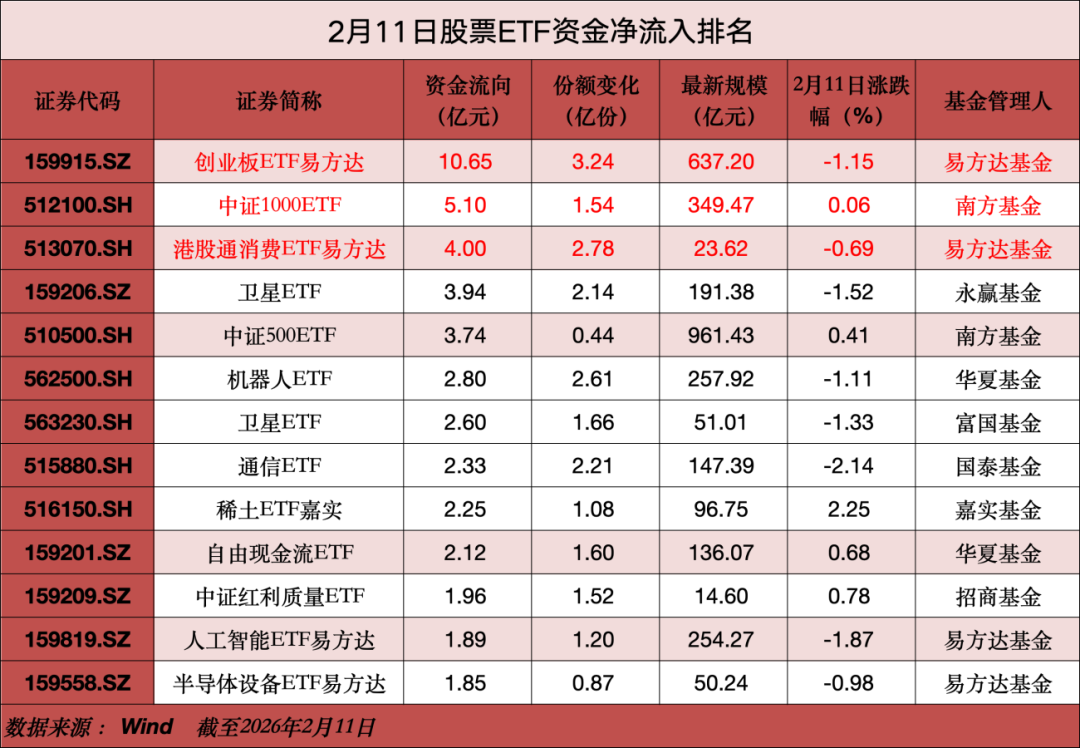
Group 1 - The A-share market showed mixed performance on February 11, with the three major indices fluctuating, and a slight net outflow of 236 million yuan from stock ETFs [1][2] - The ChiNext index saw significant net inflow of 1.14 billion yuan, while the CSI A500 index experienced net outflow [1][2] - The satellite industry and robotics sectors attracted notable capital inflows, while the new energy and dividend sectors faced outflows [1][2] Group 2 - As of February 11, the total scale of stock ETFs in the market reached 4.19 trillion yuan, with an overall net outflow of 236 million yuan for the day [2] - The ChiNext ETF led the inflows with a net inflow of 1.14 billion yuan, primarily driven by E Fund's ChiNext ETF, which saw inflows of 1.065 billion yuan [2][4] - The satellite industry also showed strong inflows, with a net inflow of 890 million yuan, including 394 million yuan into E Fund's satellite ETF [2][4] Group 3 - Over the past five days, the Hang Seng Technology Index ETF received over 6 billion yuan in inflows, while the SGE Gold 9999 Index ETF saw inflows exceeding 4.2 billion yuan [3] - The wide-based ETFs experienced a net outflow of 755 million yuan, with the CSI A500 ETF leading the outflows at 1.605 billion yuan [6][8] - The new energy sector had the highest outflow among thematic sectors, with a net outflow of 820 million yuan [7] Group 4 - The latest scale of E Fund's ETFs reached 661.02 billion yuan, with a total net inflow of 1.53 billion yuan on the previous trading day [4][5] - The robotics ETF and free cash flow ETF from Huaxia Fund saw significant inflows of 280 million yuan and 212 million yuan, respectively [5] - The market outlook suggests a focus on core growth assets, with stable earnings expectations and a potential return of foreign capital, indicating strong allocation properties in a volatile environment [9]


2月11日持仓过节的资金在买入哪些ETF?
Mei Ri Jing Ji Xin Wen· 2026-02-12 02:10
Group 1 - The Shanghai Composite Index experienced a seven-day rise, but trading volume continued to shrink, leading to a significant "seesaw" effect in capital allocation and accelerated sector rotation [1] - Ahead of the Spring Festival holiday, funds are divided into two camps: one showing cautious sentiment favoring dividend and free cash flow ETFs, while the other is positioning for a rebound after the holiday [1] - Major ETFs that received significant net subscriptions from external funds include the ChiNext ETF and the CSI 1000 ETF, with industry-specific ETFs like satellite, robotics, AI, semiconductor equipment, and chemical ETFs also seeing strong inflows [1] Group 2 - According to Wang Bo from Huaxia Fund, the reduction in trading volume before the holiday is normal, and there is a general optimistic expectation for the February market, although a short-term recovery in market sentiment will take time [2] - The investment strategy suggested includes maintaining a balanced allocation across technology, cyclical, and consumer sectors through broad-based ETFs like the Hu-Shen 300 ETF [2] - The recent increase in January PPI by 0.4% month-on-month has catalyzed price increases in the chemical sector, while positive developments in robotics and AI models are also emerging [1][2]
ETF融资榜 | 卫星ETF(563230)融资净买入1084.98万元,居可比基金首位-20260211
Xin Lang Cai Jing· 2026-02-12 02:02
Group 1 - The Satellite ETF (563230.SH) experienced a decline of 1.33% on February 11, 2026, with a trading volume of 576 million yuan [1] - The fund saw a net inflow of leveraged funds amounting to 10.84 million yuan, ranking first among comparable funds [1] - Over the past four days, the total inflow of leveraged funds into the fund reached 25.89 million yuan, also placing it at the top among comparable funds [1]
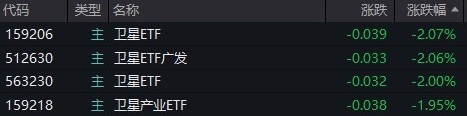
卫星概念股走低,相关ETF跌约2%
Mei Ri Jing Ji Xin Wen· 2026-02-10 05:42
Group 1 - Satellite concept stocks declined, with XW Communication falling over 4%, Aerospace Electronics down over 3%, and China Satellite, Shanghai Hanxun, and Zhenlei Technology each dropping over 2% [1] - Satellite-related ETFs experienced a decline of approximately 2% [1] Group 2 - Several brokerages indicated that during the 14th Five-Year Plan period, commercial aerospace will become a key driver for high-quality development of new productive forces and technology in China [2] - To secure valuable orbital and frequency resources, the number of satellite launches in China is expected to accelerate further by 2026, with private commercial rocket companies likely to play a significant role [2] - The investment opportunities in China's satellite internet industry chain are anticipated to grow by 2026 [2]