
可持续发展

Search documents
AIGLE艾高携手飞蚂蚁启动旧衣回收计划
Cai Jing Wang· 2025-12-02 02:33
Core Insights - AIGLE has launched a clothing recycling initiative in collaboration with the domestic environmental recycling platform "Fei Mayi" to promote public participation in old clothing recycling [1] - The initiative aims to process collected clothing through professional methods to reduce waste and support ecological protection [1] - AIGLE has set a target to collect over 5000 kg of old clothing to support the establishment of a new public welfare forest in a desert area, contributing to ecological restoration [1] Company Initiatives - Participants can drop off old clothing and shoes at designated AIGLE stores, where they will be placed in recycling bins for professional processing by Fei Mayi [1] - AIGLE's sustainable development philosophy, "AIGLE for Tomorrow," emphasizes increasing the use of recyclable materials in its products, aiming for 60% recyclable material application in the autumn/winter 2025 collection [1] - The brand has a long-term partnership with the Taohuayuan Ecological Protection Foundation and is furthering its collaboration with Fei Mayi to promote a circular economy and green consumption [1]
“构建包容可持续的老龄化社会” 联合国开发计划署发布银发经济系列报告
Sou Hu Cai Jing· 2025-12-02 01:43
Core Insights - The United Nations Development Programme (UNDP) has released three significant reports on China's silver economy, emphasizing its role in building an inclusive and sustainable aging society [1][2] - By the end of 2024, the population aged 65 and above in China is projected to reach 220 million, accounting for 15.6% of the total population, with expectations to rise to 30% by 2050 [1] - The Chinese government plans to elevate the development of the silver economy to a national strategic level, with the release of a dedicated document in 2024 [1] Group 1: Reports Overview - The report titled "Improving the Elderly Care Service System through the Silver Economy" highlights the importance of a robust elderly care service system in addressing aging challenges and the critical role of the silver economy in enhancing high-quality elderly care services [1] - The report on "Financial Empowerment of China's Silver Economy" identifies key investment opportunities in the elderly care industry, including smart devices and home modifications for the elderly [2] - The "Multidimensional Vulnerability Measurement of China's Elderly Population" report assesses the overall well-being of the elderly, identifying the most vulnerable groups, particularly rural residents and elderly women, and calls for targeted policies to enhance their resilience [2] Group 2: Expert Opinions - UNDP representatives emphasized that appropriate policy guidance and effective financing mechanisms can transform the challenges of population aging into opportunities for inclusive growth [4] - Industry leaders noted that the elderly care finance sector presents new opportunities for financial industry development while addressing aging population challenges [4] - The UN Population Fund representative highlighted China's unique advantages in turning the trend of increased longevity into new development momentum through investments in families and resilient elderly care systems [4]

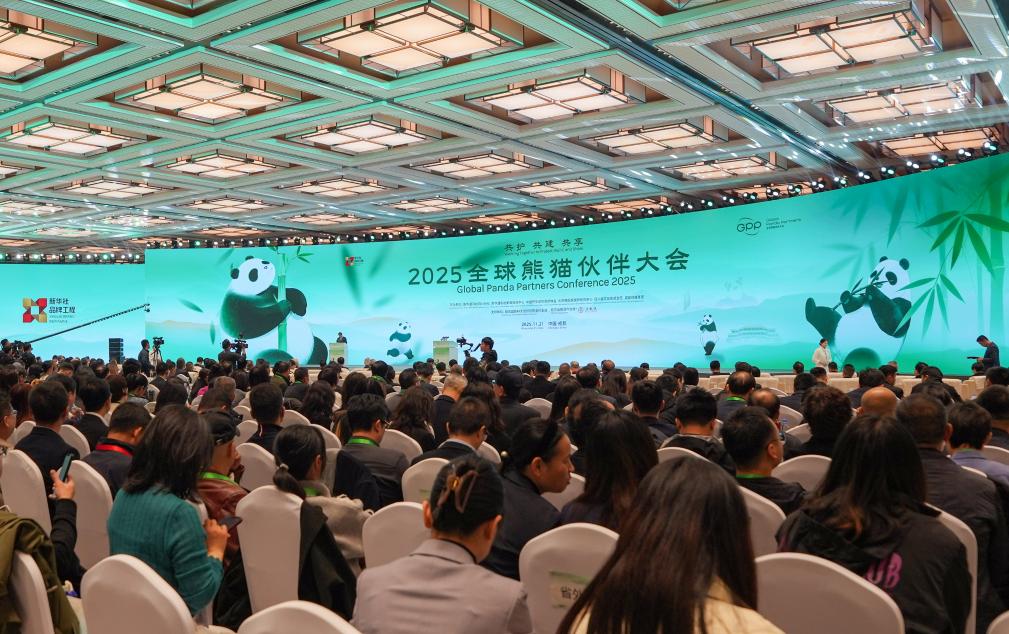
共护熊猫家园、共建美丽世界、共享开放机遇——2025全球熊猫伙伴大会综述
Xin Hua She· 2025-12-02 01:04
Core Insights - The 2025 Global Panda Partners Conference was held in Chengdu, focusing on giant panda conservation and cultural exchange, aiming to promote ecological protection and sustainable development globally [1][6][7] Group 1: Conference Overview - The conference took place from November 20 to 22, featuring one main forum, eight parallel meetings, and ten supporting activities, all aimed at fostering global consensus on ecological civilization [6] - The theme of the conference was "Co-protect, Co-build, Co-share," establishing a platform for dialogue and cooperation among global panda partners [7] Group 2: Reports and Contributions - A think tank report titled "Towards Ecological-Friendly Modernization" was released, highlighting China's contributions to global sustainable development through Xi Jinping's ecological civilization thought [2][5] - The report emphasizes the practical value of China's ecological practices in contributing to a community of shared future for mankind [5] Group 3: Achievements in Panda Conservation - The captive giant panda population has reached 808, achieving sustainable development [8] - The conference included participation from zoo directors and officials from countries like Germany and Indonesia, facilitating an international exchange of panda conservation experiences [8] Group 4: Cultural and Creative Initiatives - The conference featured a panda cultural and creative market, covering over 5,000 square meters with 145 exhibitors, showcasing panda-themed cultural products [10] - The "Panda Home" cultural creative competition attracted over 8,667 submissions, with nearly 3,000 entries from overseas, reflecting diverse cultural backgrounds [11] Group 5: Future Collaborations - The conference initiated multiple cultural and tourism cooperation plans, expanding the multi-dimensional value of the panda IP [11] - The event aims to enhance international cultural exchanges and cooperation, promoting a harmonious coexistence between humans and nature [11]
联合国报告显示——全球城市人口增量将主要来自亚非国家
Jing Ji Ri Bao· 2025-12-01 22:18
Core Insights - The report by the United Nations Department of Economic and Social Affairs predicts that by 2050, two-thirds of the global population growth will occur in urban areas, primarily in Asia and Africa [1][2] - It highlights a systematic relationship between urbanization levels and national income, indicating that higher urban population ratios correlate with increased economic productivity and income levels [2][3] Urbanization Trends - The proportion of the global population living in urban areas increased from 20% in 1950 to an expected 45% in 2025, with the number of megacities (over 10 million inhabitants) rising from 8 in 1975 to 33 in 2025, over half of which will be in Asia [1][2] - The report identifies that over half of the urban population growth from 2025 to 2050 will come from seven countries: India, Nigeria, Pakistan, the Democratic Republic of the Congo, Egypt, Bangladesh, and Ethiopia [1] Economic and Social Implications - Urbanization is seen as a fundamental driver of economic development, enhancing labor market activity and providing better access to healthcare, education, and employment opportunities [2][3] - However, rapid urban population growth can lead to significant urban pressures, including housing shortages, traffic congestion, and strained public services [3] Challenges of Urban Expansion - The report warns that unplanned urban expansion has outpaced population growth, leading to increased infrastructure costs, longer commuting times, and the encroachment on agricultural land, threatening food security and ecosystems [3] - Approximately 1 billion people live in informal settlements lacking basic services such as clean water and sanitation [3] Policy Recommendations - The report advocates for comprehensive urbanization strategies at national and city levels, emphasizing the need for coordinated governance to manage urban growth sustainably [4][5] - It suggests prioritizing compact city development to reduce land consumption and emissions while protecting ecosystems, and integrating urban and rural governance to enhance connectivity and reduce disparities [4][5] Addressing Future Challenges - To tackle issues related to population growth, aging, and informal settlements, the report recommends improving housing, transportation, and sanitation facilities in rapidly urbanizing areas [5] - It also calls for the development of "age-friendly cities" and climate-resilient infrastructure to better prepare for climate risks [5]
亚行投资7.63亿美元支持柬埔寨建设水安全和宜居城市
Zhong Guo Xin Wen Wang· 2025-12-01 18:08
预计将有15%的直接受益者来自贫困家庭。亚行驻柬埔寨代表指出,此项投资计划将助力柬埔寨建设包 容性强且具有气候适应能力的城市服务体系,不仅提升目标城市宜居性,同时也将增强相关城市的生产 力和竞争力。 这项名为"宜居、韧性及水安全城市"投资计划契合柬埔寨的城市韧性、减贫和实现可持续发展目标。亚 行希望该投资计划直接惠及柬超过200万人口,确保即使是最脆弱的社区也不会被落下。(完) (文章来源:中国新闻网) 【东盟专线】亚行投资7.63亿美元支持柬埔寨建设水安全和宜居城市 中新社金边12月1日电 (记者杨强)亚洲开发银行当地时间12月1日宣布,它已批准一项7.63亿美元的投资 计划,支持柬埔寨扩大清洁供水和卫生设施的覆盖范围,增强柬国城市供水安全并提升城市的韧性和宜 居性。 上述投资包括亚洲发展基金提供的2000万美元无偿援助。亚行当天发布的消息称,该投资计划将通过多 阶段融资机制,推动柬埔寨境内湄公河流域、洞里萨湖周边地区以及沿海地区14个城市和12个县区的供 水和卫生基础设施以及其他基本服务升级。 ...
从规模到价值共生,魏明乾谈会展业十年“升维”之路
Zhong Guo Jing Ji Wang· 2025-12-01 10:58
Core Insights - The Chinese exhibition industry has undergone a significant transformation over the past decade, shifting from scale expansion to value co-creation, from reliance on venue construction to data-driven approaches, and from operating single events to managing continuous ecosystems [1][2]. Group 1: Industry Evolution - The decade from 2015 to 2025 marks a profound reshaping of the exhibition industry's concepts and practices, summarized by "three dimensions of elevation": development concepts have shifted from quantity to quality, core values have transitioned from physical space to data elements, and the model of exhibition-driven urban development has evolved from discrete projects to continuous collaborative operations [2]. - In 2015, China became the world's leader in exhibition quantity and scale, with total exhibition area increasing from 117 million square meters to 147 million square meters between 2015 and 2024, indicating a significant shift from quantity to quality [3]. Group 2: Strategic Importance - The exhibition industry has transitioned from merely being a platform for economic exchanges to a core vehicle for national image display and strategic deployment, especially following the successful APEC meeting in Beijing in 2014 [3]. - Major exhibitions like the Canton Fair, the China International Import Expo, and the China International Fair for Trade in Services have become pillars of China's high-level opening-up strategy [3]. Group 3: Urban Development Impact - The concept of "holding a good conference revitalizes a city" has gained traction, with large-scale exhibitions acting as powerful engines for urban renewal, driving infrastructure upgrades, reshaping regional economic structures, and enhancing cities' international visibility [4]. Group 4: Venue Development - The total rentable indoor exhibition area in China surged from 8.93 million square meters in 2015 to nearly 14.18 million square meters by the end of 2024, with venues over 100,000 square meters increasing from 13 to 39 [5]. - Modern venues have evolved beyond single exhibition functions to become comprehensive urban landmarks integrating meetings, hotels, commerce, and cultural tourism [5]. Group 5: Future Outlook - The future of the Chinese exhibition industry hinges on responding to contemporary challenges and resonating with industrial developments, focusing on advanced manufacturing and modern service sectors [6]. - Urban competitiveness in exhibitions will depend on the collaborative efficiency, innovation, and vitality of the entire industrial ecosystem rather than just the scale of individual venues [6]. - The industry must achieve breakthroughs in internationalization, including having a voice in international rule-making and transitioning from participating in overseas exhibitions to hosting them [7]. - Digitalization will be crucial, with a focus on embedding digital processes deeply into business operations to create sustainable, quantifiable value [7].
对话淡马锡基金会黄文雄:构建全球绿色合作伙伴关系,推动技术创新与区域协同
Xin Lang Cai Jing· 2025-12-01 08:29
新浪财经ESG评级中心提供包括资讯、报告、培训、咨询等在内的14项ESG服务,助力上市 公司传播ESG理念,提升ESG可持续发展表现。点击查看【 ESG评级中心服务手册】 2025年11月24日,首届"绿智未来"可持续发展全球挑战赛决赛暨颁奖典礼在深圳举办。本次挑战赛由祥 峰投资中国基金和淡马锡基金会共同主办,从全球约70个国家及地区的超1000个项目中筛选出十强进入 决赛。赛事旨在发掘具备技术创新性、商业可行性的优质项目,助力全球可持续发展目标实现。决赛期 间,新浪财经围绕慈善资本角色、区域市场互补、赛事成功模式及深化全球合作等议题,对话了淡马锡 基金会执行董事兼首席执行长黄文雄。 慈善资本推动绿色技术落地 谈及慈善资本在绿色科技转化中的独特作用,黄文雄指出,相较于传统风险投资,慈善资本的核心价值 在于其高风险承受能力与示范引领价值。"淡马锡在在投资回报超过资本成本时,会将部分收益捐赠于 公益用途,以永续基金的形式进行投资。淡马锡基金会作为其旗下的慈善部门,会将部分收益以赠款资 金的形式配置于新的影响力项目,形成资金的循环投入机制。" 可持续发展全球挑战赛成功模式 经过多年实践,GFIC 挑战赛已形成"项目 ...
伊之密:举行投资者交流活动 多维度展现公司运营新成果
Zhong Guo Zheng Quan Bao· 2025-12-01 07:33
Core Viewpoint - The company, Yizhiming (伊之密), has demonstrated robust growth in its core business segments and is focusing on technological innovation and global expansion, as highlighted in its recent investor communication event [1]. Financial Performance - In the first three quarters of 2025, Yizhiming achieved a revenue of 4.306 billion yuan, representing a year-on-year increase of 17.21% [2] - The net profit attributable to shareholders reached 564 million yuan, with a growth of 17.45% compared to the previous year [2] - Revenue from injection molding machine sales was 3.098 billion yuan, up 18.42% year-on-year; die-casting machine revenue was 805 million yuan, an increase of 38.04%; and rubber machine sales amounted to 192 million yuan, growing by 15.73% [2] Research and Development - The company invested 200 million yuan in R&D during the first three quarters of 2025, a 9.55% increase from the same period last year [3] - Yizhiming has established a research team of over 900 members and holds 86 invention patents, with a total of over 400 various patent technologies [3] - The company successfully delivered the first domestic 6600-ton semi-solid magnesium alloy injection molding machine and received recognition for its A6 series intelligent injection molding machines and TP5 series in the high-end market [3] Global Operations - Yizhiming has set up subsidiaries in 12 countries and regions, with nearly 180 global service points [3] - The company leverages an industrial IoT platform to enhance equipment interconnectivity and data collaboration, providing predictive maintenance and remote services to improve operational efficiency globally [3] Recognition and Future Focus - Recently, Yizhiming was nominated for the fifth China Quality Award and recognized as a "National Enterprise Technology Center," with its Suzhou subsidiary also awarded as a "Provincial Enterprise Technology Center," reflecting its capabilities in high-end equipment R&D and industrialization [4] - The company aims to continue focusing on technology-driven and sustainable development, emphasizing innovation and quality to drive industry transformation and enhance customer value [4]

舆情监测与新媒体营销如何重塑美妆快消行业
Sou Hu Cai Jing· 2025-12-01 05:31
Core Insights - The success of beauty brands increasingly relies on effective public opinion monitoring and new media marketing in the digital age [1] - The cosmetics industry in China is experiencing significant growth, with retail sales projected to rise from 251.4 billion yuan in 2017 to 435.7 billion yuan in 2024, reflecting a compound annual growth rate of 8.17% [1] Industry Transformation: New Ecosystem in Beauty Marketing - By 2025, the beauty and personal care industry is undergoing a dual wave of channel transformation and consumer upgrading, characterized by "omni-channel resonance, refined demand, and technology-driven innovation" [3] Trends in Consumer Preferences - Trends such as health, personalization, and sustainability are gaining traction, with consumers seeking more than just functional products [4] - Sales of hand creams with soothing scents have increased by nearly 40%, while searches for fatigue-relief shower gels surged by 200% [4] Risks: Public Opinion Crisis - The cosmetics industry faces escalating public opinion risks, with the China Consumers Association reporting a total of 1.7619 million complaints in 2024, a year-on-year increase of 32.62% [5] - Complaints related to cosmetics reached 251,800, with 97,600 concerning product quality and 22,300 related to advertising [5] - Negative information can rapidly escalate online, with brand crises typically unfolding within 48 hours if not managed effectively [5] Crisis Management: Golden Rules of Public Opinion Monitoring - Advanced public opinion monitoring systems are essential for beauty companies to act as a "firewall" against potential crises [7] - Successful crisis management follows the "48-hour golden rule," which includes crisis detection and assessment within the first 6 hours, team formation within 6-12 hours, official response within 12-24 hours, and ongoing monitoring within 24-48 hours [8] Marketing Innovation: Rise of New Media Channels - The online cosmetics market in China is projected to reach 405.527 billion yuan in 2024, with Tmall holding a market share of 41.1% and Douyin at 37.8% [8] - Live commerce has surpassed 5 trillion yuan in transaction volume, creating a vast commercial ecosystem and reshaping the business model of the cosmetics industry [8] Future Trends: Technology-Driven and Channel Integration - AI technology is expected to further transform marketing strategies in the beauty industry, with systems like VOC+ providing structured reputation monitoring and market insights [9] - Beauty brands should leverage centralized media advantages to build brand consensus and enhance brand momentum [10] - Continuous exploration in technology application and strategic innovation is crucial for the beauty industry to effectively manage crises and maintain consumer trust [10]

新华社:中国科技创新闪耀海外知名榜单 武汉等中国六城跻身全球科研城市十强
Xin Hua She· 2025-12-01 03:38
Core Insights - Recent reports indicate that China's scientific research output is experiencing explosive growth in both quantity and quality, leading in various aspects such as research cities, disciplinary contributions, and international leadership [1] Group 1: Research Cities - The latest issue of the UK journal Nature highlights that Chinese research cities are flourishing, with Beijing ranking first for nine consecutive years and cities like Shanghai, Guangzhou, Wuhan, Nanjing, and Hangzhou making it to the top ten [2] - In terms of contribution share, Chinese cities show strong growth, with Beijing's research output increasing by over 9% and Shanghai by nearly 20% from 2023 to 2024 [2] - Chinese cities dominate the fields of chemistry, physical sciences, and earth and environmental sciences, with Beijing leading globally in all three areas [2] Group 2: International Influence - The international influence of Chinese scientists is on the rise, with a significant number taking leadership roles in international collaborations, particularly in projects with the UK [3] - The Chinese Academy of Sciences ranks first globally in the number of highly cited researchers, surpassing Harvard University [3] - A report indicates that China has surpassed the US in research strength, especially in mathematics, computing, and engineering [4] Group 3: Contribution to Sustainable Development - China is the largest contributor to global Sustainable Development Goals (SDG) related papers, playing an increasingly important role in global SDG policy formulation [5] - 24% of global research published in 2024 pertains to SDG-related studies, with Chinese research being widely cited in various SDG policy documents [5] - Chinese SDG-related papers have significantly influenced global health and environmental policy documents since 2022, with citations coming from international organizations like the WHO [5]