
数字孪生

Search documents
脱钩断链的“搅局者”VS 赋能全球的“稳定锚”
Sou Hu Cai Jing· 2025-07-27 18:07
Group 1 - Over 70% of countries and regions are facing threats from US tariffs, which are causing global supply chain disruptions and decoupling [1] - The US is struggling with a deindustrialization issue that began 45 years ago, raising questions about whether tariffs can effectively bring manufacturing jobs back [5][6] - The US faces significant challenges in labor quality and infrastructure, which hinder the return of manufacturing [6][7] Group 2 - High tariffs may not lead to a manufacturing return to the US, as companies like Apple rely on Asian factories for cost-effective production [7] - China has transitioned from being the "world's factory" to an "innovation laboratory," becoming a stabilizing force in global supply chains [8][10] - Major global companies recognize China's advanced manufacturing capabilities and extensive supplier networks, with a significant portion of their suppliers based in China [10]


阿维塔数智工厂正式挂牌
news flash· 2025-07-27 13:48
Core Viewpoint - The establishment of the Avita Smart Factory marks a significant milestone in the automotive industry, being the world's first fully 5G intelligent AI flexible super factory, developed in collaboration with Changan Automobile, Huawei, and China Unicom [1] Group 1 - The factory utilizes over 40 advanced technologies, including 5G, AI, and digital twin, ensuring that each vehicle produced meets top-tier manufacturing quality standards [1]


萝卜快跑获上海智能网联汽车示范运营牌照;阿维塔全新5G数智工厂正式挂牌丨汽车交通日报
创业邦· 2025-07-27 09:45
精选行业新闻,帮你省时间! 此外,如果您还想 查公司、找项目、看行业,深入了解人形机器人、商业航天、AGI等热门赛道 ,欢迎加入睿兽分析会员,解锁相关行业图谱和报告等。 更多汽车出行资讯 …… 扫码订阅汽车交通产业日报, 1.【萝卜快跑获上海智能网联汽车示范运营牌照】7月26日,在2025世界人工智能大会(WAIC) 上,上海新一批智能网联汽车示范运营牌照正式发放,萝卜快跑等首批获准。此次颁发示范运营牌照 后,用户可以在金桥、花木、世博等浦东新区重要功能片区,享受到自动驾驶带来的创新体验。同 时,萝卜快跑入选本年度中国人工智能产业创新成果展,并为本届WAIC提供L4级自动驾驶接驳服 务。(上观新闻) 2.【比亚迪元UP正式上市马来西亚】7月24日,比亚迪在马来西亚吉隆坡推出全新纯电紧凑型SUV ——元UP(BYD ATTO 2)。比亚迪与腾势在马来西亚已建立起超过40家销售门店,并正加快推进 服务网络建设,计划将服务网点扩展至30家以上。(新浪财经) 3.【阿维塔全新5G数智工厂正式挂牌】7月27日,阿维塔全新5G数智工厂正式在重庆挂牌。阿维塔 数智工厂由长安汽车与华为、中国联通等联合打造,是全球首个全域5G ...


餐饮配送→智能家居→工业制造,突破!国产机器人加速“出海”收获众多海外“粉丝”
Yang Shi Wang· 2025-07-26 05:55
Core Insights - In 2024, China's industrial robot export market share is expected to rise to the second largest globally, with a 61.5% growth in exports in the first half of 2025 [1] - The export destinations are expanding from Southeast Asia and Africa to high-end markets in Europe and North America, indicating a comprehensive enhancement in the competitiveness of Chinese robotic products [1] - The application scenarios for Chinese robots are diversifying, with significant growth in sectors such as food delivery, smart homes, industrial manufacturing, and medical assistance since 2025 [9] Group 1: Export Growth and Market Expansion - In the first five months, China's industrial robot export market share in Europe reached nearly 30%, showing significant growth [1] - The export value of China's smart lawn mowers in the first quarter of 2025 reached $1.01 billion, with a nearly 60% year-on-year increase, particularly strong in Germany and the UK [13] - In the automotive manufacturing sector, 34% of China's industrial robot exports in the first half of 2025 were attributed to this industry, with the electronics sector accounting for 28% [15] Group 2: Technological Advancements and Innovation - China has become the largest robot market and producer globally, holding over 190,000 effective patents, which account for about two-thirds of the global total [20] - Continuous technological breakthroughs and the expansion of application scenarios position China to potentially transform from the largest robot market to the most innovative hub for robot technology development [22] - The industrial robot industry is projected to have a compound annual growth rate of no less than 10% from 2025 to 2030, focusing on areas such as artificial intelligence, collaborative robots, and digital twins [26] Group 3: International Competitiveness - Over 60 Chinese companies showcased advanced robotic equipment and technology at the World Automation Exhibition in Munich, competing with top global automation firms [15] - Chinese companies are making significant inroads into the automotive supply chain, providing parts and welding solutions for European companies like BMW [17]

东营港经济开发区:先进级(省级)智能工厂再添佳绩
Qi Lu Wan Bao Wang· 2025-07-25 11:48
Group 1 - The core viewpoint of the news is the recognition of five leading chemical enterprises in Dongying Port Economic Development Zone as advanced intelligent factories by Shandong Province, highlighting the region's commitment to smart manufacturing and digital transformation [1][2][4] Group 2 - The selected factories represent the pinnacle of intelligent construction in the Dongying Port Economic Development Zone, each showcasing unique features such as advanced control integration, lean production systems, and digital twin technology [2][3] - The Dongying Port Economic Development Zone has established a public service platform for "smart transformation and digital upgrade," providing comprehensive services including diagnostic consulting and technical support to facilitate the digital transformation of traditional industries [3] - The industrial added value of above-scale industries in the Dongying Port Economic Development Zone grew by 17.6% year-on-year, leading the city, while the core value added of the digital economy surged by 80% [3] - The Dongying Port Chemical Industry Park has been recognized as a benchmark for intelligent transformation in the chemical industry and a provincial-level digital economy park, with nearly 20 national and provincial-level intelligent manufacturing demonstration projects [4] - The emergence of provincial-level intelligent factories serves as a visible and learnable benchmark for enterprises in the region, promoting collaborative upgrades across the industrial chain [4] - The Dongying Port Economic Development Zone aims to deepen the integration of new information technology with chemical production, striving to elevate the traditional chemical industry to a high-end value chain and establish itself as a model area for intelligent transformation in the chemical sector [4]
2025-2031年实验室自动化设备行业全景深度分析及投资战略可行性评估预测报告-中金企信发布
Sou Hu Cai Jing· 2025-07-24 03:42
Core Viewpoint - The laboratory automation equipment industry is experiencing rapid growth driven by advancements in life sciences and testing sectors, with a focus on automation, standardization, and integration of technologies such as machine learning and digital twins [7][11]. Industry Overview - Laboratory automation refers to the use of technology to automate laboratory processes, enhancing efficiency and accuracy across various applications [2]. - The industry can be categorized into four stages of automation: single device automation, workstation automation, assembly line automation, and intelligent automation [2]. Development Trends - High-throughput, automated, and information-driven laboratory workflows are becoming the future standard [7]. - The integration of laboratory automation with technologies like machine learning and computer vision is expected to lead to smarter decision-making and adaptive processes [7]. - The domestic market is benefiting from supportive policies and an increased focus on public health, leading to rapid development and improvement in the integration and intelligence of domestic laboratory automation equipment [7][8]. Technical Barriers - Significant technical barriers exist in the industry, including: - **Equipment and Instrumentation**: High technical requirements for system integration and manufacturing of sequencing instruments, involving multiple disciplines [9]. - **Reagents and Consumables**: High-quality reagents are essential for accurate sequencing, with stringent production processes [10]. - **Data Analysis and Software Development**: The need for advanced bioinformatics to process large volumes of sequencing data presents a major challenge [10] [11]. Economic Indicators - The report outlines the economic indicators of the laboratory automation equipment industry in China from 2019 to 2024, including profitability, operational capacity, and debt repayment ability [11][12]. - The industry is characterized by a growing number of enterprises and increasing market scale, with a focus on enhancing production and sales efficiency [11][12]. Market Environment - The industry is influenced by various factors, including policy support, macroeconomic conditions, and social demand trends [11][12]. - The competitive landscape features both domestic and international players, with established companies in overseas markets leading in technology and market channels [7][11]. Future Outlook - The laboratory automation equipment market is projected to continue its growth trajectory, with forecasts indicating significant increases in market size and demand from 2025 to 2031 [11][12].

苏州市委全面深化改革委员会召开第三十八次会议
Su Zhou Ri Bao· 2025-07-24 00:26
Group 1 - The meeting emphasized the importance of advancing key reform initiatives to achieve high-quality development in Suzhou, guided by recent speeches from General Secretary Xi Jinping [1][2] - The focus will be on reforming the management system of development zones, enhancing industrial development functions, and reducing administrative levels to mitigate debt risks [2] - There is a commitment to improving public hospitals by aligning with the diverse health needs of the population, enhancing talent acquisition, and integrating AI into healthcare services [2] Group 2 - The construction of a smart city will be prioritized, with an emphasis on deepening AI applications and developing a "city brain" to empower urban governance [2] - The meeting discussed accelerating personal bankruptcy reforms, establishing case coordination mechanisms, and regulating lending behaviors [2] - Plans to upgrade the international legal service zone were highlighted, focusing on understanding enterprise needs and expanding high-level foreign-related legal services [2]
发展“机器人+”守护大国粮仓
Jing Ji Ri Bao· 2025-07-23 22:10
Core Viewpoint - The integration of advanced technologies such as 5G, AI, digital twins, and collective intelligence is accelerating the evolution of grain storage robots towards a more intelligent, collaborative, and inclusive direction, providing robust technological support for safeguarding national grain reserves and enhancing food storage capabilities [1][5]. Group 1: Current State of Grain Storage - Traditional grain storage operations heavily rely on manual labor, which is labor-intensive and poses safety risks due to harsh working conditions [2]. - The introduction of various robots in grain storage facilities is transforming tasks such as handling, inspection, and cleaning, leading to a significant improvement in operational efficiency and safety [3]. Group 2: Advantages of Robotic Automation - Robots can operate continuously, significantly increasing work efficiency, especially during peak seasons, and reducing the risk of accidents in high-dust and high-intensity environments [3]. - The application of robots is driving the digital transformation of grain storage, enabling data connectivity across planting, processing, and logistics, thus enhancing the overall efficiency of the supply chain [3]. Group 3: Challenges and Solutions - The promotion of robotic applications faces challenges such as high initial investment, insufficient technical adaptability, and a lack of skilled personnel [4]. - Solutions include government financial support, customized technology development for different scales of grain storage, and the establishment of unified industry standards to ensure compatibility and efficiency [4].
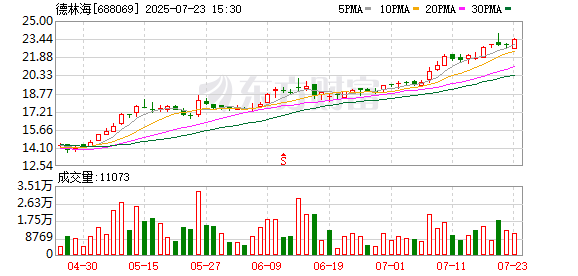
专访德林海董秘刘彦萍:用数字孪生技术为湖库“把脉” 在生态治理浪潮中开辟新航道
Zheng Quan Ri Bao· 2025-07-23 17:15
Core Viewpoint - The company, Delinhai, has developed a "lake ecological hospital" model to address issues like eutrophication and blue-green algae outbreaks in lakes, utilizing a systematic approach of monitoring, diagnosis, treatment, and rehabilitation to restore healthy ecosystems [2][6]. Group 1: Technological Advancements - Delinhai has focused on blue-green algae management since its establishment in 2009, developing a pressurized algae control equipment capable of processing up to 432,000 cubic meters of water daily, with energy consumption only 7% of the first-generation technology [3]. - The company has successfully implemented its technology in the Taihu blue-green algae management project, achieving a significant milestone by ensuring the lake's water quality reaches Class III for the first time in 2024, six years ahead of the planned target [3]. - Delinhai is integrating AI technology into its operations, launching the "Zhongyuzhou Digital Twin Diagnosis System" to enhance lake management through real-time monitoring and algorithmic diagnostics [4]. Group 2: Operational Model - The "lake ecological hospital" model includes a standardized toolkit for diagnosis, blue-green algae prevention, and sediment remediation, allowing for tailored solutions based on specific lake conditions [6]. - The company has transitioned from focusing solely on blue-green algae to a comprehensive management approach, offering full-cycle services from monitoring to rehabilitation [6][7]. - Delinhai's innovative "pay-for-performance" model ensures that clients only pay after achieving satisfactory results in lake management [7]. Group 3: Industry Expansion - Delinhai's ecological hospital model has been successfully applied to over 40 significant lakes and reservoirs in China, with plans to expand to other regions, including the Yangtze River Economic Belt by 2025 [7]. - The company is exploring a circular economy model through the "mud-worm" ecological project, which processes organic waste while promoting resource regeneration [8]. - Delinhai holds 99 patents, including 26 invention patents, and aims to transform environmental management costs into resource regeneration value, aligning with sustainable development goals [8].

多家上市公司发布高端工业母机新技术,产业升级路径明确
Zheng Quan Shi Bao Wang· 2025-07-23 13:19
Group 1 - The "Industrial Mother Machine +" event held in Wuhan showcased new technologies and products from listed companies like Huazhong CNC and Huagong Technology [1] - Huazhong CNC introduced the Huazhong 10 intelligent CNC system, integrating AI and CNC technology to enhance machine performance, achieving a 10% increase in processing efficiency for mobile phone components [1][2] - Huagong Technology launched the first domestic complex surface laser etching intelligent equipment, achieving processing efficiency 200% higher than similar foreign products [1][2] Group 2 - The equipment developed by Huagong Technology has achieved breakthroughs in precision, efficiency, and processing area, applicable across various industries including consumer electronics and aerospace [2] - The Ministry of Industry and Information Technology plans to accelerate the establishment of a development mechanism for the industrial mother machine sector, focusing on key technology breakthroughs and supporting major users and manufacturers [2][3] - The next phase of development will emphasize intelligent CNC machine tools, with a focus on high-quality production lines, marking a critical decade for the sector [3] Group 3 - Strategic investments, including policy funds and long-term special bonds, are essential for the development of emerging industries like industrial mother machines [3] - Since 2008, the National Development Bank has issued over 20 billion yuan in loans to the industrial mother machine sector, supporting key enterprises in R&D and capacity building [3]

