汽车召回

Search documents
记者实探小鹏汽车门店 4.75万辆P7+召回启动
Shen Zhen Shang Bao· 2025-09-21 00:58
Group 1 - The core issue involves the recall of 47,490 units of the XPeng P7+ due to potential safety concerns related to the steering wheel [1][2] - The recall is initiated by the company in compliance with the "Defective Automobile Product Recall Management Regulations" and is set to affect vehicles produced between August 20, 2024, and April 27, 2025 [1] - The company emphasizes that the recall is not directly related to the vehicle's intelligent driving system, which operates on a pure vision system rather than a lidar system [1] Group 2 - The specific safety concern arises from a faulty connection in the steering assist motor sensor wiring, which may lead to signal fluctuations and potential steering failure [2] - The company will provide free replacement of the improved steering assembly for the recalled vehicles to eliminate safety risks [2] - Notifications regarding the recall will be communicated to affected vehicle owners through mobile app push notifications and phone calls [2]
谁在模糊OTA与召回的边界?
Di Yi Cai Jing· 2025-09-20 07:58
Core Viewpoint - The recall of Xiaomi's SU7 vehicles, involving 117,000 units, aims to enhance the reliability of the advanced driving assistance system, despite not requiring physical part replacements, raising questions about the nature of recalls and the role of OTA upgrades in addressing safety issues [2][4]. Group 1: Recall Definition and Implementation - A recall is predicated on the existence of defects, and OTA upgrades are a method of executing recalls, which can improve efficiency and reduce costs [3][8]. - The National Market Supervision Administration has received 4,047 reports of OTA upgrade activities affecting 486 million vehicles by the end of 2024, with 19 OTA recalls involving 4.068 million vehicles in 2024, marking a 246.8% increase from the previous year [3]. - The definition of a recall includes actions taken by manufacturers to eliminate defects in sold vehicles, which can involve free repairs, replacements, or refunds [4]. Group 2: Nature of Xiaomi's Recall - Xiaomi's SU7 recall is classified as a passive recall, initiated under the investigation of the National Market Supervision Administration, rather than an active recall [5]. - The recall number for Xiaomi's SU7 indicates a safety defect, categorized as "I" for investigation-influenced recall, contrasting with other manufacturers like FAW Toyota and Xpeng, which have conducted active recalls [6]. Group 3: OTA vs. Recall - OTA upgrades are not equivalent to recalls and should not replace them; they are merely a technical service method that can be used to address defects [9]. - Tesla exemplifies the use of OTA upgrades to resolve defects, having recalled 1.1 million vehicles in 2023, primarily addressing software issues through OTA rather than physical recalls [7]. - The National Market Supervision Administration emphasizes that while OTA can enhance recall completion rates and reduce costs, it should not be used to evade the responsibilities associated with recalls [9].

福特(F.US)又出安全问题:因门饰板脱落召回近10.2万辆汽车
智通财经网· 2025-09-19 11:37
Core Points - Ford Motor Company is recalling 101,944 vehicles in the U.S. due to a defect that may cause door trim panels to detach while driving [1] - The recall affects certain 2016 to 2019 Taurus models, posing a safety risk and increasing the likelihood of collision accidents [1] - Ford has already set a record for safety recalls, with 88 recalls reported by June 2025, surpassing any other automaker's annual recall count [1] Recall Details - The issue involves the B-pillar door trim, which may detach during vehicle operation, leading to potential road safety hazards [1] - Dealers will inspect the B-pillar trim and perform repairs or replacements at no cost to the owners [1] - Earlier this year, Ford had a significant recall involving 850,000 trucks and SUVs due to potential fuel pump failures [1] - Recently, Ford also recalled 1,456,417 vehicles due to defects in rearview cameras [1]

存安全隐患,11.69万辆小米SU7被紧急召回,今年已第二次
Guo Ji Jin Rong Bao· 2025-09-19 06:30
Core Points - Xiaomi Auto Technology Co., Ltd. has announced a recall of 116,887 units of its SU7 standard electric vehicles produced between February 6, 2024, and August 30, 2025, due to safety concerns related to the L2 highway navigation assistance feature [1][3] Group 1: Recall Details - The recall plan has been filed with the National Market Supervision Administration in accordance with the regulations on defective automotive product recalls [1] - The recall includes two specific models: 98,462 units of XMA7000MBEVR2 and 18,425 units of BJ7000MBEVR2 [2][3] - The identified safety issue involves insufficient recognition and response to extreme scenarios when the L2 feature is activated, potentially increasing the risk of collisions if the driver does not intervene promptly [3] Group 2: Previous Recalls and Sales Performance - This is not the first recall for Xiaomi Auto; a previous recall occurred earlier this year affecting over 30,000 SU7 standard vehicles due to software synchronization issues that could lead to collision risks [4] - Since its launch in April last year, the SU7 model has sold a total of 139,500 units in 2022, and sales have increased significantly in 2023, with over 210,000 units sold in the first eight months, achieving 60% of the annual delivery target of 350,000 units [4] Group 3: Safety Concerns and Industry Context - The company has faced ongoing scrutiny regarding safety and marketing claims, particularly following fatal accidents involving the SU7 model that raised questions about the safety of its intelligent driving technology [5][6] - The automotive industry is experiencing increased regulatory scrutiny, with calls for standardized safety measures as the penetration rate of vehicles equipped with combined driving assistance systems reached 62.58% in the first seven months of the year, reflecting a 21.31% year-on-year growth [6][7]
丰田召回 bZ4X、进口 RZ 等纯电汽车超 3.7 万辆
Bei Jing Shang Bao· 2025-09-19 06:25
Core Points - The National Market Supervision Administration of China announced a recall plan involving multiple Toyota brands due to safety concerns related to vehicle software and design issues [1][2][3] Group 1: Recall Details - From September 22, 2025, a total of 7,945 units of the domestic bZ4X produced between November 15, 2022, and August 24, 2023, will be recalled [1] - From September 22, 2025, a total of 7,211 units of the domestic Platinum 4X produced between December 4, 2023, and August 28, 2025, will be recalled [1] - From September 26, 2025, a total of 8,909 units of imported RZ vehicles produced between August 12, 2022, and June 5, 2024, will be recalled [2] - From September 22, 2025, a total of 8,268 units of the domestic bZ4X produced between September 6, 2022, and July 15, 2023, will be recalled [2] - From September 22, 2025, a total of 647 units of the domestic C-HR EV produced between July 19, 2021, and February 21, 2022, will be recalled [2] - From September 26, 2025, a total of 3,254 units of imported UX vehicles produced between August 5, 2021, and December 1, 2022, will be recalled [3] - From September 22, 2025, a total of 1,288 units of the domestic Yize E hybrid vehicles produced between July 16, 2021, and July 27, 2022, will be recalled [3] Group 2: Safety Issues - The recalled vehicles have a software issue in the air conditioning control unit that may lead to a failure in defogging and defrosting performance, posing a safety risk [2] - The design flaw in the electric heating water heater may cause the heating element to fail, affecting the vehicle's heating and defogging capabilities, which also presents a safety hazard [3] Group 3: Remedial Actions - Toyota companies will provide free upgrades to the air conditioning control computer's internal program for the affected vehicles to eliminate safety risks [2] - Affected vehicles with the heating element issue will receive free replacements of the improved electric heating water heater [3]

小米汽车召回11万辆SU7,盘中股价跳水
Shen Zhen Shang Bao· 2025-09-19 06:24
Group 1 - Xiaomi Automotive Technology Co., Ltd. has filed a recall plan with the State Administration for Market Regulation, recalling a total of 116,887 SU7 standard electric vehicles produced between February 6, 2024, and August 30, 2025 [1] - The recall includes two specific models: 98,462 units of the XMA7000MBEVR2 and 18,425 units of the BJ7000MBEVR2 [1] - The recall is due to potential safety hazards related to the L2 highway navigation assistance feature, which may not adequately recognize, warn, or handle extreme scenarios, increasing the risk of collision if the driver does not intervene [1] Group 2 - Xiaomi will provide free software upgrades via over-the-air (OTA) technology to eliminate safety risks for the recalled vehicles [1] - The company will notify affected vehicle owners through SMS and mobile app notifications, and customers can contact the customer service hotline for more information [2] - Additional information regarding the recall can be found on the State Administration for Market Regulation's recall center website [2]
小米汽车召回超11万辆SU7
Zhong Guo Jing Ying Bao· 2025-09-19 05:09
小米汽车科技有限公司将通过汽车远程升级(OTA)技术,为召回范围内的车辆免费升级软件,以消除 安全隐患。 小米汽车科技有限公司将以短信、手机App等方式,通知相关车主。 (文章来源:中国经营报) 9月19日,《中国经营报》记者获悉,国家市场监督管理总局官网公告显示,小米汽车科技有限公司根 据《缺陷汽车产品召回管理条例》和《缺陷汽车产品召回管理条例实施办法》的要求,向国家市场监督 管理总局备案了召回计划。决定自即日起,召回2024年2月6日至2025年8月30日生产的部分SU7标准版 电动汽车,共计116887辆。 本次召回范围内部分车辆在L2高速领航辅助驾驶功能开启的某些情况下,对极端特殊场景的识别、预 警或处置可能不足,若驾驶员不及时干预可能会增加碰撞风险,存在安全隐患。 ...


小米召回超11.6万辆SU7标准版电动汽车,雷军回应
Xin Lang Ke Ji· 2025-09-19 04:06
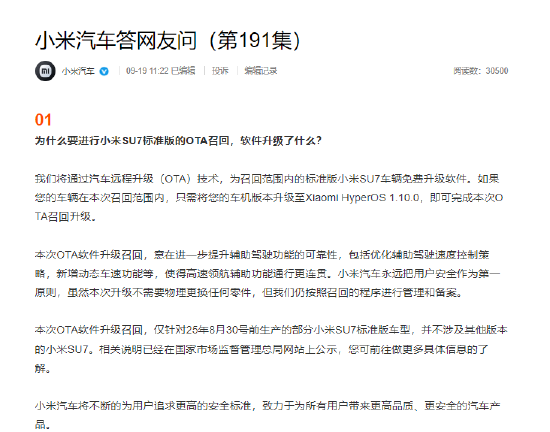
专题:小米召回部分SU7标准版电动汽车 小米汽车官方微博今日发布小米汽车答网友问(第191集),其中回应了为什么要进行小米SU7标准版 的OTA召回。雷军转发该微博并称:车主朋友们仔细看看。 内容显示,本次OTA软件升级召回,意在进一步提升辅助驾驶功能的可靠性,包括优化辅助驾驶速度控 制策略,新增动态车速功能等,使得高速领航辅助功能通行更连贯。虽然本次升级不需要物理更换任何 零件,但我们仍按照召回的程序进行管理和备案。本次OTA软件升级召回,仅针对25年8月30号前生产 的部分小米SU7标准版车型,并不涉及其他版本的小米SU7。 日前,小米汽车科技有限公司根据《缺陷汽车产品召回管理条例》和《缺陷汽车产品召回管理条例实施 办法》的要求,向国家市场监督管理总局备案了召回计划。决定自即日起,召回2024年2月6日至2025年 8月30日生产的部分SU7标准版电动汽车,共计116887辆。 本次召回范围内部分车辆在L2高速领航辅助驾驶功能开启的某些情况下,对极端特殊场景的识别、预 警或处置可能不足,若驾驶员不及时干预可能会增加碰撞风险,存在安全隐患。 小米汽车科技有限公司将通过汽车远程升级(OTA)技术,为召回范围内 ...

小米汽车回应对SU7标准版OTA召回:进一步提升辅助驾驶可靠性
Xin Lang Ke Ji· 2025-09-19 03:45
Group 1 - Xiaomi Auto announced an OTA recall for the standard version of the Xiaomi SU7 to enhance the reliability of its driver assistance features, including optimizing speed control strategies and adding dynamic speed functions [1] - The recall specifically targets certain Xiaomi SU7 standard version models produced before August 30, 2025, and does not affect other versions of the SU7 [1] - The recall plan involves 116,887 vehicles produced between February 6, 2024, and August 30, 2025, due to potential safety risks associated with the L2 highway navigation assistance feature [3] Group 2 - The company will utilize remote upgrade (OTA) technology to provide free software updates to the recalled vehicles to eliminate safety hazards [3] - The recall is in compliance with the regulations set forth by the National Market Supervision Administration regarding defective automotive products [3]
股价下挫!小米汽车宣布:召回超11万辆SU7!召回编号、原因公布
券商中国· 2025-09-19 03:41
小米召回116887辆标准版SU7汽车! 9月19日,国家市场监督管理总局消息,日前,小米汽车科技有限公司根据《缺陷汽车产品召回管理条例》和《缺陷汽车产品召回管理条例实施办法》的要求,向国家 市场监督管理总局备案了召回计划。决定自即日起,召回2024年2月6日至2025年8月30日生产的部分SU7标准版电动汽车,共计116887辆。 召回编号S2025M0149I:涉及XMA7000MBEVR2和XMA7000MBEVR2车型,共计98462辆。 召回编号S2025M0150I:涉及BJ7000MBEVR2车型,共计18425辆。 今年7月,小米SUV车型YU7正式上市交付。据小米汽车发布的数据,今年7月、8月,小米汽车已连续两个月交付量突破3万辆。 值得关注的是,该消息发布后,小米汽车官微发布最新消息,小米汽车OTA秋季大版本升级,今日(19日)起,小米SU7、YU7将同步升级至Xiaomi HyperOS 1.10.0。 小米集团2025年中期报告显示,小米汽车毛利率远超预期。二季度,汽车业务相关的毛利率已经达到了26.4%,经营亏损收窄至仅3亿元。小米汽车副总裁卢伟冰表 示,小米汽车下半年有望实现单季度 ...