智能驾驶

Search documents
智能驾驶、零售概念逆势走强
财联社· 2025-12-16 03:48
Market Overview - The A-share market experienced a volatile adjustment in the morning session, with the Shanghai Composite Index and Shenzhen Component Index both dropping over 1%, and the ChiNext Index falling over 2% [1] - The total trading volume in the Shanghai and Shenzhen markets was 1.12 trillion yuan, a decrease of 606 billion yuan compared to the previous trading day [1] - More than 4,400 stocks in the market declined [1] Sector Performance - The retail sector showed repeated activity, with Baida Group achieving four consecutive trading limits, and Hongqi Chain and Guangbai Co. both reaching two consecutive trading limits [3] - The smart driving concept saw a counter-trend rise, with stocks like Zhejiang Shibao and Suoling Co. hitting trading limits [3] - The digital currency sector strengthened, with stocks such as Cuiwei Co. and Aerospace Information reaching trading limits [3] Policy Impact - An important article by Xi Jinping published in the 24th issue of "Qiushi" magazine emphasized that expanding domestic demand is a strategic move essential for economic stability and security, and is necessary for the long-term healthy development of the economy [3] - The article highlighted the need to accelerate the filling of consumption gaps to make domestic demand the main driving force and stabilizing anchor for economic growth [3] Declining Sectors - The film and cinema sector saw a collective decline, with Bona Film Group experiencing two consecutive trading limits down [4] - The Hainan sector also fell, with Hainan Ruize dropping over 9% [4] - Overall, the retail and dairy sectors performed well, while precious metals, film and cinema, military industry, and Hainan sectors faced significant declines [4]


市场震荡调整,创业板指半日跌超2%,智能驾驶、零售概念逆势走强
Feng Huang Wang Cai Jing· 2025-12-16 03:44
凤凰网财经讯 12月16日,市场早盘震荡调整,沪指、深成指跌超1%,创业板指跌超2%。截至午间收 盘,沪指跌1.22%,深成指跌1.88%,创业板指跌2.35%。沪深两市半日成交额1.12万亿,较上个交易日 缩量606亿。全市场超4400只个股下跌。 | | | | | 经济南重要指数 | | | | | --- | --- | --- | --- | --- | --- | --- | --- | | 名称 *● | 最新 | 张幅% | | 涨跌 涨跌家数 | | 总手 | 现手 金额 | | 上证指数 | 3820.85 | -1.22 | -47.07 | 339/1955 | -0.01 | 3.40 7. | 1.82万 4825.68亿 | | 深证成指 | 12866.09 | | -1.88 -246.00 | 380/2496 | -0.04 | 4.35 7 | 1269 6410.46 Z | | 北证50 | 1447.77 | 1.10 | 15.82 | 208/75 | 0.15 | 7177 | 522 161.15亿 | | 创业板指 | 3063.97 | -2.35 | ...


12月16日证券之星午间消息汇总:支持创业板改革!深圳传来大消息
Sou Hu Cai Jing· 2025-12-16 03:44
Macro News - Shenzhen is committed to supporting the reform of the ChiNext board and promoting a series of special actions in capital markets, listing cultivation, mergers and acquisitions, and venture capital to enhance the vitality and competitiveness of its capital market [1] - The meeting emphasized the importance of preventing and mitigating various financial risks effectively, controlling new risks, managing existing risks, and preventing defaults [1] Industry News - China's annual electricity consumption is expected to exceed 10 trillion kilowatt-hours for the first time by 2025, with total installed power generation capacity exceeding 3.8 billion kilowatts, a year-on-year increase of 14% [4] - A price surge in lithium iron phosphate (LFP) is occurring, with leading companies negotiating price increases of 2,000 to 3,000 yuan per ton, driven by rising demand and increased costs of raw materials like lithium carbonate [5] - The world's farthest offshore wind power project, the 800 MW Jiangsu Dafeng offshore wind project, has achieved full capacity grid connection, marking a significant advancement in China's offshore wind energy development [7] Sector Opportunities - Huatai Securities reports that semi-solid battery equipment is expected to see significant growth by 2026, while all-solid-state battery equipment is projected to ramp up between 2027 and 2030, benefiting related equipment manufacturers [8] - Ping An Securities notes that the approval of L3 autonomous vehicle models, despite current operational limitations, signifies progress in technology and policy, laying the groundwork for the commercialization of smart driving by 2026 [8]
午评:创业板指半日跌超2% 智能驾驶、零售概念逆势走强
Xin Lang Cai Jing· 2025-12-16 03:44
【午评:创业板指半日跌超2% 智能驾驶、零售概念逆势走强】智通财经12月16日电,市场早盘震荡调 整,沪指、深成指跌超1%,创业板指跌超2%。沪深两市半日成交额1.12万亿,较上个交易日缩量606 亿。全市场超4400只个股下跌。从板块来看,零售概念反复活跃,百大集团4连板,红旗连锁、广百股 份双双2连板。智能驾驶概念逆势拉升,浙江世宝、索菱股份等十余股涨停。数字货币概念走强,翠微 股份、航天信息涨停。下跌方面,影视院线概念集体大跌,博纳影业2连跌停。海南板块下挫,海南瑞 泽跌超9%。板块方面,零售、乳业等板块涨幅居前,贵金属、影视院线、海南等板块跌幅居前。截至 收盘,沪指跌1.22%,深成指跌1.88%,创业板指跌2.35%。 转自:智通财经 MACD金叉信号形成,这些股涨势不错! ...
A股开盘|沪指跌0.17% 智能驾驶题材活跃
Di Yi Cai Jing· 2025-12-16 03:44
Market Overview - The three major stock indices opened lower, with the Shanghai Composite Index down by 0.17%, the Shenzhen Component Index down by 0.21%, and the ChiNext Index down by 0.23% [1] Sector Performance - E-commerce, photolithography, nuclear fusion, superconductors, CPO, and memory concept stocks experienced a pullback [1] - Intelligent driving themes remained active during this trading session [1]
ETF开盘:智能驾驶ETF涨2.98% 标普油气ETF跌1.55%
Xin Lang Cai Jing· 2025-12-16 03:44
Core Viewpoint - The ETF market showed mixed performance on December 16, with notable gains in smart driving and smart vehicle ETFs, while oil and gas ETFs experienced declines [1][2]. Group 1: ETF Performance - The Smart Driving ETF (516520) led the gains with an increase of 2.98% [1][2]. - The Southern Innovation Growth ETF (589700) rose by 2.24% [1][2]. - The Smart Vehicle ETF (515250) saw an increase of 2.21% [1][2]. - The S&P Oil & Gas ETF (513350) was the biggest loser, declining by 1.55% [1][2]. - The S&P Oil & Gas ETF (159518) fell by 1.52% [1][2]. - The Innovation Board Growth ETF (588070) decreased by 1.34% [1][2].
A股午评:创业板半日跌2.35%失守3100点,智能驾驶、零售及数字货币股走强,影视院线及海南板块走低
Jin Rong Jie· 2025-12-16 03:36
Market Overview - On December 16, A-shares experienced a decline, with the Shanghai Composite Index falling by 1.22% to 3820.85 points, the Shenzhen Component Index dropping by 1.88% to 12866.09 points, and the ChiNext Index decreasing by 2.35% to 3063.97 points. The total trading volume in the Shanghai and Shenzhen markets reached 1.12 trillion yuan, with over 4400 stocks declining [1] Sector Performance - The smart driving concept stocks surged against the trend, with companies like Zhejiang Shibao and Suoling Co. hitting the daily limit [1] - The digital currency sector also showed strength, with stocks such as Cuiwei Co. and Aerospace Information reaching the daily limit [1] - The retail sector remained active, with Baida Group achieving four consecutive limit-ups, while Hongqi Chain and Guangbai Co. recorded two consecutive limit-ups [1] - Conversely, the film and cinema sector saw significant declines, with Bona Film Group hitting two consecutive limit-downs. The Hainan sector fell sharply, with Hainan Ruize dropping over 9%, and the photovoltaic sector also declined, with Dongfang Risen falling over 10% [1] Policy Impact - The retail sector's activity is supported by a recent joint notice from three departments aimed at boosting consumption through precise measures that integrate livelihood improvement and consumption promotion [2] - The dairy sector strengthened due to a set of 11 policy measures proposed by the Ministry of Commerce, the People's Bank of China, and financial regulators, which encourage the issuance of consumer vouchers and low-interest installment plans, thereby reducing consumption costs for dairy products [3] Institutional Insights - Everbright Securities suggests that a new round of policy deployment will support a favorable cross-year market trend for A-shares, with expectations of sustained economic policy efforts and market confidence boosting capital inflows. They recommend focusing on TMT and advanced manufacturing sectors [4] - Huaxi Securities indicates that recent meetings have supported market risk appetite, with expectations for increased market activity and suggests focusing on growth sectors benefiting from industrial policy support, as well as cyclical sectors benefiting from "anti-involution" policies [5] - Dongfang Securities emphasizes the importance of core technology sectors with upward industry trends, noting that the market may continue to experience structural fluctuations as it tests support levels [6]
小鹏汽车20251215
2025-12-16 03:26
Summary of Xpeng Motors Conference Call Company Overview - **Company**: Xpeng Motors - **Market Position**: Transitioning from a pure automotive company to an AI technology company by 2026 [3] Key Industry Insights - **Sales Forecast**: Xpeng anticipates sales of 600,000 units by 2026, with domestic market growth of approximately 100,000 units and overseas contributions of about 15,000 units [2][4] - **Market Trends**: The overall domestic automotive market is expected to decline by around 3%, while the market share for new energy vehicles is projected to increase by 5-6 percentage points [2][4] Financial Projections - **Gross Margin**: Expected to improve in 2026, primarily due to profitability from the Volkswagen partnership, despite potential price reductions from subsidy policy changes [2][6] - **Profit Estimate**: Projected annual profit of approximately 2.5 billion RMB, with significant contributions from the Volkswagen business [2][6] - **Market Capitalization**: Current market cap is around 140 billion HKD, with expectations to reach 300 billion HKD by the end of 2026, driven by Volkswagen and Robotaxi business segments [2][8] Product Development and Launches - **New Models**: Plans to launch G7, G6, and P7+ extended-range models in Q1 2026, along with four new models including Volkswagen SUVs in Q2 and Q3 [2][7] - **Robotaxi Initiative**: Anticipated mass production of Robotaxi models in Q2 2026, with trial operations in Guangzhou later that year [2][7][12] Strategic Partnerships - **Collaboration with Volkswagen**: Development of two electric vehicles based on the G9 platform, with initial sales expectations of 100,000 units and projected revenue of 3 billion RMB from the partnership in the coming year [5][13] - **Shared Development**: Robotaxi models will share platforms with consumer models, providing cost advantages [5][12] Market Expansion - **Overseas Growth**: Significant progress in expanding overseas channels, particularly in Southeast Asia and Europe, with expectations of a 40-50% increase in overseas sales by 2026 [10] - **Local Production**: Establishment of factories in Indonesia and partnerships for localized production to mitigate trade tensions [10] Competitive Landscape - **EREV Market Outlook**: The penetration rate of extended-range electric vehicles (EREV) is expected to rise from 6-10% to 10-15% by the end of the year, with optimism about the technology's application in lower-priced models [9] - **Core Competencies**: Xpeng's strengths in intelligent driving technology, energy consumption control, and vehicle architecture platformization are seen as key competitive advantages [8] Future Outlook - **Robotaxi Development**: Positive outlook for Robotaxi operations, with expectations for advancements in autonomous driving technology and cost efficiencies [11][12] - **Industry Trends**: Overall optimism for the smart mobility industry, with potential for Xpeng to become a trillion-dollar market cap company despite current market uncertainties [15]
这一概念再度拉升,600733回封涨停
Di Yi Cai Jing Zi Xun· 2025-12-16 03:11
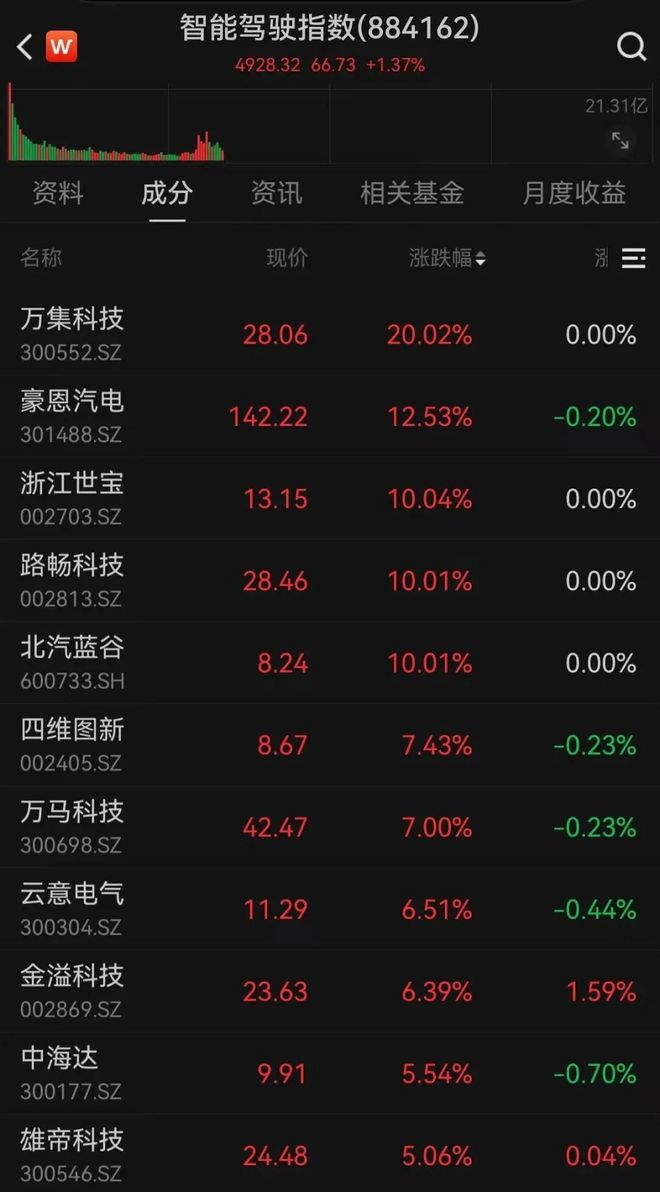
Core Viewpoint - The smart driving sector has seen a significant surge, with multiple companies experiencing substantial stock price increases following the announcement of L3-level conditional autonomous driving vehicle approvals in China [1][3]. Group 1: Market Performance - On December 16, smart driving stocks rose sharply, with companies like Beiqi Blue Valley, Wanji Technology, and Luchang Technology hitting their daily price limits [1]. - The smart driving index (884162) increased by 1.37%, reaching 4928.32 points, with a trading volume of 2.13 billion [2]. Group 2: Company Highlights - Wanji Technology's stock price surged by 20.02%, closing at 28.06 [2]. - Luchang Technology and Beiqi Blue Valley both saw their stock prices rise by 10.01%, closing at 28.46 and 8.24 respectively [2]. - Other notable performers included Zhejiang Shizong, which increased by 10.04%, and Wanmata Technology, which rose by 7.00% [2]. Group 3: Regulatory Developments - On December 15, the Ministry of Industry and Information Technology in China announced the first batch of L3-level conditional autonomous driving vehicle approvals, including models from Chongqing Changan Automobile and Beiqi Blue Valley Magna [3]. - Additionally, Hongmeng Zhixing has initiated L3-level conditional autonomous driving testing in Shenzhen in collaboration with local transportation authorities [3].


这一概念再度拉升,600733回封涨停
第一财经· 2025-12-16 03:08
Core Viewpoint - The smart driving sector has seen a significant surge, with multiple companies experiencing substantial stock price increases following the announcement of L3-level conditional autonomous driving vehicle approvals in China [1][3]. Group 1: Market Performance - On December 16, smart driving concept stocks rose sharply, with companies like Beiqi Blue Valley hitting the daily limit, Wanji Technology up by 20%, and Luchang Technology also reaching the daily limit [1]. - The smart driving index (884162) recorded a value of 4928.32, reflecting a 1.37% increase, with a trading volume of 2.131 billion [2]. Group 2: Company Highlights - Wanji Technology's stock price reached 28.06, marking a 20.02% increase [2]. - Luchang Technology and Beiqi Blue Valley both saw their stock prices increase by 10.01%, reaching 28.46 and 8.24 respectively [2]. - Other notable performers included Zhejiang Shibao with a 10.04% increase, and Yunyi Electric with a 6.51% increase [2]. Group 3: Regulatory Developments - On December 15, the Ministry of Industry and Information Technology announced the first batch of L3-level conditional autonomous driving vehicle approvals, including models from Chongqing Changan Automobile and Beiqi Blue Valley Magna [3]. - Additionally, Hongmeng Zhixing has initiated L3-level conditional autonomous driving testing in Shenzhen in collaboration with local transportation authorities [3].