智能驾驶ETF

Search documents
ETF资金榜 | 智能驾驶ETF(516520):净流出3025.88万元,居可比基金第一-20260122
Xin Lang Cai Jing· 2026-01-23 10:41
Group 1 - The smart driving ETF (516520.SH) experienced a decline of 0.22% on January 22, 2026, with a trading volume of 149 million yuan [1] - The fund saw a net outflow of 30.26 million yuan, ranking first among comparable funds [1] - Over a two-day period, the fund had a cumulative net outflow of 33.01 million yuan, also ranking first among comparable funds [1] Group 2 - The fund's latest share count decreased by 22 million shares, falling below 870 million shares [1] - The latest fund size dropped below 1.2 billion yuan [1]
投顾晨报:指数触及波动区,结构仍值得关注-20260113
Orient Securities· 2026-01-13 08:42
Core Insights - The report highlights that the market index has reached a volatile zone, but the underlying structure remains worthy of attention, indicating a healthy rotation in technology growth and cyclical stocks like non-ferrous metals and chemicals [2][3] - The report emphasizes a strategy focused on mid-cap blue chips as a stabilizing force, with technology growth providing support, particularly in sectors like smart vehicles and robotics [2][3] Industry Strategy - The non-ferrous metals sector is experiencing a price increase in lithium, driven by favorable tax policies and supply-demand dynamics, with lithium carbonate prices rising to $1,880 per ton, up $332 from the previous week [3] - The cobalt market is characterized by cautious purchasing strategies from downstream buyers, but tight supply conditions are supporting cobalt salt prices, indicating ongoing supply-demand negotiations [3] Thematic Strategy - The robotics sector is seeing increased catalysts, with the anticipated release of Tesla's Optimus V3 in Q1 2026 expected to boost attention on the robotics industry, alongside a significant number of domestic companies preparing for IPOs [4] - The report suggests that the domestic humanoid robot market is poised for substantial growth, with expected doubling of shipments and multiple companies likely to complete IPOs, benefiting from both domestic and international market developments [4]
智驾成果“闪耀”2026 CES,智能驾驶ETF(516520)助力布局汽车智能化转型新浪潮
Xin Lang Cai Jing· 2026-01-08 05:48
Core Insights - The issuance of the first L3-level autonomous driving license in Chongqing marks a significant step towards the commercial use of autonomous vehicles in China, transitioning from research and testing to compliance and commercialization [1][3] - The positive news has led to increased investment in the smart automotive sector, with the smart driving ETF (516520) attracting over 455 million yuan in net inflows since December 2025, significantly surpassing the total net inflow of 101 million yuan for the first eleven months of 2025 [1][3] - The scale of the smart driving ETF has grown from 390 million yuan at the beginning of December 2025 to 903 million yuan by January 7, 2026, representing an increase of over 130% [1][3] Industry Dynamics - The 2026 International Consumer Electronics Show (CES 2026) opened on January 6, showcasing the latest advancements in autonomous driving from various automotive companies, indicating rapid iteration in key areas such as smart cockpits, operating systems, and intelligent driving [1][4] - Artificial intelligence technology is increasingly penetrating the upgrades of intelligent driving assistance systems, in-vehicle interaction, and smart manufacturing, which is expected to drive the evolution of intelligent driving systems from single-function to cross-domain integration [4] - The smart driving ETF (516520) closely tracks the CSI Smart Automotive Theme Index, which includes companies providing terminal perception and platform applications for smart vehicles, reflecting the overall performance of the smart automotive industry [2][4] Sector Composition - The top five sectors represented in the CSI Smart Automotive Theme Index are automotive parts (24%), semiconductors (19.6%), passenger vehicles (14.4%), software development (11.3%), and communication equipment (7.1%), covering multiple segments of the smart automotive supply chain [2][4]
ETF主力榜 | 智能驾驶ETF(516520)主力资金净流出1921.65万元,居可比基金首位-20260107
Xin Lang Cai Jing· 2026-01-07 09:00
Group 1 - The smart driving ETF (516520.SH) experienced a decline of 1.16% on January 7, 2026, with a net outflow of main funds (transactions over 1 million yuan) amounting to 19.2165 million yuan, ranking first among comparable funds [1] - The latest trading volume of the fund reached 185 million shares, with a total transaction value of 253 million yuan, indicating that the net outflow of main funds accounted for 7.59% of the total transaction value on that day [1]
史上最强开门红?
表舅是养基大户· 2026-01-06 13:31
Market Overview - The A-share market is experiencing a strong performance, with the Shanghai Composite Index achieving a 13-day consecutive rise, setting a record for the longest winning streak in history [6][10] - The trading volume today reached over 2.8 trillion yuan, marking the highest single-day volume since the fourth quarter of last year, indicating increasing market enthusiasm [10] Sector Performance - The non-ferrous metals sector is leading the market, with a significant increase of over 4%. This sector's performance is driven by strong commodity prices, particularly gold, silver, and copper [12][14] - Zijin Mining, a leading company in the non-ferrous sector, saw its market capitalization exceed 1 trillion yuan, making it the first mining company to reach this milestone in A-shares [16] - The non-bank financial sector has also reached new highs since the 1994 market rally, with major insurance companies continuing to perform well [17][20] Investment Trends - There is a notable influx of funds into the market, with net purchases of financing reaching 19 billion yuan, contributing to a total financing balance of 25.434 trillion yuan, a new historical high [10][23] - The market is witnessing a divergence in sector performance, with the communication sector experiencing a decline while non-ferrous metals continue to rise [13][14] Future Outlook - Predictions suggest that a portion of the influx of funds may gradually be sold off in the early part of the year, with a moderate net sell-off observed [23] - The market's current enthusiasm is reflected in the high trading volume and the performance of key sectors, but caution is advised as certain indicators suggest potential overheating in the market [26]


ETF主力榜 | 智能驾驶ETF(516520)主力资金净流出660.58万元,居可比基金第一-20251229
Xin Lang Cai Jing· 2025-12-29 08:55
Group 1 - The smart driving ETF (516520.SH) experienced a decline of 0.47% on December 29, 2025 [1] - The net outflow of main funds (transactions over 1 million yuan) amounted to 6.6058 million yuan, ranking first among comparable funds [1] - The latest trading volume for the fund was 65.3956 million shares, with the latest trading amount falling below 90 million yuan, dropping 95 positions in the overall market ranking compared to the previous trading day [1]
ETF开盘:信息安全ETF涨4.69% 新材料ETF跌1.09%
Sou Hu Cai Jing· 2025-12-23 01:45
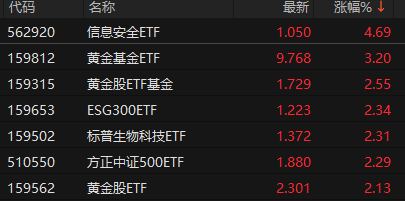
Group 1 - The ETF market opened with mixed performance on December 23, with the Information Security ETF (562920) leading gains at 4.69% [1][2] - The Gold Fund ETF (159812) increased by 3.20%, while the Gold Stock ETF (159315) rose by 2.55% [1][2] - The New Materials ETF (516360) experienced the largest decline at -1.09%, followed by the Intelligent Driving ETF (516520) at -1.03% and the Brazil ETF (520870) at -0.93% [1][2] Group 2 - The top-performing ETFs included Information Security ETF (562920) with a gain of 4.69%, Gold Fund ETF (159812) at 3.20%, and Gold Stock ETF (159315) at 2.55% [2] - The underperforming ETFs were New Materials ETF (516360) down by 1.09%, Intelligent Driving ETF (516520) down by 1.03%, and Brazil ETF (520870) down by 0.93% [2]
浙江世宝“五天五板”,2025智驾在L3资本狂欢中收官 | 智驾中场战事
Di Yi Cai Jing· 2025-12-22 07:41
Core Insights - The announcement of the first batch of L3-level conditional autonomous driving vehicle permits by the Ministry of Industry and Information Technology (MIIT) marks a significant step towards the commercialization of L3 autonomous driving in China [1][5] - The intelligent driving sector is experiencing a surge in interest, with companies like Zhejiang Shibao, Hongmeng Zhixing, Xiaopeng, and BYD announcing advancements in L3 autonomous driving technology [1][6] - The year 2025 is characterized as the "Year of High-Level Intelligent Driving," with a shift from marketing hype to stringent regulations in the industry [2][3] Industry Developments - The penetration rate of L2-level assisted driving vehicles reached 64% in the first three quarters of 2025, up from 48% in 2024, indicating a rapid adoption of advanced driving assistance systems [2] - Following incidents like the Xiaomi SU7 accident, the industry is facing increased scrutiny and regulatory measures to ensure safety and prevent misleading marketing practices [2][3] - The MIIT has mandated that companies must not exaggerate their autonomous driving capabilities and must not use consumers as test subjects [3] Regulatory Changes - A new stringent standard for L2 autonomous driving, expected to be implemented by 2027, will raise the bar for safety and operational requirements, potentially leading to a consolidation in the industry [4] - The L3 commercial pilot program is seen as a transition from technology validation to mass application, with significant implications for the future of intelligent driving [5][6] Market Outlook - The intelligent driving market is projected to see a further increase in L2 penetration to 70% by 2026, with L3 and above expected to reach a 10% penetration rate by 2030 [6] - The transition to L3 autonomous driving is complex, requiring a multi-sensor approach for safety, including the use of LiDAR and radar systems [7] - Challenges remain in the implementation of L3 systems, including liability issues, regulatory pressures, and the need for comprehensive insurance solutions [7]

L3级自动驾驶驶入快车道,把握千亿产业链的投资机遇!
市值风云· 2025-12-17 10:07
Core Viewpoint - The commercialization of Level 3 (L3) autonomous driving in China marks a new era for investment opportunities in the automotive industry, with significant policy developments and the approval of L3 vehicles for road testing [3][4]. Policy Breakthrough - The Ministry of Industry and Information Technology approved the first L3 conditional autonomous driving vehicle licenses on December 15, 2025, allowing Changan and BAIC models to operate in designated areas [4]. - The approval signifies a shift from "testing demonstration" to "commercial application" in China's autonomous driving industry, with more companies expected to receive similar licenses in the future [4]. Technology and Responsibility Shift - The fundamental difference between Level 2 (L2) and Level 3 (L3) autonomous driving lies in the shift of responsibility; in L2, the driver must be ready to take control, while in L3, the responsibility shifts to the vehicle manufacturer in specific scenarios [5][6]. - The realization of L3 autonomous driving relies on a complex supply chain and stringent safety standards, necessitating a reliable closed-loop system for perception, decision-making, and execution [6]. Investment Tools and Strategies - For ordinary investors, the high technical barriers and volatility in the smart automotive industry make investing through fund products a more prudent choice [7]. - Currently, there are only two smart automotive ETFs with a scale greater than 100 million: the Smart Automotive ETF (515250.SH) and the Smart Driving ETF (516520.SH), both tracking the CS Smart Automotive Index [7][8]. ETF Performance and Composition - The CS Smart Automotive Index includes leading companies across various segments of the smart automotive industry, reflecting the overall performance of the sector [9][10]. - The top ten weighted stocks in the index include companies like Luxshare Precision (6.11%), Chipone (5.37%), and iFlytek (4.95%), covering the entire hardware and software support chain for smart vehicles [10][11]. Market Trends and Volatility - The largest smart automotive ETF traded around 1.10 yuan as of mid-December, showing signs of short-term pressure due to the high volatility of the smart automotive sector [11][12]. - The smart automotive sector has experienced significant fluctuations, with a maximum drawdown exceeding 30% in the past year, highlighting its sensitivity to market conditions [12]. Long-term Investment Logic - The long-term investment rationale for smart automotive ETFs is rooted in the irreversible trend of automotive intelligence, while short-term performance is influenced by market sentiment and volatility [15]. - Current market adjustments may present opportunities for investors to gradually accumulate positions, with a focus on long-term industry benefits and monitoring developments in L3 autonomous driving commercialization [15].
资金涌入,持续加仓!
Zhong Guo Zheng Quan Bao· 2025-12-16 14:08
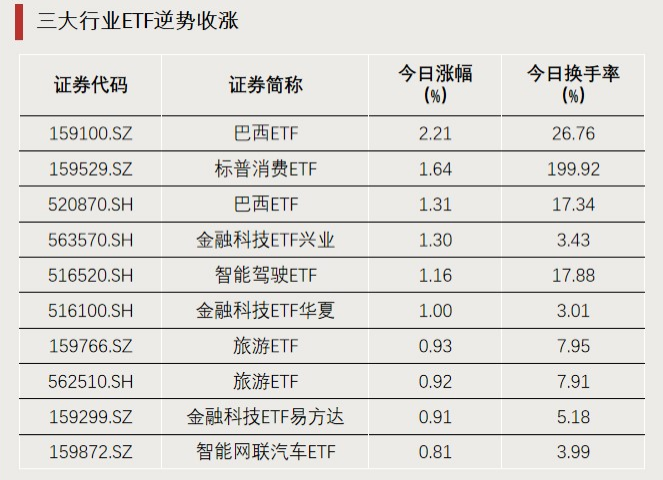
Market Overview - On December 16, A-shares and Hong Kong stocks experienced a pullback, with only about 50 out of over 1300 ETFs closing higher, and 6 of these ETFs rising by 1% or more. Financial technology, tourism, and automotive sector ETFs showed relative resilience [1] - In the cross-border ETF segment, two Brazilian ETFs and one S&P Consumer ETF led the market in terms of gains [1] ETF Performance - Notably, several ETFs that rose against the market trend saw significant increases in trading volume. The S&P Consumer ETF (159529) had a turnover rate of 199.92%, with a trading volume nearing 2 billion yuan, four times that of the previous day. The Smart Driving ETF (516520) also saw its trading volume increase to approximately seven times that of the previous day [2] - On December 16, financial technology, tourism, and automotive sector ETFs performed well, with multiple products ranking among the top gainers. The financial technology ETFs linked to the CSI Financial Technology Index saw over half of their constituent stocks close in the green, with notable gains from companies like Chuangshi Technology (300941) and Cuiwei Co. (603123) [4] Fund Flows - On December 15, despite the market pullback, ETFs experienced a net inflow of approximately 6.7 billion yuan, with broad-based ETFs attracting significant capital. Several ETFs linked to the CSI A500 Index ranked among the top for net inflows, with three A500 ETFs collectively receiving over 13.5 billion yuan in net inflows over the past five trading days [3][9] - The A500 ETF from Southern Fund (159352) led with a net inflow of 3.915 billion yuan on December 15, significantly outpacing other products [11] Sector-Specific Insights - The gold stock ETFs faced a sharp decline on December 16, with the largest drop exceeding 4%. Six out of the top ten ETFs with the largest declines were gold-related, reflecting a cautious market sentiment ahead of key economic data releases [7] - The CSI A500 Index has over 280 public funds linked to it, with more than 80 asset management firms involved, totaling over 240 billion yuan in assets. Over 80% of this is held in ETF products, with 40 ETFs exceeding 210 billion yuan in total assets [10] Upcoming Products - On December 19, Huatai-PB Fund will launch the Sci-Tech Entrepreneurship Artificial Intelligence ETF, adding to the growing list of innovative ETF products in the market [13]