
全国统一大市场建设

Search documents
推进省内全域一体化全面融入长三角一体化
Xin Hua Ri Bao· 2025-06-23 21:00
Core Viewpoint - Jiangsu province is emphasized to actively participate in the integrated development of the Yangtze River Delta and the Yangtze River Economic Belt, focusing on regional coordination and high-quality development [1] Group 1: Achievements in Regional Integration - Jiangsu has made significant progress in implementing regional coordinated development strategies since the 18th National Congress, addressing regional imbalances and promoting coordinated growth [2] - The "1+3" key functional area strategy initiated in 2017 has effectively broken traditional geographical and administrative barriers, optimizing resource allocation and promoting balanced development [2] - The Yangtze River Delta urban agglomeration contributes 77% to the province's economic growth, while the coastal economic belt accounts for over 10% of the national marine production value [2] Group 2: Promoting Provincial and Regional Integration - Jiangsu aims to enhance its integration within the Yangtze River Delta and the Yangtze River Economic Belt by coordinating regional interests and improving development mechanisms [3][4] - The province plans to strengthen major transportation infrastructure and establish a modern comprehensive transportation system to facilitate resource flow and optimize land use [4] Group 3: Active Participation in Regional Cooperation - Jiangsu is set to enhance regional connectivity by optimizing infrastructure and developing a modern transportation network centered around Shanghai and Nanjing [5] - The province will promote collaborative innovation by forming industry innovation alliances and enhancing the transfer of scientific achievements [6] Group 4: Collaborative Development with Neighboring Regions - Jiangsu is positioned to enhance its role in supporting Shanghai and collaborating with Zhejiang and Anhui, focusing on ecological and green development along the Ning-Hang Economic Belt [7] - The province aims to leverage its educational and industrial resources to create a comprehensive development model that integrates headquarters, research, and production [7]
苏州税务“跨区通办”3万余笔
Su Zhou Ri Bao· 2025-06-21 23:37
Core Viewpoint - Suzhou's tax authorities are enhancing service efficiency by optimizing cross-regional operations and addressing the needs of businesses and citizens for remote services, contributing to the construction of a unified national market [1][2] Group 1: Cross-Regional Services - Suzhou tax authorities have processed a total of 30,307 cross-regional service transactions from January to May this year, accounting for approximately 5.8% of the national total, with 5,302 of these being inter-provincial transactions [1] - The establishment of a "remote virtual window" through the tax interaction platform allows for online submission of documents, online process flow, and real-time feedback, enhancing the efficiency of cross-regional services [1] Group 2: Migration Facilitation - The tax department is addressing the challenges of cross-regional migration by streamlining the process, which includes optimizing pre-reminders, expediting in-process handling, and improving post-service support [2] - The goal is to achieve a "one-stop, convenient, and efficient" migration registration process for businesses, thereby enhancing the overall tax service environment [2] Group 3: Service Stations - As of April 2025, Suzhou has established 42 various service stations to support cross-regional business operations, covering towns, financial institutions, communities, and social venues [1] - These service stations are part of the initiative to extend tax services and improve taxpayer convenience [1]
信心、布局……共享红利!中国创新力驱动跨国企业对华投资战略升级
Yang Shi Wang· 2025-06-21 03:34
无论是第一次"在中国为全球",还是第一次"在中国为中国",这些变化都体现出中国的创新能力正驱动跨国企业对华投资战略升级。 央视网消息:国家发展改革委与跨国企业座谈会6月20日在福建福州举行。为了加强在华跨国企业与政府部门的沟通,国家发展改革委自 2021年起建立圆桌会沟通机制,通过对话解决企业发展中的实际问题。2025年这场圆桌会,吸引了近50家跨国企业参加。这场会议不仅是政企 沟通的桥梁,更折射出外资企业对中国市场的坚定信心与深度参与的战略布局。 国家发展改革委与跨国企业交流会在福建福州举行,企业代表的热情都非常高涨,距离开会还有一个小时,他们就已经纷纷来到了现场。 立足当下,深耕未来。2025年的圆桌会,跨国企业格外关心中国的"下一个五年"。期待让企业的规划与中国的规划同频共振,体现出在中国深 耕的信心。 丹纳赫中国区副总裁韦春艳表示,国家在积极筹备"十五五"规划,他们现在正在跟全球总部一起合作,制定丹纳赫中国未来10年的战略规划。 西门子(中国)有限公司政府事务总监刘铭扬表示,他们十分关注在"十五五"期间,中国在科技创新、高端制造、基础设施这些方面,未来还 有哪些规划,他们相信这些政策能够不断给他们企业 ...


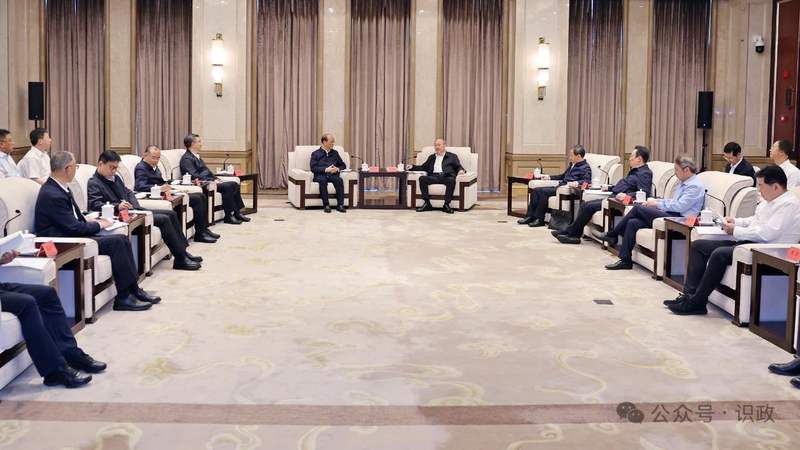
青海省党政代表团来京考察,尹力、殷勇与吴晓军、罗东川座谈,共商全面深化京青发展合作
Xin Jing Bao· 2025-06-21 02:17
Group 1 - The core viewpoint of the articles revolves around the deepening cooperation between Beijing and Qinghai, focusing on mutual support and development strategies [1][3][4] - Qinghai's leadership expresses gratitude for Beijing's long-term support, highlighting significant changes in the region due to this assistance over the past 15 years [3][4] - Beijing aims to enhance its support for Qinghai by leveraging its experience in high-quality economic development and political responsibility, particularly in the context of the "14th Five-Year Plan" and the upcoming "15th Five-Year Plan" [4][6] Group 2 - The discussions emphasize the importance of ecological protection and high-quality development in Qinghai, aligning with President Xi Jinping's vision for the region [3][4] - Beijing plans to strengthen technological innovation and industrial collaboration, particularly in clean energy and tourism, to promote high-quality development and environmental protection [4][6] - The Qinghai delegation's visit includes inspections of various projects in Beijing, focusing on urban renewal, industrial heritage preservation, and expanding sales channels for Qinghai's agricultural products [6]
跨国公司领导人青岛峰会丨商务部报告显示:跨国公司在华拥有广阔新机遇
Zhong Guo Jing Ji Wang· 2025-06-20 02:45
Core Insights - The report highlights the significant role of multinational companies in China's economy, emphasizing their contributions to the development of an open economy, modern industrial system, and regional coordination [1] - It identifies the advantages of the Chinese market, including certainty, safety, openness, scale, convenience, growth potential, and profitability, making it an attractive investment destination for multinational companies [1] - The report suggests that multinational companies should reassess their global positioning in the Chinese market and optimize their investment strategies from a long-term perspective [1] Group 1 - Multinational companies can leverage China's policy guidance, open scenarios, and factor restructuring to transition from traditional industries to emerging fields, achieving goals of "leapfrogging" and "renewing existing stock" [2] - The report emphasizes the importance of deep integration into China's regional strategies and utilizing local advantages to enhance global competitiveness [2] - Companies are encouraged to adopt a "localized innovation + supply chain collaboration" model to improve their position in the global value chain [2] Group 2 - The report outlines that multinational companies can act as "ecological co-builders" in China's modernization efforts, sharing commercial value and sustainable development responsibilities [3] - It suggests various investment paths, including equity investment, venture capital, and patient capital, to participate deeply in the Chinese market and share long-term development dividends [3] - Companies are advised to collaborate with local venture capital institutions to establish venture capital funds, providing financial support to promising startups [3]
近期政策关注出现变化(国金宏观张馨月)
雪涛宏观笔记· 2025-06-16 09:40
《意见》进一步落实了二十届三中全会在城镇化和民生领域的改革部署 。核心思想是通过结构性改 革,推动基本公共服务与户籍脱钩、与人口挂钩,促进政府增加对基本公共服务的投入,减轻消费潜力 最大的中低收入群体,尤其是灵活就业人员、农民工、新就业形态人员在养老、教育、医疗、住房等领 域的负担,提升其消费能力和意愿。 外部环境相对缓和之后,政策转向更加关注长期目标和高质量发展,改革有望再提速。 文:国金宏观宋雪涛/联系人张馨月 近期改革信号释放加快,反映出外部环境相对缓和后,政策转向更加关注长期目标和高质量发展,改革 进程有望再提速。 6月9日中办、国办印发《关于进一步保障和改善民生 着力解决群众急难愁盼的意见》(下文简 称"《意见》)。 值得注意的是, 《意见》的成文时间为3月2日,但公布时间为6月9日 ,可能是因 为4-5月的关税密集冲击造成外部不确定性上升,延缓了落实深化改革的政策节奏。 除《意见》外,近期在消费政策方面,更强调完善促消费的长效机制。 6月8日经济日报《金观平:持 续完善促消费长效机制》中提到,"要用好考核'指挥棒',建立完善科学合理的考核指标体系,引导地 方政府和领导干部树立以促消费为导向的政绩观 ...

宏观经济点评报告:改革再提速
SINOLINK SECURITIES· 2025-06-16 09:09
Group 1: Policy Reforms - The document outlines the implementation of reforms aimed at decoupling basic public services from household registration, allowing non-resident workers to access the same services as local citizens[4] - It emphasizes the need for basic public services to be linked to population changes, promoting a tailored approach for different cities based on their specific circumstances[6] - The central government plans to allocate 400 billion yuan and 420 billion yuan in 2024 and 2025 respectively to support the urbanization of agricultural transfer populations[6] Group 2: Economic Implications - The reforms are expected to enhance the consumption capacity of low- and middle-income groups, particularly migrant workers, by reducing their burdens in areas like education and healthcare[4] - The shift towards a service-oriented government is anticipated to improve public services and attract more population inflow, creating a positive feedback loop for local economies[7] - The report highlights the importance of breaking down barriers in education, healthcare, and housing to ensure equitable access to basic public services across regions[8] Group 3: Risks and Challenges - There is uncertainty regarding the pace of reform implementation, as the process involves multiple sectors and may be complex[10] - Subjectivity in expectations of reform policies could lead to discrepancies between anticipated and actual outcomes[10]
税务部门优化跨区涉税服务
Jing Ji Ri Bao· 2025-06-14 21:45
Core Insights - The tax authorities have strengthened their service measures to facilitate cross-regional operations for businesses and individuals, enhancing administrative efficiency to support the construction of a unified national market [1][2] - In the first five months of this year, the tax authorities processed 527,700 cross-regional business transactions, and 14,700 taxpayers successfully completed inter-provincial migration, marking a year-on-year increase of 13.52% [1] Group 1 - The tax authorities have implemented a series of measures to address the challenges faced by businesses during cross-regional migration, including optimizing pre-reminders, expediting processing times, and improving post-service support [2] - The average processing time for migration matters has been reduced by 5 to 10 days, allowing eligible businesses to complete their migration on the same day [2] - The tax authorities are committed to continuously optimizing tax payment services and addressing urgent issues faced by taxpayers, translating educational outcomes into practical results for high-quality development [2]
广东“荔”量:破局南果北运,链动粤陕经济
2 1 Shi Ji Jing Ji Bao Dao· 2025-06-10 13:49
Core Viewpoint - The surge in demand for Guangdong lychees in Xi'an, driven by the popularity of the TV series "Lychee of Chang'an," highlights a significant shift in consumer behavior and market dynamics, connecting southern fruit farmers with northern consumers and enhancing regional agricultural transformation [1][6]. Group 1: Market Dynamics - The presence of Guangdong lychees in Xi'an this year is unprecedented in terms of distribution and consumer interest, with multiple retailers establishing dedicated display areas for lychees [1]. - There is a notable increase in demand for high-quality lychee varieties, such as "Highzhou White Sugar Lychee" and "Zengcheng Guiwei," leading to faster sales compared to previous years [1][5]. - The daily transaction volume of Guangdong lychees at wholesale markets can reach up to 10 tons, with total seasonal transactions expected to hit tens of thousands of tons [5]. Group 2: Logistics and Supply Chain - Modern logistics solutions, including drone technology and smart cold chain transportation, have effectively addressed the challenges of lychee transportation over long distances [2][7]. - The establishment of a drone network in Guangdong has improved the efficiency of lychee transportation, reducing costs and ensuring product freshness from harvest to market [2][3]. - The integration of various transportation methods has reduced the delivery time from 5-7 days to under 30 hours, enhancing product quality and minimizing losses [7]. Group 3: Agricultural Innovation - Guangdong's agricultural sector is undergoing a transformation with the introduction of ultra-low temperature preservation technology, which helps stabilize supply and demand during peak seasons [3][6]. - The focus on standardized planting and post-harvest processing has improved the quality of lychees, leading to better market acceptance and pricing power [4][6]. - The shift towards a direct supply chain from orchards to consumers is becoming mainstream, with increased collaboration between large retailers and production areas [6][7]. Group 4: Economic Impact - The lychee industry supports approximately 1.8 million jobs in Guangdong, reflecting a broader shift towards modern agricultural practices and economic sustainability [6][8]. - The successful operation of the "Guangdong-Xi'an" lychee supply chain exemplifies the potential for a unified national market, balancing supply and demand across regions [7][8]. - The integration of quality, standardization, and branding in the lychee supply chain serves as a valuable reference for optimizing agricultural product distribution and enhancing regional industry complementarity [7][8].
“三位一体”推动统一大市场建设
Jing Ji Ri Bao· 2025-06-06 21:43
Core Viewpoint - The construction of a national unified market is progressing steadily, aiming to unleash domestic demand potential and solidify economic recovery through systematic reforms focusing on "institutional innovation, technological empowerment, and governance collaboration" [1][2]. Group 1: Progress and Achievements - Since the issuance of the "Opinions on Accelerating the Construction of a National Unified Market" in April 2022, various reform measures have been implemented, including the pilot program for rural collective operating construction land and the official operation of the inter-provincial electricity spot market [1]. - The introduction of the "Guidelines for the Construction of a National Unified Market (Trial)" at the beginning of this year has clarified the implementation path from three dimensions: requirements, prohibitions, and encouragements [1]. - The launch of a special action to standardize enterprise-related law enforcement has provided legal support for the construction of a unified market [1]. Group 2: Challenges and Barriers - The construction of a national unified market has entered a complex phase, with deep-rooted issues such as hidden barriers in bidding processes and enterprise registration obstacles persisting in many areas [2]. - Local protectionism has evolved, with some regions shifting from explicit approvals to implicit subsidies, leading to differentiated regulatory practices [2]. - These challenges increase institutional transaction costs and hinder the full realization of the advantages of a large-scale market [2]. Group 3: Strategic Focus Areas - To address these challenges, the focus should be on "institutional innovation, technological empowerment, and governance collaboration" as a systematic reform approach [2]. - In terms of institutional innovation, efforts are being made to deepen the market-oriented reform of factors, streamline the "Fair Competition Review Regulations," and enhance the flow of factors [2]. - Technological empowerment includes accelerating the cultivation of data factor markets and promoting the sharing of digital infrastructure, exemplified by the launch of the first cross-provincial freight station in Suzhou, which reduced international logistics costs by nearly 30% [3]. - Governance collaboration aims to improve central-local coordination mechanisms and explore a "negative list + credit supervision" model to enforce market segmentation behavior as a rigid constraint [3].