
智能驾驶

Search documents
L3级自动驾驶商业化应用迈出关键一步,智驾产品成供应商新增长点
Quan Jing Wang· 2025-12-16 02:15
Core Insights - The Ministry of Industry and Information Technology has officially granted the first batch of L3 conditional autonomous driving vehicle permits in China, marking a significant step from testing to commercial application for L3 autonomous driving [1] - 2026 is anticipated to be a critical year for the mass production of L3 intelligent driving in China, which is expected to drive orders for related automotive component companies [1] Industry Summary - Several automotive component companies have achieved breakthroughs in orders related to intelligent driving this year, becoming new growth points for their businesses [1] - For instance, Joyson Electronics (均胜电子) announced in September that its central computing unit (CCU) products, which integrate intelligent driving, intelligent networking, and intelligent cockpit technologies, received orders from two leading OEMs, with a total project lifecycle order value of approximately 15 billion yuan, set to begin mass production in 2027 [1] - Joyson Electronics has introduced intelligent driving domain control products based on different chip platforms to cater to various global market and vehicle demands [1] - In 2023, Joyson Electronics launched the world's first intelligent auxiliary driving domain controller nDriveH based on Qualcomm's Snapdragon Ride second-generation chip platform, supporting full-scenario functions from L2++ to L4 level intelligent auxiliary driving [1]

利好传来,智能驾驶概念大涨,万集科技20cm涨停,关注两大方向
21世纪经济报道· 2025-12-16 02:11
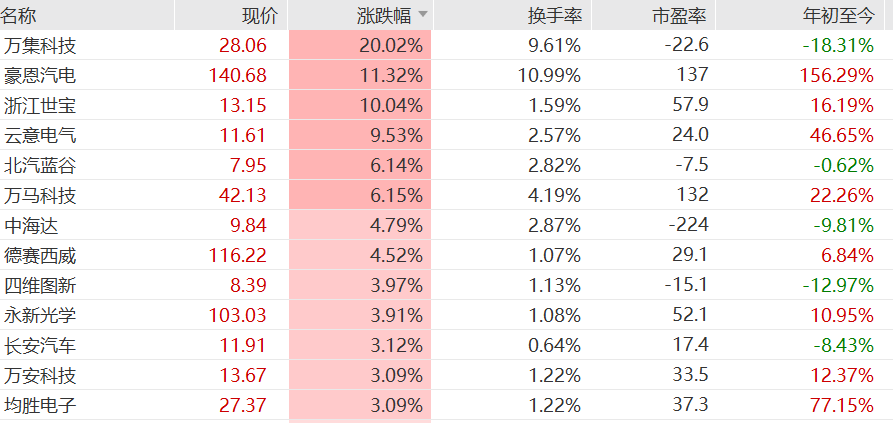
两款L3级自动驾驶产品获准 12月15日,据工业和信息化部官方公众号消息,我国首批L3级有条件自动驾驶车型准入许可 公布,两款分别适配城市拥堵、高速路段的车型将在北京、重庆指定区域开展上路试点,意味 着我国L3级自动驾驶从测试阶段向商业化应用迈出了关键一步。 记者丨叶映橙 见习记者林健民 编辑丨 刘雪莹 12月16日,A股指数低开, 智能驾驶概念大面积高开。 截至9:35,万集科技20cm涨停,浙江 世宝一字涨停,莱赛激光高开超10%,云意电气、北汽蓝谷、万马科技涨幅靠前。 | | 现价 | 涨跌幅 ▼ | | | 中国 安全 | | --- | --- | --- | --- | --- | --- | | 万集科技 | 28.06 | 20.02% | 9.61% | -22.6 | -18.31% | | 豪恩汽电 | 140.68 | 11.32% | 10.99% | 137 | 156.29% | | 浙江世宝 | 13.15 | 10.04% | 1.59% | 57.9 | 16.19% | | 云意电气 | 11.61 | 9.53% | 2.57% | 24.0 | 46.65% | | ...


利好传来,智能驾驶概念大涨,万集科技20cm涨停,关注两大方向
2 1 Shi Ji Jing Ji Bao Dao· 2025-12-16 02:10
Core Viewpoint - The approval of two L3-level autonomous driving models marks a significant step towards the commercialization of autonomous driving in China, transitioning from testing to practical application [4][6]. Market Performance - A-share indices opened lower, but the smart driving concept stocks surged, with Wanji Technology (300552) hitting a 20% limit up, and Zhejiang Shibao (002703) also reaching a limit up [1]. - Key stock performances include: - Wanji Technology: Current price 28.06, up 20.02%, YTD down 18.31% [2] - Haoen Automotive: Current price 140.68, up 11.32%, YTD up 156.29% [2] - Zhejiang Shibao: Current price 13.15, up 10.04%, YTD up 16.19% [2] - Yunyi Electric: Current price 11.61, up 9.53%, YTD up 46.65% [2] - Beiqi Blue Valley: Current price 7.95, up 6.14%, YTD down 0.62% [2] - Wanma Technology: Current price 42.13, up 6.15%, YTD up 22.26% [2] - Hong Kong smart driving concept stocks also showed strength, with Youjia Innovation and Hesai-W up around 3% [2]. L3 Autonomous Driving Approval - The Ministry of Industry and Information Technology announced the approval of two L3-level autonomous driving models, which will be tested in designated areas in Beijing and Chongqing [4][6]. - The two approved models are: - Changan Automobile's SC7000AAARBEV, capable of autonomous driving in congested traffic at speeds up to 50 km/h [6]. - Arcfox's BJ7001A61NBEV, capable of autonomous driving at speeds up to 80 km/h [6]. Future Developments - The L3-level autonomous driving system allows for full driving task execution under specific conditions, although users must remain ready to take control [7]. - The Ministry plans to enhance vehicle operation monitoring and safety assurance, aiming for high-quality development of the smart connected vehicle industry [8]. - The L3 formal approval is anticipated to be a key milestone post-2026, with significant opportunities in policy-driven market demand and technological upgrades [10][11]. - Companies like BYD, NIO, Changan, and GAC, which have obtained L3 road testing licenses, are expected to gain first-mover advantages [11].




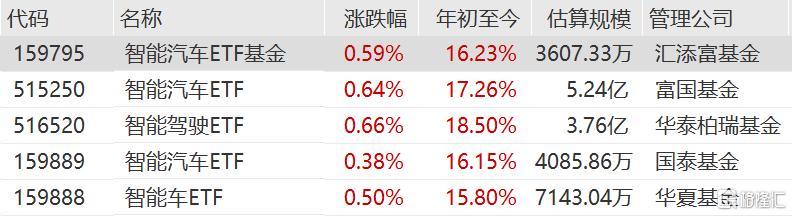
首批L3级自动驾驶车型获准入许可,智能汽车ETF基金、智能汽车ETF、智能驾驶ETF、智能车ETF上涨
Ge Long Hui A P P· 2025-12-16 02:04
Group 1 - The A-share market opened lower, while the smart driving concept stocks saw significant gains, with Wanji Technology hitting the 20% limit up and Zhejiang Shibao and Suoling Co. also reaching the limit up [1] - The smart car ETFs have shown strong performance, with year-to-date increases exceeding 15%, indicating a growing interest in the smart automotive sector [1][2] Group 2 - The Ministry of Industry and Information Technology has approved two L3-level autonomous driving vehicle models, which will be tested on specific roads in Chongqing and Beijing [3] - The approved models include a Changan electric sedan capable of autonomous driving at speeds up to 50 km/h in congested traffic and an Aiways electric sedan capable of 80 km/h on designated highways [3] - This approval marks the official entry of China into the L3 autonomous driving era, presenting new business opportunities for automotive testing and hardware sectors [4] Group 3 - The automotive industry is expected to experience high-quality development driven by policies supporting high-end, intelligent, and globalized growth, with projected sales exceeding 34 million vehicles in 2025 [4] - Domestic brands have captured 65% of the retail market share, a 5.5 percentage point increase from the previous year, with new energy vehicles accounting for a 50.7% penetration rate [4] - By 2026, the automotive market is anticipated to shift towards high-quality development, with projected passenger vehicle sales reaching approximately 31.1 million units [4]

A股低开,智能驾驶概念大面积高开
Di Yi Cai Jing Zi Xun· 2025-12-16 02:01
Market Overview - The A-share market opened lower with the Shanghai Composite Index down by 0.17%, the Shenzhen Component Index down by 0.21%, and the ChiNext Index down by 0.23% [3][4] - The Hang Seng Index also opened lower, down by 0.32%, while the Hang Seng Tech Index fell by 0.56% [6] Bond Market - The bond futures market showed mixed results with the 30-year main contract down by 0.07%, while the 10-year, 5-year, and 2-year main contracts saw slight increases of 0.02%, 0.06%, and 0.01% respectively [2] Sector Performance - The smart driving concept stocks were notably active, with companies like Beiqi Blue Valley and Zhejiang Sebao hitting the daily limit up, and Wanjie Technology rising over 15% [2] - Other sectors such as e-commerce, lithography machines, nuclear fusion, superconductors, CPO, and memory chip stocks experienced a pullback [4] Individual Stock Highlights - Aerospace Electronic opened over 4% higher following an announcement of a 727 million yuan capital increase to gain control of its subsidiary, Aerospace Rocket Company [4]

智能驾驶迎重磅利好,智能车ETF(159888)逆市领涨,万集科技涨停
Mei Ri Jing Ji Xin Wen· 2025-12-16 01:54
Group 1 - The core viewpoint of the news is the significant rise in the smart driving sector, driven by the recent approval of L3-level conditional autonomous driving vehicles in China, marking a transition from testing to commercial application [1] - The smart car ETF (159888) has shown a leading increase of 1% in the market, with key holdings such as Wanjie Technology, Zhejiang Sebao, and Suoling Co., Ltd. reaching their daily limit [1] - The Ministry of Industry and Information Technology announced the first batch of L3-level autonomous driving vehicle licenses, allowing two models to conduct road trials in designated areas of Beijing and Chongqing [1] Group 2 - According to China International Capital Corporation (CICC), the penetration rate of advanced autonomous driving is expected to gradually increase, with urban NOA penetration surpassing 15% and highway NOA exceeding 30% by September 2025 [1] - The smart car ETF closely tracks the CS Smart Car Index, with its constituent stocks primarily distributed across high-quality sectors such as electronics, computers, automobiles, and communications, showcasing a strong technological attribute [1] - The automotive parts ETF (562700) tracks the CSI Automotive Parts Theme Index, focusing on high-quality parts companies, with significant weight in automotive parts, automation equipment, and consumer electronics sectors [2]


AH股低开震荡,创业板指跌超1%,消费、智能驾驶逆势走强,商业航天回调,港股黄金股走弱,铂钯期货续涨
Hua Er Jie Jian Wen· 2025-12-16 01:52
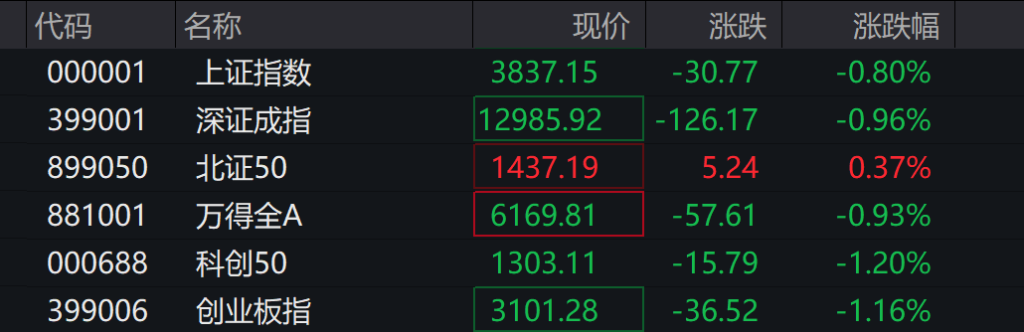
A股低开,创业板指跌超1%,沪指跌0.69%,深成指跌0.85%。电商、光刻机、核聚变、超导、CPO、存储器概念股纷纷回调,智能驾驶题材活 跃。 港股指数继续低开,恒指跌0.32%,恒生科技指数跌0.56%。大型科技股继续昨日跌势,百度、小米、阿里巴巴均跌超1%;连续上涨的黄金股集体 走低,汽车股、建材水泥股、消费电子概念股普跌。另外,港口及海运股上涨明显,海丰国际大涨近15%,重卡股中国重汽涨4.4%。 消息面,隔夜美股三大指数收跌,中概指数大跌2.17%。 国债期货开盘多数上涨,30年期主力合约跌0.07%报111.520元,10年期主力合约涨0.02%报107.875元,5年期主力合约涨0.06%报105.825元,2年期 主力合约涨0.01%报102.454元。 9:45 国内商品期市开盘多数下跌,沪镍跌2.29%,不锈钢跌1.91%,低硫燃料油跌1.67%,玻璃跌1.63%,红枣跌1.21%,集运指数(欧线)涨2.42%,钯金 涨1.64%。 创业板指跌超1%,沪指跌0.69%,深成指跌0.85%,商业航天、光伏风电、影视院线等方向跌幅居前,沪深京三市下跌个股近4400只。 | 代码 | 名称 | ...

A股低开,智能驾驶概念大面积高开
第一财经· 2025-12-16 01:48
Market Overview - The A-share market opened lower with the Shanghai Composite Index down 0.17%, the Shenzhen Component down 0.21%, and the ChiNext Index down 0.23% [4][5] - The Hang Seng Index also opened lower, down 0.32%, while the Hang Seng Tech Index fell by 0.56% [9][10] Sector Performance - The smart driving sector showed strong activity with stocks like Beiqi Blue Valley and Zhejiang Shibao hitting the daily limit, and Wanji Technology rising over 15% [3][6] - Other sectors such as e-commerce, lithography machines, nuclear fusion, superconductors, CPO, and memory chips experienced a pullback [6] Notable Stocks - Aerospace Electronics opened over 4% higher after announcing a plan to invest 727 million yuan to gain control of its subsidiary, Aerospace Rocket Company [7][8] Monetary Policy - The central bank conducted a 135.3 billion yuan reverse repurchase operation with a rate of 1.40%, while 117.3 billion yuan of reverse repos matured today [8]



滚动更新丨A股三大指数集体低开,智能驾驶题材表现活跃
Di Yi Cai Jing Zi Xun· 2025-12-16 01:41
09:29国债期货开盘,30年期主力合约跌0.07%,10年期主力合约涨0.02%,5年期主力合约涨0.06%,2 年期主力合约涨0.01%。 09:27智能驾驶概念开盘活跃,北汽蓝谷、浙江世宝竞价涨停,万集科技涨超15%,索菱股份、经纬恒 润等纷纷高开。 09:25 A股开盘丨三大指数集体低开 沪指低开0.17%,深成指低开0.21%,创业板指低开0.23%。 | HCRT | 名称 | 两日图 | 现价 | 涨跌 | 涨跌幅 | | --- | --- | --- | --- | --- | --- | | 000001 | 上证指数 | | 3861.51 | -6.41 | -0.17% | | 399001 | 深证成指 | NAJA | 13084.88 | -27.21 | -0.21% | | 399006 | 创业板指 | Nam | 3130.43 | -7.37 | -0.23% | 个股方面,航天电子高开超4%,公司公告,拟7.27亿元增资控股子公司航天火箭公司。 | 16.51 +0.69 +4.36% | | | | 航天电子 1 立即 600879 交易 | | --- | -- ...

智能驾驶概念大面积高开 北汽蓝谷、浙江世宝等多股涨停
Mei Ri Jing Ji Xin Wen· 2025-12-16 01:41
Core Viewpoint - The smart driving concept stocks experienced significant gains in early trading on December 16, with several companies reaching their daily price limits [1] Group 1: Stock Performance - Beiqi Blue Valley and Zhejiang Shibao both hit the daily price limit [1] - Yunyi Electric, Wanjie Technology, and Laisai Laser opened over 10% higher [1] - Other companies such as Suoling Co., Jingwei Hengrun, Haon Electric, Zhonghaidah, and Jinjiang Online also showed notable increases in stock prices [1]