生成式AI

Search documents
韩知名高校曝上百人用AI考试作弊丑闻,已有约40名学生“自首”
Huan Qiu Shi Bao· 2025-11-10 22:51
Core Insights - A significant cheating scandal has emerged at Yonsei University in South Korea, involving over a hundred students in a course on "Natural Language Processing (NLP) and ChatGPT" [1][2] - The course, attended by approximately 600 students, conducted its midterm exam online, where students were required to record their screens and themselves to prevent cheating [1] - The instructor discovered multiple instances of cheating, including students manipulating camera angles and using AI tools outside the monitoring range [1] Group 1 - The midterm exam was held on October 15, and the instructor noted that many students exhibited suspicious behavior, such as frequently looking at blind spots and switching windows [1] - The instructor announced that confirmed cheaters would receive a score of zero for the midterm and warned of severe consequences for those who deny or conceal their actions [1] - Following the scandal, approximately 190 out of 353 students polled admitted to using ChatGPT or other AI tools during the exam, indicating a significant prevalence of AI usage among students [2] Group 2 - The university has initiated an investigation, comparing exam footage with submitted answers, and plans to impose penalties according to school regulations [2] - The rise of generative AI has caused unprecedented disruption in South Korean universities, with 91.7% of surveyed students reporting AI usage for assignments or research [2] - Experts warn that excessive reliance on AI is diminishing students' independent thinking skills, suggesting a need for clear guidelines on AI usage in academic settings [2]
英硅智能(03696) - 申请版本(第一次呈交)
2025-11-10 16:00
香港交易及結算所有限公司、香港聯合交易所有限公司與證券及期貨事務監察委員會對本申請版本的內容 概不負責,對其準確性或完整性亦不發表任何意見,並明確表示概不就因本申請版本全部或任何部分內容 而產生或因倚賴該等內容而引致的任何損失承擔任何責任。 InSilico Medicine Cayman TopCo 英矽智能 (「本公司」) (於開曼群島註冊成立的有限公司) 的申請版本 INSILICO MEDICINE InSilico Medicine Cayman TopCo 英矽智能 警告 本申請版本乃根據香港聯合交易所有限公司(「聯交所」)及證券及期貨事務監察委員會(「證監會」)的要求 而刊發,僅用作提供資料予香港公眾人士。 本申請版本為草擬本,其內所載資料並不完整,亦可能會作出重大變動。 閣下閱覽本文件,即代表 閣 下知悉、接納並向本公司、本公司的聯席保薦人、整體協調人、顧問或包銷團成員表示同意: 本公司招股章程根據香港法例第32章公司(清盤及雜項條文)條例送呈香港公司註冊處處長登記前,本公 司不會向香港公眾人士提出要約或邀請。倘在適當時候向香港公眾人士提出要約或邀請,有意投資者務請 僅依據於香港公司註冊處處長 ...
百度第二次做AI眼镜,售价超过2000元
第一财经· 2025-11-10 12:50
Core Insights - Baidu has re-entered the AI glasses market with the launch of its AI Smart Glasses Pro, priced at 2299 yuan, marking its return after 11 years since its initial attempt with BaiduEye [3][5][6] - The new product focuses on features such as photography, AI translation, AI object recognition, AI reminders, and AI recording, but lacks a display function, distinguishing it from "AI + AR" glasses [3][6] - The competitive landscape is heating up with major players like Xiaomi, Huawei, and Alibaba also entering the "Hundred Glasses War," raising questions about Baidu's ability to stand out in this crowded market [6][7] Company Overview - Baidu's first foray into smart glasses was with BaiduEye in 2014, which aimed to serve as a new search interface but ultimately did not succeed due to limitations in technology and market readiness [5][6] - The current iteration, the AI Smart Glasses Pro, is positioned as an AI assistant, leveraging advancements in hardware and deep learning algorithms that have emerged in recent years [6][7] Market Dynamics - The smart glasses market in China is projected to see significant growth, with an expected shipment of 2.907 million units by 2025, representing a year-on-year increase of 121.1% [7] - Audio and audio photography glasses are anticipated to dominate this growth, with expected shipments of 2.165 million units, reflecting a 178.4% increase [7] - Despite the influx of competitors, challenges remain in AI integration, system connectivity, and user experience, indicating that the market's potential may take time to fully realize [7]



百度第二次做AI眼镜 售价超过2000元
Di Yi Cai Jing· 2025-11-10 12:16
Core Insights - Baidu has re-entered the AI glasses market with the launch of its AI Smart Glasses Pro, priced at 2299 yuan, marking its return after 11 years since its initial attempt with BaiduEye [2][3] - The new product offers features such as photography, AI translation, AI object recognition, AI reminders, and AI recording, but lacks display functionality, distinguishing it from "AI + AR" glasses [2][4] - The competitive landscape includes major players like Xiaomi, Huawei, and Alibaba, raising questions about Baidu's ability to stand out in the "hundred glasses war" [3][4] Product Features and Market Position - The AI Smart Glasses Pro's pricing exceeds that of competitors like Xiaomi and Huawei, as well as the basic model of Ray-Ban Meta priced at 299 USD [4] - The glasses are positioned as a systematic output of Baidu's AI ecosystem, leveraging its semantic understanding capabilities, search and mapping support, and years of accumulated voice interaction technology [4] - The product's market penetration may depend on improving distribution channels and enhancing online service experiences [4] Industry Trends - The "hundred glasses war" indicates a low entry barrier in the smart glasses industry, with rapid product replication possible due to mature supply chains [5] - IDC forecasts that by 2025, China's smart glasses market will reach an estimated shipment volume of 2.907 million units, with audio and audio photography glasses expected to see significant growth [4] - Despite the influx of products, challenges remain in AI integration, system connectivity, and user experience, suggesting that market growth will require time and development [5]
百度第二次做AI眼镜,售价超过2000元
Di Yi Cai Jing Zi Xun· 2025-11-10 11:59
Core Viewpoint - Baidu has re-entered the AI glasses market with the launch of its AI Smart Glasses Pro, priced at 2299 yuan, marking its return after 11 years since its initial attempt with BaiduEye [1][3][4] Company Summary - Baidu's first foray into smart glasses began in 2014 with BaiduEye, which aimed to serve as a new search interface but ultimately did not succeed due to limitations in hardware capabilities and privacy concerns [3][4] - The new Baidu AI Smart Glasses Pro focuses on features such as photography, AI translation, AI object recognition, AI reminders, and AI recording, but lacks a display function, differentiating it from "AI + AR" glasses [1][4] - The pricing of 2299 yuan positions Baidu's product above competitors like Xiaomi and Huawei, as well as the basic model of Ray-Ban Meta priced at 299 USD [4] Industry Summary - The smart glasses market is experiencing a competitive landscape referred to as the "Hundred Glasses War," with major players like Xiaomi, Huawei, and Alibaba entering the fray [4][5] - IDC projects that by 2025, the shipment volume of smart glasses in China will reach 2.907 million units, representing a year-on-year growth of 121.1%, with audio and audio photography glasses expected to account for 2.165 million units [5] - Industry experts note that while the entry barriers are low, the core competitiveness of smart glasses extends beyond mere hardware, with challenges in AI integration, system connectivity, and user experience still needing to be addressed [5]

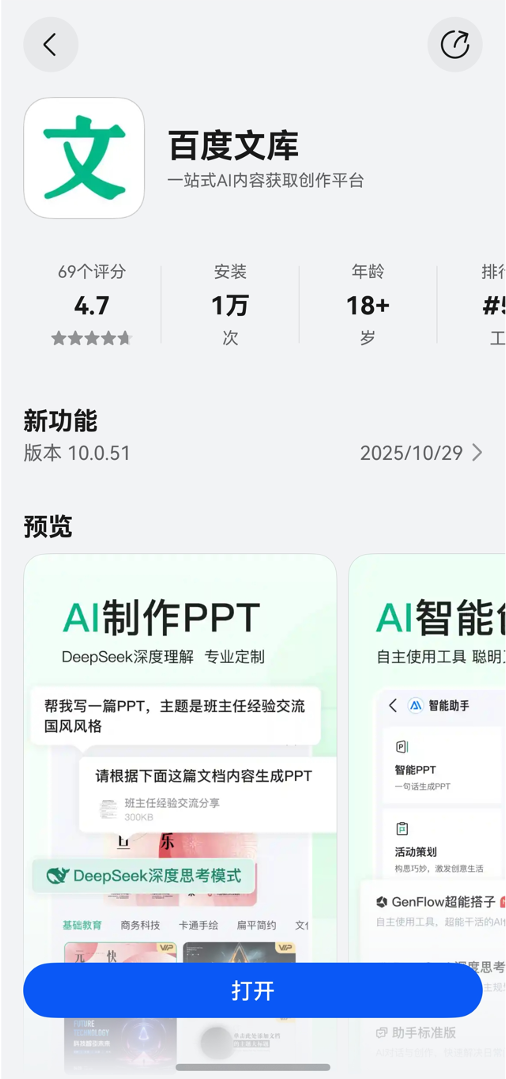
鸿蒙版百度文库上架!18亿文档+多样AI工具,让创作更专业、高效
Cai Fu Zai Xian· 2025-11-10 09:46
Core Insights - The launch of the HarmonyOS version of Baidu Wenku marks a significant advancement in the professional content domain, providing over 1.8 billion professional documents and diverse AI creation tools for users [1][3]. Group 1: Product Features - Baidu Wenku offers over 1.8 billion professional documents, including academic papers, industry reports, and teaching resources, enabling users to quickly access materials for various needs such as report writing and exam preparation [3][5]. - The platform includes comprehensive AI creation tools that support the intelligent generation of documents, presentations, mind maps, and research reports, enhancing content production efficiency [3][5]. - Users can utilize AI features for summarizing content, refining text, and rewriting, which aids in improving understanding and optimizing document quality [5][6]. Group 2: User Experience - The app allows for multi-device data synchronization, enabling users to access recently viewed, saved, and downloaded content seamlessly across devices [5][6]. - The integration of practical tools such as voice transcription, image-to-text conversion, and translation enhances efficiency in both office and learning environments [6]. - User feedback highlights the comprehensive functionality of the app, with many expressing satisfaction with its features and the long-awaited availability of the HarmonyOS version [7]. Group 3: Future Developments - Baidu Wenku plans to continue evolving with the introduction of a universal agent called "Wenku GenFlow," which will leverage multi-modal AI capabilities to provide users with a personalized AI expert team, enhancing the collaborative experience [8].
MeshCoder:以大语言模型驱动,从点云到可编辑结构化物体代码的革新
机器之心· 2025-11-10 03:53
Core Insights - The article discusses the evolution of 3D generative AI, highlighting the transition from rudimentary models to more sophisticated systems capable of creating structured and editable virtual worlds [2][3] - The introduction of MeshCoder represents a significant advancement in 3D procedural generation, allowing for the translation of 3D inputs into structured, executable code [3][4] Group 1: MeshCoder Features - MeshCoder generates "living" programs rather than static models, enabling the understanding of semantic structures and the decomposition of objects into independent components for code generation [4] - It constructs high-quality quad meshes, which are essential for subsequent editing and material application [5][7] - The generated Python code is highly readable, allowing users to easily modify parameters for editing 3D models [9] - Users can control mesh density through code adjustments, balancing detail and performance [12] Group 2: Implementation and Training - The development of MeshCoder involved creating a large dataset of parts and training a part code inference model to understand basic geometries [19][21] - A custom Blender Python API was developed to facilitate complex modeling operations, enabling the creation of intricate geometries with simple code [20] - A million-level "object-code" dataset was constructed to train the final object code inference model, allowing for the understanding and assembly of complex objects [25][28] Group 3: Performance and Comparison - MeshCoder outperforms existing methods in high-fidelity reconstruction, achieving significantly lower Chamfer distance and higher Intersection over Union (IoU) scores across various object categories [32][33] - The model demonstrates superior ability to reconstruct complex structures accurately, maintaining clear boundaries and independent components [32] Group 4: Code-Based Editing and Understanding - MeshCoder enables code-based editing, allowing users to easily change geometric and topological aspects of 3D models through simple code modifications [36][39] - The generated code serves as a semantic structure, enhancing the understanding of 3D shapes when analyzed by large language models like GPT-4 [41][44] Group 5: Limitations and Future Directions - While MeshCoder shows great potential, challenges remain regarding the diversity and quantity of the training dataset, which affects the model's generalization capabilities [46] - Future efforts will focus on collecting more diverse data to improve the model's robustness and adaptability [46]

腾讯研究院AI速递 20251110
腾讯研究院· 2025-11-09 16:09
Group 1: Generative AI Developments - Grok 4 has upgraded its context window to 2 million tokens, which is twice that of Gemini 2.5 Pro and five times that of GPT-5, with reasoning mode completion rate increasing from 77.5% to 94.1% [1] - The upgraded Grok Imagine can generate high-quality outputs that are indistinguishable from reality, accurately depicting scenes from Western classical literature, with x.ai capturing 26.4% of API calls on OpenRouter [1] - The 2 million token context capability allows processing of approximately 1.5 million English words or 6,000 pages of text, equivalent to two volumes of "War and Peace" [1] Group 2: New Model Releases - OpenAI has released the compact version of GPT-5-Codex Mini, which has a usage rate approximately four times that of GPT-5-Codex, and ChatGPT Plus users see a 50% increase in rate limits [2] - The code reveals traces of three new models in the GPT-5.1 series, including flagship model GPT-5.1, reasoning model GPT-5.1 Reasoning, and research-grade GPT-5.1 Pro [2] - New models are expected to be released by the end of November, with one model possibly being tested under the name Polaris Alpha, showing strong performance in creative writing and benchmark tests [2] Group 3: AI in Entertainment - Utopai Studios has partnered with LG and a Middle Eastern sovereign fund to establish a joint venture, Utopai East, with a capital scale of several billion dollars [4] - Utopai employs a "decoupled planning and rendering" architecture, addressing long-range consistency issues in traditional models, enabling stable character identity and scene consistency across multiple shots [4] - This architecture reduces the creative iteration cycle from weeks to days, facilitating a significant leap from short film generation to industrial-level feature film production [4] Group 4: Financial Technology Innovations - The new version of Google Finance integrates the Gemini multimodal AI model's "deep search" feature, capable of scanning hundreds of documents in minutes to generate comprehensive analysis reports [5] - For the first time, it incorporates predictive market data from platforms like Kalshi and Polymarket, providing investors with an unprecedented "market sentiment barometer" [5] - The redesigned "earnings season experience" interface supports real-time transcription, AI-generated news summaries, and historical data comparisons, currently available for beta testing [5] Group 5: Advances in Antibody Design - The RFdiffusion model developed by David Baker's team can rapidly generate new antibody designs with near-atomic precision, targeting specific viral epitopes [6] - This model has successfully designed antibodies against influenza, Clostridium difficile toxin, COVID-19, and RSV, with cryo-electron microscopy validating the designs [6] - RFdiffusion can create new antibody design diagrams in hours, potentially transforming human responses to infectious diseases, with the team founding Xaira Therapeutics [6] Group 6: Space Exploration Updates - The U.S. has simplified the Artemis lunar lander plan, reducing the number of onboard devices and cutting the number of refueling launches from 15-30 to fewer than 10 [8] - China's space agency has announced breakthroughs in key technologies for a new generation of crewed launch vehicles, with demonstration flights imminent [8] - The Long March 10 rocket is 92.5 meters tall with a launch thrust of approximately 2,678 tons, capable of carrying at least 27 tons to lunar transfer orbit, with the Dream Chaser 1 spacecraft set for its first flight in 2026 [8] Group 7: AI Industry Insights - Six AI leaders, including Yann LeCun and Fei-Fei Li, debated the authenticity of the AI revolution, with Huang Renxun asserting that AI is a productivity driver requiring significant investment [9] - LeCun argued that current large language models cannot lead to human-level intelligence without fundamental breakthroughs [9] - Predictions on achieving "human-level AI" vary, with Hinton suggesting it could happen within 20 years, while Li emphasized the vast potential in frontier fields yet to be explored [9] Group 8: AI Model Performance Evaluation - Kimi K2 Thinking scored 67 in the Artificial Analysis intelligence index, ranking second among all open-source models, only behind GPT-5 [10] - The model achieved a 93% score in the τ²-Bench Telecom benchmark, setting a new record for open-source models [10] - With a total parameter count of 1 trillion and 32 billion active parameters, Kimi K2 was evaluated using 1.4 million tokens, approximately 2.5 times that of DeepSeek V3.2, showcasing its extensive capabilities [10] Group 9: Training Large Language Models - HuggingFace released a comprehensive technical blog exceeding 200 pages, detailing the end-to-end experience of training advanced LLMs, specifically the SmolLM3 model with 3 billion parameters [11] - The blog covers the entire process from decision-making to implementation, including training compass, ablation study design, model architecture, data management, and infrastructure [11] - It emphasizes that data quality has a far greater impact than architecture choice, and training LLMs is a "learn-as-you-go" process, requiring sufficient computational power and rapid iteration [11]

十大典型案例——百度:数字人提升商家效益
Jing Ji Ri Bao· 2025-11-09 05:49
Core Insights - Huibo Star is the first AI full-stack digital human solution under Baidu, leveraging multiple generative AI technologies to empower various scenarios such as live commerce, lead collection, and content broadcasting [1] - The solution enables businesses across industries to achieve low-threshold, round-the-clock live commerce, driving efficiency growth [1] - In the AI video sector, Baidu's Huibo Star has launched an end-to-end one-stop AI video generation platform, allowing users to quickly capture real-time trends and automatically generate video scripts for efficient digital human video creation [1]

Python只是前戏,JVM才是正餐!Eclipse开源新方案,在K8s上不换栈搞定Agent
AI前线· 2025-11-09 05:37
Core Insights - Eclipse Foundation has launched the Agent Definition Language (ADL) within its open-source platform Eclipse LMOS, allowing users to define AI behaviors without coding [2] - LMOS aims to reconstruct the development and operation chain of enterprise-level AI agents in a unified and open manner, challenging proprietary platforms and Python-centric enterprise AI tech stacks [2][4] - The project follows a "land first, open source later" approach, initially developed from Deutsche Telekom's production-level practices in traditional cloud-native architecture [2][6] Group 1: Project Overview - ADL is a structured, model-agnostic description method that simplifies the definition of AI behaviors [2] - LMOS is designed to run natively on Kubernetes/Istio, targeting the JVM ecosystem and facilitating the integration of AI capabilities into existing infrastructures [2][4] - The project was led by Arun Joseph, who aimed to deploy AI capabilities across 10 European countries for Deutsche Telekom [6] Group 2: Technical Implementation - The platform utilizes Kubernetes as its foundation, deploying agents as microservices and enhancing them with custom resources for declarative management and observability [7] - Eclipse LMOS integrates seamlessly with existing DevOps processes and tools, allowing for minimal migration costs when introducing AI agents into production systems [7][8] - The initial deployment of agents has resulted in significant operational efficiencies, including a 38% reduction in human handovers and processing approximately 4.5 million conversations monthly [9][10] Group 3: Development Efficiency - The development cycle for creating new agents has been significantly reduced, with initial deployments taking one month, later decreasing to as little as one to two days [10] - A small team consisting of one data scientist and one engineer can rapidly iterate from idea to production deployment, showcasing cost advantages [10][12] - The dual strategy of LMOS includes both the open-source platform and the ADL, which allows business and engineering teams to collaboratively define agent behaviors [12][17] Group 4: Market Positioning - Eclipse LMOS positions itself between the agile, open-source Python ecosystem and the robust, mature JVM world, aiming to bring AI agents into familiar enterprise infrastructures [22] - The platform is designed to enable organizations to build scalable, intelligent, and transparent agent systems without the need to overhaul existing technologies [22] - Eclipse Foundation's executive director emphasizes the need for open-source solutions to replace proprietary products in the agentic AI space [22]