市净率

Search documents
Air Traffic Is Stabilizing, According to GE Aerospace. As the Company Raises Its Forecast, Is It Time to Buy the Stock?
The Motley Fool· 2025-11-16 10:32
Core Insights - GE Aerospace reported strong third-quarter earnings, with adjusted earnings rising 44% year-over-year and adjusted revenue increasing by 26% [3] - The company has raised its 2025 earnings guidance from $5.60 to a range of $6.00 to $6.20 per share, indicating a positive outlook for future growth [6] Business Overview - GE Aerospace operates two main businesses: jet engine manufacturing and parts/services maintenance for airlines [3] - The commercial division is larger, with commercial services revenues advancing 28%, internal shop visit revenue increasing by 33%, and parts revenue rising approximately 25% [4] Market Dynamics - Air travel is expected to grow at a rate of 3% to 4% annually under normal conditions, which is crucial for GE Aerospace's revenue [5] - The number of engines requiring maintenance is projected to increase significantly in 2026, based on flight cycles already completed [6] Stock Performance - GE Aerospace's stock has increased by 68% over the past 12 months, outperforming the S&P 500 index's 14% gain [8] - The current price-to-earnings (P/E) ratio is 41.5x, compared to 29x for the S&P 500, and the price-to-book (P/B) ratio is 17.4x versus 5.2x for the S&P 500, indicating high valuation levels [10] Future Outlook - The company is executing well and has a promising future, but high valuations suggest limited room for error [11] - Investors should be cautious as the stock may experience volatility despite the positive long-term outlook for air travel [12]



安泰集团(600408.SH):目前的市净率高于所属行业板块的市净率,存在市场情绪过热、非理性炒作风险
Ge Long Hui A P P· 2025-11-14 10:35
Core Viewpoint - Antai Group (600408.SH) has experienced a significant stock price increase of 176.99% from October 9, 2025, which is higher than the Shanghai Composite Index during the same period, indicating a potential disconnection from the company's fundamentals [1] Company Performance - The company's current price-to-book ratio (P/B) stands at 4.64, which is notably higher than the P/B ratios of its industry segments: 1.48 for the coking processing sector and 1.17 for the steel sector [1] - The company is currently operating normally, and there have been no significant changes in the external operating environment [1] - There are no undisclosed significant information that the company is required to disclose [1] Market Sentiment - The substantial increase in stock price suggests a risk of market sentiment being overly optimistic and irrational speculation [1] - There is a potential risk of a rapid decline in stock price in the future due to the current market conditions [1]

指数百分位,使用的时候要注意这四点|投资小知识
银行螺丝钉· 2025-11-13 14:08
Core Viewpoint - The article discusses the importance of historical data in understanding market cycles and the impact of index rule changes on valuation metrics. Group 1: Historical Data Reference - Historical market cycles typically last 7-10 years, and analyzing only 2-3 years of data can lead to incomplete insights [2] - It is recommended to find similar style indices with longer historical data for reference, as they tend to exhibit similar performance trends [3] Group 2: Index Rule Changes - Changes in index rules can significantly alter valuation metrics, making historical valuations less relevant [5] - For example, the change of the CSI 100 index name to CSI A100 shifted its selection criteria from market capitalization to a leading stock strategy, affecting its valuation [5] - The H-share index also underwent changes, increasing from 40 to 50 stocks, which included more internet companies, thus altering its historical valuation reference [6] Group 3: Valuation Calculation Methods - Different weighting algorithms in index valuation can lead to changes in percentile rankings [6] - The CSI Dividend Index transitioned from a market-cap weighted approach to a dividend yield weighted approach, which significantly changed the representation of bank stocks within the index [8][9] - The actual P/E ratio of the CSI Dividend Index is around 9-10 times, contrasting with the lower P/E ratio calculated using the previous market-cap weighting method [9] Group 4: Economic Downturns - During economic downturns, declining profits can lead to an increase in P/E ratios, which may not reflect actual stock price increases [11][13] - Indices like CSI 1000 and CSI 2000 have experienced profit declines over the past two years, necessitating the use of stable financial metrics for valuation [14] - In cases of unstable or declining profits, the price-to-book ratio may serve as a more reliable valuation metric [15]

国晟科技:股价异常波动且市净率高于行业,提示业绩及投资风险
Di Yi Cai Jing· 2025-11-12 12:30
Core Viewpoint - The company, Guosheng Technology, has experienced unusual stock trading fluctuations, with a cumulative increase of over 20% during three consecutive trading days from November 10 to 12, 2025, despite facing significant operational challenges in its financial performance [1] Financial Performance - For the first three quarters of 2025, the company's net profit attributable to shareholders was -151.05 million yuan, and the net profit after deducting non-recurring gains and losses was -151.71 million yuan [1] - The company's current price-to-book ratio stands at 5.77, which is significantly higher than the industry average of 3.35 for the electrical machinery and equipment manufacturing sector [1] Market Behavior - The stock price has been closing at the daily limit up price during the specified trading days, indicating strong market interest despite the underlying financial difficulties [1] - The company has issued a reminder to investors to be cautious regarding performance risks and to make prudent investment decisions [1]

研报掘金丨中金:上调农业银行AH股目标价 维持“跑赢大市”评级
Ge Long Hui· 2025-11-04 02:50
Core Viewpoint - Agricultural Bank of China reported a year-on-year revenue growth of 2% and a net profit growth of 3.3% for the first three quarters of this year, aligning with the bank's expectations [1] Summary by Category Financial Performance - Revenue increased by 2% year-on-year for the first three quarters [1] - Net profit grew by 3.3% year-on-year, meeting the bank's expectations [1] Analyst Ratings and Price Targets - CICC maintains a "outperform" rating for Agricultural Bank of China [1] - A-share target price raised by 14.9% to 8.87 yuan, equivalent to 1.1 times the expected price-to-book ratio for 2025 and 1 time for 2026, providing a 10% upside potential [1] - H-share target price increased by 14.7% to 6.62 HKD, equivalent to 0.8 times the expected price-to-book ratio for 2025 and 0.7 times for 2026, also offering a 10% upside potential [1]

时空科技:股价短期涨幅达33.10%
Xin Lang Cai Jing· 2025-10-27 12:59
Core Viewpoint - The stock price of the company has experienced significant increases, raising concerns about potential market overreaction and irrational speculation [1] Group 1: Stock Performance - The company's stock price rose by 33.10% from October 23 to October 27, 2025, and has increased by 103.54% since September 2025 [1] - The current price-to-book ratio of the company is 3.72, which is notably higher than the industry average of 2.3 [1] Group 2: Financial Performance - The company has reported continuous losses from 2022 to the first half of 2025 [1] - Investors are advised to be cautious regarding the operational performance risks associated with the company [1]

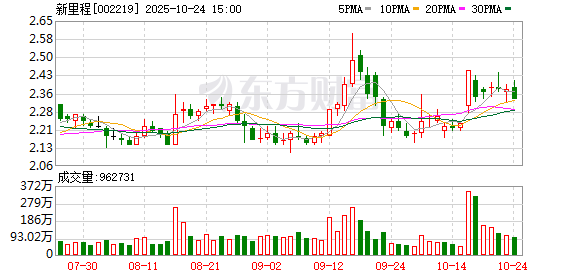
新里程:2025年前三季度实现营业总收入22.56亿元
Zhong Guo Zheng Quan Bao· 2025-10-26 15:08
Core Viewpoint - The company reported a significant decline in revenue and net profit for the third quarter of 2025, indicating financial challenges and a need for strategic adjustments [2][21]. Financial Performance - Total revenue for the first three quarters of 2025 was 2.256 billion yuan, a decrease of 23.40% year-on-year [2]. - The net profit attributable to shareholders was a loss of 38.468 million yuan, compared to a profit of 56.716 million yuan in the same period last year [2]. - The net profit after deducting non-recurring items was a loss of 33.421 million yuan, down from a profit of 47.780 million yuan year-on-year [2]. - Basic earnings per share were -0.0114 yuan, with a weighted average return on net assets of -1.95% [2][21]. Cash Flow and Capital Structure - The net cash flow from operating activities was 1.509 billion yuan, a decline of 31.88% compared to the previous year [24]. - The company experienced a significant decrease in cash and cash equivalents, down 34.72% from the end of the previous year [26]. - The current ratio was 0.56, and the quick ratio was 0.5, indicating potential liquidity issues [32]. Asset and Liability Changes - As of the end of the third quarter of 2025, the company's total assets were approximately 6.553 billion yuan, with a notable increase in construction in progress by 11.54% [26]. - Other receivables increased by 60.45%, while fixed assets decreased by 3.37% [26]. - Short-term borrowings increased by 23.29%, while long-term borrowings decreased by 15.67% [29]. Valuation Metrics - As of October 24, the company's price-to-earnings (P/E) ratio was approximately 403.08, and the price-to-book (P/B) ratio was about 4.01 [1].

每日钉一下(港股科技股上涨后市盈率仍然较低,还在低估吗?)
银行螺丝钉· 2025-10-24 13:59
Group 1 - The article emphasizes that different regional stock markets do not move in unison, and understanding multiple markets can provide investors with more opportunities [2] - Global investment can significantly reduce volatility risk, and the article suggests a free course on investing in global stock markets through index funds [2][3] - The course includes notes and mind maps to help participants quickly grasp the course content and learn more efficiently [3] Group 2 - The article discusses the current valuation of Hong Kong technology stocks, noting that despite recent price increases, their price-to-earnings (P/E) ratios remain relatively low [4] - As of October 16, 2025, the P/E ratio percentile for the Hong Kong technology index is around 30%, while the price-to-book (P/B) ratio percentile is about 60% [5] - The article attributes the low P/E and high P/B ratios to a period of poor fundamentals and declining earnings for listed companies from 2020 to 2023 [5][6] Group 3 - In 2024, Hong Kong technology stocks are expected to see a recovery, with earnings projected to grow over 100% year-on-year in the first half of 2024-2025, marking the highest growth rate in five years [6] - The rapid increase in earnings leads to a quick decline in both the P/E ratio and its percentile ranking [7] - Despite the growth in earnings, revenue and net assets have increased but not at the same rate, resulting in a normalization of the P/E and P/B ratios as the index rises from its lows [7] Group 4 - The article questions the sustainability of the recent earnings growth, suggesting that it is unlikely for technology companies to maintain such high growth rates for multiple years [8] - The recent surge in earnings is attributed to cost-cutting measures, such as layoffs and salary reductions, as well as investment gains from asset sales [9]

股价涨幅仅排行业第22位,“零售之王”招商银行被高估了吗?
3 6 Ke· 2025-10-23 23:41
Core Viewpoint - China Merchants Bank (CMB) is facing pressure on its performance, with interest income recovering in the first half of 2025, but non-interest net income declining by 6.73%, resulting in a mere 0.25% growth in net profit attributable to shareholders [1][10]. Financial Performance - In the first half of 2025, CMB reported operating income of 169.97 billion yuan, a year-on-year decline of 1.72%, and net profit attributable to shareholders of 74.93 billion yuan, growing only 0.25% [1][10]. - The annualized weighted return on equity (ROE) fell to 13.85% in the first half of 2025, down from over 15% in 2024 [3][10]. - Interest net income was 106.09 billion yuan, showing a year-on-year increase of 1.57%, while non-interest net income was 63.88 billion yuan, down 6.73% [10]. Non-Interest Income Breakdown - Within non-interest income, net commission and fee income was 37.60 billion yuan, down 1.89% year-on-year, with significant declines in credit card fees (down 16.37%) and asset management fees (down 6.91%) [11][12]. - Wealth management fees increased by 11.89% to 12.80 billion yuan, partially offsetting declines in other areas [11][12]. Regulatory Issues - CMB has faced regulatory fines totaling 22.06 million yuan in 2025, with the latest fine of 3 million yuan imposed on its Hangzhou branch for inadequate checks on loans [3][10]. Real Estate Loan Performance - As of mid-2025, CMB's total real estate loans amounted to 1.75 trillion yuan, with personal housing loans increasing by 20.93 billion yuan, while corporate real estate loans decreased by 6.99 billion yuan [13][14]. - The bank's real estate non-performing loans (NPLs) decreased to 21.39 billion yuan, with the NPL ratio for corporate real estate loans at 4.56% [13][14]. Market Position - As of October 23, 2023, CMB's stock price was 42.24 yuan per share, with a market capitalization of 1,058 billion yuan, reflecting a decline of 9.24% from recent highs [4].

鼎泰高科:2025年前三季度净利润2.82亿元 同比增长63.94%
Zhong Guo Zheng Quan Bao· 2025-10-23 14:06
Core Insights - The company reported a total revenue of 1.457 billion yuan for the first three quarters of 2025, representing a year-on-year growth of 29.13% [4] - The net profit attributable to shareholders reached 282 million yuan, with a year-on-year increase of 63.94% [4] - The net profit after deducting non-recurring gains and losses was 263 million yuan, showing a significant growth of 79.94% year-on-year [4] Financial Performance - The basic earnings per share (EPS) for the reporting period was 0.69 yuan, and the weighted average return on equity (ROE) was 10.75% [4][17] - The net cash flow from operating activities was 22.01 million yuan, which represents a decline of 89.05% compared to the previous year [4][20] - The company’s total assets at the end of the reporting period were approximately 4.056 billion yuan, an increase from the previous year [5] Profitability Metrics - The weighted average return on equity increased by 3.59 percentage points year-on-year [17] - The return on invested capital for the first three quarters of 2025 was 9.68%, up by 2.87 percentage points from the same period last year [17] Asset and Liability Changes - The company’s trading financial assets decreased by 23.26% compared to the end of the previous year, while fixed assets increased by 4.04% [23] - Accounts receivable increased by 25.98%, and construction in progress rose by 69.95% [23] - Short-term borrowings increased by 104.32%, and long-term borrowings rose by 139.2% compared to the previous year [26] Liquidity Ratios - The current ratio was reported at 2.06, and the quick ratio was 1.64 [29] Valuation Metrics - The current price-to-earnings (P/E) ratio is approximately 114.62, the price-to-book (P/B) ratio is about 14.54, and the price-to-sales (P/S) ratio is around 20.24 [5]