虚假宣传

Search documents
因虚假宣传“保证找到对象”,世纪佳缘被罚
Xin Jing Bao· 2025-10-14 11:39
Core Points - Shanghai Huqianshu Information Technology Co., Ltd., associated with Century Jiayuan, was fined 280,000 RMB for false advertising practices [1] - The company operates the "Century Jiayuan" app, primarily providing online matchmaking services [1] - Between December 2024 and May 2025, the company misled consumers with false membership information and promises of guaranteed matches [1] - The total service fees involved in the case amounted to over 38,000 RMB, with no illegal gains reported [1] Company Background - Shanghai Huqianshu Information Technology Co., Ltd. was established in April 2004, with a registered capital of 100 million RMB [1] - The company has a total of 222 self-risk records, 66 surrounding risk records, 489 historical risk records, and 87 warning alerts [1] Previous Violations - In April of the previous year, the company was fined 200,000 RMB for deceiving consumers regarding the provision of services [2] - From June to September 2023, the company failed to deliver services as promised to multiple consumers, involving service fees totaling over 100,000 RMB [2] - The company was also highlighted in the 2023 CCTV 3.15 Gala for exploiting consumer anxieties to sell high-priced membership services [2]
世纪佳缘因虚假宣传“保证找到对象”被罚28万
Bei Ke Cai Jing· 2025-10-14 11:33
新京报贝壳财经讯(记者俞金旻)10月14日,贝壳财经记者从上海市市场监督管理局获悉,世纪佳缘关 联公司上海花千树信息科技有限公司因存在虚假或引人误解的宣传行为,被上海市杨浦区市场监督管理 局处以28万元罚款。 贝壳财经记者在行政处罚决定书看到,该公司为"世纪佳缘"App的经营主体,主要从事互联网婚介服 务。消费者注册后,销售人员会主动联系,并根据其意向推荐高端定制会员服务,消费者付费签订合同 后即可获取介绍对象的联系方式及后续服务。 天眼查显示,上海花千树信息科技有限公司成立于2004年4月,法定代表人为孙鹏轩,注册资本10000万 人民币。目前共有222条自身风险,66条周边风险,489条历史风险,以及87条预警提醒。 记者注意到,去年4月,世纪佳缘旗下上海花千树信息科技有限公司因骗取消费者价款或者费用而不提 供或者不按照约定提供商品或者服务,被上海市杨浦区市场监督管理局罚款20万元。处罚事由显示,当 事人为"世纪佳缘"App的经营管理者。自2023年6月至9月,当事人对多名消费者未能按照售前约定内容 提供服务。同时,2023年6月至8月,当事人在向2名消费者销售付费会员服务中,部分款项未告知消费 者具体的 ...
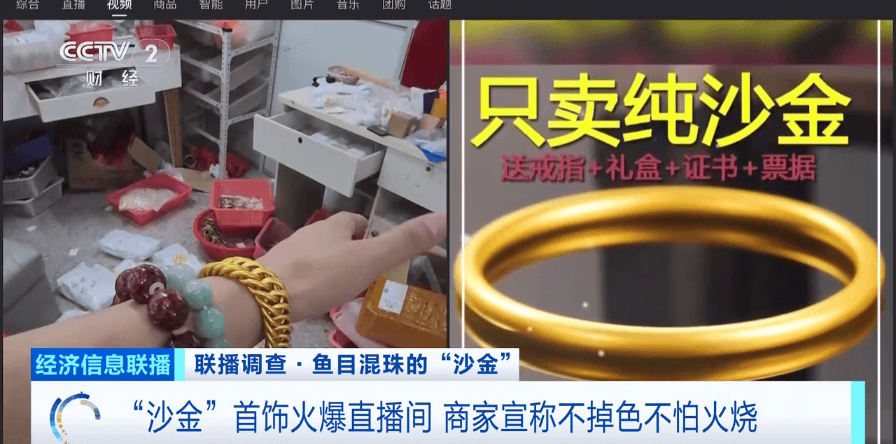
别买、别戴!重金属严重超标
Sou Hu Cai Jing· 2025-10-13 05:00
Core Viewpoint - The rise of "sand gold" jewelry, which mimics the appearance of gold but is sold at a much lower price, has gained popularity among consumers due to the high prices of gold this year. However, the actual composition and quality of these products are questionable, with many not containing any gold at all [1][12]. Group 1: Market Dynamics - "Sand gold" jewelry is marketed as a low-cost alternative to gold, with prices ranging from a few hundred yuan to over a hundred yuan in live-streaming sales [1][11]. - Many sellers claim that "sand gold" products are made from materials that do not fade and are resistant to burning, creating a perception of high quality [1][3]. - The term "sand gold" is often used misleadingly, with some sellers using names similar to well-known brands to attract customers [3][4]. Group 2: Composition and Quality - "Sand gold" is defined as mineral rock containing about 5% gold, but most products sold under this name do not contain any gold and are primarily made from copper-nickel alloys or thinly gold-plated materials [12][14]. - The gold plating on these products is often less than 0.05 microns thick, which does not meet national standards for gold-plated items, leading to rapid wear and potential exposure to harmful metals like nickel [16][18]. - Testing has shown that some "sand gold" jewelry can release nickel at levels exceeding national safety standards, posing health risks to consumers [18][20]. Group 3: Legal and Regulatory Concerns - There are legal implications for sellers who engage in false advertising, as they may face penalties under Chinese law for misrepresenting their products [22]. - The industry is under scrutiny for the widespread misleading claims regarding the quality and composition of "sand gold" jewelry, prompting calls for better regulation and consumer protection [22].

侵害消费者权益 世纪佳缘提供虚假相亲信息被罚28万
Qi Lu Wan Bao· 2025-10-13 03:51
Core Viewpoint - Shanghai Huqianshu Information Technology Co., Ltd., an affiliate of Century Jiayuan, was fined 280,000 RMB for providing false matchmaking membership information, violating consumer rights [1] Group 1: Penalty Details - The penalty was issued by the Shanghai Yangpu District Market Supervision Administration [1] - The fine amount is 280,000 RMB, equivalent to approximately 28 million RMB [1] - The violation occurred between December 2024 and May 2025, where the company misrepresented membership information and guaranteed outcomes to consumers [1] Group 2: Legal Context - The company was found to have violated Article 20, Paragraph 1 of the Consumer Rights Protection Law of the People's Republic of China [2] - The investigation was initiated on February 10, 2025, following a consumer complaint [2] - The company primarily engages in internet-based marriage introduction and membership services for the "Century Jiayuan" app [2]

消费获得的积分到底谁说了算?专家解读
Yang Shi Xin Wen· 2025-10-12 03:59
Core Points - The article discusses the complexities and frustrations consumers face when trying to redeem loyalty points, which are often marketed as benefits but come with numerous restrictions and unclear rules [1][8] - Legal experts emphasize that businesses must clearly communicate the rules and limitations of point redemption to protect consumer rights [2][7] Group 1: Consumer Experiences - Consumer Mr. Dai experienced a situation where his points were forcibly reclaimed without prior notification, raising concerns about the legality of such actions [2][3] - Consumer Ms. Sun reported difficulties in redeeming points for quality products, often facing issues with after-sales service for items obtained through points [4][5] - Consumer Mr. Li found it challenging to redeem points for desired products, often encountering unavailability and additional costs, leading to skepticism about the promotional offers [6][7] Group 2: Legal Perspectives - Legal expert Lu Yun stated that points can be considered part of consumer property, as they often represent value derived from consumer spending [3][5] - Lu emphasized that businesses must ensure that the quality and after-sales service of products obtained through points are equivalent to regular purchases, and cannot exempt themselves from quality guarantees [5][6] - The article highlights that businesses have the right to set point rules, but these must be fair and transparent, as unfair terms may be deemed invalid under consumer protection laws [7][8] Group 3: Recommendations and Industry Implications - The article calls for better regulation of point systems to ensure consumer rights are protected and to prevent businesses from exploiting these systems for short-term gains [8] - It suggests that businesses should prioritize maintaining their reputation and consumer trust by honoring the promises made during marketing campaigns [8] - The need for regulatory bodies to establish clear guidelines for point redemption practices is emphasized to ensure fairness and transparency in the industry [8]
重拳整治!全国首张“职业弹幕人”罚单开出 “水军狂欢”该降温了
Yang Shi Xin Wen Ke Hu Duan· 2025-10-10 15:27
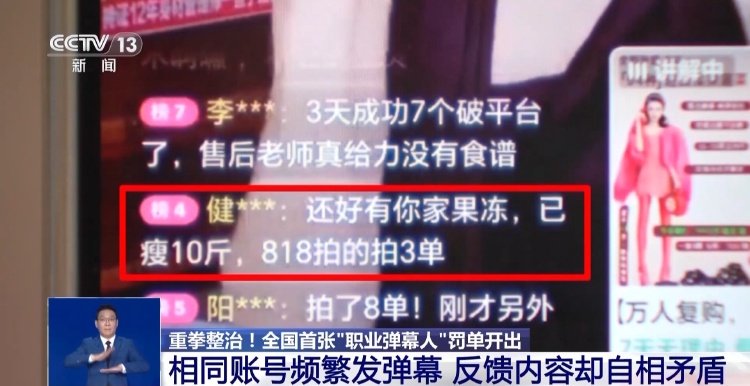
Core Viewpoint - The article discusses the emergence of "professional barrage people" in live-streaming sales, highlighting how they manipulate consumer perceptions through misleading comments, leading to regulatory actions against such practices [1][30]. Group 1: Live Streaming and Consumer Manipulation - A product named "燃咔果冻" was promoted in a live-streaming session, where numerous comments claimed significant weight loss effects, despite the host not directly stating such claims [3][7]. - Observations revealed that the same accounts frequently posted contradictory comments about the product's effectiveness, raising suspicions of coordinated manipulation [7][9]. - The market regulators identified that these comments were likely generated by hired individuals, known as "professional barrage people," who create a false narrative to mislead consumers [11][14]. Group 2: Regulatory Actions and Legal Framework - The market regulators discovered that the live-streaming session involved purchasing third-party services to send bulk false comments, which misrepresented the product's capabilities [17][20]. - The product in question was determined to be an ordinary food item without any weight loss benefits, contradicting the claims made in the barrage comments [19][27]. - The involved company faced a fine of 100,000 yuan for false advertising, marking a significant regulatory action against deceptive practices in live-streaming sales [34][38].
西贝贾国龙多个社交账号内容被清空,抖音仅留一条视频作品
2 1 Shi Ji Jing Ji Bao Dao· 2025-09-28 07:02
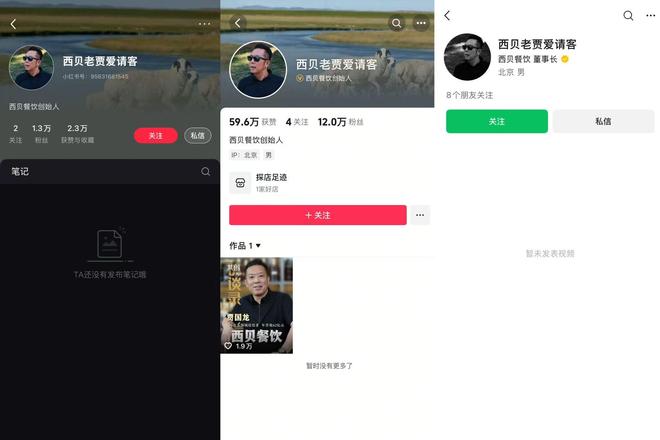
Core Viewpoint - The recent actions of Xibei Catering Group's founder, Jia Guolong, to clear his social media accounts come in the wake of a public relations crisis related to the company's use of pre-packaged food and other controversies [1][3]. Group 1: Public Relations Crisis - Xibei faced backlash after a public comment by Luo Yonghao criticized the high prices of their pre-packaged dishes, leading to Jia's initial denial and threats of legal action [3]. - Following the opening of their kitchen to the public, issues such as the accumulation of frozen ingredients and the use of genetically modified soybean oil were revealed, further intensifying public scrutiny [3]. - Content published by Xibei, including articles and videos, was criticized for being overly sentimental and perceived as deliberate marketing ploys, leading to negative public reactions [3][4]. Group 2: Legal Actions and Consumer Rights - A long-time customer and lawyer filed a lawsuit against Xibei for alleged false advertising and violation of consumer rights, aiming to promote better food safety legislation in China [4]. - The lawsuit highlights concerns over Xibei's marketing practices and the need for more stringent regulations to protect consumer health and safety [4]. Group 3: Social Media Strategy - Xibei attempted to improve its image through emotional storytelling in videos, but these efforts were met with skepticism and ridicule from the public [4]. - The company's official customer service stated that the removal of certain content was due to online harassment faced by customers and employees [4].
西贝别想蒙上消费者的眼睛
Sou Hu Cai Jing· 2025-09-28 05:58
Core Viewpoint - The recent controversy surrounding Xibei's promotional video, which features a bizarre story about a customer offering a house in exchange for soup, has sparked widespread criticism and raised questions about the company's marketing practices and authenticity [1][3][4]. Group 1: Incident Overview - A video from over 20 years ago resurfaced, where a Xibei manager recounts a story about a customer who offered to give her a house in Beijing for a bowl of soup [1]. - The manager, Liu, was only 15 years old when she started working at Xibei, leading to accusations of child labor and skepticism about the customer's true intentions [3]. Group 2: Public Reaction - The public has reacted negatively to Xibei's marketing tactics, with many finding the stories unbelievable and questioning the company's integrity [3][4]. - There are calls for regulatory bodies to investigate Xibei for potential false advertising, as the company's claims seem to mislead consumers [4]. Group 3: Company Image and Marketing Strategy - Xibei's recent marketing campaigns, including emotional stories about children and food, have been criticized for being overly dramatic and lacking authenticity [3]. - The company appears to be out of touch with consumer expectations, focusing on sensational narratives rather than the quality of its food [4].
贾国龙清空多平台账号内容,此前西贝公关文再引争议,9年老客户起诉其欺诈、虚假广告
Sou Hu Cai Jing· 2025-09-28 04:18
Core Points - The founder of Xibei Catering, Jia Guolong, has cleared his social media accounts, including Xiaohongshu and video accounts [1] - Xibei's annual revenue is reported to be 6.2 billion [4] - A recent controversy involving Xibei and pre-made dishes has led to public backlash and legal action [9][11] Group 1 - Xibei's official account shared a video about a mother whose child learned to eat at Xibei, which moved Jia Guolong to tears, but the video has since been removed [9] - The official account "Xibei Taste Morning Read" has been set to private, requiring approval to follow [11] - A lawyer, who has been a client of Xibei for nine years, filed a lawsuit against the company for alleged fraud and false advertising related to their use of pre-made dishes [11] Group 2 - The lawsuit includes claims for triple compensation and demands for transparency in food ingredients [11] - The lawyer submitted over 86,000 yuan in consumption records as evidence, alleging that Xibei misrepresented its food as "organic" and "freshly cooked" while using frozen semi-finished products [11] - The lawsuit also highlights contradictions in Xibei's marketing of children's meals [11]
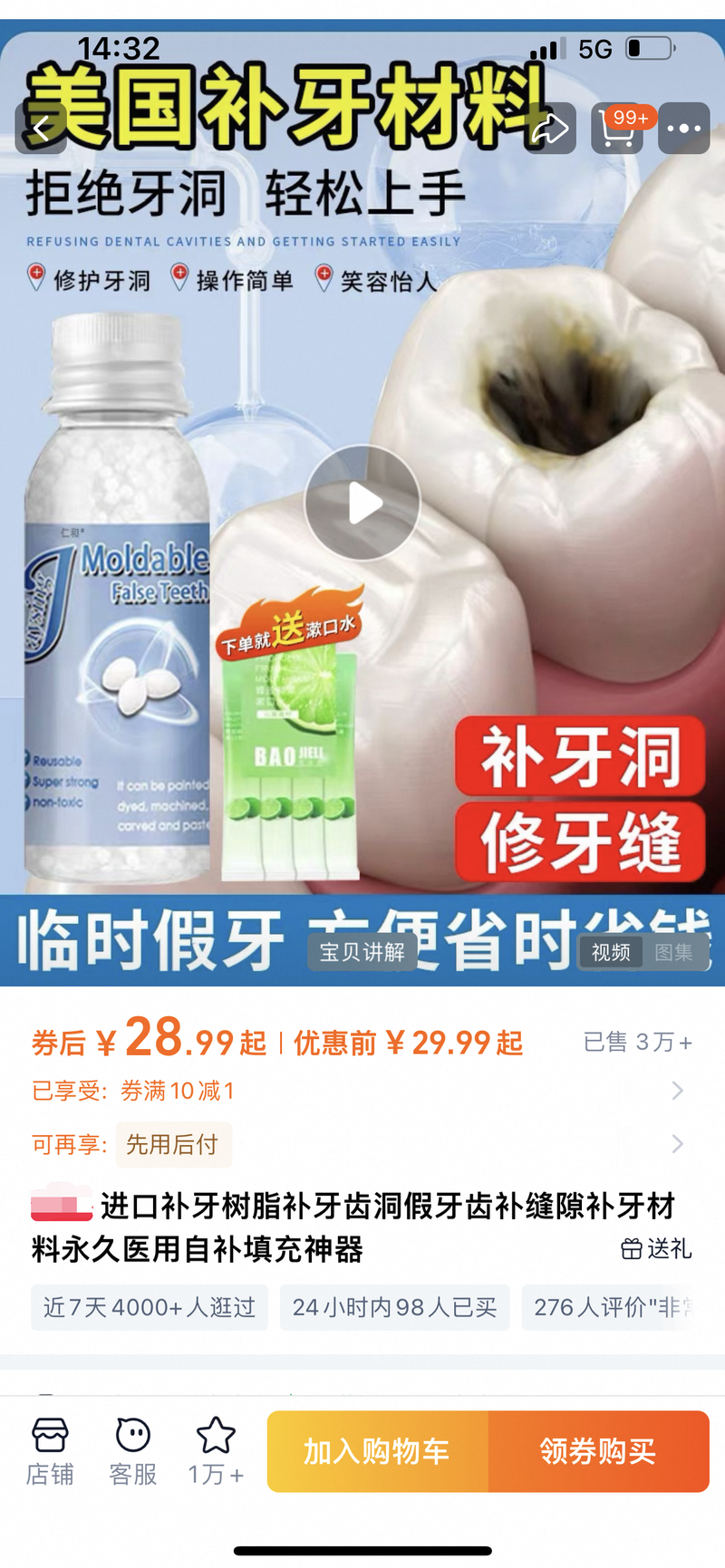
宣称“安全无毒”“永久修复”,网售树脂补牙产品风险有多大?
Xin Jing Bao· 2025-09-28 02:12
Core Viewpoint - The rise of DIY dental repair products sold online poses significant health risks due to misleading marketing and lack of professional oversight [1][2][11] Group 1: Product Claims and Misleading Marketing - Many DIY dental products are marketed with terms like "permanent" and "medical-grade," which can mislead consumers about their effectiveness and safety [2][11] - Some products falsely claim to be "imported" while being domestically produced, constituting deceptive advertising [12][15] - The promotional materials often contain contradictory information regarding the product's intended use and effectiveness, leading to consumer confusion [11][12] Group 2: Regulatory and Safety Concerns - Numerous products lack proper medical device registration or have unverifiable registration numbers, raising concerns about their compliance with safety standards [16][20][22] - The distinction between first-class and second-class medical devices is crucial, as dental materials used in professional settings undergo stricter safety evaluations [20][21] - Consumers are often unaware of the potential health risks associated with using unregulated products, which may contain harmful substances [24][26] Group 3: Health Risks of DIY Dental Repair - The use of DIY dental materials can lead to severe health issues, including chemical toxicity and allergic reactions, due to the unknown composition of these products [24][26][27] - Improper application of these materials can result in further dental complications, such as secondary caries, which may necessitate more extensive and costly treatments [27][28] - Professional dental procedures are essential for ensuring long-term oral health, and attempting to perform these procedures at home is highly discouraged [28]