
高标准农田建设

Search documents
国务院常务会议解读|提升耕地数量质量,国务院常务会议有新部署
Xin Hua Wang· 2025-08-01 00:52
Core Points - The State Council has discussed and approved the draft of the "Law on the Protection and Quality Improvement of Arable Land," which will be submitted to the National People's Congress for review [1] - The meeting emphasized the need to enhance the sense of responsibility for legally protecting arable land, ensuring the integration of quantity, quality, and ecological protection [1][2] - The goal is to maintain the "red line" of 1.8 billion acres of arable land and impose strict penalties for activities that damage arable land, such as illegal excavation [1] - High-standard farmland construction is identified as a key measure to improve arable land quality, with a target of over 1 billion acres of high-standard farmland by the end of 2024 [1] - The implementation plan aims to transform 4.55 million acres of permanent basic farmland into high-standard farmland by 2035, with an additional 1.3 million acres of efficient water-saving irrigation [2] - High-standard farmland is expected to enhance grain production capacity by approximately 10% [2] Summary by Category Legislation and Policy - The draft law aims to enhance the legal framework for arable land protection and quality improvement [1] - The plan includes a long-term goal to convert all eligible permanent basic farmland into high-standard farmland by 2035 [2] Agricultural Development - The construction of high-standard farmland is crucial for improving agricultural productivity and resilience against disasters [2] - The integration of land protection with ecological conservation is emphasized to create a sustainable environment [2] Targets and Goals - The immediate target is to achieve over 1 billion acres of high-standard farmland by the end of 2024 [1] - The long-term goal includes transforming 4.55 million acres of farmland and adding 1.3 million acres of efficient irrigation by 2035 [2]
国务院常务会议解读 | 提升耕地数量质量,国务院常务会议有新部署
Xin Hua She· 2025-07-31 17:24
Core Points - The State Council of China has approved the draft law on farmland protection and quality improvement, emphasizing the need to enhance the responsibility for protecting farmland and ensuring sustainable use [1][2] - The goal is to maintain the "red line" of 1.8 billion acres of farmland, with strict penalties for actions that damage farmland, such as illegal excavation [1] - The construction of high-standard farmland is a key strategy for improving farmland quality, with a target of over 1 billion acres of high-standard farmland by the end of 2024 [1][2] Summary by Sections Farmland Protection - The draft law aims to integrate the protection of farmland quantity, quality, and ecology, ensuring comprehensive measures to restore and enhance ecological functions [1] - Experts stress the importance of strict enforcement against activities that harm farmland, highlighting the need for a strong sense of responsibility in farmland protection [1] High-Standard Farmland Development - The implementation plan aims to convert 4.55 million acres of permanent basic farmland into high-standard farmland by 2035, with an additional 1.3 million acres of efficient water-saving irrigation [2] - High-standard farmland is expected to improve grain production capacity by approximately 10%, enhancing quality, output capability, disaster resistance, and resource utilization efficiency [2] Ecological Integration - The approach to farmland protection will also consider ecological preservation, promoting a holistic strategy that integrates land and ecological protection [2]
地不“懒” 人更勤 ——一碗粮里看“四向”
He Nan Ri Bao· 2025-07-28 23:08
Core Insights - The article emphasizes the transformation of agriculture in Henan province through the adoption of new agricultural technologies and management practices, which are crucial for strengthening food production and ensuring food security [1] Group 1: Agricultural Upgrades - High-standard farmland in Lan'ao County demonstrates effective water management with drainage channels and irrigation systems, allowing for resilience against flooding and drought [2][4] - The implementation of water and fertilizer integration techniques has led to increased crop yields, with specific mention of corn production benefiting from precise water and nutrient management [4][8] Group 2: Infrastructure and Maintenance - The establishment of high-standard farmland includes robust infrastructure, such as wells and drainage systems, which are essential for long-term agricultural productivity [6][8] - The provincial government allocates 100 million yuan annually for maintenance support, ensuring that agricultural facilities remain functional and effective [7] Group 3: Agricultural Services and Efficiency - The rise of agricultural service organizations, like Tianhui Agricultural Service Co., has improved operational efficiency by providing advanced machinery and professional services to local farmers [10][11] - The trend towards agricultural socialization has led to the establishment of over 127,000 service organizations in Henan, enhancing the quality and efficiency of food production across the province [11]
累计建成高标准农田超10亿亩 农业综合生产能力明显提高踔厉奋发新征程 | 沃土良田助丰产
Zhong Yang Ji Wei Guo Jia Jian Wei Wang Zhan· 2025-07-28 00:00
Core Insights - Food security is a crucial aspect of national security, with the goal of achieving stable and abundant summer grain production by 2025, reaching a yield of 375.6 kg per mu, an increase of 0.1 kg per mu from the previous year [1] Group 1: High-Standard Farmland Development - The construction of high-standard farmland is essential for improving agricultural productivity and ensuring food security, with over 1 billion mu of high-standard farmland established nationwide by the end of last year [1] - High-standard farmland features well-structured irrigation systems, smooth roads, and efficient land use, which enhances agricultural mechanization and information technology [2][5] - The implementation of high-standard farmland has led to significant increases in crop yields, with reports of wheat yields exceeding 410 kg per mu, a 40 kg increase compared to pre-construction levels [4] Group 2: Agricultural Mechanization and Efficiency - The use of large agricultural machinery has become feasible due to the consolidation of fragmented farmland, resulting in a 50% reduction in labor costs and minimal waste during harvesting [4][5] - The integration of smart irrigation systems and agricultural IoT devices has improved water management, allowing for precise irrigation and monitoring of crop conditions [8][9] - Water-saving technologies, such as integrated water and fertilizer systems, have been adopted, leading to a 25% reduction in annual water usage and a 68% increase in fertilizer efficiency [10] Group 3: Management and Maintenance of Farmland - Effective management and maintenance of high-standard farmland are critical for sustaining its benefits, with local governments implementing structured management systems [12][16] - Innovations in monitoring, such as the use of drones for inspections and data collection, have enhanced the ability to address issues promptly and maintain farmland quality [17]

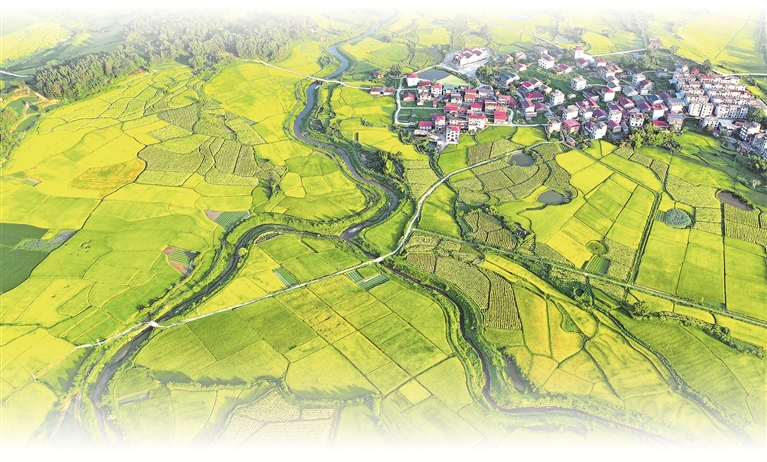
天府粮仓好“丰”景
Jing Ji Ri Bao· 2025-07-23 22:10
Core Viewpoint - Sichuan province is implementing strict measures to protect arable land and enhance agricultural productivity, focusing on the construction of high-standard farmland and the promotion of quality seed varieties to achieve food security and sustainable agricultural development [2][5][10]. Group 1: Land Protection and Management - Sichuan has established a comprehensive land management system, increasing the area of "Tianfu good farmland" and implementing higher levels of land supervision, resulting in significant improvements in grain production [2][3]. - The province has reversed the trend of decreasing arable land from 2020 to 2021, maintaining a stable grain sowing area of over 96 million mu for three consecutive years as of December 2024 [2][3]. - A five-level "field chief system" has been established to ensure comprehensive coverage of land protection responsibilities, with 187,600 field chiefs and grassroots grid members appointed [3]. Group 2: Agricultural Productivity Enhancement - Sichuan aims to complete the construction of 1.734 million mu of high-standard farmland in 2024, with a focus on improving the quality of agricultural land [6][10]. - The province has built over 60 million mu of high-standard farmland, ranking among the top in the country, and is also a major breeding base for agricultural species [5][7]. - The introduction of differentiated subsidies for grain producers and the increase in subsidy standards are designed to encourage more farmers to engage in grain production [7][10]. Group 3: Agricultural Industry Development - Sichuan has launched the "Billion-level Advantageous Characteristic Agricultural Industry Circle Strengthening Chain Cultivation Plan," with a total investment of 199.41 billion yuan for 465 projects by 2025 [8]. - The province is focusing on the development of a comprehensive grain and oil industry chain, establishing multiple key industrial zones to enhance agricultural processing and branding [9]. - The integration of agriculture with tourism and other industries is being promoted to transform agricultural areas into scenic spots and enhance the value of agricultural products [10]. Group 4: Achievements and Future Goals - In 2024, Sichuan's total grain output is projected to reach 72.68 billion jin, an increase of 800 million jin from the previous year, marking a new historical high [10]. - The province has allocated 7.56 billion yuan in subsidies for land fertility protection and rice production, with a significant increase in the number of large-scale grain producers and the area of land under large-scale cultivation [10].
大禹节水(300021) - 300021大禹节水投资者关系管理信息20250723
2025-07-23 11:48
Group 1: Company Overview and Business Operations - Dayu Water-saving Group has been involved in water and hydropower projects in Tibet since 2015, collaborating with state-owned enterprises like China Energy Construction and China Electric Power Construction [4] - The company has established a strong presence in high-altitude regions, demonstrating its construction capabilities in complex geographical conditions [4] - Dayu Water-saving has plans to set up a branch in Linzhi and participate in surrounding projects related to the Yarlung Tsangpo River hydropower station [4] Group 2: Project Capabilities and Competitive Advantages - The company possesses a first-class qualification for water conservancy and hydropower engineering contracting, with extensive experience in large and medium-sized water conservancy facilities [5] - Dayu Water-saving's design group is a leading private water conservancy design enterprise in China, aiming to enhance its design qualifications through mergers and acquisitions [5] - The company has successfully implemented modernized renovation projects for reservoirs, showcasing its integrated solution capabilities [5] Group 3: Market Trends and Investment Opportunities - Water conservancy investment has exceeded 1 trillion yuan for three consecutive years, with a positive outlook for future orders in the sector [7] - The government has set ambitious goals for high-standard farmland construction, targeting 1.35 billion mu by 2030, which translates to a market space exceeding 1.5 trillion yuan [9] - The "soft construction" initiative proposed by the National Development and Reform Commission is expected to benefit private enterprises significantly, enhancing their competitive advantages [10] Group 4: Future Projections and Strategic Directions - The agricultural investment landscape is improving, with new policies aimed at enhancing agricultural infrastructure and water management [8] - The company anticipates that the government's increased investment in agriculture will secure orders and performance for the next three to five years [9] - Dayu Water-saving is committed to leveraging its strengths and foresight to create greater value for investors in the future [10]

中国联塑(02128):城市更新催化,高标农田拉动
HTSC· 2025-07-23 06:05
Investment Rating - The investment rating for the company is maintained as "Buy" with a target price of HKD 5.89, up from the previous target of HKD 4.36, representing a 35% increase [1][5]. Core Views - The report emphasizes that urban renewal is transitioning from large-scale expansion to improving existing stock, which is expected to catalyze demand for municipal plastic pipes due to infrastructure upgrades [1][2]. - The company is well-positioned to benefit from the growing demand in the agricultural plastic pipe sector, supported by stable growth in primary industry investments and high market share in engineering [1][4]. - The projected total investment in urban gas, water supply, and heating networks over the next five years is approximately CNY 4 trillion, indicating significant market opportunities [3]. Summary by Sections Urban Renewal and Market Potential - The central urban work conference highlighted urban renewal as a key strategy for enhancing quality and efficiency, with a substantial number of existing buildings (3.54 billion) and a total area of 128 billion square meters [2]. - The estimated demand for building renovations is around 2.4 billion square meters, with a stable upward trend expected [3]. Agricultural Investment and Demand Stability - First industry fixed asset investment grew by 6.5% year-on-year in the first half of 2025, indicating robust growth [4]. - The government aims to transform 4.55 million acres of farmland into high-standard farmland by 2035, with increased subsidy standards from CNY 1,300 to CNY 2,400 per acre [4]. Financial Projections and Valuation - The company’s EPS forecasts for 2025-2027 are CNY 0.67, CNY 0.74, and CNY 0.82 respectively, with a projected PE ratio of 8x for 2025 [5][10]. - Revenue is expected to grow from CNY 27,026 million in 2024 to CNY 33,404 million by 2027, reflecting a compound annual growth rate [10][19].

积极应对台风及降雨天气 广西早稻收获超七成
Zhong Guo Xin Wen Wang· 2025-07-22 03:14
此外,广西紧盯逐步将永久基本农田全部建成高标准农田这一目标,持续提高亩均投资标准,财政 投入从3年前每亩1500元提升到3000元,目前累计建成高标准农田2872万亩,占全区耕地的57.9%;持 续开展工程质量和资金使用问题专项整治行动,确保项目建好、管好、用好;实施小型农业水利设施建 设与管护攻坚行动,不断夯实粮食生产抗旱防涝能力。 目前,广西中稻面积205.65万亩、同比增加2.32万亩,完成全年种植意向的100.25%,在田作物长 势良好;晚稻种植意向1237.04万亩、同比去年略增,已育秧1109.1万亩、已插174.24万亩。 今年以来,针对冬春连旱,广西农业农村部门迅速启动应急响应,投入抗旱资金3亿元,派出42批 次抗旱服务队下沉一线指导,通过启用抗旱井、投入抽水设备、打井抽水、实施飞机增雨等举措,确保 播得下、能保苗,按计划完成早稻插播。 与此同时,广西继续实施水稻增密增穗、绿色高产高效和水稻玉米高产攻关三大行动,在16个县开 展粮油绿色高产高效、97个县开展粮油规模主体单产提升和60个县开展水稻高产攻关行动,示范推广水 稻增密增穗、节水增粮、统防统治、一喷多促等关键技术。派出各级农技推广站专家 ...
还有多少高标准农田“四处漏风”
Xin Jing Bao· 2025-07-18 11:23
据人民网报道,近期,重庆、山西等地群众向人民网"领导留言板"反映,当地已建成的高标准农田配套 设施无法使用,影响粮食收成。记者调研发现,一些地方高标准农田项目存在未按规划建设、配套设施 管护不到位、浇灌设备建而不用等现象。 高标准农田名不副实已然令人吃惊,"鸠占鹊巢"更是让人难以置信,遑论已经投入建设的部分基础设施 废弃的废弃、断裂的断裂——本该成为精品工程的高标准农田,何至于"四处漏风"? 报道刊发后,酉阳发布通报称,正在按照相关标准规范开展整改。同时,举一反三全面开展情况摸排, 发现问题立即整改。山西长治则回应称,针对"集控房不通电,多个出水口不出水"等问题,已采取相关 措施,保障灌溉设施正常使用。其余问题正在全力整改。 如重庆市酉阳县酉水河镇洞口村村民反映,村里的高标准农田存在水渠排水不畅、无耕作道等问题,致 使部分水田撂荒。甚至,村里数十亩永久基本农田已成为"稻田蟹"养殖场,有的被种上柚子树。 而在山西长治上党区北呈乡西坡村的高标准农田里,则存在"机井房废弃""一些农田里黑色管道断 裂""农户没有机电井用水户头和感应卡""集控房不通电,多个出水口不出水"等多个问题。 面对问题,当地的积极态度值得肯定, ...
严把“三关” 护航高标准农田项目
Xin Hua Ri Bao· 2025-07-14 04:54
Group 1 - The core viewpoint is that Taixing City is actively seizing the opportunity presented by the high-standard farmland policy, with a total investment of 384 million yuan for 150,100 acres of high-standard farmland projects, leading the city in both project scale and funding [1] - The completion of these projects will result in a high-standard farmland construction rate of 93.7% within the city's permanent basic farmland [1] Group 2 - Strict quality control measures are being implemented for high-standard farmland construction, including the establishment of various management regulations and the formation of a law enforcement team to oversee project quality [2] - The use of the "e管田" software allows for digital monitoring of project personnel, enhancing management efficiency and accountability [2] Group 3 - A detailed management system for post-construction maintenance of high-standard farmland has been developed, assigning management responsibilities to village collectives and establishing a monitoring system involving dedicated personnel and community participation [3]