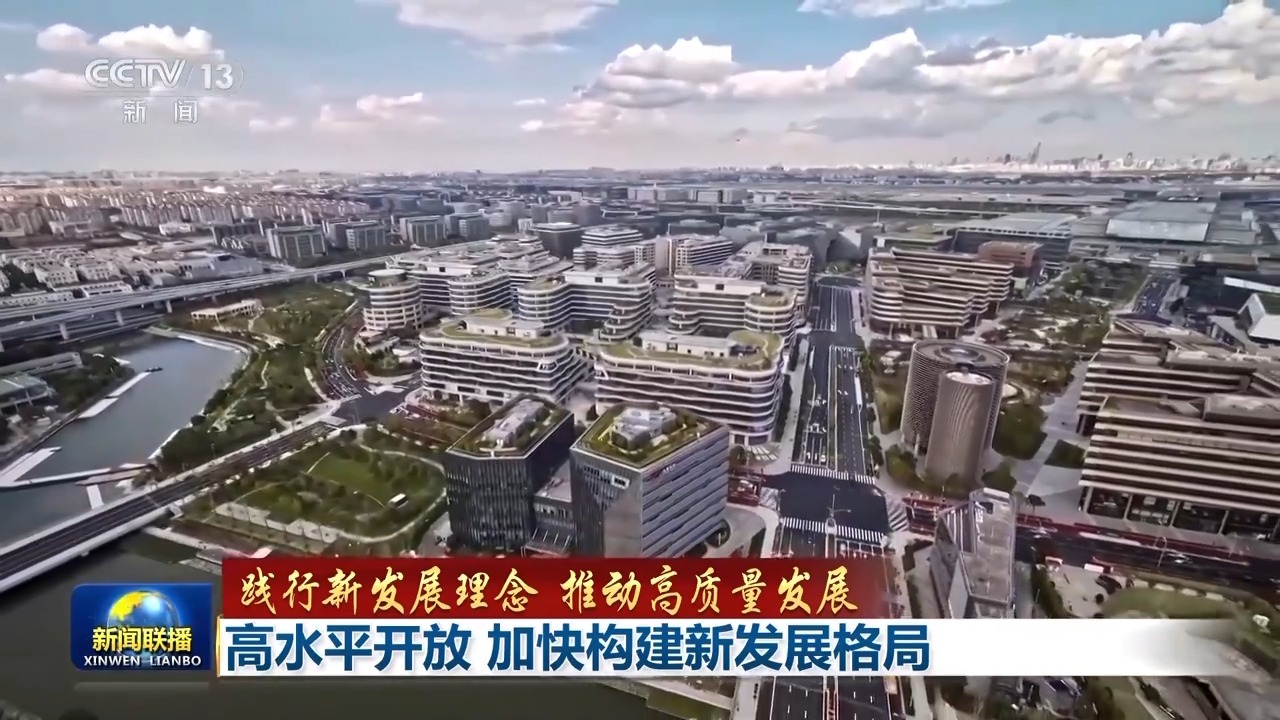
高水平开放

Search documents
开放中国为世界经济提供“稳定锚”(和音) ——读懂中国的确定性③
Ren Min Ri Bao· 2025-11-02 22:27
Core Viewpoint - China is committed to high-level openness and aims to create greater development opportunities for countries worldwide by aligning with the trends of economic globalization and the new technological revolution [1][4]. Group 1: High-Level Openness - The "14th Five-Year Plan" emphasizes expanding autonomous openness, promoting innovative trade development, and enhancing bilateral investment cooperation [1][2]. - China has reduced the negative list for foreign investment and eliminated restrictions in the manufacturing sector, demonstrating a significant increase in openness [2][3]. - Over the past five years, China has established 22.9 million new foreign-funded enterprises, indicating strong foreign confidence in the Chinese market [2][3]. Group 2: Global Trade and Cooperation - China has signed 23 free trade agreements with over 30 countries and regions, leading to the largest scale of goods and services trade globally [3]. - The China-Laos railway has transported over 15 million tons of goods, and the China-Europe freight trains have operated over 110,000 times, showcasing the success of the Belt and Road Initiative [3][4]. - China's commitment to open trade is seen as a stabilizing force in the current global trade tensions, contributing to global economic development [4]. Group 3: Market Potential - With a population of over 1.4 billion and more than 400 million middle-income individuals, China's vast market is viewed as a significant opportunity for international businesses [2]. - The World Economic Forum's executive director highlighted China's attractive market space and stable policy expectations for global enterprises [2]. Group 4: Future Outlook - China will continue to open its doors wider, implementing decisions from the 20th National Congress of the Communist Party to create broader opportunities for global development [4]. - The ongoing modernization efforts in China are expected to generate more benefits for people worldwide [4].
开放中国为世界经济提供“稳定锚”(和音)
Ren Min Ri Bao· 2025-11-02 22:21
中国顺应经济全球化和新一轮科技革命大趋势,始终坚持高水平开放,兼顾自身之需与世界之盼,加快 形成更大范围、更宽领域、更深层次对外开放格局,将给世界各国带来更大发展机遇 在亚太经合组织第三十二次领导人非正式会议期间,习近平主席向国际社会介绍中共二十届四中全会通 过了关于制定"十五五"规划的建议,再次明确了中国将继续以高水平对外开放促进深层次改革、推动高 质量发展,不断以中国式现代化新成就为世界各国提供新机遇的坚定意愿。 坚持开放合作、互利共赢是中国式现代化的必然要求。"十五五"规划建议从积极扩大自主开放、推动贸 易创新发展、拓展双向投资合作空间、高质量共建"一带一路"四个方面作出重要部署,每一个维度都展 现了中国与各方共享机遇、共同发展的决心。 中国统筹用好全球要素和市场资源,坚定不移奉行互利共赢开放战略。"十四五"时期,从持续缩减外资 准入负面清单、制造业领域准入限制全部"清零",到22个自贸试验区构建起覆盖东西南北中的"雁阵", 再到海南自贸港即将封关运作……中国开放的广度、力度、深度持续提升。稳步扩大规则、规制、管 理、标准等制度型开放,持续优化营商环境,让中国大市场日益成长为世界大机遇。过去5年,中国累 ...
第八届进博会前瞻:开放中国助全球发展
Zhong Guo Xin Wen Wang· 2025-11-02 06:03
中新社上海11月2日电 (高志苗)第八届中国国际进口博览会开幕在即,在全球经济面临不确定性的背景 下,中国通过这场"越办越好"的年度大会,向世界传递持续扩大高水平开放的明确信号。 本届进博会迎来155个国家、地区和国际组织的参与,4108家境外企业参展,整体展览面积超过43万平 方米,规模再创新高。 "常办常新"的进博会,已成为中国推动世界经济发展和高水平开放的重要举措。上海财经大学中国式现 代化研究院特聘研究员秦焕梅接受中新社采访时表示,进博会不仅是中国构建新发展格局的窗口,更是 推动高水平开放的重要平台,通过打造"投资中国""购在中国""出口中国"等品牌,把中国超大规模市场 打造为世界共享的创新大市场。 ASICS亚瑟士中国总裁高凯是进博会的"老朋友",他也感受到了进博会开放的"进阶"。在他看来,进博 会展现的不仅是市场的开放,更是发展理念与合作模式的开放。"进博会让我们看到了一个更包容、更 创新、更活力的中国市场,"高凯说,"它是一座多维的桥梁,让全球与中国、创新与消费、现在与未 来,都能在此交汇,共创未来。" 从汇聚全球精品的"汇展",到激发创新智慧的"慧创",进博会也见证了中国开放内涵的深化。苏宁指 ...
新华社评论员:以全面深化改革增动力激活力——五论学习贯彻党的二十届四中全会精神
Xin Hua She· 2025-10-28 17:02
Core Viewpoint - The 20th Central Committee of the Communist Party of China emphasizes the need for comprehensive deepening of reforms during the "14th Five-Year Plan" period to drive high-quality development and advance Chinese-style modernization [1][2][3]. Group 1: Reform and Development - The main goal for the "14th Five-Year Plan" period is to achieve breakthroughs in comprehensive deepening of reforms, addressing deep-seated contradictions and issues such as unbalanced development and bottlenecks in domestic circulation [2][3]. - Reform and opening-up are identified as crucial for overcoming challenges and enhancing development momentum, with a focus on aligning production relations with productivity and improving governance [2][3]. Group 2: Economic System and Innovation - The establishment of a high-level socialist market economy system is essential for driving high-quality development, with an emphasis on enhancing macroeconomic governance and fostering innovation [3]. - Deepening reforms is necessary to stimulate innovation and create a competitive open innovation ecosystem, integrating technological and industrial innovation to seize technological development opportunities [3]. Group 3: Open Cooperation - Open cooperation and mutual benefit are deemed essential for achieving high-quality development, with a call to expand institutional openness and maintain a multilateral trade system [4]. - The strategy includes promoting trade innovation, expanding investment cooperation, and enhancing the Belt and Road Initiative to leverage global resources for domestic development [4].
深耕中国丨透过四中全会 外资收获三个重要信号
Yang Shi Xin Wen Ke Hu Duan· 2025-10-27 00:21
Group 1 - The importance of policy consistency for the business community is emphasized [1] - Foreign enterprises operating in China express confidence in the country's high-level opening-up initiatives [1] - The 20th Central Committee's Fourth Plenary Session has garnered global attention, particularly from foreign businesses in China [1]
“十五规划”干货来了!
Sou Hu Cai Jing· 2025-10-26 10:42
Core Insights - The article emphasizes the transition of China's economy from stability to rapid growth, highlighting the "15th Five-Year Plan" as a blueprint for modernization and high-quality development [3][5]. Group 1: High-Quality Development - The focus is on "high-quality development," shifting from quantity to quality, indicating that efficiency and effectiveness will be the new benchmarks for growth [3][5]. - Quality is described as the "hard currency" for the next phase of economic development, moving away from mere production to producing better goods and services [3]. Group 2: Technological Independence - The plan marks a "leading period" for technological self-reliance, with an emphasis on original innovation in fields such as AI, chips, and quantum computing [3]. - The narrative suggests that China is no longer catching up but is now aiming to lead in technological advancements [3]. Group 3: Expanding Domestic Demand - The strategy shifts from "supply-driven" to "demand-driven," with consumption, social security, and education identified as key growth drivers [3]. - This approach aims to encourage citizens to spend and invest, thereby stimulating economic growth [3]. Group 4: High-Level Openness - The article discusses a transition from "passive openness" to "institutional confidence," promoting active sharing of opportunities and collaborative rule-making in a complex international environment [3]. - This new posture reflects a proactive approach to global engagement [3]. Group 5: Green Transformation and Security - The plan incorporates green transformation as a fundamental aspect, emphasizing the importance of environmental sustainability alongside energy security and national defense modernization [3]. - This dual focus aims to ensure both ecological balance and national safety [3].


中国记协举办新闻茶座 聚焦二十届四中全会后中国发展与世界形势
Xin Hua She· 2025-10-24 12:40
Core Viewpoint - The discussion focuses on China's high-quality development and high-level opening-up post the 20th Central Committee's Fourth Plenary Session, emphasizing confidence and strategic determination for future growth [1] Group 1: Economic Development - By 2035, China aims for its per capita GDP to reach the level of moderately developed countries, reflecting its confidence in future development [1] - The 14th Five-Year Plan will see China positively impacting global development through trade, investment, technology cooperation, and green development [1] Group 2: Trade and Investment - China plans to innovate in trade, focusing on digital and green trade to enhance trade quality [1] - The scale advantages of China's green industries, particularly in photovoltaic, wind power, and power batteries, will significantly reduce global green transition costs [1] Group 3: Technology and Finance - The discussion included topics on the intersection of technology and finance, China's aspirations in aerospace, and the country's economic growth rate [1]
尹江鳌:发挥再保险“三器”功能,促进实现敢保、善保、会保
2 1 Shi Ji Jing Ji Bao Dao· 2025-10-23 02:52
Core Viewpoint - The reinsurance sector is urged to leverage its roles as an "amplifier," "regulator," and "connector" to enhance the insurance industry's capacity to underwrite risks effectively and responsibly [1][3]. Group 1: Amplifier Role - The reinsurance industry should utilize global reinsurance capacity to promote "daring to insure," thereby improving the overall level of protection. As of January to September 2025, China's insurance premium income reached 5.2 trillion yuan, a year-on-year increase of 8.5%, with a projected annual premium scale exceeding 6 trillion yuan [3][4]. - The global direct insurance and reinsurance markets are valued at over $7.2 trillion and $900 billion, respectively, with underwriting capacities approximately nine times and slightly more than China's [3][4]. - The Shanghai International Reinsurance Registration and Trading Center is expected to create a favorable environment to attract more institutions, facilitating the connection of risks and capital [3]. Group 2: Regulator Role - The reinsurance sector is positioned as a tool for regulating market competition, particularly in addressing irrational competition in the non-auto insurance sector. The comprehensive loss ratio for the property insurance industry was 72.2% from January to September 2025, which is 5.9 percentage points higher than the average over the past decade [4]. - Recent regulatory measures have been implemented to strengthen oversight in the non-auto insurance sector, aiming to promote fair competition [4]. - Reinsurance serves not only as a risk transfer mechanism but also as a pricing benchmark and risk transmission signal, helping to regulate the insurance market [4]. Group 3: Connector Role - The reinsurance industry is tasked with utilizing global reinsurance technology to promote "knowing how to insure," thereby advancing high-level openness. There are existing gaps in risk modeling and loss assessment for traditional risks such as typhoons and earthquakes [5]. - New risks arising from advancements in information technology and artificial intelligence present challenges in pricing and loss assessment, particularly in areas like cybersecurity and low-altitude flying vehicles [5]. - The Shanghai International Reinsurance Registration and Trading Center is encouraged to facilitate technical exchanges in risk modeling and underwriting, enhancing the professional standards of China's insurance industry [5].

要动力 推进高水平开放
Jing Ji Ri Bao· 2025-10-22 22:10
Group 1 - The logistics channel for importing fresh Southeast Asian durians to Dalian, China, has been established, marking a breakthrough for northern ports in the sea freight import of durians [1] - Wuxi City in Jiangsu Province, known as the "hometown of electric vehicles," has established around 2,000 overseas sales outlets in over 40 countries and invested in more than 20 production bases in over 10 countries [2] - During the "14th Five-Year Plan" period, China's foreign trade is expected to reach $6.16 trillion in 2024, maintaining its position as the world's largest for eight consecutive years [2] Group 2 - China's visa-free "circle of friends" is expanding, and foreign investment in China is becoming a global consensus, with significant improvements in the foreign investment management system [3] - By December 18, 2025, Hainan Free Trade Port will officially operate under a closed-loop system, indicating a shift towards institutional openness in trade [4] - China has achieved new progress in the Belt and Road Initiative, expanding cooperation to over 150 countries and more than 30 international organizations, contributing approximately 30% to global economic growth annually over the past four years [5]
高水平开放 加快构建新发展格局
Yang Shi Xin Wen· 2025-10-22 13:08
Core Insights - The article emphasizes the importance of a new development model that promotes a higher level of open economy and high-quality development in China [1] Group 1: Shanghai Free Trade Zone Developments - Shanghai has expanded its Free Trade Zone to include eight key areas and five national economic and technological development zones, transitioning from "single-point experiments" to a multi-point linkage model [3] - Since the 14th Five-Year Plan, Shanghai's Free Trade Zone has implemented significant innovations, including data export management regulations and negative lists in finance, trade, and shipping [3] Group 2: Economic Growth in Pudong New Area - Pudong New Area aims for its three leading industries—integrated circuits, biomedicine, and artificial intelligence—to reach a scale of 832.3 billion yuan by 2024, with an average annual growth rate of 11.7% over the past three years [5] Group 3: Nationwide Free Trade Zone Initiatives - China has established 22 Free Trade Zones across the country, facilitating institutional openness and enhancing trade efficiency, particularly in Qingdao and Dalian [7] - In Hainan, efforts are underway to prepare for the island's full closure operation by December 18, creating a conducive environment for the free flow of people, goods, and capital [9] Group 4: Belt and Road Initiative and Regional Development - The Belt and Road Initiative is opening new development opportunities for central and western regions, with significant increases in trade volumes through key ports like Alashankou and Horgos [11] - In the first three quarters of this year, Hunan's trade with Africa reached 44.52 billion yuan, marking a nearly 20% year-on-year increase [11] Group 5: Infrastructure and Connectivity Enhancements - The Western Land-Sea New Corridor has reached 127 countries and regions, with a record import-export volume of 702.42 billion yuan in the first three quarters, reflecting a 17% year-on-year growth [13] - The Guangxi region is enhancing connectivity with ASEAN countries, projecting a 37.1% increase in port cargo volume by 2024 compared to the end of the 13th Five-Year Plan [15]