AIoT

Search documents
3年半亏损超7亿元,德风科技“带伤”冲击港股IPO
Sou Hu Cai Jing· 2025-12-26 09:19
Core Viewpoint - Defeng Technology is seeking to go public on the Hong Kong Stock Exchange, aiming to leverage its position as a leading AIoT service provider in China, despite facing significant financial challenges and uncertainties related to its IPO process [3][4]. Group 1: Company Overview - Defeng Technology specializes in AI-enabled industrial IoT (AIoT) production optimization software solutions, focusing on enhancing energy efficiency, operational excellence, safety, and sustainability in China's energy, manufacturing, and mixed industries [3]. - According to Frost & Sullivan, Defeng Technology ranks as the fifth largest independent AIoT service provider in China, with a market share of approximately 1.8% based on 2024 fiscal year revenue [3][20]. - The company holds over 300 software copyrights, 50 patents, and approximately 10 trademarks as of June 30, 2025 [3]. Group 2: Financial Challenges - Defeng Technology has accumulated redemption liabilities of RMB 1.22 billion, RMB 1.45 billion, and RMB 1.46 billion for the years 2023, 2024, and the first three quarters of 2025, respectively, indicating a rising trend [5]. - The company reported a cumulative net loss exceeding RMB 700 million from 2022 to the first half of 2025, primarily driven by changes in the fair value of redemption liabilities [5]. - As of June 30, 2025, the company's cash and cash equivalents were only RMB 43.99 million, a significant decrease of approximately 51% from the beginning of the year, with current liabilities reaching RMB 17.14 billion [10]. Group 3: Revenue and Cash Flow - Revenue increased from RMB 313 million in 2022 to RMB 525 million in 2024, reflecting a compound annual growth rate of 29.7%, but the company has faced continuous net losses [8]. - The average collection period for trade receivables has extended from 139 days in 2022 to 653 days in the first half of 2025, indicating severe cash flow issues [14]. - The company's operating cash flow has been negative, with net outflows totaling approximately RMB 467 million from 2022 to the first half of 2025 [8]. Group 4: Customer Dependency and Market Position - Defeng Technology's revenue heavily relies on state-owned enterprises, with over 78% of its revenue coming from this sector in 2023, leading to long payment cycles and high accounts receivable [12]. - The company has a concentrated customer base, with the top five customers contributing approximately 68.9% of revenue in the first half of 2025 [16]. - Despite the growth in the AIoT market, Defeng Technology's market share remains low compared to competitors, with the leading company holding a market share of 10.2% [20].


德风科技上市申请遭驳回 独家保荐人被“贴堂”
Zhi Tong Cai Jing· 2025-12-26 06:18
Group 1 - The core point of the news is that Beijing Defeng New Journey Technology Co., Ltd. (Defeng Technology) submitted its IPO application to the Hong Kong Stock Exchange (HKEX) on November 14, which was returned on November 24, marking the first "tied" case in two and a half years [1] - The "tied" mechanism is a criticism notification system by HKEX, where a rejected IPO application is recorded to enhance the quality of listed companies in Hong Kong [1] - Since the implementation of the "tied" system, there have been 10 cases on the Main Board and 15 on GEM, involving 26 sponsors, including major firms like Goldman Sachs and Morgan Stanley [1] Group 2 - Defeng Technology, established in March 2015, is an AI-enabled Industrial Internet of Things (AIoT) software solution developer focused on enhancing energy efficiency and operational excellence in China's energy, manufacturing, and mixed industries [2] - The company has completed over 600 projects, primarily serving state-owned enterprises, with around 200 clients, including leading firms in the electricity, public utilities, oil and gas, and tobacco sectors [2] - Defeng Technology previously attempted to list on the Shanghai Stock Exchange's Sci-Tech Innovation Board in 2022 but terminated its A-share listing efforts in October 2024, subsequently applying for a listing on HKEX in November 2023 [2] Group 3 - The IPO application involves a special agreement granting investors rights such as redemption rights, anti-dilution rights, and preemptive rights [2] - The target date for completing the IPO has been extended from December 31, 2024, to December 31, 2026, with the redemption rights of original shareholders being terminated before the submission of the prospectus [2] - If the IPO fails, the previously terminated redemption rights will automatically be reinstated [2] Group 4 - Due to the granting of redemption rights, Defeng Technology incurred redemption liabilities of 1.224 billion yuan, 1.455 billion yuan, and 1.462 billion yuan for the years 2023, 2024, and the first half of 2025, respectively [3]
社保基金“压箱底”的科技股名单曝光
Sou Hu Cai Jing· 2025-12-21 12:25
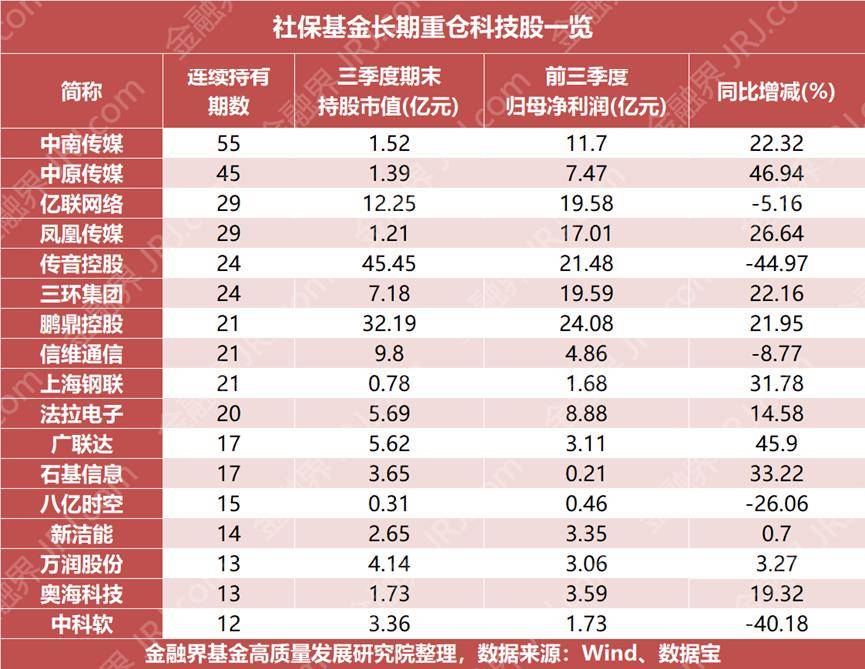
Core Insights - The National Social Security Fund (NSSF) has significantly increased its investment in technology stocks, with a market value exceeding 46.9 billion yuan as of Q3, marking an 18-fold increase compared to the same period in 2011 [1] Group 1: Investment Trends - The NSSF's heavy investment in technology stocks includes sectors such as electronics, communications, computers, and media, reaching a historical high [1] - Six technology stocks have been held by the NSSF for over 24 consecutive quarters, indicating a strong long-term commitment [1] Group 2: Key Companies - Transsion Holdings leads with a market value of over 4.5 billion yuan, focusing on mid-to-high-end products and expanding into AIoT and home appliances [3] - Pengding Holdings ranks second with over 3.2 billion yuan in market value and is recognized for its leadership in the PCB industry, capitalizing on AI-related growth opportunities [3] - Yealink Network, with a market value exceeding 1.2 billion yuan, is noted for its competitive edge in AI meeting products and cloud office terminals, driving market share and performance growth [3] Group 3: Company Performance - Zhongnan Media has been held for 55 consecutive quarters and is actively transforming its business model while showing strong profit growth [2] - The net profit of Zhongyuan Media increased by 46.94% year-on-year, reflecting its resilience amid industry transitions [2] - The net profit of Pengding Holdings increased by 21.95% year-on-year, showcasing its robust financial performance [2]




从“A热H冷”到“同升企稳”,当题材退潮后,谁在炒作广和通?
Hua Xia Shi Bao· 2025-12-19 15:15
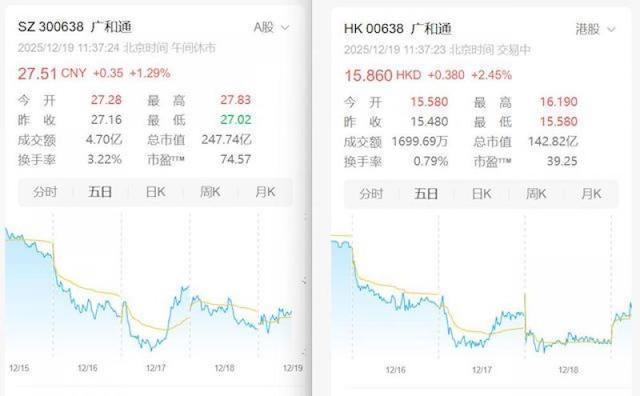
Core Viewpoint - Guanghetong's stock performance has experienced significant fluctuations since its dual listing, reflecting market sentiment and investor behavior, with recent trends indicating a stabilization after a period of decline [2][3]. Stock Performance Summary - As of December 19, Guanghetong's A-shares closed at 27.10 CNY, with a slight daily decrease of 0.22%, while its H-shares rose to 15.76 HKD, indicating a potential stabilization after previous declines [2]. - The company's total market capitalization stands at 244.04 billion CNY for A-shares and 141.92 billion HKD for H-shares, showing a notable market presence [2]. Market Sentiment and Investor Behavior - Initial trading saw A-shares experiencing high volatility driven by speculative trading, while H-shares exhibited a more stable performance, reflecting differing investor strategies [4][5]. - A significant increase in retail investor participation was noted, with a 121% rise in the number of retail investors on December 18, indicating a shift in market dynamics [5]. Valuation and Market Analysis - Guanghetong's current price-to-earnings ratio is at 58.02, placing it in the 92.56 percentile of its historical valuation range, raising concerns about its attractiveness to long-term investors [6][10]. - The company's stock price has been under pressure due to a combination of market conditions, including a decrease in overall risk appetite and the withdrawal of speculative funds [8][11]. Company Strategy and Future Outlook - Guanghetong's strategic shift towards AIoT and the sale of mature businesses has raised questions about its long-term growth potential amidst a competitive landscape [10][11]. - The upcoming shareholder meeting on December 22 is seen as a critical opportunity for management to address market concerns and stabilize investor confidence [9][10].

联芸科技(688449):联芸芯途,主控领航
China Post Securities· 2025-12-19 05:16
Investment Rating - The report assigns a "Buy" rating for the company, marking its first coverage [1]. Core Insights - The company has demonstrated steady revenue and profit growth, with a significant increase in net profit excluding non-recurring items. In the first three quarters of 2025, the company achieved a revenue of 921 million yuan, a year-on-year increase of 11.59%. The net profit attributable to shareholders reached 90 million yuan, up 23.05%, while the net profit excluding non-recurring items surged by 141.76% to 62 million yuan [4]. - The company is optimizing its storage controller chip matrix and strengthening its market advantage in the SSD controller field. It has fully laid out SATA and PCIe 3.0/4.0/5.0 SSD controller chips, becoming one of the manufacturers with the most complete product lines in the industry. In the first half of 2025, the company saw steady growth in SSD controller chip shipments, with significant market recognition for its PCIe Gen4 products [5]. - The embedded controller chip segment is expected to become a new growth engine. The company has entered the embedded controller chip market, with its UFS 3.1 controller chip already being applied in mobile terminals. The development of embedded UFS module solutions is progressing smoothly, which may become a new business growth point for the company [6]. Financial Projections - The company is projected to achieve revenues of 1.4 billion yuan, 1.7 billion yuan, and 2.0 billion yuan in 2025, 2026, and 2027 respectively, with net profits attributable to shareholders of 150 million yuan, 200 million yuan, and 270 million yuan for the same years [7]. - The financial metrics indicate a growth rate of 13.55% for revenue in 2024, increasing to 20.26% by 2027. The net profit growth rate is expected to be 126.04% in 2024, tapering to 35.33% by 2027 [10]. Relative Valuation - The company is positioned as a leading independent SSD controller chip manufacturer globally, with a comprehensive chip design and industrialization platform. The relative valuation analysis suggests a price-to-sales (P/S) average of 20.31x for 2025, based on comparisons with peers [13].
增资提速战略落地 汉桑科技稳健迈向新阶段
Quan Jing Wang· 2025-12-19 02:30
Core Insights - Company has obtained a new business license with a registered capital increase to 129 million yuan, expanding its business scope to include smart home consumer devices, VR/AR, IoT, AI hardware, and integrated circuit chip design, marking a significant step in its intelligent and diversified layout [1] - The company is advancing its "1+2+3+4" development strategy, focusing on audio technology and integrating AI into its product system to enhance its traditional advantages in the era of intelligence [1][2] - The company is adopting a dual-engine model for domestic and overseas markets, strengthening its audio technology chain, and expanding into three major business areas: audio IoT modules, ODM audio systems, and smart audio-visual systems [2] Business Strategy - The company aims to clarify its business layout and improve resource allocation efficiency by focusing on four major tracks: home, commercial, personal, and automotive audio products, catering to diverse application scenarios [2] - Despite challenges such as cyclical fluctuations in the consumer electronics industry and the need for customer structure diversification, the company maintains stable progress in core audio technology and AIoT product layout [2] - The adjustment of the business scope and strategic collaboration is expected to lay a solid foundation for the company's business growth in the coming years as global consumer electronics demand gradually recovers [2]

构建产业生态影响力 亿道信息:打造优质AI产品解决方案提供商
Zhong Guo Zheng Quan Bao· 2025-12-18 22:08
Core Viewpoint - The company aims to become a leading global provider of AI product solutions, emphasizing the vast potential of AI and its integration into various sectors [1][2]. Group 1: AI Strategy Implementation - The company has elevated its "AI+" strategy to a top-level corporate strategy, focusing on deep integration of AI technology in product design and application [2]. - By December 2025, the company plans to launch the "Yidao AI Intelligent Computing Solution Matrix," marking a strategic shift from being a product provider to a scene-based intelligent computing system builder [2]. - The company is committed to investing more resources into the "AI+" strategy, including establishing a corporate research institute to explore foundational AI technologies [3]. Group 2: Industry Chain Integration - The signing of the Yifeng Zhixin advanced packaging project represents a significant step in the company's integration within the semiconductor industry, enhancing its technological capabilities [4]. - The company is pursuing vertical business expansion through collaborations, aiming to strengthen its core technology and resource integration within the industry chain [4]. - The company is also planning strategic acquisitions to enter the smart interactive display and RFID sectors, enhancing its competitive edge in the "AI+" application and terminal markets [5]. Group 3: Expansion into Emerging Business Areas - The company is actively expanding its AIoT business, leveraging AI technology to innovate and create new commercial opportunities [7]. - AI glasses are a key focus area, with the company’s subsidiary, Yijing Virtual, developing a comprehensive product matrix and achieving full-chain customization capabilities [7]. - The company has also initiated a robotics team targeting the commercial cleaning sector, with the launch of its flagship A10 cleaning robot [7].
亿道信息:打造优质AI产品解决方案提供商
Zhong Guo Zheng Quan Bao· 2025-12-18 20:23
Core Insights - The company aims to become a leading global provider of AI product solutions, emphasizing the vast potential of AI technology and its integration into various sectors [1][2] - The "AI+" strategy has been elevated to a top-level strategy, focusing on deep integration of AI technology in product design and application scenarios [1][2] AI Strategy Implementation - The company has launched the "Yidao AI Intelligent Computing Solution Matrix," marking its strategic shift from a product provider to a scene-based intelligent computing system builder [2] - The strategy encompasses six major scenarios: personal, family, enterprise, industrial, wearable, and robotics, utilizing a three-in-one infrastructure of hardware computing power, AESOF platform, and AI atomic capabilities [2] - The company is investing more resources to implement the "AI+" strategy, including establishing a corporate research institute to focus on foundational AI technologies [2][3] Industry Chain Integration - The signing of the Yifeng Zhixin advanced packaging project represents a significant step in the company's integration within the semiconductor industry chain [3] - The company is extending its business from consumer electronics to advanced semiconductor packaging, enhancing collaboration across the industry chain [3] - Plans for mergers and acquisitions are underway to enter the smart interactive display and RFID sectors, aiming to enhance the company's competitive edge in AI applications and terminals [3][4] Emerging Business Expansion - The company is actively pursuing the expansion of the AIoT ecosystem, which is expected to generate diverse scene innovations and commercial growth opportunities [4] - AI glasses are a key focus area, with the company’s subsidiary, Yijing Virtual, developing a product matrix that includes AI audio glasses, AI camera glasses, and AI display glasses [5] - The company has also initiated a robotics team targeting the commercial cleaning sector, with the launch of the A10 cleaning robot as part of its new business expansion [5]
龙旗科技(603341):智能硬件ODM龙头 智能穿戴设备、AIPC打开成长新空间
Xin Lang Cai Jing· 2025-12-18 08:25
Core Insights - The company is a leading ODM in smart products, providing comprehensive services to major global consumer electronics brands and tech companies, including Xiaomi, Samsung, Huawei, Lenovo, Honor, OPPO, vivo, and Company B [1] - In 2024, the company achieved a revenue of 46.38 billion yuan, a year-on-year increase of 70.6%, with a CAGR of 36.0% from 2019 to 2024; however, the net profit attributable to shareholders decreased by 17.2% to 501 million yuan [1] - For the first three quarters of 2025, the company reported a revenue of 31.33 billion yuan, a year-on-year decline of 10.28%, while the net profit attributable to shareholders increased by 17.74% to 507 million yuan [1] Business Segments - The AIoT business is growing rapidly, with significant performance in smartwatches and AI glasses; the smartwatch series has surpassed 10 million units in cumulative shipments, and the company is expanding into the medical wearables sector [2] - In the smart glasses segment, the company is deepening its engagement with top international clients and has launched new products, including children's glasses, while focusing on key technologies such as human factors, battery life, and lightweight design [2] - The company has successfully developed and delivered multiple AIPC products, enhancing its capabilities in ARM/X86 platform development and supply chain management, positioning itself to benefit from the rapid growth in AIPC shipments [3] Financial Projections - Revenue projections for 2025-2027 are 45.84 billion, 54.15 billion, and 65.91 billion yuan, with year-on-year growth rates of -1.16%, 18.12%, and 21.71% respectively; net profit projections for the same period are 651 million, 897 million, and 1.25 billion yuan, with growth rates of 29.92%, 37.81%, and 39.18% respectively [3] - The company is expected to benefit from new product lines such as AI glasses and AIPC while maintaining its core business [3]
高德开放平台发布智能穿戴解决方案,已落地小米、荣耀等品牌
Xin Lang Cai Jing· 2025-12-18 03:00
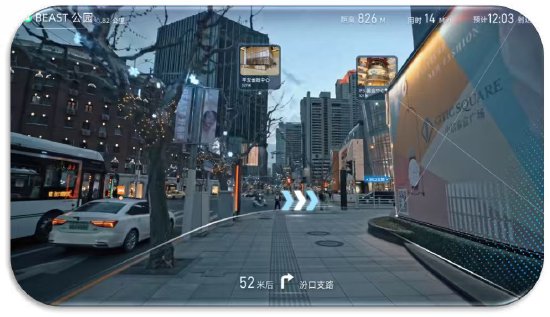
新浪科技讯 12月18日上午消息,近日,高德开放平台推出"智能穿戴解决方案",以"数据底座+AI空间 智能+生态协同"的技术架构破解行业痛点。近年来,随着AIoT技术的迅猛发展,智能穿戴设备逐渐成 为用户日常出行与生活的重要入口。然而,行业长期面临交互不便、算力受限、续航短、生态割裂等痛 点。为破解这些难题,高德开放平台正式发布面向智能手表与智能眼镜的解决方案,以推动智能穿戴设 备迈向"更方便、更安全、更智能"的新阶段。 据悉,高德开放平台三大底层能力构建支撑体系:一是基于多年积累的全量出行数据与自研高精导航引 擎,保障厘米级定位与分钟级路况更新;二是"小高老师"AI空间智能体,可理解用户所处场景、预测出 行需求,实现主动提醒与守护;三是深度整合打车、本地生活等服务,打造"出行即服务"的全链路体 验。 目前,高德智能手表解决方案已成功落地小米、荣耀、优创亿等品牌或解决方案厂商。在智能眼镜领 域,高德已与夸克、Rokid、雷鸟创新、逸文科技、星纪魅族等达成战略合作,进一步拓展应用场景。 责任编辑:江钰涵 责任编辑:江钰涵 新浪科技讯 12月18日上午消息,近日,高德开放平台推出"智能穿戴解决方案",以"数据底座 ...