太空光伏

Search documents
反内卷趋势无忧,太空光伏产业提速
Yin He Zheng Quan· 2026-01-09 15:34
Investment Rating - The report maintains a "Recommended" rating for the electric equipment industry [1] Core Insights - The report highlights that the trend of anti-involution is not a concern, and the space photovoltaic industry is accelerating [1] - The report discusses the recent regulatory actions in the photovoltaic sector, emphasizing the prohibition of monopolistic behaviors such as price and capacity coordination, while allowing compliance with cost-based sales and technology standard improvements [4] - The report notes a continued upward trend in industry prices, with expectations for profit recovery in 2026 as terminal demand gradually improves [4] - The rise of commercial space ventures is accelerating the development of space photovoltaic technology, with significant plans for satellite energy networks and high-efficiency energy generation [4] Summary by Sections Regulatory Environment - The market regulatory authority has halted self-regulatory actions related to the photovoltaic industry's silicon material integration platform, citing monopolistic concerns [4] - A collaborative governance framework is being established among enterprises, power generation entities, and associations to ensure compliance and quality standards [4] Industry Price Trends - The average transaction price for N-type silicon material has increased to 59,200 CNY per ton, reflecting a week-on-week increase of 9.83% [4] - Prices for N-type silicon wafers and battery cells have also seen upward adjustments, indicating a recovery in the industry [4] Space Photovoltaic Development - Elon Musk has announced plans to deploy a 100GW solar-powered satellite energy network annually, while China aims to establish gigawatt-level space data centers by 2035 [4] - Space photovoltaic technology is expected to achieve commercial viability within the next 10-15 years, driven by advancements in battery technology and reduced launch costs [4] Investment Recommendations - The report suggests focusing on companies with technological reserves in space photovoltaic, such as Junda Co., JinkoSolar, Trina Solar, and others [4] - It also recommends monitoring leading companies with strong advantages in new technologies, as well as those benefiting from anti-involution policies in the silicon material segment [4]
财政部、税务总局:取消,光伏、电池,迎重磅新政
Zheng Quan Shi Bao· 2026-01-09 12:09
Group 1 - The Ministry of Finance and the State Taxation Administration announced the cancellation of VAT export tax rebates for photovoltaic products starting April 1, 2026, and for battery products starting January 1, 2027 [1][2] - From April 1, 2026, to December 31, 2026, the VAT export rebate rate for battery products will be reduced from 9% to 6% [2] Group 2 - The "anti-involution" trend in the photovoltaic industry has led to a recovery in industry valuations, with upstream prices returning to reasonable levels and mid-to-downstream prices showing an upward trend [4] - Investment opportunities are identified in three areas: price elasticity opportunities, new technology advancements, and the commercialization of perovskite solar cells [4] - The space photovoltaic sector is gaining attention, with plans for deploying solar energy satellites, which could significantly enhance energy supply for space applications [4][5] - The potential market size for space photovoltaics is estimated at approximately 80 billion yuan, driven by the demand for energy in satellite communication and emerging applications [6]


刚刚公告!财政部、税务总局:取消!光伏、电池,迎重磅新政!
券商中国· 2026-01-09 11:41
Core Viewpoint - The Chinese government has announced significant changes to the export tax rebate policy for the photovoltaic industry, which will impact the financial dynamics of the sector starting in 2026 [1][2]. Policy Changes - The Ministry of Finance and the State Taxation Administration announced that from April 1, 2026, the value-added tax (VAT) export rebate for photovoltaic products will be canceled [2]. - From April 1, 2026, to December 31, 2026, the VAT export rebate rate for battery products will be reduced from 9% to 6%, and from January 1, 2027, the rebate will be completely canceled [2]. Industry Trends - The "anti-involution" movement in the photovoltaic industry has led to a recovery in pricing, particularly in the upstream sector, with expectations for price increases in the mid and downstream segments [4]. - Investment opportunities are identified in three main areas: price elasticity as inventory is digested, new technologies that enhance efficiency, and the commercialization of perovskite solar cells [5]. Emerging Technologies - The potential for space photovoltaic systems is gaining attention, with plans for deploying solar energy satellites that could generate 100 GW annually [5]. - The space photovoltaic market could reach approximately 800 billion yuan if 4,000 satellites are launched, each with an average solar wing area of 100 square meters [6]. - Current leading technologies for space applications include gallium arsenide multi-junction batteries, while P-type HJT and next-generation perovskite/silicon tandem batteries are expected to dominate the market due to their efficiency and adaptability [6].

电力设备行业点评报告:反内卷趋势无忧,太空光伏产业提速
Yin He Zheng Quan· 2026-01-09 09:20
Investment Rating - The report maintains a "Recommended" rating for the electric equipment industry [1] Core Insights - The report highlights that the trend of anti-involution is not a concern, and the space photovoltaic industry is accelerating [1] - The report discusses the recent regulatory actions in the photovoltaic sector, emphasizing the prohibition of monopolistic behaviors such as price and capacity coordination, while allowing compliance with cost-based sales and technology standard improvements [4] - The report notes a continued upward trend in industry prices, with expectations for profit recovery in 2026 as terminal demand gradually improves [4] - The rise of commercial space and the acceleration of the space photovoltaic industry are underscored, with significant plans for deploying solar energy networks in space [4] Summary by Sections Regulatory Environment - The market regulatory authority has halted self-regulatory actions related to the photovoltaic industry's silicon material integration platform, citing monopolistic concerns [4] - A collaborative governance framework is being established among enterprises, power generation entities, and associations to ensure compliance and quality standards [4] Industry Price Trends - The average transaction price for N-type silicon material has increased to 59,200 CNY per ton, reflecting a week-on-week increase of 9.83% [4] - Prices for N-type silicon wafers and battery cells have also seen upward adjustments, indicating a recovery in the industry [4] Space Photovoltaic Development - Elon Musk's plan to deploy 100GW of solar-powered satellites annually is highlighted, along with China's plans for gigawatt-level space data centers [4] - The report anticipates that space photovoltaic technology will become commercialized in the next 10-15 years, driven by decreasing launch costs and technological breakthroughs [4] Investment Recommendations - The report suggests focusing on companies with technological reserves in space photovoltaic, such as Junda Co., JinkoSolar, Trina Solar, and others [4] - It also recommends monitoring leading companies with strong advantages in new technologies, as well as those benefiting from anti-involution policies in the silicon material segment [4]
太空光伏赛道兴起 或催生万亿级市场
Zhong Guo Jing Ying Bao· 2026-01-09 09:07
Core Viewpoint - The photovoltaic industry is exploring opportunities in space photovoltaic technology, which is seen as a potential solution for future energy needs on Earth and in space, with major companies signaling their intentions to invest in this area [1][4]. Group 1: Industry Trends - Major players in the photovoltaic sector, such as JinkoSolar and Trina Solar, are emphasizing the importance of space photovoltaic technology for future energy solutions, particularly for deep space exploration and AI power shortages on Earth [1]. - The space photovoltaic market is projected to reach a trillion-dollar scale, becoming a core investment theme in the power equipment and renewable energy sectors by 2026 [1][4]. - The demand for space photovoltaic technology is driven by the growth of commercial space ventures and the need for efficient energy solutions in low Earth orbit satellite networks [4][5]. Group 2: Technological Developments - Current space photovoltaic systems predominantly use gallium arsenide solar cells, which are lightweight and efficient but expensive; however, P-type crystalline silicon and perovskite tandem cell technologies are emerging as potential alternatives [2][7]. - The transition from N-type to P-type silicon cells in space applications is influenced by their ability to withstand high-energy particle radiation and maintain performance over time [8][11]. - The development of perovskite tandem cells is expected to enhance efficiency and reduce weight, making them suitable for various space energy applications, including low Earth orbit communication satellites and solar power stations [10]. Group 3: Market Potential - The low Earth orbit satellite sector alone is anticipated to generate a trillion-dollar market, with significant growth expected in the space computing center market as well [5]. - The global space photovoltaic market is projected to reach a trillion-dollar scale by 2030, driven by the increasing demand for reliable and efficient energy solutions in commercial space applications [4][5]. - The competitive landscape in the commercial satellite sector is intensifying, with major companies like SpaceX and Google planning extensive satellite networks, further highlighting the need for advanced photovoltaic solutions [4].
电力设备行业:反内卷趋势无忧,太空光伏产业提速
Yin He Zheng Quan· 2026-01-09 07:39
Investment Rating - The report maintains a "Recommended" rating for the electric equipment industry [1] Core Insights - The report highlights that the trend of anti-involution is not a concern, and the space photovoltaic industry is accelerating [1] - The report discusses the recent regulatory actions in the photovoltaic sector, emphasizing the prohibition of monopolistic behaviors such as price and capacity coordination, while allowing compliance with cost-based sales and technology standard improvements [4] - The report notes a continued upward trend in industry chain prices, with expectations for profit recovery in 2026 as terminal demand gradually warms up [4] - The rise of commercial space and the acceleration of the space photovoltaic industry are emphasized, with significant plans for deploying solar energy networks in space [4] Summary by Sections Regulatory Environment - The market regulatory authority has halted self-regulatory actions related to the photovoltaic industry's silicon material integration platform, citing monopolistic concerns [4] - The framework for collaborative governance among enterprises, power generation parties, and associations is outlined, focusing on compliance and quality standards [4] Industry Price Trends - Recent data indicates that the average transaction price for N-type silicon material has increased to 59,200 CNY per ton, reflecting a week-on-week increase of 9.83% [4] - Prices for N-type silicon wafers and battery cells have also seen upward adjustments, with average prices reaching 1.4 to 1.7 CNY per piece and 0.39 CNY per watt, respectively [4] Space Photovoltaic Development - Elon Musk's plan to deploy 100GW of solar energy satellites annually is highlighted, alongside China's phased deployment of gigawatt-level space data centers from 2025 to 2035 [4] - The report anticipates that space photovoltaic technology will become commercialized within the next 10-15 years, driven by decreasing launch costs and breakthroughs in battery technology [4] Investment Recommendations - The report suggests focusing on companies with technological reserves in space photovoltaic, including JunDa Co., JinkoSolar, Trina Solar, and others [4] - It also recommends attention to leading companies with strong advantages in new technologies, such as LONGi Green Energy and Aiko Solar [4] - Companies benefiting from anti-involution policies in the silicon material segment, such as Tongwei Co. and GCL-Poly Energy, are also highlighted [4] - The report advises monitoring companies that prioritize synergy in energy storage and are relatively independent from the main chain, such as Sungrow Power Supply and others [4]
电力设备:反内卷趋势无忧,太空光伏产业提速
Yin He Zheng Quan· 2026-01-09 07:03
Investment Rating - The report maintains a "Recommended" rating for the electric equipment industry [1] Core Insights - The report highlights that the trend of anti-involution is not a concern, and the space photovoltaic industry is accelerating [1] - The recent regulatory actions in the photovoltaic sector aim to prevent monopolistic behaviors while allowing compliance with cost-based sales and technology standards [4] - The prices in the industry continue to rise, indicating a recovery, with silicon material prices increasing by 9.83% week-on-week to 59,200 CNY/ton [4] - The commercial space sector is emerging, with plans for deploying solar energy satellites, which could lead to significant advancements in space photovoltaic technology [4] Summary by Sections Regulatory Environment - The market regulatory authority has halted self-regulatory actions related to silicon material integration in the photovoltaic industry, focusing on preventing monopolistic practices [4] - Compliance measures are being established to ensure fair competition among industry participants [4] Industry Performance - The prices of N-type silicon wafers and cells have seen increases, with N-type cell prices rising to 0.39 CNY/W and TOPCon module prices reaching 0.7 CNY/W [4] - The industry is expected to turn profitable in 2026 as terminal demand recovers [4] Technological Advancements - The report emphasizes the potential of space photovoltaic technology, which can generate energy continuously and is projected to become commercialized in the next 10-15 years [4] - The focus is on companies with technological reserves in space photovoltaics, such as Junda Co., JinkoSolar, Trina Solar, and others [4]
半日,2万亿!狂掀涨停潮!
天天基金网· 2026-01-09 05:24
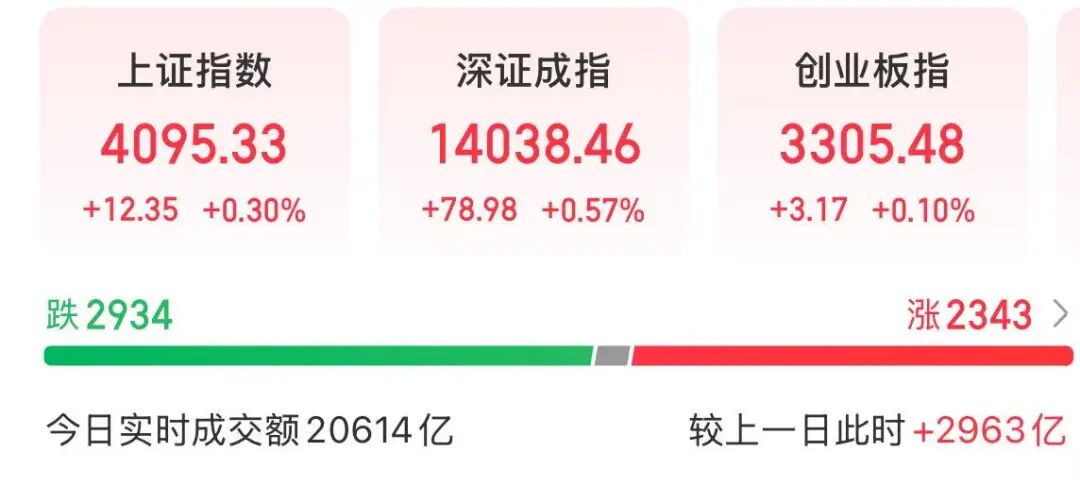
Market Overview - The A-share market saw all three major indices rise, with the Shanghai Composite Index up by 0.3%, the Shenzhen Component Index up by 0.57%, and the ChiNext Index up by 0.1% [3] - The market experienced significant trading volume, with a turnover of 20,614 billion yuan, an increase of 2,963 billion yuan compared to the previous day [3] Sector Performance - Various sectors showed positive performance, including non-ferrous metals, AI applications, commercial aerospace, computing power, consumer electronics, and diversified finance [5] - The commercial aerospace sector experienced a strong rally, leading to a surge in related stocks and positively impacting military stocks and other sectors such as diversified finance, wind power, photovoltaic, carbon fiber, and engineering machinery [7] Notable Stocks - Leading consumer electronics stock Lens Technology rose over 12%, reaching a historical high with a market capitalization of 200.9 billion yuan [5] - Multiple stocks in the commercial aerospace sector hit their historical highs, including Xinyuan Technology and Guokai Biological Engineering, with significant percentage increases [8][10] Investment Insights - The commercial aerospace sector is gaining attention, with companies like Luxin Venture Capital and Yuexiu Capital seeing stock price increases due to their investments in the sector [10] - The wind power sector also saw gains, with companies like Taisheng Wind Energy and Goldwind Technology experiencing significant stock price increases [10] - The carbon fiber sector is benefiting from its applications in commercial aerospace, with companies like Huayin Technology and Guangqi Technology seeing substantial stock price increases [10] Consumer Sector Recovery - The consumer sector rebounded, with increases in stocks related to duty-free shops, retail, and film and television [13] - The film industry is showing signs of recovery, with the box office for 2025 projected to reach 531 billion yuan, driven by strong demand during key holiday periods and the release of quality content [15]

半日,2万亿
Zhong Guo Zheng Quan Bao· 2026-01-09 05:21
今天上午,A股三大股指齐涨。截至上午收盘,上证指数上涨0.3%,深证成指上涨0.57%,创业板指上涨0.1%。上午,市场大幅放量,成交额为20614亿 元,较昨日上午增加2963亿元。 盘面上,有色金属、AI应用、商业航天、算力、消费电子、多元金融等板块上涨。 个股方面,消费电子龙头股蓝思科技涨超12%,盘中股价创历史新高,最新市值为2009亿元。鼎泰高科、源杰科技、云南锗业等细分领域龙头股上涨,盘 中股价均创历史新高。 商业航天板块上涨 今天上午,商业航天板块再度走强,掀起涨停潮,其对盘面产生了明显的带动作用:一方面,带动军工股走强;另一方面,多元金融、风电、光伏、碳纤 维、工程机械等板块,也受益商业航天板块交易逻辑扩散。 | V | 商业航天 2511.42 1.73% | ▲ | C | | --- | --- | --- | --- | | 成分股 基金 | 资金 | 板块分析 | 新闻 | | ●展开分析 | 最新 | 涨幅 ◆ | 流通市值 | | 信科移动-U 融 688387 | 15.84 | 20.00% | 319亿 | | 首板涨停 最终涨停 11:08 | | | | | 部归液压 ...
半日,2万亿!
Zhong Guo Zheng Quan Bao· 2026-01-09 04:43
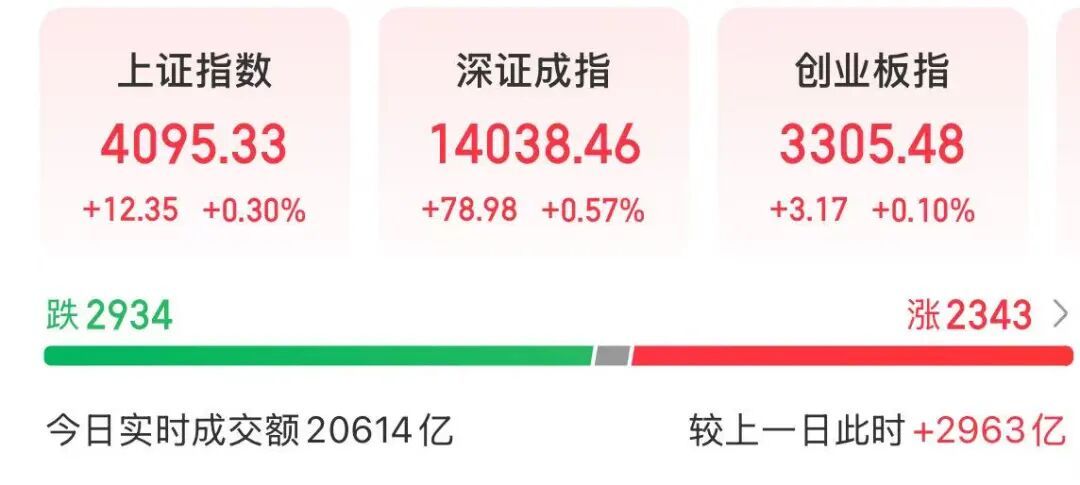
今天上午,A股三大股指齐涨。截至上午收盘,上证指数上涨0.3%,深证成指上涨0.57%,创业板指上涨0.1%。上午,市场大幅放量,成交额为20614亿 元,较昨日上午增加2963亿元。 盘面上,有色金属、AI应用、商业航天、算力、消费电子、多元金融等板块上涨。 个股方面,消费电子龙头股蓝思科技(300433)涨超12%,盘中股价创历史新高,最新市值为2009亿元。鼎泰高科(301377)、源杰科技、云南锗业 (002428)等细分领域龙头股上涨,盘中股价均创历史新高。 商业航天板块上涨 今天上午,商业航天板块再度走强,掀起涨停潮,其对盘面产生了明显的带动作用:一方面,带动军工股走强;另一方面,多元金融、风电、光伏、碳纤 维、工程机械等板块,也受益商业航天板块交易逻辑扩散。 | 1 | 商业航天 2511.42 1.73% | | € | | --- | --- | --- | --- | | 基金 成分股 | 资金 | 板块分析 | 新闻 | | ●展开分析 | 最新 | 涨幅 = | 流通市值 | | 信科移动-U 融 688387 | 15.84 | 20.00% | 319亿 | | 首板涨停 最终涨停 ...