全球贸易战

Search documents
英伟达泡沫即将破灭!趁现在还能退出的时候赶紧退出
美股研究社· 2025-04-11 12:08
Core Viewpoint - Nvidia has faced significant challenges recently, with its stock price dropping approximately 30% since the end of 2024, indicating that aggressive growth rates may be a thing of the past. Analysts suggest that Nvidia's stock is overvalued and recommend selling due to substantial downside potential [1][2]. Group 1: Market Dynamics - Nvidia experienced a strong finish in 2024 with soaring revenues, but market sentiment is shifting as competitors like Deepseek demonstrate higher efficiency at lower costs, raising doubts about the necessity of Nvidia's GPUs for running models [2][3]. - Reports indicate that Microsoft has paused some data center projects, suggesting potential overcapacity in AI data centers, which could negatively impact Nvidia's performance in upcoming quarters [2][3]. Group 2: Competitive Landscape - Major clients of Nvidia, including Amazon, OpenAI, Google, and Meta, are developing custom chips to reduce reliance on Nvidia, threatening its dominance in the AI accelerator market [3][4]. - The escalation of global trade tensions poses additional challenges for Nvidia, particularly in its operations in China, where sales remain below pre-export control levels [3][4]. Group 3: Financial Valuation - Nvidia's stock was previously overvalued at $132 per share, with an intrinsic value estimated at $91.20 per share. Current economic factors suggest that intrinsic value may be even lower, indicating further downside potential [4][6]. - Updated valuation models show Nvidia's enterprise value at $1.79 trillion and equity value at $1.83 trillion, translating to an intrinsic value of $73.87 per share, suggesting Nvidia is overvalued by approximately 22% [6][7]. Group 4: Future Outlook - Analysts have adjusted sales growth expectations for fiscal year 2026 down to 50% due to the impact of trade tensions, with further adjustments likely after the first quarter earnings report [5][6]. - Despite the challenging environment, there are signals that the U.S. government may be open to trade negotiations, which could alleviate some economic pressures on Nvidia [8].


Big Pharma Stocks Dive Amid Trade War Jitters & Inflation Woes
ZACKS· 2025-04-07 13:40
Core Viewpoint - The pharmaceutical sector is facing significant challenges due to China's imposition of a 34% retaliatory tariff on all U.S. imports, raising concerns about potential price increases for drugs and the risk of a global trade war [1][2][6]. Group 1: Impact of Tariffs - Major large-cap pharmaceutical companies experienced substantial stock declines, with AbbVie, Amgen, Merck, and Pfizer losing 7.3%, 5.0%, 5.7%, and 5.4% respectively [3]. - Eli Lilly and Novo Nordisk also saw declines of 6.5% and 6.8%, influenced by the Trump administration's decision not to expand Medicare coverage for weight-loss drugs [4]. - The overall market was affected, with the S&P 500 declining 6%, the Dow falling 5.5%, and the Nasdaq dropping 5.8% [5]. Group 2: Industry Challenges - The tariff policy, while aimed at boosting U.S. investments, is likely to increase costs for drugmakers, particularly affecting those with thin profit margins, such as generic and biosimilar manufacturers [6]. - Potential supply shortages may arise as some countries exporting drugs or APIs to the U.S. might withdraw from the market, disrupting the global supply chain [7]. Group 3: Regulatory Uncertainty - The resignation of Dr. Peter Marks from the FDA has raised concerns about regulatory clarity and innovation momentum in the biotech sector [8]. - The appointment of Robert F. Kennedy Jr. as head of Health and Human Services has sparked criticism due to his vaccine skepticism, raising fears about the influence on public health policy [9]. - Kennedy's push for a nationwide ban on direct-to-consumer pharmaceutical advertising could significantly alter marketing strategies for healthcare products in the U.S. [10].


台积电熔断!
国芯网· 2025-04-07 13:18
国芯网[原:中国半导体论坛] 振兴国产半导体产业! 不拘中国、 放眼世界 ! 关注 世界半导体论坛 ↓ ↓ ↓ 4月7日消息,受特朗普抛出的"对等关税"政策影响,中国台湾地区股票交易市场出现 "跳水式暴 跌", 台积电 开盘近下跌10%, 触发台股熔断机制! 今日是台湾地区清明连假结束后的首个台股交易日,据台媒报道,开盘后台股便出现"跳水式暴 跌"。大盘一开盘便狂泻2000点,不仅失守具有象征意义的2万点重要关卡,还创下了台股史上"最 大开盘跌点纪录"。 台积电开盘跳空跌停价848元,为去年8月初以来低位,也是 16 年 4 个月以来首次开盘即跳空跌 停。台积电上一次盘中触及跌停是2024年8月 5 日,因美股收黑走低。上一次开盘即跳空跌停是 16 年 4 个月前的 2008 年 12 月 2 日,当时次级房贷危机引发全球金融海啸。 据报道,岛内"三大权值股"台积电、鸿海、联发科同步亮灯跌停,电子、AI、金融等板块全面溃 散,盘面血流成河。 岛内有机构表示,美国政府4月2日公布关税政策不仅冲击全球股市、引发多个经济体表态反制,全 球贸易战升温,市场担忧美国经济未来发展打击美股与台股投资人信心,不利台股近期表现 ...
中原期货晨会纪要-2025-04-07
Zhong Yuan Qi Huo· 2025-04-07 07:59
Report Industry Investment Rating - No relevant content provided Core Viewpoints of the Report - The US government's tariff policy has a significant impact on global capital markets, with sharp declines in major indices such as the S&P 500, Nasdaq, and Saudi All-Share Index [7]. - China will impose a 34% tariff on all imported goods from the US starting from April 10, 2025, which is expected to affect the market sentiment of related products [12][19]. - The global manufacturing recovery is weakening, while China's consumer market is showing positive momentum in the first quarter [8]. - The performance of various commodities and financial markets is affected by factors such as supply and demand, policies, and macro - economic conditions, and investors need to pay attention to risks and opportunities [12][13][14][15][18][19][20] Summary by Directory Commodity Index Daily Market Tracking - **Stock Indices**: On April 7, 2025, compared with April 6, major global stock indices generally declined. The Dow Jones Industrial Index dropped by 5.503% to 38314.86, the Nasdaq Index fell by 5.817% to 15587.79, and the S&P 500 decreased by 5.975% to 5074.08. The Hang Seng Index declined by 1.520% to 22849.81 [2]. - **Currencies**: The SHIBOR overnight rate decreased by 7.916% to 1.62, the US dollar index dropped by 0.415% to 102.49, and the US dollar against the Chinese yuan (CFETS) remained unchanged at 7.30 [2]. - **Commodities**: Most commodities showed price declines. For example, COMEX gold decreased by 2.613% to 3056.10, COMEX silver fell by 7.518% to 29.53, and LME copper dropped by 7.223% to 8690.00. However, CBOT corn rose by 0.436% to 460.50 [2]. Macro - Economic News - **Global Market Impact**: The US tariff policy has led to significant drops in global stock markets, with the S&P 500 and Nasdaq falling more than 10% and 11% respectively in two days. Saudi All - Share Index tumbled 6.78%, and Saudi Aramco's market value evaporated about $90 billion [7]. - **Upcoming Events**: China will impose a 34% tariff on US goods starting from April 10; the EU plans to take comprehensive counter - measures against US tariffs; inflation data of China and the US in March will be released; the US earnings season will start; and the 2025 Global 6G Technology and Industry Ecology Conference will be held in Nanjing [7]. - **China's Economic Situation**: China is strengthening its opening - up legal system, attracting more international investors. The global manufacturing PMI in March was 49.6%, down 0.4 percentage points from the previous month. China's consumer market showed positive momentum in the first quarter, with the offline consumption heat index increasing by 14.2% year - on - year [8]. - **Regional Economic Developments**: In Zhejiang, manufacturing investment increased significantly from January to February. Hunan Province plans to develop a credible data space, aiming to have over 500 network nodes by 2028 [9]. Morning Meeting Views on Major Varieties Agricultural Products - **Peanuts**: The spot market is in a stalemate. With the tariff on US goods, the peanut market is expected to rise with oilseeds and meals [12]. - **Oils and Fats**: The tariff on US imports is expected to drive the oil and meal market to be bullish [12]. - **Sugar**: The price has broken through the previous range. Short - term buying on dips is recommended, but attention should be paid to the resistance at 6200 and the risk of price correction [12]. - **Corn**: The price has shown a stable rebound. Buying on dips is suggested, but beware of port inventory pressure and weak spot price follow - up [12]. - **Hogs**: The spot price is stable, and the futures contract is in a discount state, oscillating between 13500 - 14000. A 5 - 10 positive spread can be considered [12][14]. - **Eggs**: The spot price is stable. Attention should be paid to the price changes around holidays [14]. Energy and Chemicals - **Caustic Soda**: The 2505 contract may continue to be weak, but beware of short - term rebound due to position reduction [14]. - **Urea**: The price is stable with a slight weakness. The UR2505 contract is expected to trade between 1840 - 1930 yuan/ton. Unilateral operations should be cautious [14]. Industrial Metals - **Copper and Aluminum**: Affected by the US tariff policy, the prices of copper and aluminum have weakened. Copper and aluminum inventories have decreased [13][14][15]. - **Alumina**: The 2505 contract is expected to be weak, and beware of short - term rebound due to position reduction [15]. - **Steel Products**: The inventory of five major steel products is decreasing. The prices of steel products may continue to decline, and attention should be paid to the support levels of 3200 for rebar and 3300 for hot - rolled coils [15]. - **Ferroalloys**: Silicon iron and manganese silicon are expected to continue weak oscillations [15]. - **Coking Coal and Coke**: The prices may face pressure due to tariff sentiment, and they are in a weak oscillation at low levels [15]. - **Lithium Carbonate**: The price is in a weak oscillation. Short positions are recommended, but beware of over - decline rebound [15][16]. Options and Financial Markets - **Stock Market Performance**: On April 3, A - share indices closed lower. The US tariff policy has put pressure on the A - share market. The domestic market may remain weak in the short - term. Before a significant bottom - out with heavy trading volume, short - term volatility strategies can be considered; otherwise, combination arbitrage strategies of IF/IH and IC/IM can be used [18][19][20].
特朗普关税战引全球震动!澳股开盘暴跌,市值蒸发$350亿
Sou Hu Cai Jing· 2025-04-04 17:37
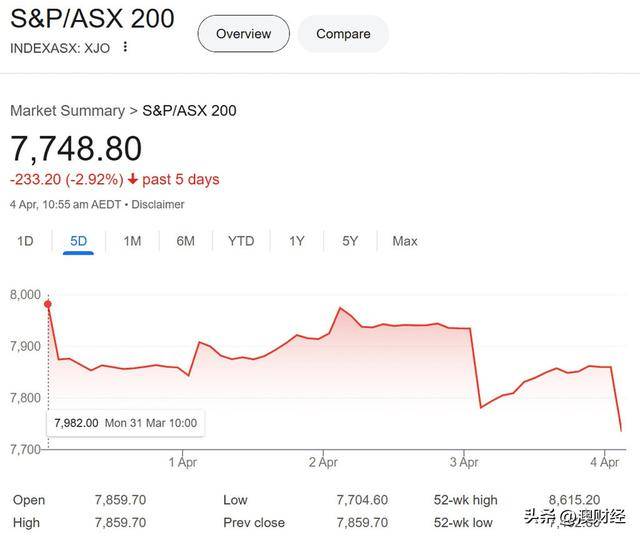
Group 1 - The Australian stock market experienced a significant drop, with a market value loss of 35 billion AUD, influenced by Trump's tariff policies [1] - The S&P/ASX 200 index fell by 1.4% to 7751.1 points, with most sectors declining sharply, particularly the energy sector, which saw a nearly 6% drop [1] - Approximately 4% of Australian export goods are sent to the United States, indicating that Trump's tariffs will not have a direct impact on Australian exports [1] Group 2 - The total tariffs imposed by the U.S. on China have increased to 54%, which is expected to negatively affect Australian exporters due to decreased demand from China, Australia's largest trading partner [3] - The U.S. financial markets were also shaken, with the S&P 500 index dropping by 3.7%, the European STOXX 600 index down by 2.7%, and the Tokyo benchmark index falling by 2.8% [3] - Global oil prices decreased by over 2 USD per barrel as a result of the market turmoil [3] Group 3 - Trump's tariff actions are anticipated to trigger a global trade war, with countries such as China, the EU, South Korea, Mexico, and India indicating plans for retaliatory measures [5] - Analysts believe that these actions will disrupt global trade order and undermine decades of efforts to reduce tariffs through trade negotiations and free trade agreements [5] - Deutsche Bank's Jim Reid described the situation as a "radical policy restructuring," noting that the current average tariffs in the U.S. range from 25% to 30%, marking the highest levels since the early 20th century [5]