
基准利率

Search documents
利比里亚央行将基准利率维持在17.25%。
news flash· 2025-07-25 12:11
Core Viewpoint - The Central Bank of Liberia has maintained the benchmark interest rate at 17.25% to stabilize the economy and control inflation [1] Group 1 - The decision to keep the interest rate unchanged reflects the bank's strategy to manage economic stability [1] - The current rate of 17.25% indicates a cautious approach in response to economic conditions [1] - This rate has implications for borrowing costs and investment decisions within the country [1]
利率变局中的攻守之道:浮息债全解
Guoxin Securities· 2025-07-24 09:54
Group 1: Report Industry Investment Rating - No relevant content found Group 2: Core Viewpoints of the Report - The issuance scale of floating - rate bonds in China has shown a fluctuating upward trend in the past 30 years, with significant shrinkage in the past three years. The benchmark interest rate has changed from single to diverse, and the dominant bond varieties have alternated between policy - bank bonds and asset - backed securities. The issuance term has evolved from high concentration to dispersion and then back to concentration [29][35][45]. - The valuation of floating - rate bonds is based on the discounted cash flow method (DCF). The key difficulties lie in predicting future coupon payments and selecting the discount rate. The change in the benchmark interest rate and the term spread △y can affect the value of floating - rate bonds [106][109][144]. - Floating - rate bonds are more resistant to decline in a bear market but weaker in a bull market compared to fixed - rate bonds. The absolute value change of floating - rate bonds is complex, and its value is affected by the relative changes of the benchmark interest rate and the market interest rate [161][168][197]. - Based on the analysis of the cash - flow simulation of floating - rate bonds, the market implies that the 1 - year LPR will decline steadily in the next two years and then rise. The floating - rate bonds of China Development Bank imply a stronger expectation of interest - rate cuts than those of Agricultural Development Bank [319][339]. - Considering the expected interest - rate cuts in the second half of the year, the allocation value of floating - rate bonds may be lower than that of fixed - rate bonds [353][356]. Group 3: Summary According to the Directory 1. Floating - Rate Bond Historical Changes and Current Situation - **Historical Changes** - **Issuance Scale**: It has experienced three rounds of expansion and adjustment in the past 30 years. The first round (1995 - 2002) was an exploration period with the first breakthrough to the 10 - billion - level. The second round (2003 - 2013) was a consolidation period with the scale reaching 50 - billion - level. The third round (2014 - 2024) was a mature and fluctuating period with the peak exceeding 60 - billion - level, but it has shrunk significantly in the past three years [35][37]. - **Benchmark Interest Rate**: It has changed from a single 1 - year fixed - deposit interest rate to a diverse range, including 7 - day repo rate average, LIBOR, SHIBOR, LPR, etc. Currently, LPR and DR series have become the mainstream [41][45][48]. - **Bond Varieties**: Policy - bank bonds and asset - backed securities have alternately dominated. Policy - bank bonds were dominant in the early stage, and asset - backed securities took the lead in 2014. Since 2022, policy - bank bonds have regained the dominant position [50][60][61]. - **Issuance Term**: It has evolved from high concentration in the 7 - 10 - year term to dispersion and then back to concentration in the 2 - 3 - year term [65][71][72]. - **Current Situation** - As of the end of 2024, the stock of floating - rate bonds in China was 50.08 billion yuan, accounting for 0.3% of the total bond balance. The top three in terms of bond varieties are policy - bank bonds, ABS, and non - financial corporate credit bonds. The top three in terms of benchmark interest rates are 1 - year LPR, DR007, and 5 - year LPR [78]. 2. Floating - Rate Bond Valuation Method - **Valuation Principle and Theoretical Calculation Method**: It is based on the DCF method. The key is to predict future coupon payments and select the discount rate. The China Foreign Exchange Trade System has a specific valuation formula for non - option - embedded and non - early - repayment floating - rate bonds. However, the simple model does not reflect the market's expectation of future interest rates [106][112][116]. - **Analysis of Factors Affecting Investment Value**: The change in the benchmark interest rate can affect the value of floating - rate bonds. Generally, an increase in the benchmark interest rate leads to a decline in bond value, and vice versa. The impact is greater when the valuation date is farther from the reset date. The term spread △y also affects the bond value, and its impact needs to be considered in combination with the benchmark interest rate [120][139][144]. 3. Relative Value Assessment of Floating - Rate Bonds (Based on Historical Backtracking) - Floating - rate bonds are more resistant to decline in a bear market but weaker in a bull market compared to fixed - rate bonds. In a rising - interest - rate environment, the price decline of floating - rate bonds is smaller than that of fixed - rate bonds. In a falling - interest - rate environment, the performance of fixed - rate bonds is better [161][162][180]. 4. Absolute Value Assessment of Floating - Rate Bonds (Based on Historical Backtracking) - The absolute value change of floating - rate bonds is complex. By observing the historical trends of two floating - rate bonds with DR007 as the benchmark interest rate, it is found that when the benchmark interest rate and the market interest rate change in opposite directions, the value change direction of floating - rate bonds is clear; when they move in the same direction, the value change direction cannot be determined; when they are flat, the value center is stable [197][269][271]. 5. Future Interest - Rate Cut Path Implied by Current Floating - Rate Bonds - By simulating the cash flows of three actively traded floating - rate bonds of Agricultural Development Bank, it is inferred that the 1 - year LPR will decline steadily in the next two years and then rise. The floating - rate bonds of China Development Bank imply a stronger expectation of interest - rate cuts and a faster interest - rate cut speed than those of Agricultural Development Bank [319][339]. 6. Consideration of Floating - Rate Bond Investment Value - Considering the expected interest - rate cuts in the second half of the year, the allocation value of floating - rate bonds may be lower than that of fixed - rate bonds. For DR007 floating - rate bonds, the decline of DR007 may compress the coupon income, and different interest - rate cut scenarios will affect the capital gains of floating - rate bonds [353][356][362].
下周继续“按兵不动”?日本央行发声:选举对利率立场影响不大
Hua Er Jie Jian Wen· 2025-07-22 07:44
Core Viewpoint - The Bank of Japan is likely to maintain its benchmark interest rate at 0.5% during the upcoming policy meeting, as officials wish to observe the impacts of US-Japan trade negotiations and domestic political changes on fiscal policy before taking further action [1][5]. Group 1: Interest Rate Policy - The Bank of Japan's policy committee, led by Governor Kazuo Ueda, is expected to decide to keep the benchmark interest rate unchanged at 0.5% [1]. - Officials believe that the recent electoral defeat of Prime Minister Shigeru Ishiba will have minimal impact on the central bank's gradual rate hike stance [1][5]. - The decision to pause rate hikes is influenced by ongoing US-Japan trade negotiations, with officials wanting to assess the potential effects of any trade agreements on inflation and the economy [1][5]. Group 2: Economic Outlook - The Bank of Japan officials consider it appropriate to continue raising the benchmark interest rate if the economic outlook aligns with expectations, but they require more time to evaluate external and internal uncertainties [5]. - Despite the ruling coalition losing its majority in the upper house elections, this has not immediately altered the Bank of Japan's policy trajectory [5]. - The central bank is closely monitoring the government's fiscal policy direction, which may be influenced by the election results [5]. Group 3: Inflation Concerns - There is an increasing risk of upward inflation pressure, primarily due to rising prices of rice and other food-related items, which have exceeded the central bank's expectations [5]. - Some central bank officials believe that if the government significantly loosens fiscal policy, it will be necessary to monitor its potential upward impact on inflation [5].

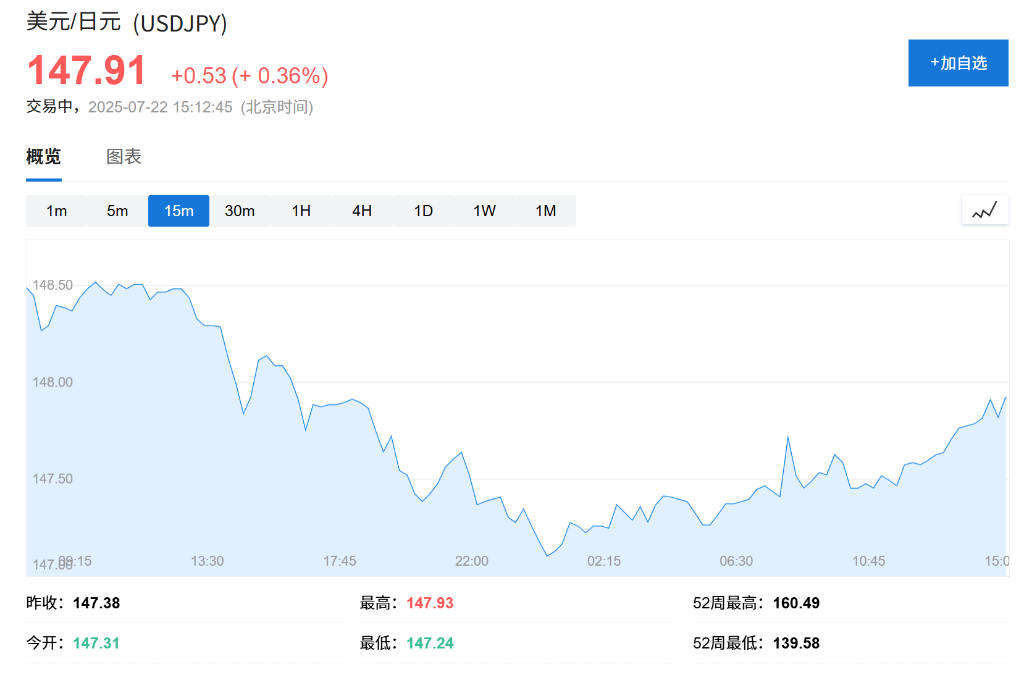
市场消息:据悉日本央行下周可能维持基准利率不变;日本央行认为选举对利率立场影响不大。
news flash· 2025-07-22 06:50
Core Viewpoint - The Bank of Japan is likely to maintain its benchmark interest rate unchanged next week, indicating that the upcoming elections will have little impact on its monetary policy stance [1] Group 1 - The Bank of Japan's decision to keep the interest rate steady reflects its assessment of the current economic conditions [1] - The central bank believes that the elections will not significantly influence its interest rate policy [1]
报道:日本央行下周可能维持基准利率不变
news flash· 2025-07-22 06:48
Core Viewpoint - The Bank of Japan is expected to maintain its benchmark interest rate next week, indicating that the upcoming elections will have little impact on its monetary policy stance [1] Group 1 - The Bank of Japan plans to observe the effects of trade negotiations before making any decisions on interest rate hikes [1] - There is a concern that significant fiscal easing could lead to upward risks in prices [1]
国债ETF5至10年(511020)多空胶着,机构:长久期利率债的性价比已有所修复
Sou Hu Cai Jing· 2025-07-21 02:04
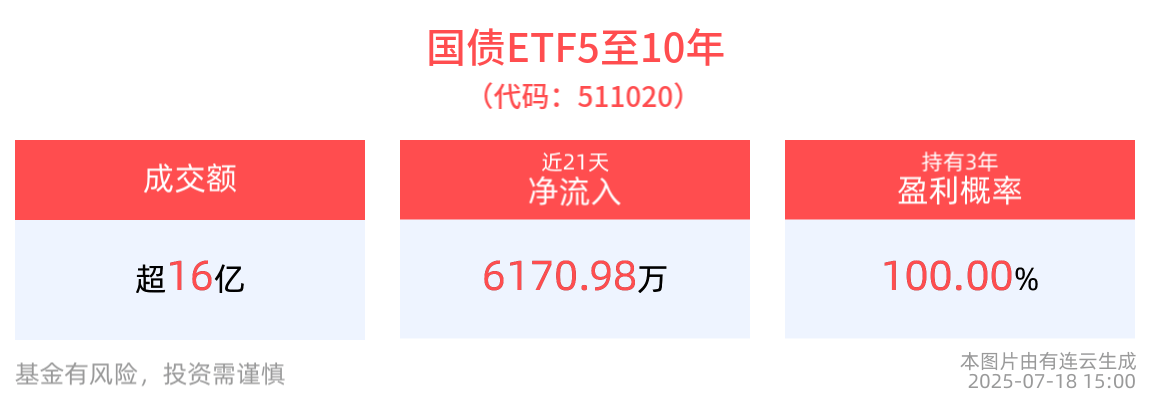
Group 1 - The recent rise in equity market sentiment has led to a narrow fluctuation in the bond market, with 10-year and 30-year government bonds struggling to break previous lows, while credit bonds and local government bonds are performing relatively strongly, indicating that compressing yield spreads is becoming a less obstructive direction in an unclear benchmark interest rate environment [1] - As of July 18, 2025, the active bond index for 5-10 year government bonds has decreased by 0.02%, while the government bond ETF for the same duration has seen a recent price of 117.55 yuan, with a nearly 1-year cumulative increase of 5.06% [3] - The government bond ETF for 5-10 years has a recent trading volume of 16.18 billion yuan, with an active market turnover rate of 108.29%, and an average daily trading volume of 7.40 billion yuan over the past month [3] Group 2 - The government bond ETF for 5-10 years has a recent scale of 1.494 billion yuan, with net inflows and outflows remaining balanced, accumulating a total of 61.71 million yuan in inflows over the past 21 trading days [3] - The government bond ETF for 5-10 years has achieved a net value increase of 21.14% over the past 5 years, with a maximum monthly return of 2.58% and a historical profitability rate of 100% over 3 years [3] - The Sharpe ratio for the government bond ETF for 5-10 years over the past 2 years is 1.26, with a maximum drawdown of 2.15% this year, and a management fee rate of 0.15% and a custody fee rate of 0.05% [4]
7月18日电,安哥拉央行维持基准利率于19.5%不变。
news flash· 2025-07-18 11:26
Core Viewpoint - The Central Bank of Angola has maintained the benchmark interest rate at 19.5% [1] Group 1 - The decision to keep the interest rate unchanged reflects the bank's strategy to manage inflation and stabilize the economy [1]
美联储威廉姆斯:关税对通胀影响将更大 限制性政策“完全恰当”
智通财经网· 2025-07-17 01:14
Group 1 - The Federal Reserve's current tightening policy is deemed "entirely appropriate" by the New York Fed President Williams, who anticipates that tariffs will have a greater impact on inflation in the coming months [1] - Williams expects tariffs to raise inflation rates by approximately one percentage point from the second half of this year until 2026, with a weaker dollar potentially exacerbating inflationary pressures [1] - Recent inflation data indicates that tariffs imposed by Trump on imported goods have started to increase prices for certain items, although overall consumer prices have decreased for five consecutive months due to moderate service cost increases [1] Group 2 - Williams predicts that the economic growth rate will decline to around 1% this year, while the unemployment rate is expected to rise to approximately 4.5% [2] - The importance of an independent central bank for national economic health is emphasized, with Williams stating that it leads to better outcomes in price and economic stability [2] - Despite a more than 8% depreciation of the dollar against a basket of developed market currencies this year, Williams reassures that the dollar's status as a reserve currency remains solid, supported by fundamental factors [2]
7月11日电,秘鲁央行将基准利率维持在4.50%不变。
news flash· 2025-07-10 23:05
Core Viewpoint - The Central Bank of Peru has decided to maintain the benchmark interest rate at 4.50% [1] Group 1 - The decision to keep the interest rate unchanged reflects the bank's assessment of the current economic conditions [1] - The stability of the interest rate is aimed at supporting economic growth while managing inflation [1]