地方债

Search documents
【申万固收|地方债周报】今年新增地方债限额与上年持平——地方债周度跟踪20260306
申万宏源证券上海北京西路营业部· 2026-03-11 02:11
Core Viewpoint - The new local government bond issuance limit for this year remains the same as last year, indicating a stable approach to local debt management [2] Group 1: Local Government Debt - The total new local government bond issuance limit for this year is set at the same level as the previous year, reflecting a cautious stance in fiscal policy [2] - The weekly tracking of local government bonds shows consistent patterns in issuance and management, which may influence market expectations [2] - The stability in the issuance limit suggests that local governments are likely to maintain their current funding strategies without significant changes [2]


地方债余额增至约54.8万亿,风险总体安全可控
Di Yi Cai Jing· 2026-01-31 05:38
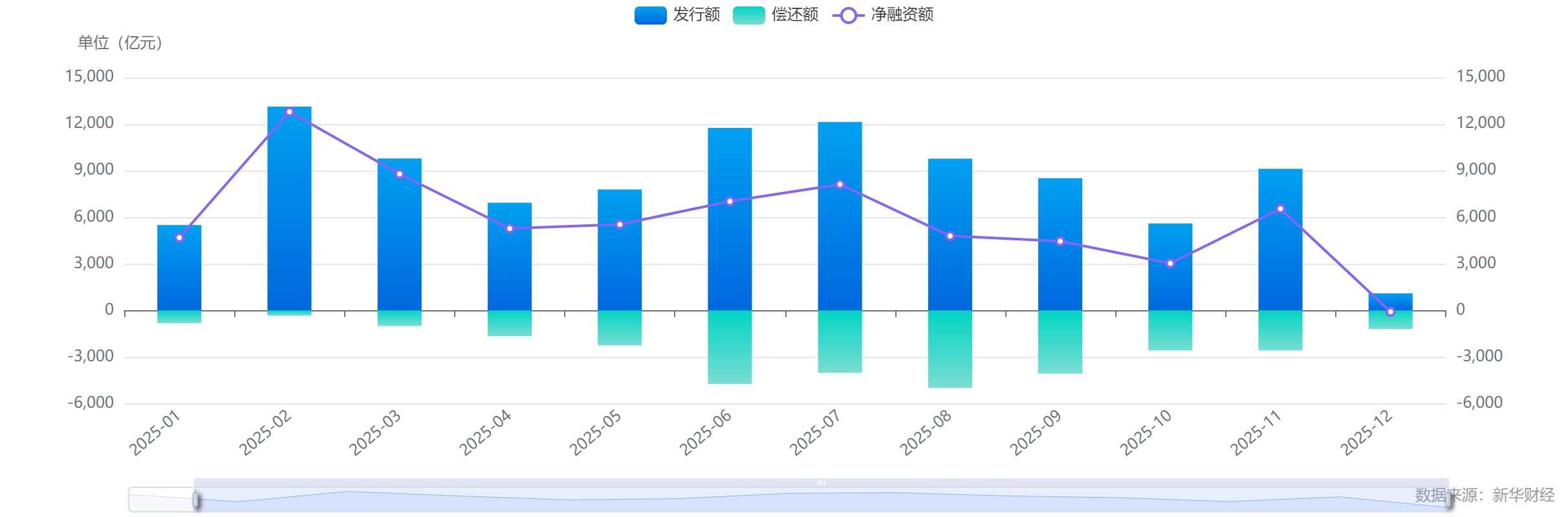
Core Insights - The balance of local government debt has increased by approximately 15%, surpassing both economic growth and local fiscal revenue growth [1][2][3] - The total local government debt balance reached about 54.82 trillion yuan by the end of December 2025, an increase of approximately 7.29 trillion yuan from the end of 2024 [1] - The issuance of local government bonds in 2025 reached a historical high of about 10.31 trillion yuan, with new bond issuance accounting for approximately 5.38 trillion yuan and refinancing bonds for about 4.93 trillion yuan [1][2] Debt Management and Risks - The refinancing bonds, which constitute nearly half of the total issuance, are primarily used to repay maturing principal and replace hidden debts, alleviating repayment pressure on local governments [2] - The average issuance term of local government bonds has extended to 15.4 years, with an average interest rate of 1.97%, which is lower than the previous year's rate of 2.29%, thus reducing financing costs [4] - Local government debt accounted for approximately 39% of the GDP, which is about 140.19 trillion yuan, indicating a potential accumulation of medium to long-term risks [4] Fiscal Performance - The repayment of local government bond principal in 2025 is estimated at about 3.03 trillion yuan, with refinancing bonds covering approximately 2.62 trillion yuan and fiscal funds covering about 0.41 trillion yuan [3] - Interest payments on local government bonds are projected to be around 1.48 trillion yuan, reflecting a year-on-year increase of approximately 9.6% [3] - The overall government debt balance, including both statutory and hidden debts, was 92.6 trillion yuan by the end of 2024, with local government statutory debt at 47.5 trillion yuan and hidden debt at 10.5 trillion yuan [4]
财政能为“开门红”增色几许?【华福宏观·陈兴团队】
陈兴宏观研究· 2026-01-21 14:44
Key Points - The fiscal policy in 2025 remains strong, but the effectiveness of fiscal expansion in driving economic growth has decreased, reflecting a lower "cost-effectiveness" of fiscal measures due to structural transformation, slow spending of special government bonds, and low price levels impacting fiscal efficiency [2][6][13] Group 1: Fiscal Strength and Effectiveness - The fiscal policy maintains a strong expansionary stance, with total fiscal expenditure as a percentage of GDP showing a recovery in 2025 after a decline from Q3 2022 to the end of 2024 [5][6] - The fiscal multiplier effect has weakened, with the fiscal effect coefficient dropping below 1, indicating that fiscal spending is less effective in driving GDP growth compared to 2024 [6][10] - Structural transformation has led to a shift in fiscal spending towards areas with higher capital retention and longer effectiveness cycles, reducing the expected impact on traditional infrastructure [7][10] Group 2: Changes in Policy Focus - The 2026 fiscal policy aims to maintain a stable budget deficit rate while expanding fiscal spending, with a focus on domestic demand, technological innovation, and strengthening social welfare [15][18] - The emphasis on domestic demand has shifted to a strategic priority of "domestic demand-led" growth, highlighting the importance of increasing residents' income [18][20] - The standardization of tools and policies is aimed at enhancing efficiency, with a focus on preventing local subsidy competition and creating a unified national market [20][21] Group 3: Government Debt and Financing - The issuance of government bonds in Q1 2026 is expected to remain stable compared to the previous year, with a slight increase in net financing scale [24][26] - Local government debt issuance is primarily focused on special refinancing bonds, with a more uniform pace of debt issuance anticipated in 2026 compared to 2025 [26] - The overall growth rate of government debt in Q1 2026 is expected to be lower than in the same period in 2025, indicating a more moderate approach to fiscal expansion [26]

助力经济平稳开局,地方债“早发早用早见效”
Sou Hu Cai Jing· 2026-01-08 23:35
Core Viewpoint - The issuance of local bonds by Ningbo and Shandong is aimed at boosting effective investment and stimulating domestic demand, contributing to a stable economic start in the first quarter of the year [1] Group 1: Local Bond Issuance - Ningbo issued 25.372 billion yuan in local bonds on January 8 [1] - Shandong became the first province to issue local bonds this year, with an issuance of 72.381 billion yuan on January 5 [1] Group 2: Economic Impact - The early issuance of local bonds is expected to facilitate early fund utilization and visible results [1] - The newly disclosed special bonds are primarily directed towards new infrastructure and urban renewal projects, which are beneficial for expanding effective investment [1] - Government investment is anticipated to leverage private investment, reinforcing the positive trend of economic recovery [1]
助力经济平稳开局 地方债“早发早用早见效”
Zhong Guo Zheng Quan Bao· 2026-01-08 22:12
Core Viewpoint - The issuance of local government bonds is expected to accelerate in 2026, with a focus on effective investment and economic stabilization, particularly in new infrastructure and urban renewal projects [1][3][4]. Group 1: Local Government Bond Issuance - Ningbo issued 25.372 billion yuan in local bonds on January 8, while Shandong was the first province to issue bonds this year with 72.381 billion yuan on January 5 [1]. - The Ministry of Finance plans to expedite the allocation of the 2026 local government debt limit, facilitating early issuance and usage of bonds to support key projects [2]. - As of January 8, 27 regions, including Beijing and Hebei, have disclosed bond issuance plans for the first quarter, totaling approximately 2 trillion yuan [2]. Group 2: Investment Focus and Economic Impact - The newly disclosed special bonds are primarily directed towards new infrastructure and urban renewal, which are expected to enhance effective investment and stimulate domestic demand [1][3]. - The first quarter of 2026 is projected to see a significant issuance of special bonds, with an estimated scale of around 670 billion yuan [3]. - The focus on major projects in transportation, energy, and urban renewal is seen as essential for both expanding domestic demand and ensuring high-quality development during the 14th Five-Year Plan period [3][4]. Group 3: Trends in Special Bond Issuance - The issuance and utilization of special bonds in 2026 are anticipated to follow three main trends: steady expansion of issuance scale, continued front-loading of issuance rhythm, and an expanded range of funding applications [4]. - The expansion of the funding scope for special bonds will include quasi-public sectors such as the acquisition of existing residential properties [4]. - There is a need for enhanced evaluation mechanisms for special bond projects to ensure quality and prevent misuse of funds [5].
助力经济平稳开局地方债“早发早用早见效”
Zhong Guo Zheng Quan Bao· 2026-01-08 20:50
Core Viewpoint - The issuance of local government bonds is expected to accelerate in 2026, with a focus on effective investment and stimulating domestic demand, which will support a stable economic start in the first quarter of 2026 [1][2][3] Group 1: Local Government Bond Issuance - Ningbo issued 25.372 billion yuan in local bonds on January 8, while Shandong was the first province to issue local bonds in 2026, totaling 72.381 billion yuan on January 5 [1] - As of January 8, 27 regions, including Beijing, Hebei, and Shanxi, have disclosed bond issuance plans for the first quarter, with a total scale of approximately 2 trillion yuan [1] Group 2: Investment Focus and Economic Impact - The newly disclosed special bonds are primarily directed towards new infrastructure and urban renewal, which are expected to enhance effective investment and boost domestic demand [1][2] - The first quarter of 2026 is anticipated to see a concentrated issuance of special bonds, with an estimated issuance scale of around 670 billion yuan [2] Group 3: Policy and Management Trends - The Ministry of Finance plans to advance the issuance of local government bonds and has indicated that the new debt limit for 2026 will be announced early to facilitate project funding [1][3] - There is a growing need for local governments to increase investment in major projects in transportation, energy, and urban renewal to meet the demands of domestic consumption and economic growth [3][4] Group 4: Evaluation and Oversight - The expansion of the scope of special bonds will increase the complexity of evaluating project profitability, necessitating more specialized personnel for oversight [4] - A more scientific performance evaluation system for special bond projects is recommended, including mechanisms for pre-, mid-, and post-evaluation [4]
平安证券:26年1月利率债月报:再通胀对债市的影响路径-20260104
Ping An Securities· 2026-01-04 13:05
Report Industry Investment Rating - The report does not mention the industry investment rating. Core Viewpoints of the Report - In December 2025, the weakening of the US dollar and the improvement of risk appetite led to a steeper curve overseas, while in China, loose funds drove the yield curve to steepen. The bond market remained volatile due to the supply - demand contradiction at the long end [2]. - In 2026, the PPI is facing three positive factors: the tail - lifting factor, imported inflation, and the continued effectiveness of the "anti - involution" policy. Under the neutral scenario, the PPI is expected to turn positive in the second quarter of 2026 and reach around 1.2% by the end of the year. The mild re - inflation needs to resonate with other factors to significantly affect the bond market [3][55]. - Currently, the bond market is in a wait - and - see state. It is expected to remain volatile in the short term, lacking the motivation and space for trend trading. There are some structural opportunities, such as the follow - up rise opportunity of 5 - 7Y China Development Bank bonds and the compression opportunity of credit spreads [4]. Summary by Directory PART1: December 2025 - Curve Steepening Driven by Overseas and Domestic Factors Overseas - In December 2025, the Fed announced reserve management - style purchases (RMP) and continued to cut interest rates. The US dollar index weakened, liquidity improved, the US stock market rose, and risk appetite recovered. The US bond yield curve steepened due to factors like Fed's short - term bond purchase, market concerns about Fed independence, and rising commodity prices. Precious and industrial metals performed well, with copper benefiting from AI demand and gold and silver supported by geopolitical events [10][16]. Domestic - In November 2025, the domestic economic fundamentals showed a divergence between quantity and price, and in December, both supply and demand declined. The capital market was generally loose, and the overnight interest rate hit a new low for the year. The bond market remained volatile due to the long - end supply - demand contradiction, and the yield curve steepened [17][23]. - In terms of institutional behavior, large banks and insurance companies, as allocation players, increased their bond - buying in the secondary market in December. Large banks added some policy - related financial bonds and focused on 5 - 7 - year varieties. Insurance companies mainly added long - term treasury bonds. Trading players became conservative. Rural commercial banks mainly invested in certificates of deposit, funds reduced duration and mainly sold long - term treasury bonds, and wealth management products seasonally reduced bond allocation and slightly increased credit bond allocation [26][35][47]. PART2: How the 2026 Re - inflation Narrative May Affect the Bond Market 2026 PPI's Three Positive Factors - The tail - lifting factor can support the PPI to turn positive in the second half of 2026 even without new price - increasing factors [55]. - Imported inflation may occur as overseas capital expenditure and manufacturing investment are likely to rise in 2026. The US deficit rate may expand, and the Fed's new round of easing may release emerging market countries' capital expenditure demand [57]. - The "anti - involution" policy has shown a supporting effect on the PPI. Since August 2025, the month - on - month PPI of the mining industry has turned positive, driving the overall PPI to turn positive since October [60]. PPI Forecast under Different Scenarios - Under the pessimistic scenario, the PPI is expected to turn positive in the second half of 2026 with an average monthly PPI growth rate of 0%. Under the neutral scenario, with a monthly average PPI growth rate of 0.1%, the PPI is expected to turn positive in the second quarter of 2026 and reach around 1.2% by the end of the year. Under the optimistic scenario, with a monthly average PPI growth rate of 0.2%, the PPI is expected to turn positive in April 2026 and exceed 2% in the second half of the year [67]. PPI's Impact on the Bond Market - Historically, during the four PPI upward cycles since 2009, three typical upward periods were driven by the resonance of domestic and overseas demand or supply - demand. The PPI and the bond market generally move in the same direction, but there were several periods of divergence, mainly due to strong economic recovery expectations or PPI being mainly affected by the supply side while the domestic demand did not improve significantly and the monetary policy remained loose [69][71]. - In 2026, the mild re - inflation needs to resonate with other factors such as total demand, central bank's capital management, financial institutions' liability - side stability, and the flow of activated household deposits to significantly affect the bond market. The trading of typical total assets based on re - inflation may have limited odds [78]. PART3: Bond Market Strategy for January 2026 - In January 2026, the bond market may still be in a wait - and - see period. Potential risks include government bond supply pressure, the spring rally in the equity market, and the first - quarter credit boom. Potential positive factors include the possible relaxation of large banks' bond - allocation pressure and the relatively loose capital market, with a higher probability of a reserve - requirement ratio cut than an interest - rate cut in January [81]. - The bond market is expected to remain volatile in the short term, lacking the motivation and space for trend trading. Structurally, there are opportunities such as the follow - up rise of 5 - 7Y China Development Bank bonds and the compression of credit spreads in credit bonds [4][83].
全国负债高达两百万亿,现在“人均”已达到14万?我们的钱被花到哪去了?
Sou Hu Cai Jing· 2026-01-02 05:33
Core Viewpoint - The article discusses the complexity behind the national debt of 200 trillion, emphasizing that understanding the sources, uses, and benefits of this debt is crucial rather than merely reacting to the large number [1][12]. Group 1: National Debt Understanding - National debt is essentially money borrowed by the government from various institutions and individuals through the issuance of bonds, which investors purchase for interest payments [1][3]. - The government borrows money to fund investments and infrastructure projects, such as railways, highways, hospitals, and schools, which are essential for development [3][4]. - The significant national debt should not be viewed solely as a negative; if the borrowed funds are used effectively, they can be seen as investments rather than liabilities [4][12]. Group 2: Investment Areas - A major portion of the national debt has been allocated to infrastructure projects, which, despite high initial costs, create substantial long-term value and improve efficiency [4][5]. - Investments in education have been significant, with funds directed towards building schools and improving conditions, which ultimately yield high returns through the development of skilled talent [5][7]. - Healthcare and social security have also seen increased funding, leading to improved access and quality of services, particularly in rural areas [7][12]. Group 3: Debt Implications - The average debt per person, while alarming at 140,000, does not imply that each individual is responsible for this amount; rather, it reflects a complex system of government financing through taxes and long-term repayment plans [8][12]. - Government debt often corresponds with valuable assets created through investments, such as highways that generate toll revenue and stimulate regional development [8][9]. - The rationale for borrowing rather than relying solely on tax revenue is to enable faster development and investment in infrastructure, which can lead to greater future income [9][11]. Group 4: Debt Management - The government is aware of the risks associated with high debt levels and manages borrowing based on economic growth and repayment capacity [11][12]. - Local government debt also contributes to the national debt, as regional authorities borrow to fund local development projects, which can lead to economic growth [11][12]. - A balanced view of national debt should consider its structure, purpose, and the economic context, rather than focusing solely on the total amount [12][14].
中国财政政策展望:如何理解适度扩张
Zhong Xin Qi Huo· 2025-12-18 11:59
1. Report Industry Investment Rating No information provided in the content. 2. Core Viewpoints of the Report - Fiscal policy is expected to remain proactive next year, with a moderately increased intensity. The deficit-to-GDP ratio is expected to be 4% in 2026, and the net supply of government bonds is projected to reach 15.2 trillion yuan, an increase of about 820 billion yuan compared to 2025. The front-loading degree of fiscal policy implementation may moderate compared to this year [2][11][42]. - For the bond market, the fiscal policy is likely to provide a measured boost rather than strong stimulus, so a significant market adjustment driven by fiscal expansion is unlikely. However, attention should be paid to potential volatility caused by market speculation about further policy escalation. The pressure from government bond supply is likely to be manageable, and the impact may mainly manifest in the term structure, maintaining a steepening yield curve [3][4]. 3. Summary According to the Table of Contents Proactive Fiscal Policy Stone - The central government's stance on macro policy is relatively proactive. The "Recommendations for the 15th Five - Year Plan" emphasizes strengthening counter - and cross - cyclical adjustments and implementing more proactive macro policies, as well as leveraging the role of proactive fiscal policy to improve fiscal sustainability [12][43]. Moderate Expansion of Fiscal Policy 2.1 The Economy is generally better than the same period last year - Domestic demand continues its moderate recovery. The GDP growth rate for the first three quarters of this year was better than the same period last year (5.2% vs. 4.8%), and the inflation readings are overall better than last year. Consumer confidence has been warming up from low levels. The necessity for a significant marginal increase in fiscal policy intensity in 2026 is likely not high [13][43]. - Tariff risks have marginally diminished. The US side will cancel the 10 - percent "fentanyl tariffs" and suspend the 24 - percent reciprocal tariffs on Chinese goods for an additional year. The trade situation may have eased compared to the same period last year [14][44]. 2.2 Estimated Treasury Bond Net Financing: 7.08 tn Yuan, + 420 bn Yuan - The targeted deficit - to - GDP ratio is expected to be 4%, corresponding to a deficit scale of approximately 5.88 trillion yuan. The main entity for increasing leverage is likely to be the central government, with a targeted deficit of 5.08 trillion yuan, while local governments' target deficit is expected to remain flat at 80 billion yuan [14][47]. - The issuance of ultra - long - term special treasury bonds is expected to total 1.6 trillion yuan, and the scale of special treasury bonds for capital injection into central financial institutions is projected to be 40 billion yuan. The total issuance scale of special treasury bonds in 2026 is estimated to reach 2 trillion yuan. The net financing of treasury bonds in 2026 is projected to be 7.08 trillion yuan, an increase of 42 billion yuan YoY [15][47][48]. 2.3 Estimated Local Government Bond Net Financing: at 8.1 tn Yuan, + 400 bn Yuan - The scale of local government bonds is projected to reach 5.6 trillion yuan in 2026. The targeted local government deficit is expected to remain unchanged at 80 billion yuan, and the scale of special - purpose bonds is anticipated to increase to 4.8 trillion yuan. An additional 50 billion yuan from the unused bond quota may be allocated next year. The net financing of local government bonds is projected to reach approximately 8.1 trillion yuan, an increase of 40 billion yuan compared to the current year [29][64]. - Overall, the net financing scale of government bonds is projected to reach 15.2 trillion yuan in 2026, an increase of approximately 82 billion yuan compared to the current year [30][64]. Optimized Expenditure Structure: Investing in People - During the "15th Five - Year Plan" period, fiscal policy will continue to focus on people's livelihood, optimizing the expenditure structure and increasing the proportion of spending on livelihood - related projects [38][71]. Less Front - loaded Implementation of Fiscal Policy - Fiscal policy support in 2026 is expected to remain front - loaded, but the degree of front - loading may be reduced. The utilization of 50 billion yuan in new policy - oriented financial tools and idle fiscal deposits may bolster the economic fundamentals at the end of this year and early next year. The U.S. mid - term elections in the second half of 2026 could reignite tariff risks, necessitating reserved policy space for response measures [39][72].
地方债年度发行规模首次突破10万亿元
Xin Hua Cai Jing· 2025-12-02 12:19
Core Insights - The total issuance of local government bonds in China for 2025 has surpassed 10 trillion yuan, marking the first time this annual scale has crossed the 10 trillion yuan threshold [1][3] - The increase in local bond issuance is seen as a necessary measure for stabilizing growth and managing long-term debt risks, emphasizing the need to balance growth and risk prevention [1][3] Group 1: Local Government Bond Issuance - As of December 2, 2025, the net financing amount of local government bonds is approximately 7.1 trillion yuan, with total issuance around 10.1 trillion yuan, including 2.55 trillion yuan in general bonds and 7.56 trillion yuan in special bonds [1] - The issuance scale for local government bonds has been notably high in 2025, with approximately 2.8 trillion yuan, 2.6 trillion yuan, and 3 trillion yuan issued in the first three quarters respectively [1] Group 2: Special Bonds and Project Financing - The issuance of new special bonds is accelerating, which is expected to facilitate the advancement of major local projects and increase tangible work output [3] - The planned issuance of local government bonds for December 2025 totals 1.05 billion yuan, with 213 million yuan allocated for new special bonds, a significant decrease compared to the previous year [3] - The new special bond issuance is expected to reach a record high, taking into account the "negative list" management of fund allocation and the saturation of traditional infrastructure projects [3] Group 3: Future Projections - For 2026, the limit for new local government special bonds is anticipated to reach 5 trillion yuan, with specific allocations for debt repayment, land acquisition, and project construction [4] - The special bond quota for debt repayment is projected at 1.6 trillion yuan, while the quota for project construction is expected to increase by 1 trillion yuan compared to 2025 [4]