数字孪生技术

Search documents
2025 俄罗斯钢铁冶金展邀您共赴
Sou Hu Cai Jing· 2025-09-03 10:19
Group 1 - The exhibition will take place from November 11 to 14, 2025, at the CEC Expoforum in Saint Petersburg, organized by the Russian Metal Exhibition Company [1] - The exhibition is significant for the global steel and metallurgy industry, providing a platform for companies, experts, and scholars to exchange advanced technologies and innovative ideas [4] - The Russian metallurgy industry is actively promoting large-scale projects, with an industry growth rate exceeding 3% last year, supported by the national strategy for metallurgy development by 2030 [4] Group 2 - The exhibition will showcase a wide range of products across the entire industry chain, including rebar, wire rod, plates, pipes, and special steels, highlighting innovations in high-strength and corrosion-resistant construction steels [5] - The metallurgy equipment and technology section will feature advanced global equipment and cutting-edge technologies, including intelligent smelting equipment and energy-saving green metallurgy technologies [5] - The raw materials and auxiliary materials section will present high-quality iron ore, low-sulfur coke, and various metallurgical additives that improve steel performance and reduce production costs [5] Group 3 - The innovation achievements section will allow companies to showcase new material research results, intelligent production solutions, and the application of digital twin technology in steel production [6]

关税战下突围:中国风电叶片单批出口4600万,东南亚成新战场
Sou Hu Cai Jing· 2025-08-30 04:06
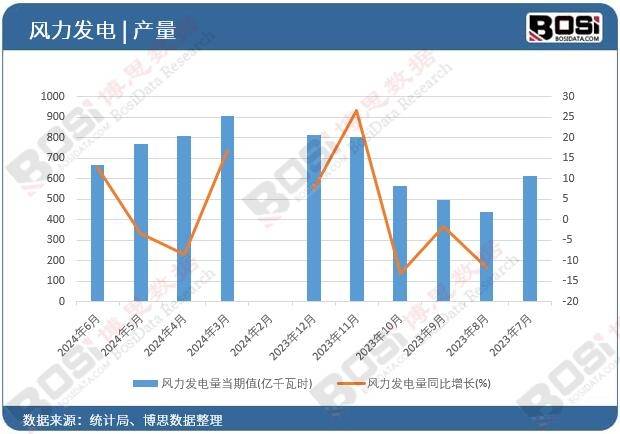
Industry Overview - Large wind turbine blades are core components of wind power units, typically exceeding 40 meters in length, responsible for capturing wind energy and converting it into mechanical energy. The primary materials used are glass fiber reinforced plastics (GFRP), accounting for over 70%, while carbon fiber reinforced plastics (CFRP) are gradually penetrating the market due to their lightweight advantages. The industry chain includes raw material supply, design and manufacturing, testing and certification, and operation and maintenance services, with high technical barriers [1]. Market Characteristics - The design of blades is becoming larger (with lengths expected to reach 153 meters by 2025) and smarter to enhance power generation efficiency in low wind speed environments [4]. - The industry is heavily reliant on policies, directly influenced by "dual carbon" goals and wind power subsidy policies, making demand closely tied to policy cycles [4]. - Production capacity is concentrated in coastal provinces such as Jiangsu and Shandong, leveraging port advantages to boost exports (with Jiangsu's single batch export value expected to reach 46 million yuan by 2025) [4]. Current Status (2015-2025) - The market size for blades is approximately 44.2 billion yuan in 2023, projected to increase to 49.1 billion yuan in 2024 (a year-on-year increase of 11.09%), and expected to surpass 50 billion yuan by 2025 [5]. - Blade length has increased from an average of 38 meters in 2010 to 153 meters by 2025, with low wind speed start-up technology significantly enhancing power generation efficiency [5]. - The market concentration is relatively low, with the top five companies (CR5) accounting for less than 40%, while leading companies like Times New Material are solidifying their positions through technological upgrades (e.g., TMT126BA floating blades) [5]. Future Trends (2025-2030) - The demand for offshore wind power will drive the penetration rate of carbon fiber blades, with 20MW floating units (paired with 126-meter blades) entering the testing phase [8]. - Smart upgrades utilizing AI design and digital twin technology will optimize blade aerodynamic performance, potentially increasing annual power generation by 600,000 kilowatt-hours per unit [8]. - Export expansion is being driven by tariff policies that compel supply chain optimization, with Southeast Asia and Europe identified as key export markets [8]. Challenges and Opportunities - The U.S. tariff policy is raising carbon fiber costs, while global wind power installations are expected to exceed 2,000 GW by 2030 [7]. - Extreme weather conditions are impacting blade durability, but low wind speed technology is broadening the inland market [7]. - Cost reduction pressures (with GFRP accounting for over 60% of costs) and breakthroughs in recycling technology are fostering a circular economy [7].
德林海:中报大幅亏损 因23年未单独评估信用风险财务总监季乐华被警示
2 1 Shi Ji Jing Ji Bao Dao· 2025-08-29 04:09
Group 1 - The company's revenue significantly declined to 108 million yuan, a year-on-year decrease of 47.35%, and it reported a net loss of 3.09 million yuan, a year-on-year decline of 112.49% [1] - The decline in performance is primarily due to the delay in revenue recognition from large orders that have not yet been accepted, including projects with pending acceptance amounts of 70.8252 million yuan and 42.5003 million yuan [1] - Despite new orders totaling 402 million yuan and a cumulative backlog of approximately 527 million yuan, the low project conversion rate has negatively impacted short-term performance [1] Group 2 - The company's inventory surged to 77.19 million yuan, a year-on-year increase of 368.98%, with 97.6% of the cost related to contract performance, mainly due to increased upfront investments in ongoing projects [1] - High accounts receivable risk is evident, with 738 million yuan in accounts receivable, of which 46.1% are over three years old, including 199 million yuan aged four to five years, leading to increased collection pressure [1] - The company received a warning from the Jiangsu Securities Regulatory Bureau for failing to accurately assess bad debts for clients with significant credit risk changes in its 2023 annual report, resulting in accountability for the former financial officer [1] Group 3 - The company has changed its fundraising project from the original plans for "Lake Eutrophication Monitoring and Early Warning Construction" and "Blue Algae Disposal R&D Center" to the "Lake Ecological Hospital Project," involving 327 million yuan [2] - The reason for the change is attributed to market environment shifts and the company's strategic transition towards an overall lake governance model, focusing on digital twin technology and ecological restoration [2]

瑞纳智能2025年中报简析:营收上升亏损收窄,盈利能力上升
Zheng Quan Zhi Xing· 2025-08-28 22:59
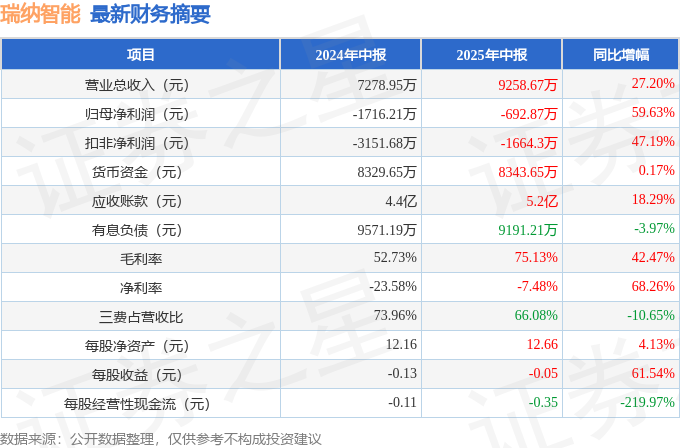
Core Viewpoint - The recent financial report of Ruina Intelligent (301129) shows significant growth in revenue and improvement in profitability metrics, indicating a positive trend in the company's financial health and operational efficiency [1][3]. Financial Performance - As of the latest report, the company's total revenue reached 92.5867 million yuan, a year-on-year increase of 27.2% [1]. - The net profit attributable to shareholders was -6.9287 million yuan, showing a year-on-year improvement of 59.63% [1]. - In Q2 alone, total revenue was 80.5169 million yuan, up 83.71% year-on-year, with a net profit of 14.5235 million yuan, reflecting a 278.43% increase [1]. - The gross margin improved to 75.13%, a year-on-year increase of 42.47%, while the net margin was -7.48%, up 68.26% year-on-year [1]. - Total expenses (selling, administrative, and financial) amounted to 61.1831 million yuan, accounting for 66.08% of revenue, a decrease of 10.65% year-on-year [1]. Key Financial Ratios - The company's return on invested capital (ROIC) was 4.44%, indicating a relatively weak capital return, while the historical median ROIC since listing is 20.93% [3]. - The net profit margin for the previous year was 17.93%, suggesting high added value in products or services [3]. - The average operating cash flow over the past three years was negative, raising concerns about cash flow management [3]. Technological Advancements - The company has made significant advancements in technology, including the RUN-STORM I smart heating system, which integrates big data, cloud computing, and digital twin technology to enhance energy efficiency and reduce carbon emissions by 10%-30% [4]. - The development of a 100kW magnetic levitation centrifugal compressor fills a gap in waste heat recovery and heating, characterized by low vibration, low noise, and high efficiency [5]. - The integration of the RUN I intelligent system with DeepSeek's large model aims to transform the industry from experience-driven to data-driven decision-making [5].
30秒看工程攻坚瞬间|沪渝蓉铁路沪宁段宝慧制梁场箱梁制造突破400榀
Xin Hua Wang· 2025-08-28 06:43
Core Viewpoint - The Shanghai-Chongqing-Rong Railway's Shanghai-Nanjing section is a significant project under China's "14th Five-Year Plan," with a breakthrough in box girder manufacturing, achieving over 400 units produced [1] Group 1: Project Overview - The box girder construction in this high-speed rail project has achieved a technological breakthrough, moving away from traditional manual assembly methods [1] - A research team was established by China Railway Fourth Engineering Group to manage the box girder manufacturing process using a railway engineering management platform [1] Group 2: Technological Advancements - The implementation of "digital twin technology + BIM (Building Information Modeling)" allows for real-time management of the entire girder manufacturing process [1] - The introduction of a super-large automatic welding mesh machine has led to 70% of the processes being automated, requiring only 2 operators, resulting in over 30% savings in labor [1]
数智化浪潮下的汽车产业变革 还需突破“三座大山”
Zhong Guo Chan Ye Jing Ji Xin Xi Wang· 2025-08-26 03:23
Core Insights - The automotive industry is undergoing a significant transformation driven by digital technologies and artificial intelligence, focusing on electrification, intelligence, connectivity, and sharing [1][2] - A recent forum highlighted the consensus among industry leaders on the need for collaboration to elevate China's automotive industry within the global value chain [2] Group 1: AI and Digital Transformation - AI is reshaping production relationships and lifestyles across various industries, with an estimated economic impact of $22.3 trillion by 2030, accounting for 3.7% of global GDP [3] - Huawei aims to enhance service capabilities through "AI for Service" and create conditions for agile innovation in new business applications [3][4] - The automotive sector is transitioning from "mobile machinery" to "mobile computing centers," necessitating a complete reconstruction of production relationships and business models [4] Group 2: Challenges in Digital Transformation - The automotive industry faces three major challenges: restructuring ICT technology architecture, transforming ICT operation systems, and upgrading ICT personnel skills [5][6] - The demand for computing power is growing exponentially due to the need for processing large amounts of data in intelligent driving [6] - Data security and ethical standards are critical challenges, with the automotive sector generating terabytes of user behavior and vehicle condition data daily [7] - There is a significant talent gap in the industry, requiring professionals who understand both automotive engineering and AI algorithms [8] Group 3: Collaborative Solutions - The forum reached a consensus on the need for practical collaboration to establish data circulation rules and build shared platforms for data flow [8] - Huawei has already provided services to over 8,000 manufacturing enterprises in China, helping automotive companies achieve their goals through comprehensive solutions [9] - The transition to digitalization is essential for survival, driving the shift from linear supply chains to networked ecosystems, with new business models emerging rapidly [9]
达索系统为上海再投“信任票” 中国首个开放创新实验室启用 还成立创业孵化器企业引入全球专家资源
Jie Fang Ri Bao· 2025-08-23 02:28
Core Viewpoint - Dassault Systèmes has launched its first 3DEXPERIENCE Lab in China, located in Shanghai, aiming to foster innovation and collaboration in advanced manufacturing, new materials, green infrastructure, and life sciences [1][2]. Group 1: Establishment of the 3DEXPERIENCE Lab - The 3DEXPERIENCE Lab in Shanghai is the fifth globally and focuses on creating a collaborative innovation ecosystem by leveraging global expert resources [1]. - The lab aims to incubate up to 1,000 startups in its first year, with potential growth to over 10,000, comparable to the scale of labs in the United States [3]. Group 2: Support for Startups - The lab will provide guidance to startups in using 3D modeling software and digital twin technology for material design and validation [2]. - Over 2,000 entrepreneurial mentors from Dassault Systèmes' global labs will interact with startups, offering cross-disciplinary and international experience [2]. Group 3: Commitment to the Chinese Market - Dassault Systèmes has seen a 22-fold growth in its Chinese market over 20 years, with over 60,000 customers, making it the largest market globally for the company [4]. - The company has moved its Asia-Pacific headquarters to Shanghai, reflecting the strategic importance of the Chinese market [4]. Group 4: Future Plans - The company plans to establish a venture capital fund in Shanghai to support local innovation enterprises [5]. - The lab's establishment received support from the Shanghai government, highlighting the city's commitment to fostering innovation [5].

大湾区工程清花高速北江特大桥主梁施工过半
Zhong Guo Xin Wen Wang· 2025-08-22 12:42
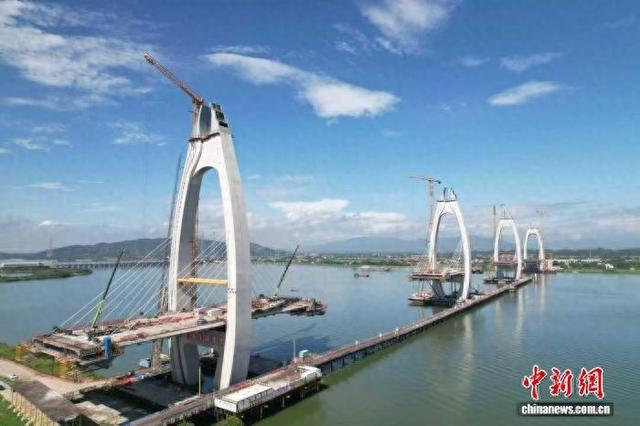
Core Viewpoint - The Qinghua Expressway's Beijiang Grand Bridge has entered a critical construction phase, with significant progress made and innovative technologies applied to enhance construction quality and efficiency [1][3][4]. Group 1: Project Overview - The Qinghua Expressway spans 54 kilometers, connecting Qingyuan City and Guangzhou, and includes the Beijiang Grand Bridge, which is set to become a landmark in Qingyuan [1][3]. - The main bridge measures 1,440 meters in total length, featuring a main span of 360 meters and a unique design with four towers [3]. - The bridge is currently the largest four-tower, double-cable-stayed concrete bridge in mainland China, with a construction complexity that has posed several technical challenges [3]. Group 2: Construction Progress - Over 50% of the main beam construction has been completed, with 102 segments finished, and the project is on track to achieve completion by the first half of 2026 [3][4]. - The overall construction of the Qinghua Expressway has surpassed 90% completion for the foundation and bridge structures, with all projects progressing according to the established timeline [3][4]. Group 3: Technological Innovations - The project has implemented advanced technologies such as BIM models, AI, and digital twin technology to create a smart management center for efficient construction processes [4]. - Innovations like adjustable end molds and combination bottom molds have expanded the applicability of smart beam yards, enhancing production efficiency [6]. - The production capacity of a single production line can reach 1.5 beams per day, with a total production task of 16,242 beams, of which 15,587 have been completed [6].
修筑数字堤坝 守护城市安澜——“防汛哨兵”金樊的9年风雨逆行
Hang Zhou Ri Bao· 2025-08-22 03:18
Core Insights - The article highlights the critical role of water reservoir management in urban flood prevention, emphasizing the importance of real-time data analysis and decision-making during extreme weather events [2][3][4] Group 1: Role of Water Reservoirs - The Qing Shan Reservoir is identified as a key flood control project in the Dongtiao Creek basin, serving a densely populated upstream area and a significant innovation district downstream [3][4] - The Xianlin Reservoir acts as an emergency water source and a hub for water supply projects, underscoring its importance in urban water management [4] Group 2: Flood Prevention Efforts - The article details the extensive experience of engineers like Jin Fan, who have successfully managed over ten significant flood events in the past nine years, utilizing their expertise to protect urban areas [2][5] - Jin Fan's proactive measures during extreme weather, such as providing accurate flood forecasts with a margin of error of just 1 cm, demonstrate the effectiveness of timely and precise flood management [5][6] Group 3: Digital Transformation in Water Management - The article discusses the ongoing digital transformation in Hangzhou's water management, including the integration of advanced technologies like digital twin systems and AI applications to enhance operational efficiency [6][7] - The establishment of a modernized reservoir management matrix aims to improve risk identification and emergency response capabilities, showcasing Hangzhou's leadership in digital water management [6][7] Group 4: Community Engagement and Education - Jin Fan's involvement in community outreach and education initiatives reflects the importance of public engagement in water conservation and management efforts [8] - The formation of various alliances and partnerships aims to enhance the overall effectiveness of water management practices in Hangzhou, fostering a collaborative approach to environmental stewardship [8]
“大国重器”突围之后,中国企业还差什么?
Ke Ji Ri Bao· 2025-08-20 12:43
Core Viewpoint - The "Patigalang" shield machine, developed by China Railway Engineering Equipment Group, represents China's entry into the global customized shield machine market, marking a significant milestone in the country's engineering capabilities [2][4]. Group 1: Development and Achievements - The "Patigalang" shield machine has a diameter of 15.7 meters, making it the largest shield machine exported by China [4]. - In the early 2000s, the Chinese shield machine market was dominated by international giants like Herrenknecht and Kawasaki, with imported machines costing up to 150 million yuan [4]. - A collaborative effort began in 2002 involving over 20 research institutions, leading to the development of more than 30 core technologies, including composite cutter head design and domestic production of main bearings [4][6]. - The first domestic composite shield machine, "China Railway No. 1," was launched in April 2008, marking the end of reliance on foreign technology [6]. Group 2: Current Challenges - Despite significant advancements, the Chinese shield machine industry faces new challenges, particularly in the Southeast Asian market, where a lack of digital twin technology has hindered competitiveness [6]. - Japanese companies, such as Mitsubishi Heavy Industries, have gained a competitive edge by utilizing a dual-mode shield machine and localized assembly, reducing delivery times by 40% and capturing 80% of hard rock tunneling orders in Southeast Asia [6]. - The complexity of shield machines, which consist of thousands of components across various disciplines, presents challenges in integrating multi-disciplinary models and leveraging AI for high-end manufacturing solutions [8]. Group 3: Future Directions - There is a pressing need to address the disconnect between academia and industry in talent cultivation, as many universities offer interdisciplinary courses but fail to bridge the gap between research and practical application [8].