
消费金融

Search documents
消费金融公司“花式”免息助“双11”大促
Zheng Quan Ri Bao· 2025-10-21 16:44
Core Viewpoint - The "Double 11" shopping festival has commenced on Tmall, with various e-commerce platforms and licensed consumer finance companies launching promotional activities, including interest-free installments and cash red envelopes, to stimulate consumer spending [1]. Group 1: Consumer Finance Trends - Consumer finance companies are increasingly offering interest-free installment plans and flexible repayment options, enhancing the integration of finance and consumption, which injects strong momentum into the consumer market [1][3]. - Interest-free installments are becoming a preferred payment method for consumers, allowing them to reduce the burden of one-time payments. Some brands are offering installment plans of up to 24 months during this year's "Double 11" [2][3]. - The availability of interest-free installments lowers the purchasing threshold for high-value items, benefiting both cash-strapped consumers and those with sufficient funds who prefer to retain liquidity for investments [3]. Group 2: Financial Product Upgrades - Consumer finance companies are focusing their promotional activities on key consumer categories such as home appliances and electronics, with various companies launching targeted campaigns during the "Double 11" period [4]. - Experts suggest that consumer finance products and services need further optimization and innovation to better support consumer spending, including the development of tailored financial products for specific consumption areas [4][5]. - There is a call for consumer finance companies to enhance their integration with consumption scenarios and ecosystems, improve consumer rights protection, and leverage digital technologies to expand service offerings [5].
重庆百货(600729):西部地区零售龙头 基本面持续改善
Xin Lang Cai Jing· 2025-10-16 08:26
Core Viewpoint - The company is positioned as a retail leader in the western region, continuously enhancing store adjustments to improve market competitiveness [1][2]. Group 1: Store Adjustments and Market Strategy - By June 30, 2025, the company plans to open 275 various types of malls and stores, with operational outlets established in 35 districts and counties in Chongqing and other areas [1]. - The department store format adopts a "one store, one policy" approach driven by regional consumer demand, implementing a "1+6+N" adjustment strategy [1]. - In the first half of 2025, the company added 116,900 square meters of non-purchase area and introduced 38 new brands [1]. - The company completed adjustments in 27 stores in the first half of 2025, resulting in an increase of 528,000 customer visits, a growth of 15% [1]. Group 2: Management Team and Operational Efficiency - The management team has extensive industry backgrounds, including experience from major retail and technology firms, which is expected to enhance operational efficiency [2]. - The chairman is the founder of Wumart Group and Dmall, while the vice chairman has a background in consumer finance, indicating a strong leadership team [2]. Group 3: Financial Performance and Investment Outlook - The company holds a 31.06% stake in a consumer finance firm, which has shown stable growth over the past five years, contributing positively to the company's investment returns [2]. - The projected net profit for the company from 2025 to 2027 is estimated at 1.48 billion, 1.65 billion, and 1.86 billion yuan, corresponding to PE ratios of 8, 7, and 6 times [2]. - A target price of 45.00 yuan is set based on a 12 times PE for 2026, with an initial "buy" rating recommended [2].

国家贴息活动再升级 京东白条撬动近亿级商品为用户提供至高24期免息
Zhong Jin Zai Xian· 2025-10-15 08:43
Group 1 - The core idea of the news is that JD.com is enhancing its consumer financing options through the upgraded "White Bar" interest-free installment plan during the 2025 Double 11 shopping festival, making it more attractive for cost-conscious consumers [1][2] - JD.com is collaborating with over 50 brands, including Xiaomi, Apple, and Haier, to launch a "Super Brand White Bar Interest-Free Day," allowing consumers to purchase premium brands at better financing terms [1] - Consumers can combine national subsidies with the White Bar interest-free benefits on eligible products, further stimulating consumer spending [1] Group 2 - JD Finance is introducing interactive user engagement activities, such as the "White Bar Tie Tie Festival," where users can collect rewards and participate in a chance to win significant prizes, including a year of free household services [2] - The White Bar program is also providing exclusive benefits to participating merchants, such as up to 18 days of zero interest fees and cash incentive packages, which help reduce operational pressures for businesses [2] - As the first internet credit consumption product in China, the White Bar has served nearly 300 million consumers and connected over 2 million merchants and 100+ financial institutions, continuously enhancing its services to boost consumer activity and industry growth [2]

江西银行消费金融助力“双节”赣鄱消费热潮
Xin Hua She· 2025-10-15 05:43
Core Insights - Jiangxi Bank has launched a "Consumer Finance Package" during the "Double Festival" holiday, focusing on consumer dynamics and hot demands, integrating online and offline resources to stimulate consumption [1][4] - The bank's personal comprehensive consumer loans and credit card overdraft balances have increased by 11.67% and 9.85% respectively since the beginning of the year, facilitating 10.84 million online transactions totaling 3.7 billion yuan [1] Group 1: Product Offerings - The "Four Good" product series targets core consumer needs in clothing, food, housing, and transportation, creating a comprehensive product matrix to meet diverse consumption demands during the holiday [2] - The "Good Life" series includes products like "Good Life Quick Loan" and "Jiangyin Fast Loan," which utilize digital processes for quick approvals, with funds available in as little as 5 minutes [2] - The "Good Journey Car Loan" offers flexible loan amounts and exclusive interest rates for large automobile purchases, with a repayment period of up to five years [2][3] Group 2: Consumer Support - The "Good Home" mortgage product provides optimal down payment ratios and interest rates, along with a streamlined approval process to support home purchases during the holiday [3] - The "Good Business Micro Flash Loan" offers unsecured, pure credit loans for small businesses, with rapid disbursement to alleviate inventory concerns during peak consumption periods [3] Group 3: Scene Integration - Jiangxi Bank has enhanced scene channel integration, launching a "scene + credit + rights" service system to activate market potential through various consumer scenarios [4] - The bank's offline tourism experience has been upgraded with comprehensive discounts for travel-related expenses, encouraging customer engagement through themed activities [4] - The "one beautiful life" platform integrates various online channels, allowing users to enjoy discounts and benefits from the comfort of their homes [4] Group 4: Future Outlook - Jiangxi Bank plans to continue optimizing its "Good" series financial products and deepen the integration of online and offline scenes to provide more precise financial services and richer consumer rights [5]
江苏银行金融服务提振消费活力 特色活动助燃消费市场
Zhong Jin Zai Xian· 2025-10-15 01:22
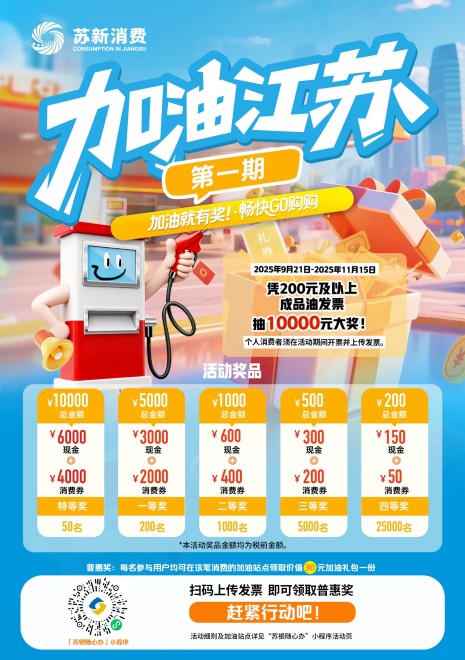
Core Insights - The article highlights the efforts of Jiangsu Bank to stimulate consumer spending during the National Day and Mid-Autumn Festival, focusing on various consumer needs and sectors such as travel, automotive, and cultural tourism [1] Consumer Incentives - Jiangsu Bank launched the "Fuel Jiangsu" prize invoice campaign, allowing consumers who spend over 200 yuan on fuel to enter a lottery with a top prize of 10,000 yuan [2] - The bank has set up promotional materials at nearly 4,000 partner gas stations and utilized holiday car exhibitions to effectively reach fuel consumers [2] Automotive Support - Jiangsu Bank is facilitating easy access to automotive subsidies in collaboration with local business bureaus, resulting in 267 subsidy applications totaling 911,000 yuan, which directly boosted automotive sales by over 58.34 million yuan [5] Thematic Activities - The bank introduced the "Play During the Holiday" series of themed activities, offering benefits such as random discounts on credit card payments and double points on rewards, reaching over 500,000 people through various promotional platforms [7] Offline Engagement - During the holiday period, Jiangsu Bank organized over 40 promotional events in key commercial areas and sports venues, providing consumers with special packages and discounts to enhance the shopping and entertainment experience [9] Credit Support - To alleviate consumer payment pressure during the holidays, Jiangsu Bank increased personal consumer loan approvals by over 600 million yuan, marking a 12.97% increase compared to the same period last year [10] - The bank aims to continue collaborating with various partners to launch more consumer promotion activities, further energizing the consumption market [10]


李波获批担任京东消金董事长!
Sou Hu Cai Jing· 2025-10-10 11:28
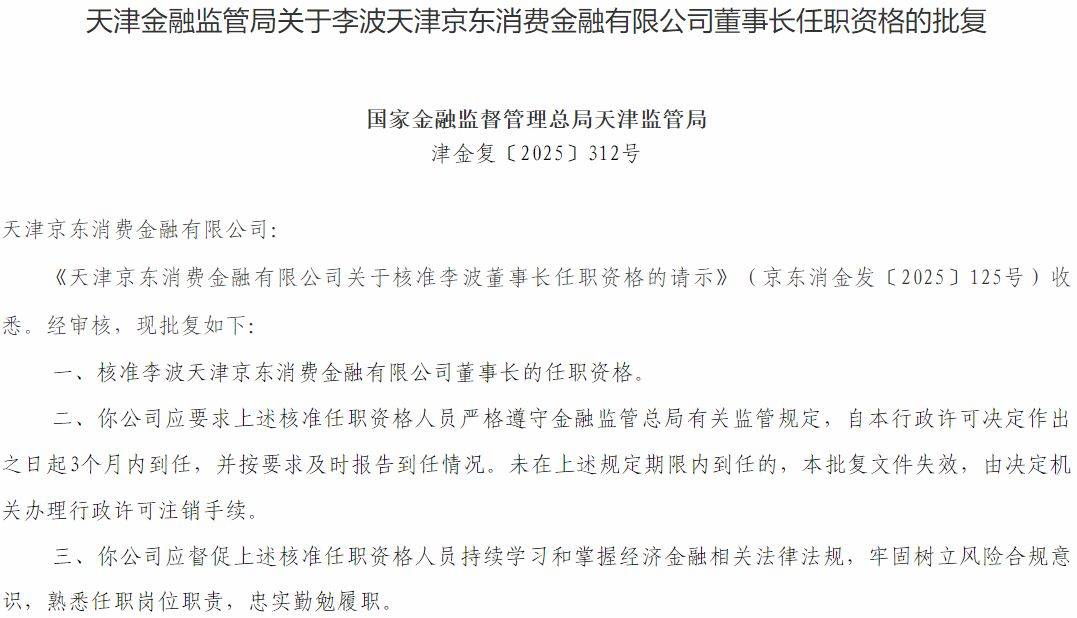
Core Viewpoint - The Tianjin Financial Regulatory Bureau has approved Li Bo as the new chairman of JD Consumer Finance Co., Ltd. (JD Finance) [1] Group 1: Leadership Changes - Li Bo is currently the Vice President of JD Group and has over 20 years of experience in the financial industry, having joined JD in 2021 [2] - Prior to his appointment as chairman, Li Bo was approved as a director of JD Finance in early September [4] - JD Finance has also approved six other directors alongside Li Bo [5] Group 2: Company Developments - JD Finance underwent a restructuring process involving multiple institutions, including Tianjin Bank and China Foreign Trade Trust, in December of last year [5] - The shareholding structure of JD Finance was officially approved in January 2025, with a registered capital of 5 billion yuan [6] - JD Finance was officially renamed from Jiexin Consumer Finance in May [8] Group 3: Operational Expansion - JD Finance launched its operations in the Tianjin Economic Development Zone, planning to establish a team of around 200 people and various operational centers [9] - The company has integrated its services with the JD ecosystem, including the JD White Bar payment service, and is also collaborating with external platforms for loan assistance [10][11] - JD has been an early player in the consumer finance sector, launching JD White Bar in 2014 and expanding its financial product offerings [12]
天津:金融“组合拳”提振消费市场活力
Xin Hua Wang· 2025-10-04 06:27
Group 1 - The article highlights the positive impact of financial support on boosting consumer activity in Tianjin during the National Day holiday [1][2] - Agricultural Bank of China provided over 26 million yuan in loans to more than 20 rural guesthouses, enhancing their service quality and business performance [1] - Various financial institutions in Tianjin have launched unique consumer finance activities, contributing to a vibrant consumption market [1][2] Group 2 - Bank of China in Tianjin has expanded consumer credit offerings, including products like "Zhongyin E-loan" and "Personal Unsecured Consumption Loan," to meet customer needs [2] - The bank aims to continue enhancing its product range and service experience to support the development of Tianjin as an international consumption center [2] - China Construction Bank has partnered with nearly 6,000 retailers to offer promotional activities, including discounts and loan incentives, to stimulate consumer spending [3]



银行“花式营销”抢抓“双节”消费红利
Zheng Quan Ri Bao· 2025-09-29 16:22
Core Insights - The article highlights the proactive measures taken by commercial banks to stimulate consumer spending during the upcoming National Day and Mid-Autumn Festival by offering low-interest loans and enhanced credit card benefits [1][4]. Group 1: Marketing Strategies - Banks are leveraging both online and offline marketing strategies to boost holiday consumption, collaborating with various merchants to create attractive offers [2]. - Specific promotions include tiered discounts for debit cardholders and partnerships with major e-commerce platforms to integrate financial services into shopping experiences [2][3]. Group 2: Consumer Loan Initiatives - Several banks have significantly reduced personal consumption loan interest rates, with some offering rates as low as 2% after applying government subsidies [4]. - The introduction of interest subsidies has led to a notable increase in the consumption loan market, with banks actively promoting these low-rate loans to encourage consumer spending [4][5]. Group 3: Economic Impact - The multi-faceted approach by banks is expected to lower consumer credit costs, enhance consumer willingness to spend, and create a positive feedback loop of policy benefits leading to increased consumption [5]. - The shift in banks' strategies from merely providing loans to creating a comprehensive consumer service ecosystem is emphasized, aiming for deeper integration of finance and consumption [5][6]. Group 4: Future Directions - Recommendations for future innovations include leveraging financial technology for improved service efficiency, focusing on rural market expansion, and enhancing support for green and cross-border consumption [6].

清仓式减持?这家金控出手!
券商中国· 2025-09-29 08:39
Core Viewpoint - Guosheng Jin控 announced plans to dispose of up to 12.67 million shares of Qudian, representing approximately 7.87% of its holdings, to enhance asset efficiency and focus on core business development [1][2]. Summary by Sections Company Actions - Guosheng Jin控 plans to sell its stake in Qudian to improve asset utilization and concentrate resources on its main business [2][4]. - The decision was approved during the 51st meeting of the fourth board of directors on September 26, with authorization for the management to determine the timing, method, and price of the sale within 12 months [2][4]. Financial Implications - If Guosheng Jin控 fully liquidates its Qudian shares, it is expected to recover around RMB 400 million [1][2]. - As of March 31, Qudian reported total assets of RMB 12.464 billion, total liabilities of RMB 1.173 billion, net assets of RMB 11.291 billion, total revenue of RMB 216 million, and net profit of RMB 92 million for the year 2024 [3]. Historical Context - Guosheng Jin控 acquired a 5% stake in Beijing Happy Times Technology Development Co., which later led to the acquisition of shares in Qudian through a VIE structure [3]. - The initial investment in Qudian was part of a strategic shift in 2016, focusing on expanding into the financial services sector and exploring consumer finance [4][5]. Stakeholder Information - Other significant shareholders of Qudian include Luo Min, who holds 40.2% of the shares [3]. - The company emphasizes that the planned share disposal will not harm the interests of shareholders, particularly minority shareholders [4].



民生信用卡“双节”福利金融赋能消费扩容
Zhong Guo Jing Ji Wang· 2025-09-29 06:27
Core Insights - China Minsheng Bank's credit card center is launching a series of promotional activities to boost consumption during the upcoming Mid-Autumn and National Day holidays, including exclusive offers for Minsheng-Sam's Club co-branded credit cards and various discounts [1][2] Group 1: Promotional Activities - The credit card center is enhancing its Minsheng-Sam's Club co-branded credit card benefits until December 31, collaborating with over ten well-known brands such as McDonald's, Pizza Hut, and Luckin Coffee to offer WeChat cash reduction activities [1] - The promotional activities cover essential consumption scenarios including dining, travel, and supermarkets, providing customers with exclusive benefits while enjoying UnionPay Platinum Card privileges [1] Group 2: Consumer Finance Role - Consumer finance is playing a crucial role in connecting consumption and supply, significantly contributing to consumption upgrades [1] - The credit card center aligns with national policies aimed at expanding domestic demand and promoting consumption, partnering with major platforms like JD.com, Meituan, and Alipay to launch the "One-Click Bind Card to Get Payment Gift Package" campaign [1] Group 3: Inclusive Finance Initiatives - The credit card center is increasing its efforts in exploring and practicing inclusive finance by extending discounts to daily life services through the "Universal Housekeeper" feature [2] - Cardholders can enjoy discounts on various life services such as utility payments, mobile recharges, and car maintenance, positioning the credit card as a service assistant closely aligned with the daily needs of residents [2]
