
边缘计算

Search documents
芯原股份20251228
2025-12-29 01:04
Summary of New Yuan Co., Ltd. Conference Call Company Overview - **Company**: New Yuan Co., Ltd. (新元股份) - **Industry**: Semiconductor and AI-related technology Key Financial Metrics - **New Orders**: - In the first three quarters of 2025, new orders totaled **1.593 billion** CNY, with **65%** related to AI computing [2][5] - Fourth quarter new orders reached **2.494 billion** CNY, a **129%** increase year-over-year and a **56.54%** increase from the previous quarter [3][13] - **Revenue**: - Revenue for the first three quarters was **2.255 billion** CNY, a **36.64%** year-over-year increase [2][5] - **Backlog**: - Total backlog reached **3.286 billion** CNY [2][5] Business Segments - **AI Computing**: - AI-related chip design revenue accounted for **73%** of total revenue [2][5] - AI computing orders in Q4 comprised over **84%** of new orders [3][13] - **Chip Production**: - 112 chips were shipped in the first three quarters, with 47 ongoing production design projects [6][2] Strategic Developments - **Mergers and Acquisitions**: - The reduction of **1.7%** in holdings by the Big Fund is a normal operation after a ten-year investment period [7] - The Big Fund plans to invest **1.3 billion** CNY in acquiring Zhudian Semiconductor, indicating long-term national support [7] - **Partnerships**: - Collaborating with automotive companies to develop custom chips for autonomous driving, outperforming existing NVIDIA products, with plans for mass production in Spring 2026 [4][18][19] Market Trends and Future Outlook - **AI and Edge Computing**: - Emphasis on the importance of edge computing, with a focus on smart glasses and small model applications [4][17] - Anticipation of a long-term bullish but steady market development, with expectations for the market to reach at least **5,000 points** by 2026 [24][25] - **Technological Advancements**: - The acquisition of Zhudian Technology is expected to enhance display technology capabilities, improving product competitiveness [20] - Future mobile chip development will focus on the integration of pre-processing and post-processing capabilities [21][22] Challenges and Considerations - **AI Limitations**: - Current AI technologies face challenges in complex scenarios and emotional processing, indicating a gap in fully surpassing human intelligence [9] - **Global Economic Impact**: - The complex global economic situation, including potential interest rate changes, may influence market dynamics [23] Conclusion New Yuan Co., Ltd. is positioned strongly within the semiconductor and AI sectors, with significant growth in orders and revenue driven by AI computing. Strategic partnerships and acquisitions are set to enhance its technological capabilities, while the company remains optimistic about future market trends despite potential economic challenges.

全球数据中心用干式变压器行业总体规模、主要企业国内外市场占有率及排名
QYResearch· 2025-12-25 10:07
Core Viewpoint - The data center dry-type transformer industry is experiencing unprecedented growth opportunities and technological innovations driven by the acceleration of global digitalization and the explosive development of artificial intelligence (AI) technology [5][7]. Product Definition - Data center transformers are crucial devices designed for power distribution systems, responsible for voltage conversion, electrical isolation, and power protection. They are essential for reducing high or medium voltage electricity to the low voltage required by servers and related loads [2]. - Compared to ordinary transformers, data center transformers emphasize high reliability, low energy consumption, fire safety, and environmental adaptability. Common types include dry-type transformers and oil-immersed transformers, each suited for different power supply stages and environmental needs [2][3]. Industry Development Overview - The dry-type transformer market for data centers is projected to grow significantly, with global sales expected to reach $888 million in 2024 and $2.463 billion by 2031, reflecting a compound annual growth rate (CAGR) of 14.53% from 2025 to 2031. The Chinese market is anticipated to account for 31.46% of the global market in 2024, increasing to 33.62% by 2031 [7][8]. - Major international manufacturers include Schneider Electric, Siemens Energy, GE Vernova, Hitachi Energy, and Hyosung Heavy Industries, which collectively hold 56.80% of the market share in 2024 [7]. Industry Growth Drivers - The demand for data centers is surging due to advancements in cloud computing, AI, and big data technologies, particularly with the rise of hyperscale data centers. In 2023, over 300 data centers are under construction globally [10]. - China's "East Data West Computing" initiative is expected to drive over 100 billion yuan in new infrastructure investments annually, significantly increasing transformer demand in western hub nodes [11]. - The need for energy efficiency upgrades is pressing, with the EU's Energy Efficiency Directive mandating that new data centers achieve a Power Usage Effectiveness (PUE) of ≤1.3 by 2025, and China's requirement for eastern hubs set at ≤1.25 [11]. Technological Innovations - The industry is focusing on new materials like amorphous alloys and optimizing designs to reduce no-load and load losses, meeting higher energy efficiency standards [15]. - Integration of sensors and monitoring systems for real-time parameter tracking is becoming standard, enabling predictive maintenance and remote management [16]. - Modular designs are increasingly favored for their rapid deployment and scalability, catering to the dynamic needs of data centers [17]. Market Challenges - Fluctuations in raw material prices, such as copper and silicon steel, can directly impact manufacturing costs and profit margins [19]. - High R&D costs for developing energy-efficient and intelligent transformers pose significant challenges, especially for small and medium-sized enterprises [19]. - The tightening delivery timelines for data center construction necessitate optimized supply chain management to meet customer demands [19]. Competitive Landscape - The market is characterized by high entry barriers due to stringent efficiency, safety, and environmental standards that transformers must meet [20]. - Established brands enjoy strong customer loyalty and trust, making it difficult for new entrants to gain market share despite potential price advantages [20].


中兴通讯涨2.10%,成交额35.19亿元,主力资金净流入3.33亿元
Xin Lang Cai Jing· 2025-12-24 06:16
Core Viewpoint - ZTE Corporation's stock price has shown fluctuations, with a recent increase of 2.10% to 37.97 CNY per share, while the company has experienced a year-to-date decline of 4.56% [1] Financial Performance - For the period from January to September 2025, ZTE achieved a revenue of 100.52 billion CNY, reflecting a year-on-year growth of 11.63%, while the net profit attributable to shareholders decreased by 32.69% to 5.32 billion CNY [2] - The company has distributed a total of 17.14 billion CNY in dividends since its A-share listing, with 8.11 billion CNY distributed over the last three years [3] Shareholder Information - As of December 19, 2025, ZTE had 623,100 shareholders, an increase of 9.68% from the previous period, with an average of 6,467 circulating shares per shareholder, down by 8.82% [2] - The top ten circulating shareholders include significant institutional investors, with notable reductions in holdings from several ETFs [3]

趋势研判!2025年中国物联网网关行业政策背景、发展现状、细分市场及未来发展趋势分析:智联万物加速渗透,物联网网关前景广阔[图]
Chan Ye Xin Xi Wang· 2025-12-23 03:10
Core Insights - The Internet of Things (IoT) gateway is a crucial hub in the IoT architecture, facilitating interconnectivity between the perception layer, network layer, and application layer, while performing key functions such as data collection, protocol conversion, and edge computing [1][2][3] - The global IoT market is experiencing rapid growth, with revenues expected to reach $1.016 trillion in 2024 and projected to rise to $2 trillion by 2030, with the Asia-Pacific region contributing 55% of the revenue, primarily driven by China [1][7] - The Chinese IoT industry is set to reach a market size of 4.01 trillion yuan in 2024, increasing to 4.55 trillion yuan in 2025, with a year-on-year growth rate of approximately 13.7% [1][7] - The IoT gateway market in China is expected to grow to 45 billion yuan in 2024 and surpass 51.8 billion yuan in 2025, with an annual compound growth rate of over 15% [1][8] Industry Overview - The IoT gateway serves as a key device for interconnecting various IoT terminal devices with different protocols, types, and transmission rates, while also performing data collection, protocol conversion, edge computing, data filtering, and secure transmission [2][3] - The IoT gateway can be categorized based on protocol type, deployment scenario, and functional characteristics, including wireless protocol gateways, wired protocol gateways, and multi-protocol fusion gateways [3][5] Market Dynamics - The industrial-grade gateway accounts for over 42% of the market, with significant demand from key industries such as automotive manufacturing and energy and chemical sectors [8] - The consumer-grade gateway market is driven by the proliferation of smart home devices, while the automotive IoT gateway is experiencing rapid growth due to the development of V2X infrastructure [8] - Edge computing gateways, although currently holding a market share of about 6%-10%, are seeing a penetration rate of 35% due to the demand for real-time industrial applications [8] Policy Environment - The Chinese government has implemented various policies to promote the high-quality development of the IoT industry, including the "Digital China Construction Overall Layout Plan" and local initiatives aimed at integrating new information technologies with vertical sectors [6][7] Industry Chain - The IoT gateway industry chain is clearly defined, with upstream focusing on hardware and core technology suppliers, midstream consisting of gateway manufacturers and integrators, and downstream involving users and service providers in various IoT application fields [6] Competitive Landscape - The industry is characterized by a competitive landscape dominated by local giants like Huawei and ZTE, which hold approximately 41% of the market share, while specialized companies like Yihantong focus on specific verticals [10] Future Trends - The IoT gateway industry is expected to evolve towards deeper technological integration, with a focus on edge computing and artificial intelligence, transforming gateways into intelligent decision-making terminals [11] - The market will shift towards customized solutions for vertical industries, with a focus on adapting gateways to specific scenarios [12] - The trend of domestic substitution will continue, with local companies building self-sufficient supply chains and innovative service models emerging, such as "device as a service" [13][14]





2025年中国高光谱相机行业发展历程、产业链、市场规模、重点企业及趋势研判:下游应用持续深化,驱动高光谱相机市场强劲增长[图]
Chan Ye Xin Xi Wang· 2025-12-23 01:15
Core Insights - The hyperspectral camera industry in China is projected to reach a market size of 218 million yuan in 2024, reflecting a year-on-year growth of 20.44% driven by increasing demand in remote sensing, smart manufacturing, agricultural monitoring, and national defense security [1][11] - The technology is transitioning from research applications to commercial use, particularly in emerging fields such as smart agriculture, precision medicine, and new energy material testing [1][11] - The market is expected to grow to 259 million yuan by 2025, indicating a continuous expansion of the hyperspectral camera market [1] Industry Overview - Hyperspectral cameras capture images across multiple narrow spectral bands, providing detailed spectral information that enhances object analysis and identification compared to traditional RGB cameras [3][5] - The development of hyperspectral cameras dates back to the late 1970s and early 1980s, initially used in remote sensing applications by NASA and other research institutions [9] - The industry has seen significant advancements in sensor design and data processing capabilities, leading to increased practicality in various applications [9] Industry Chain - The upstream of the hyperspectral camera industry includes raw materials and components such as high-purity silicon, rare earth materials, lenses, sensors, and optical elements [9] - The midstream involves the manufacturing of hyperspectral cameras, while the downstream encompasses applications in remote sensing, agricultural management, environmental protection, and medical diagnostics [9] Market Trends - The optical lens market, crucial for hyperspectral cameras, is projected to grow from 11.156 billion yuan in 2019 to 17.39 billion yuan by 2024, with a compound annual growth rate of 9.28% [9][10] - The core trends in the hyperspectral camera industry include high integration and chip miniaturization, enabling deployment in various platforms such as smartphones and drones [15] - The integration of artificial intelligence with hyperspectral technology is expected to transform data collection into real-time insights, enhancing decision-making capabilities in various applications [17] Key Companies - Notable companies in the hyperspectral camera sector include Guangsheng Youse, Phoenix Optical, Fuguang Co., and SineSpec, among others, which are making strides in breaking foreign monopolies through technological innovation [2][14] - Hangzhou Caipu Technology Co., a leader in the field, focuses on the development and production of optical instruments, including hyperspectral cameras, and collaborates with renowned research institutions to enhance its technological capabilities [14] - Guangdong SineSpec Technology Co. is recognized for its proprietary technology and comprehensive solutions in hyperspectral imaging, catering to diverse applications from agriculture to environmental monitoring [15]

云端RTX 4090性能缩水了吗?实测海马云等主流平台,还原算力真相
Sou Hu Cai Jing· 2025-12-22 04:05
Core Insights - The cloud computer market in 2025 appears prosperous but is plagued by issues such as lag, poor graphics quality, and high latency, raising questions about the technology's limitations and business model constraints [1] Group 1: Performance and Technology - The root cause of lag in cloud gaming often lies in hardware configuration and power distribution mechanisms, with many platforms using low-performance graphics cards and a "virtualization" approach that divides a single GPU among multiple users, leading to performance degradation in high-demand scenarios [2] - Haima Cloud Computer stands out by utilizing a "non-virtualized" architecture with dedicated physical computing power, confirmed through testing with RTX 4070/4090 graphics cards and Intel i7-12700KF processors, resulting in significantly better performance [2][3] - In stress tests, Haima Cloud achieved an average of 86 fps (peak 101 fps) in 4K graphics for demanding games, demonstrating stable performance without the micro-stuttering common in virtualized platforms [3] Group 2: Network and Latency - Network latency is critical for cloud gaming, with physical distance from data centers affecting performance; users connecting across provinces can experience round-trip times (RTT) exceeding 30 ms, detrimental for FPS gaming [4] - Haima Cloud's innovative architecture, based on a proprietary high-bandwidth low-latency streaming system, has achieved a 98% in-province direct connection rate, keeping latency under 10 ms and virtually eliminating packet loss [4] Group 3: Ecosystem and Versatility - The richness of content is a key measure of platform success; while Tencent START offers convenience, it lacks support for major third-party titles, and other platforms are limited in their application for serious productivity tasks [5] - Haima Cloud distinguishes itself with a built-in library of 500 TB of games, enabling instant play and successfully extending its capabilities into productivity applications, performing comparably to high-end local workstations [5] Group 4: Cost Structure - The pricing strategy in the cloud computer market varies significantly, with some platforms charging 3-5 yuan per hour, making cloud gaming expensive [7] - Haima Cloud has managed to reduce the cost of using RTX 4070 configurations to 0.66 yuan per hour, based on a membership package, which is 20% lower than the market average and offers a more affordable long-term solution for users [7] Group 5: Conclusion - The cloud computer market is undergoing a transformation from merely functional to highly usable, with Haima Cloud emerging as the optimal choice for gamers seeking high-quality graphics, low latency, and cost-effectiveness [8][9]

云天励飞涨2.08%,成交额2.12亿元,主力资金净流出678.05万元
Xin Lang Cai Jing· 2025-12-22 03:43
Group 1 - The core viewpoint of the news is that Yuntian Lifei's stock has shown significant volatility, with a year-to-date increase of 43.49% but a recent decline in the last five days [1] - As of December 22, Yuntian Lifei's stock price is 71.17 yuan per share, with a total market capitalization of 25.538 billion yuan [1] - The company has experienced a net outflow of main funds amounting to 6.7805 million yuan, with large orders showing a buy of 48.2617 million yuan and a sell of 59.4434 million yuan [1] Group 2 - Yuntian Lifei, established on August 27, 2014, specializes in artificial intelligence algorithms and chip technology, with its main business revenue composition being 44.22% from consumer-level applications, 27.66% from industry-level applications, and 27.10% from enterprise-level applications [2] - The company was listed on April 4, 2023, and is categorized under the computer-IT services sector, with concepts including AI toys, neural networks, cloud computing, SOC chips, and edge computing [2] - As of September 30, 2025, Yuntian Lifei reported a revenue of 0.951 billion yuan, a year-on-year increase of 96.85%, while the net profit attributable to shareholders was -0.298 billion yuan, reflecting a year-on-year growth of 29.95% [2] Group 3 - As of September 30, 2025, the top ten circulating shareholders of Yuntian Lifei include Huaxia CSI Robot ETF as the third-largest shareholder, increasing its holdings by 1.279 million shares [3] - Hong Kong Central Clearing Limited is a new shareholder, holding 2.9903 million shares, ranking as the ninth-largest shareholder [3] - Bosera SSE STAR Market Artificial Intelligence ETF is the tenth-largest shareholder, increasing its holdings by 0.4227 million shares [3]

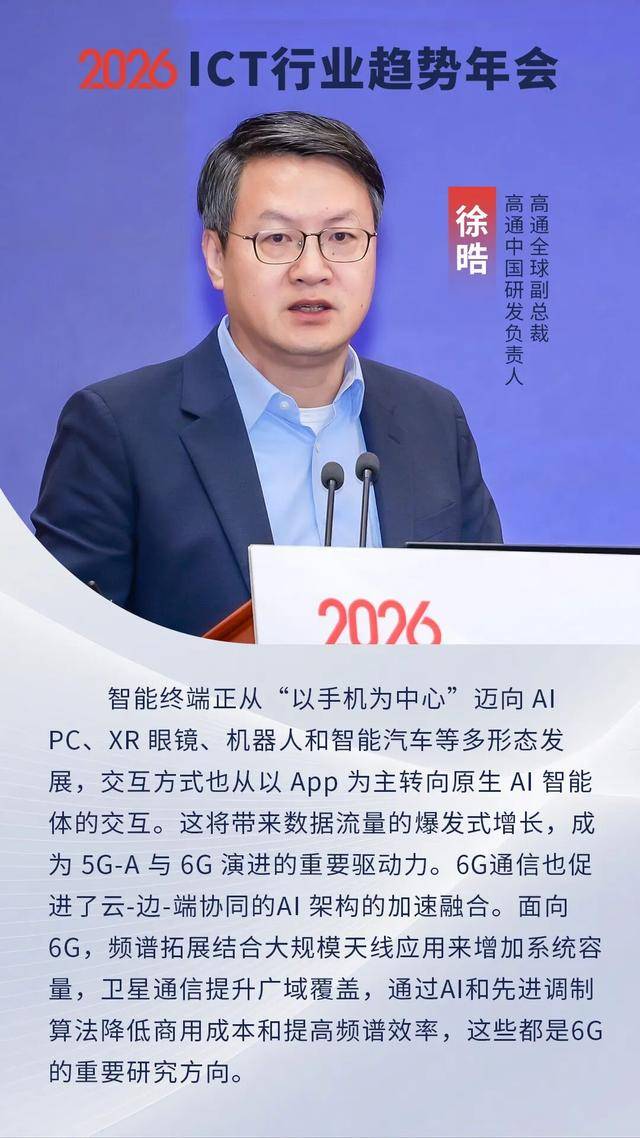
ICT趋势年会 | 6G研发先锋企业!高通中国研发负责人徐晧解读6G关键趋势
Sou Hu Cai Jing· 2025-12-19 16:45
Core Insights - The communication industry is reassessing the foundational logic of next-generation networks as the standardization year for 6G approaches, with significant emphasis on the impact of AI and intelligent agents on future network forms [1][3]. Group 1: Technological Evolution and Application Trends - The evolution of mobile communication has been driven by two main lines: continuous technological advancement and changing industry application trends, with AI increasingly influencing these developments since the advent of 5G [3]. - The integration of edge computing, intelligent agents, and robotics will be core drivers of 6G development, reshaping the capabilities of future networks [3]. Group 2: Rise of Intelligent Agents and AI - The global intelligent agent market is expected to grow rapidly, fundamentally changing user interaction methods, moving away from independent apps to native AI agents for natural interaction [4]. - This shift will not only affect user behavior but also reshape the terminal ecosystem, expanding Qualcomm's focus from mobile phones to AI PCs, XR, wearables, and smart connected vehicles [6]. Group 3: Network Demand and Traffic Models - The rise of intelligent agents will generate substantial data, necessitating increased network and traffic demands, shifting from a "downlink-dominated" model to an "uplink-dominated" structure [7]. - Specific usage scenarios indicate that personal AI assistants could generate 44GB of data monthly, while XR applications could exceed 50GB of traffic, with a significant portion being uplink data [7]. Group 4: Key Technologies Supporting 6G Growth - To meet the increasing traffic demands, the industry will rely on two core technologies: massive MIMO and wider frequency spectrum bandwidth [8]. - The introduction of the FR3 frequency band (approximately 7GHz–24GHz) aims to expand bandwidth significantly, enhancing system capacity [8]. Group 5: AI's Value in Wireless Systems - AI will not only drive application innovation but also play a crucial role in reducing operational costs and supporting new business models [10]. - Qualcomm's collaboration with Nokia Bell Labs focuses on wireless AI interoperability, exploring how AI models can collaborate across terminal and cloud environments [10]. Group 6: Satellite Communication and Key Technologies - Satellite communication is becoming essential for broader network coverage in 6G, with ongoing research into non-terrestrial networks (NTN) [12]. - The development of Probabilistic Amplitude Shaping (PAS) is highlighted as a significant advancement for 6G, potentially offering performance gains in signal transmission [12]. Group 7: Qualcomm's Leadership in 6G Development - Qualcomm has been recognized as a "6G R&D Pioneer" for its early investments and practices in 6G technology, focusing on AI and integrated sensing innovations [13]. - The company is actively advancing its technical layout for 6G, aiming for pre-commercial terminal readiness by 2028, while also collaborating with industry partners on standardization efforts [15].

联想与Alat"联姻",沙特资本从"买股票"进阶"建产业"
Ge Long Hui· 2025-12-19 07:37
Core Viewpoint - Tesla's successful use of convertible bonds has influenced other companies, leading to innovative financing structures that combine capital and industry collaboration, exemplified by Lenovo's partnership with Saudi Arabia's Alat [1][2][6]. Group 1: Tesla's Financing Strategy - In 2014, Tesla issued approximately $2 billion in convertible bonds, which supported the construction of its Gigafactory and the development of new vehicles, allowing the company to transition from a niche sports car manufacturer to a mass-market automaker [1]. - The financing structure utilized by Tesla, which included convertible bonds, debt hedging, and warrants, enabled the company to secure substantial funds at low interest rates while managing equity dilution risks [1]. - The success of Tesla's financing strategy has led to its adoption by other tech giants, such as Alibaba and Supermicro, particularly between 2020 and 2025 [2]. Group 2: Lenovo and Alat Partnership - In May 2024, Lenovo announced a strategic partnership with Saudi Arabia's Public Investment Fund (PIF) through its subsidiary Alat, involving a $2 billion investment in the form of three-year zero-coupon convertible bonds [2][3]. - This partnership aims to establish Lenovo's regional headquarters and advanced manufacturing facilities in Saudi Arabia, enhancing the country's industrial capabilities [2][3]. - The collaboration is seen as a win-win, improving Lenovo's balance sheet while helping Saudi Arabia attract a top global ICT hardware manufacturer [3]. Group 3: Economic Impact and Future Prospects - The partnership is expected to contribute approximately $10 billion to Saudi Arabia's non-oil GDP by 2030, creating 15,000 direct jobs and 45,000 indirect jobs [7]. - Lenovo's project is part of a broader strategy by PIF to diversify the Saudi economy and establish a sustainable technology manufacturing hub [6][7]. - The collaboration is designed to bring technology, production capacity, and talent to Riyadh, marking a shift in Saudi investment strategy towards building a real technology industry [6]. Group 4: Market Trends and Lenovo's Position - The global tech giants are projected to increase capital expenditures significantly, with annual spending exceeding $400 billion by 2025, driven by AI and cloud infrastructure demands [10]. - Lenovo is well-positioned to benefit from the surge in demand for AI servers and data center hardware, with expectations of a 55% year-on-year growth in the global AI server market by 2025 [10]. - The establishment of Lenovo's manufacturing capabilities in Saudi Arabia is expected to enhance supply chain resilience and optimize regional profit margins [11].
中兴通讯涨2.03%,成交额8.65亿元,主力资金净流入1930.56万元
Xin Lang Cai Jing· 2025-12-19 02:04
Core Viewpoint - ZTE Corporation's stock has experienced fluctuations, with a current price of 37.26 CNY per share and a market capitalization of 178.235 billion CNY, reflecting a year-to-date decline of 6.34% [1] Group 1: Stock Performance - As of December 19, ZTE's stock rose by 2.03% during the trading session, with a trading volume of 865 million CNY and a turnover rate of 0.58% [1] - The stock has seen a decline of 1.30% over the last five trading days, 2.13% over the last twenty days, and 15.80% over the last sixty days [1] - ZTE has appeared on the "龙虎榜" (a trading board for stocks with significant trading activity) five times this year, with the most recent appearance on December 11, where it recorded a net buy of -264 million CNY [1] Group 2: Financial Performance - For the period from January to September 2025, ZTE reported a revenue of 100.52 billion CNY, representing a year-on-year growth of 11.63%, while the net profit attributable to shareholders decreased by 32.69% to 5.322 billion CNY [2] - Since its A-share listing, ZTE has distributed a total of 17.137 billion CNY in dividends, with 8.114 billion CNY distributed in the last three years [3] Group 3: Shareholder Information - As of December 10, ZTE had 568,100 shareholders, an increase of 7.28% from the previous period, with an average of 7,092 shares held per shareholder, a decrease of 6.79% [2] - The top ten circulating shareholders include Hong Kong Central Clearing Limited, which holds 76.8764 million shares, a decrease of 11.3435 million shares from the previous period [3]