量子计算

Search documents
400亿美元!特朗普访英,美科技巨头齐“下注”英国
Ge Long Hui A P P· 2025-09-17 02:37
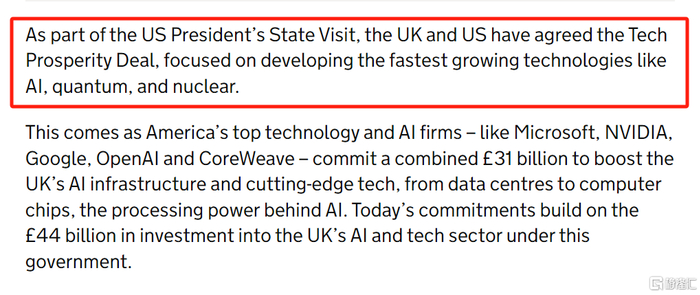
Group 1: Core Agreement and Investment Overview - The UK and the US have reached a landmark "Tech Prosperity Deal," with US tech giants committing to invest over £31 billion ($42.3 billion) in AI systems, quantum computing, and other tech projects in the UK [1][7] - Microsoft plans to invest $30 billion in the UK from 2025 to 2028, including $15.5 billion in additional capital and $15.1 billion in local operations, marking its largest financial commitment in the UK [2] - Other tech companies, including Nvidia, Google, OpenAI, and Salesforce, have also announced significant investments in the UK, contributing to the overall commitment under the Tech Prosperity Deal [3][5] Group 2: Company-Specific Investments - Nvidia will invest approximately $15 billion in the UK, deploying 120,000 Blackwell GPU chips, the largest deployment in Europe to date [3] - Google plans to invest around $6.8 billion in the UK over the next two years, including the establishment of a new data center in Waltham Cross, expected to create 8,250 jobs [3] - Salesforce has increased its investment in the UK to $6 billion, up from a previous commitment of $4 billion [5] Group 3: Strategic Implications - The investments are aimed at making the UK a leader in AI development rather than just a user, as stated by Nvidia's European sales head [3] - The Tech Prosperity Deal is expected to enhance collaboration in AI, quantum computing, and civil nuclear energy, supporting economic growth and scientific research between the two nations [7][8] - The agreement also includes commitments to develop AI models for healthcare and expand quantum computing capabilities [7]




423亿美元!特朗普访英,美科技巨头齐“下注”英国
Ge Long Hui· 2025-09-17 02:18
Group 1 - The core point of the news is the announcement of a "Tech Prosperity Deal" between the UK and the US, which will see major American tech companies invest over £31 billion ($42.3 billion) in the UK for AI systems, quantum computing, and other tech projects [1][10][11] Group 2 - Microsoft plans to invest $30 billion in the UK from 2025 to 2028, including $15.5 billion in additional capital and $15.1 billion in local operations, marking its largest financial commitment in the UK [2][3] - This investment will support the construction of the UK's largest supercomputer, equipped with over 23,000 advanced GPU chips, in collaboration with UK cloud computing company Nscale [3] Group 3 - Nvidia announced an investment of approximately $15 billion in the UK, partnering with Nscale and CoreWeave to deploy 120,000 Blackwell GPU chips, marking the largest deployment in Europe [5] - Google plans to invest around $6.8 billion in the UK over the next two years for AI, R&D, and related engineering, including the establishment of a new data center in Waltham Cross [6][7] Group 4 - OpenAI will invest in the UK through the "Stargate UK" initiative, planning to deploy up to 8,000 GPUs initially, with potential expansion to about 31,000 GPUs [7] - Salesforce has increased its investment in the UK to $6 billion, up from a previously committed $4 billion in 2023 [7] Group 5 - CoreWeave has added £1.5 billion to its investment in the UK, bringing its total investment over the past year to £250 million, and plans to collaborate with DataVita to build a large AI data center powered by renewable energy [7] - Oracle and Amazon Web Services have also reaffirmed or announced multi-billion-pound investment commitments to the UK [7]

特朗普刚到英国就派“红包”,微软OpenAI等美国科技企业承诺投资超400亿美元
美股IPO· 2025-09-17 01:18
Core Insights - The "Tech Prosperity Agreement" between the UK and the US signifies a major investment commitment from American tech giants, with over £31 billion ($42.3 billion) earmarked for AI, quantum computing, and other tech projects in the UK [1][3][4] Investment Commitments - Microsoft plans to invest over $30 billion (£22 billion) in the UK over the next four years to expand its cloud and AI infrastructure, including a partnership with Nscale to build the UK's largest supercomputer with over 23,000 advanced GPUs [5][6] - Google announced a two-year £5 billion investment plan, which includes opening a new data center in Hertfordshire, expected to create 8,250 jobs annually for UK businesses [6] Major Projects - The "UK Stargate" project, a significant initiative under the Tech Prosperity Agreement, aims to establish top-tier AI infrastructure in collaboration with Nscale, Nvidia, and OpenAI [7][8] - Nvidia plans to deploy 120,000 advanced GPUs in the UK, marking its largest deployment in Europe to date, with up to 60,000 of its Grace Blackwell Ultra GPUs being deployed by Nscale [9] Economic Impact - The investments are expected to bolster the UK's digital infrastructure and support thousands of high-skilled jobs, reinforcing the country's leadership in the AI sector [6][10] - OpenAI's CEO highlighted that the "UK Stargate" project will accelerate scientific breakthroughs and economic growth [12] Additional Investments - CoreWeave announced an additional £1.5 billion investment, bringing its total investment in the UK to £250 million, and plans to collaborate with DataVita to build a large AI data center powered by renewable energy [12] - Salesforce committed to an additional $2 billion investment by 2030 to establish its UK operations as Europe's AI hub [12]

新力量NewForce总第4860期
First Shanghai Securities· 2025-09-16 07:01
Group 1: Company Overview - China Gold International (2099) is rated as "Buy" with a target price of HKD 167.07, representing a 25.7% upside from the current price of HKD 132.9[3][7] - The company's market capitalization is HKD 52.7 billion, with 396 million H shares issued[7] Group 2: Production and Growth Strategy - The Jiama Mine's Phase II processing plant resumed operations on May 30, 2024, achieving a stable processing capacity of 34,000 tons per day[8] - Gold and copper production in the first half of the year increased by 69% and 230% year-on-year, respectively, indicating a strong recovery[8] - The "Three-Step" expansion plan aims to increase processing capacity from 34,000 tons to 50,000 tons per day by mid-2027, and further to 80,000 tons per day in subsequent phases[9] Group 3: Financial Projections - Projected net profits for 2025, 2026, and 2027 are USD 370.74 million, USD 453.61 million, and USD 519.37 million, respectively, reflecting significant growth[11] - Earnings per share (EPS) are forecasted to be USD 0.94 for 2025 and USD 1.14 for 2026, with a corresponding price-to-earnings (PE) ratio of 20 times for 2026[11] Group 4: Risks and Market Conditions - Key risks include fluctuations in gold and copper prices and potential delays in mine construction[12] - The current macroeconomic environment supports high prices for copper and gold, which is expected to enhance the company's profitability[11]
知名量子计算公司,启动IPO辅导
Shang Hai Zheng Quan Bao· 2025-09-16 06:53
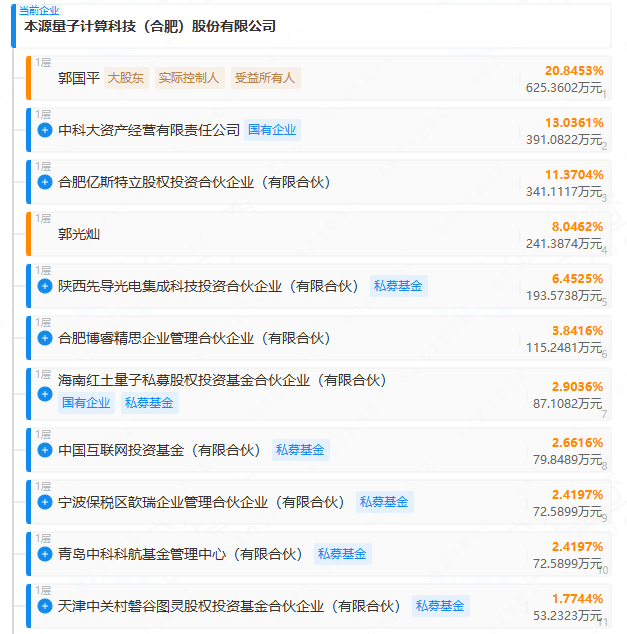
Core Viewpoint - Benyuan Quantum Computing Technology (Hefei) Co., Ltd. has completed its IPO counseling filing with the Anhui Securities Regulatory Bureau, marking it as the third quantum technology company in Hefei High-tech Zone to initiate the IPO process after Guodun Quantum and Guoyi Quantum [1] Company Overview - Benyuan Quantum was established on September 11, 2017, with a registered capital of 30 million yuan. The actual controller, Guo Guoping, holds 21.08% of the shares directly and controls over 30% of the voting rights through various investment partnerships [2] - The technology team originates from the Quantum Information Key Laboratory of the Chinese Academy of Sciences, focusing on building a self-controllable engineering quantum computer and a complete industrial chain ecosystem [2][3] Technological Development - The company has developed China's first quantum chip design software, quantum chip production line, quantum computer systems, and quantum operating systems, holding the second-largest number of quantum computing-related patents globally [2] - Benyuan Quantum is one of only two organizations globally that publicly provide quantum computing cloud services, with its "Benyuan Wukong" quantum computer set to launch in January 2024, marking China's first large-scale provision of autonomous quantum computing power [5] Market Deployment - As of now, "Benyuan Wukong" has achieved over 30 million global visits and completed 690,000 quantum computing tasks for users across 163 countries and regions [5] - The quantum computer has been deployed in various locations in China, including supercomputing centers and universities, supporting major national research projects and talent training [5] Industry Collaboration - Benyuan Quantum has engaged in over 100 quantum computing application collaborations with more than 500 domestic entities across sectors such as defense, finance, medicine, electricity, telecommunications, and aviation [5] - The company signed a strategic cooperation agreement with ChinaLink ESGt to enhance quantum technology collaboration between China and Spain, focusing on building a computing power center and developing quantum-resistant cryptography [6]
本源量子启动IPO辅导 国内量子计算龙头冲刺资本市场
Ju Chao Zi Xun· 2025-09-16 05:52
Core Viewpoint - Benyuan Quantum Computing has officially initiated its IPO process, indicating its readiness for the A-share market and highlighting its leadership in the domestic quantum computing sector [2][3]. Company Overview - Benyuan Quantum was established in 2017 and originated from the Quantum Information Key Laboratory of the Chinese Academy of Sciences, focusing on a full-stack technology layout in quantum computing [2]. - The company's core business includes quantum chips, quantum computing measurement and control integrated machines, quantum operating systems, quantum software, quantum computing cloud platforms, and quantum education [2]. Technological Advancements - The company has made significant breakthroughs, including the successful launch of its third-generation autonomous superconducting quantum computer, "Benyuan Wukong," positioning China among the global leaders in quantum computing [2]. - The technology is transitioning from theoretical frameworks to practical applications, with potential breakthroughs expected in finance, aerospace, and medicine [3]. Industry Challenges - Despite advancements, the industry faces common challenges such as qubit stability, error correction capabilities, and scalability, which are critical technical bottlenecks [3]. - Continuous focus on core areas like quantum chips, measurement and control systems, and ultra-low temperature environments is necessary to solidify the foundation for quantum computing industrialization [3]. Shareholding Structure - As of June 30, 2025, the chief scientist of Benyuan Quantum, Guo Guoping, directly holds 21.08% of the company's shares and controls over 30% of the voting rights through various employee stockholding platforms, making him the actual controller of the company [3]. Future Prospects - With the initiation of the IPO guidance, Benyuan Quantum is expected to leverage capital markets to enhance its technology research and industrial applications, accelerating the construction and commercialization of China's quantum computing ecosystem [3].
彩讯股份(300634):重点发力AI及算力,战略投资布局量子计算
Guotou Securities· 2025-09-16 05:35
Investment Rating - The investment rating for the company is "Buy-A" with a target price of 29.63 CNY, indicating a potential upside from the current price of 26.59 CNY [5]. Core Insights - The company reported a revenue of 920 million CNY for the first half of 2025, representing a year-on-year growth of 17.72%, and a net profit of 135 million CNY, up 14.74% year-on-year. AI and computing-related revenue accounted for 177 million CNY, nearly 20% of total revenue [1][2]. - The company has made a strategic investment in Zhongke Kuyuan Technology, aiming to accelerate the development of atomic quantum computers and promote the industrial application of quantum computing technology [1][3]. Summary by Sections Financial Performance - For the first half of 2025, the company achieved a revenue of 920 million CNY, a 17.72% increase year-on-year, and a net profit of 135 million CNY, reflecting a 14.74% growth [1]. - The company’s AI-related revenue is divided into two main parts: over 100 million CNY from computing-related income and approximately 50-60 million CNY from AI application-related income [2]. Strategic Initiatives - The company has partnered with several funds to invest in Zhongke Kuyuan, which focuses on the research and development of atomic quantum computing technology, aiming to transition from laboratory research to industrial applications [3]. - The company maintains a low debt ratio of 15% and strong cash flow, which supports its strategic investments and business development in AI and computing [3]. Market Position and Future Outlook - The company is positioned to benefit from the growing demand for AI and intelligent solutions across various industries, including partnerships with major clients like China Mobile and China Southern Power Grid [2]. - Revenue projections for 2025-2027 are estimated at 1.98 billion CNY, 2.36 billion CNY, and 2.62 billion CNY, with net profits expected to be 297 million CNY, 366 million CNY, and 402 million CNY respectively [11].
本源量子启动上市辅导 聚焦量子计算产业生态建设
Zheng Quan Shi Bao Wang· 2025-09-16 04:40
Core Insights - Benyuan Quantum Computing Technology (Hefei) Co., Ltd. has filed for listing guidance with the Anhui Securities Regulatory Bureau, with CITIC Securities as the advisory institution [1] - The company focuses on building a self-controlled engineering quantum computer and developing a full-stack quantum computing ecosystem, including quantum chips, measurement and control systems, operating systems, software, cloud platforms, and educational initiatives [1] - Benyuan's quantum computer "Wukong" has successfully completed over 500,000 quantum computing tasks for users in 143 countries and regions since its launch on January 6, 2024, marking a significant milestone in China's quantum computing capabilities [2] Company Overview - Founded in 2017 in Hefei, Benyuan Quantum is a leading player in the domestic quantum computing industry, with technology originating from the Chinese Academy of Sciences [1] - The company aims to explore applications of quantum computing across various sectors, including biotechnology, chemical materials, financial analysis, ship manufacturing, and big data [1] - The ownership structure indicates that Guo Guoping holds 21.08% of the shares directly and controls over 30% of the voting rights through various investment partnerships, making him the controlling shareholder [3] Product Development - "Wukong" is recognized as China's most advanced programmable superconducting quantum computer, with applications extending from basic research to fluid dynamics, biomedicine, and financial technology [2] - The quantum computing tasks completed by "Wukong" reflect its significant role in the global quantum ecosystem, particularly with high user engagement from countries like the United States and Canada [3] - Future developments include the integration of "Wukong" into a financial quantum cloud platform by early 2025 and the introduction of applications for drug development, enhancing efficiency in pharmaceutical research [2]
民生证券:后量子密码技术加速演进 国内龙头企业加大布局
智通财经网· 2025-09-16 04:00
Core Insights - Quantum computing is expected to be a disruptive force in solving AI computing power bottlenecks, offering superior parallel computing capabilities and lower energy consumption compared to traditional computing [2][5] - Post-quantum cryptography aims to create new cryptographic systems that can withstand attacks from quantum computers, becoming a crucial technology for future information security [1][2][5] - The standardization process for post-quantum cryptography is accelerating, with increasing exploration of applications and intensified competition among leading domestic and international companies [1][5] Industry Overview - The global market for quantum computing reached $4.7 billion in 2023 and is projected to exceed $800 billion by 2035, indicating significant growth potential [2] - Domestic leading companies are rapidly advancing in the fields of quantum computing and post-quantum cryptography, focusing on algorithm development, hardware innovation, and industry application [3] Company Highlights - GuoDun Quantum (国盾量子) supports the commercialization of post-quantum cryptography with a complete industrial chain [4] - Sanwei Xinan (三未信安) has developed a full range of anti-quantum cryptography products, from chips to systems [4] - Jida Zhengyuan (吉大正元) is actively promoting research on anti-quantum cryptography migration, achieving full-stack innovation from algorithms to applications [4] - Tianrongxin (天融信) has made strategic investments in quantum computing, leading the upgrade of security products with chip-level post-quantum cryptography cards [4] - Electric Science Network Security (电科网安) has launched the "Quantum Armor" series of anti-quantum cryptography products, creating a comprehensive security ecosystem [4] - Geer Software (格尔软件) focuses on financial industry applications for anti-quantum migration solutions [4] - GuoXin Technology (国芯科技) is integrating quantum technology with trusted computing chips, establishing a full-chain layout from algorithms to products [4] Investment Recommendations - Companies to watch in the post-quantum cryptography space include GuoDun Quantum, Sanwei Xinan, Jida Zhengyuan, Tianrongxin, Electric Science Network Security, Geer Software, and GuoXin Technology [5] - Additional companies related to quantum computing include Qiming Star (启明星辰), Keda Guokuan (科大国创), Hexin Instruments (禾信仪器), Shenzhou Information (神州信息), Kehua Data (科华数据), China Great Wall (中国长城), Guangxun Technology (光迅科技), Unisoc (紫光国微), and Hengtong Optic-Electric (亨通光电) [5]



计算机行业深度研究:后量子密码技术:应对量子计算威胁的关键防线
Minsheng Securities· 2025-09-16 02:46
Investment Rating - The report maintains a positive investment rating for the quantum computing and post-quantum cryptography sectors, highlighting significant growth potential and competitive dynamics in the industry [4]. Core Insights - Quantum computing is poised to revolutionize AI capabilities by overcoming computational bottlenecks, with the market expected to grow from $4.7 billion in 2023 to over $800 billion by 2035, reflecting a compound annual growth rate (CAGR) of 44.8% [1][27]. - Post-quantum cryptography (PQC) is emerging as a critical defense against the threats posed by quantum computing to traditional encryption systems, with the U.S. leading in the development and standardization of PQC technologies [1][36]. - Domestic companies are accelerating their efforts in the quantum computing and cybersecurity sectors, aiming to establish a robust information security framework that is self-sufficient and resilient against quantum threats [2][3]. Summary by Sections 1. Addressing Quantum Computing Challenges and Advancements in Post-Quantum Cryptography - Quantum computing leverages unique quantum mechanical properties to achieve unprecedented computational power, enabling significant advancements in parallel processing and energy efficiency [7][10]. - The quantum computing market is expected to reach $10.5 billion by 2027, driven by breakthroughs in specialized quantum computers and applications across various sectors [27]. - The development of post-quantum cryptography is essential to safeguard against the vulnerabilities of traditional encryption methods, with various algorithms being explored to ensure security in a quantum computing era [30][32]. 2. Focus on Future Technological Transformations and Domestic Leaders' Accelerated Layout - Leading domestic enterprises are actively investing in quantum computing and post-quantum cryptography, enhancing their capabilities in algorithm development, hardware innovation, and practical applications [2][3]. - Companies like GuoDun Quantum and Sanwei Xinan are at the forefront of developing comprehensive solutions that integrate quantum key distribution (QKD) and post-quantum cryptography [61][52]. - The report identifies key players such as GuoDun Quantum, Sanwei Xinan, and Jida Zhengyuan as significant contributors to the advancement of post-quantum cryptography technologies [3][47][57].