
数字金融

Search documents
百姓财经话丨改版亮相!数字人民币App服务再升级
Xin Hua Wang· 2025-08-12 05:50
Core Insights - The recent updates to the digital RMB app reflect significant enhancements in user experience and functionality, with over 40 updates since its launch in 2022, indicating a commitment to continuous improvement [1] Group 1: User Experience Enhancements - The latest version of the digital RMB app focuses on simplifying operations related to money management, allowing users to access key functions like payment, transfer, recharge, and bank storage directly from the homepage, thus reducing operational steps [2] - The app now features improved wallet management, allowing users to easily switch between multiple wallets, with the most frequently used wallets displayed prominently for convenience [4] Group 2: Hard Wallet Services - The upgrade includes enhancements to the hard wallet service, making it easier for users, including foreign visitors and seniors, to make payments without internet or power [5] - The process for deactivating a hard wallet has been streamlined, enabling users to remove or deactivate their hard wallets directly through the app, even if the wallet is lost or damaged [6] Group 3: Broader Applications and Innovations - The digital RMB is being increasingly utilized in various business scenarios, including enterprise payments and cross-border transactions, with notable implementations in cities like Guangzhou, Beijing, and Chongqing [7] - The digital RMB is enhancing the financial infrastructure by providing a compliant, secure, and efficient currency settlement channel for cross-border trade, while also leveraging smart contracts to reduce transaction costs and improve payment efficiency [7]

年中经济观察丨金融精准发力提升高质量发展成色——中国经济年中观察之五
Xin Hua Wang· 2025-08-12 05:42
Core Insights - Financial sector plays a crucial role in promoting high-quality economic development in China, with significant increases in social financing and loans in the first half of the year [1][3]. Group 1: Financial Support for Key Sectors - Financial institutions are focusing on five key areas: technology finance, green finance, inclusive finance, pension finance, and digital finance, to provide higher quality and more efficient financial services [2][3]. - As of the end of May, loans in these five areas reached 103.3 trillion yuan, a year-on-year increase of 14% [3]. - Specific examples include a 70 million yuan green loan supporting a company in producing high-value activated carbon from agricultural waste, and various loans aiding companies in manufacturing and technology innovation [2][4]. Group 2: Enhancing Financing Structure - There is a notable increase in credit allocation to advanced manufacturing, technology innovation, and private enterprises, which is essential for traditional companies to transform and rejuvenate [4][5]. - By the end of June, the balance of technology loans from major banks reached nearly 6 trillion yuan, with significant growth in loans for the manufacturing sector [5]. Group 3: Promoting Consumption and Domestic Demand - Financial policies are being implemented to stimulate consumption and expand domestic demand, including a 7.29 billion yuan loan for a cultural tourism project [6][7]. - The People's Bank of China has introduced measures to support key areas of domestic demand, with mid-to-long-term loans for manufacturing and infrastructure growing by 8.7% and 7.4% year-on-year, respectively [7]. Group 4: Future Outlook - The financial sector is expected to maintain stable support for the real economy, ensuring that credit resources are directed towards key economic areas and weak links [7][8]. - The People's Bank of China plans to adjust policy implementation to better stimulate domestic demand and market vitality [7].



夯实数字化底座!国金证券打造“AI友好型组织”
券商中国· 2025-08-11 23:31
Core Viewpoint - The article emphasizes the role of digital finance in empowering the transformation and upgrading of the securities industry, highlighting the importance of technology in enhancing service capabilities and operational efficiency [2][3]. Group 1: Digital Transformation in Securities Industry - The securities industry is undergoing a digital transformation driven by emerging technologies like artificial intelligence (AI), with firms like Guojin Securities leading the way [2]. - Guojin Securities has implemented a strategy focused on leveraging technology to enhance core business areas such as investment banking, institutional services, and wealth management [2][3]. Group 2: Business Development and Efficiency - Guojin Securities has developed an integrated investment banking platform that incorporates intelligent document review and writing functions, significantly improving work efficiency and quality [4]. - In 2023, the platform assisted in reviewing over 6,000 documents and comparing more than 20,000 data streams, enhancing data comprehensiveness and timeliness [4]. Group 3: Research and Institutional Services - The company has invested in digital technologies to improve analysts' efficiency in information acquisition and processing, utilizing tools like big data and intelligent search [5]. - Since the beginning of 2023, Guojin Securities has served over 50,000 online institutional clients and produced more than 1,700 digital reports covering nearly 20 industries [5]. Group 4: Continuous Investment in Technology - Guojin Securities has maintained a high level of investment in technology, with a significant portion of revenue allocated to tech development, positioning itself as a leader in the industry [6]. - The company launched its first AI advisory service in June 2025, focusing on providing accessible and customized investment support to retail investors [6]. Group 5: AI Integration and Organizational Culture - The rise of generative AI technologies has prompted Guojin Securities to explore and apply large model capabilities across various financial scenarios [7][8]. - The company aims to create an "AI-friendly organization" to foster collaboration and innovation, enhancing its competitive edge in the market [8][9].



夯实数字化底座 国金证券打造“AI友好型组织”
Zheng Quan Shi Bao· 2025-08-11 17:40
Core Viewpoint - Digital finance has become a core force in empowering the transformation and upgrading of the securities industry, driven by emerging technologies like artificial intelligence (AI) [1] Group 1: Digital Transformation and Innovation - The securities industry is steadily advancing its digital transformation, with Guojin Securities as a pioneer, leveraging technology to enhance core businesses such as investment banking, institutional, and wealth management [1][2] - Guojin Securities has implemented various AI applications, including AI office assistants and programming assistants, which have improved employee efficiency by approximately 30% and have seen over 2000 daily uses since launch [2] - The company has built an integrated investment banking platform that incorporates intelligent document review and writing functions, significantly enhancing work efficiency and quality [3] Group 2: Research and Client Services - Guojin Securities has developed a service platform focused on roadshow and client management, providing a one-stop service for institutional clients, with over 50,000 online clients served and 1700 digital reports produced in 2023 [4] - The company is enhancing wealth management through digital transformation, aiming for more convenient services, lower costs, smarter trading, and comprehensive investment education [4] Group 3: Continuous Investment in Technology - Guojin Securities has maintained a high level of investment in technology since 2014, with a significant portion of revenue allocated to tech development, and plans to launch the first AI advisory service in June 2025 [5] - The company has established multiple business data centers to support core services like wealth advisory, enhancing data governance and infrastructure [5] Group 4: AI and Big Model Exploration - The rise of generative AI technologies has prompted Guojin Securities to explore and apply big model capabilities across various financial scenarios, including intelligent advisory and research [6] - The company aims to create an "AI-friendly organization" to foster collaboration and innovation in AI applications, enhancing its competitive edge in the market [7][8]

中国稀土集团辟谣!否认发行“稀土人民币稳定币”|破谣局
Sou Hu Cai Jing· 2025-08-11 14:51
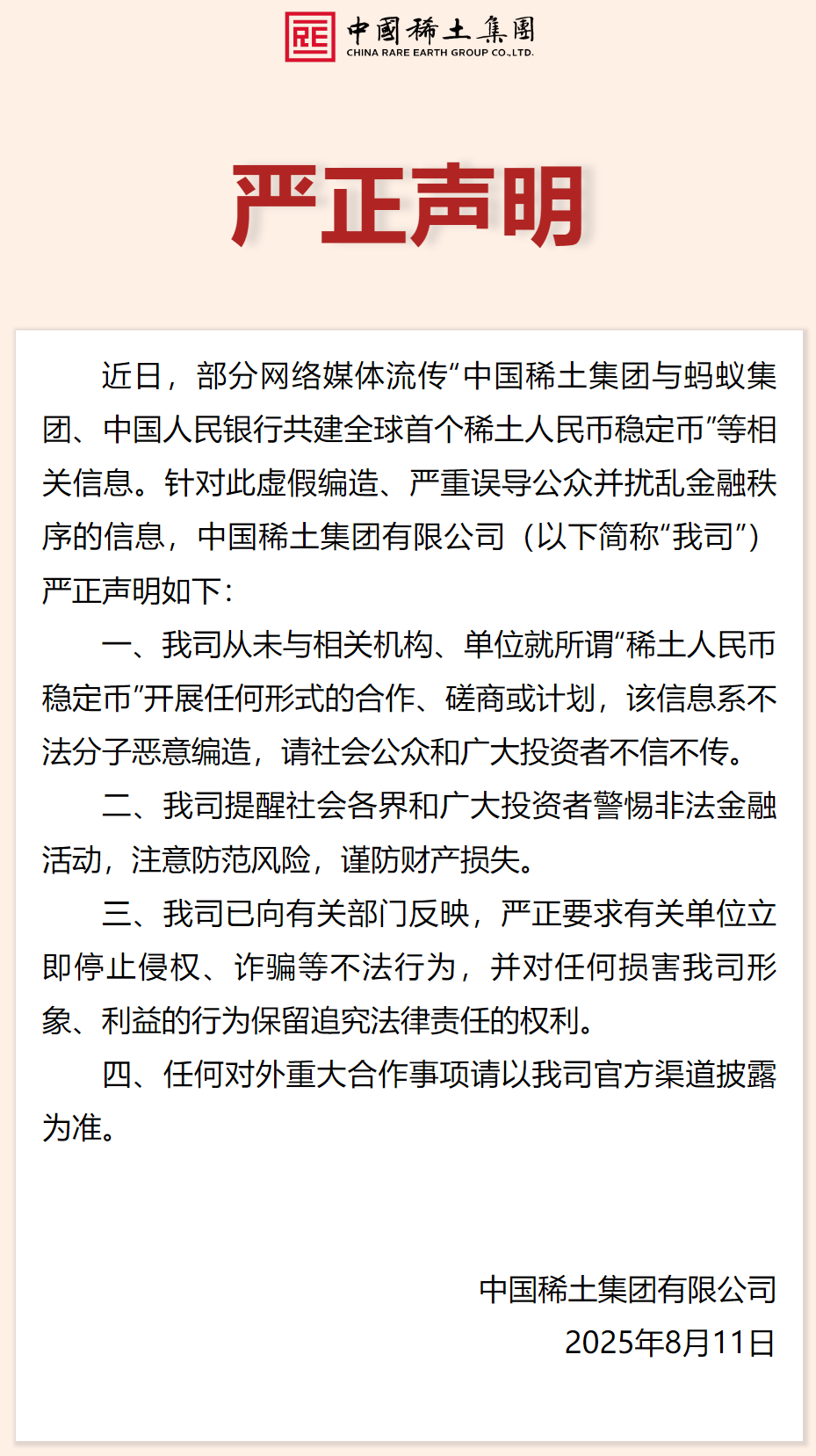
Group 1 - The core message is that the news regarding the collaboration between China Rare Earth Group, Ant Group, and the People's Bank of China to create the world's first rare earth-backed RMB stablecoin is false and misleading [1][4] - China Rare Earth Group issued a statement denying any cooperation or plans related to the so-called "rare earth RMB stablecoin," labeling the information as fabricated by malicious individuals [1] - Ant Group also clarified through its official Weibo account that it has never had any plans with the mentioned institutions regarding such a stablecoin [4] Group 2 - The announcement of a rare earth-backed stablecoin project by Ant Group and China Rare Earth Group was initially reported but later denied by both parties [1][4] - The false information aimed to mislead the public and induce investors to focus on related sectors, prompting both companies to urge the public to be cautious and avoid falling for scams [4]

国新证券加入中国国新三周年:践行金融报国使命 书写改革发展新篇章
Zheng Quan Ri Bao Wang· 2025-08-11 10:47
Group 1 - The core viewpoint of the articles highlights the transformation and strategic focus of Guoxin Securities since its establishment, emphasizing its role in supporting state-owned enterprises and national strategies [1][2] - Guoxin Securities has engaged with 54 state-owned enterprise groups and has successfully implemented 37 projects out of 56 initiated, maintaining over 30% of its financing services directed towards state-owned enterprises [1] - The company has adopted a comprehensive approach to financial services, including technology finance, green finance, inclusive finance, pension finance, and digital finance, achieving significant progress in each area [2] Group 2 - In technology finance, Guoxin Securities has completed the listing of Chuanli Intelligent on the New Third Board and issued the first "ESG + Technology Innovation" corporate bond in the national chemical industry [2] - The company has issued seven green bonds, including those for Guoxin Leasing and Huadian Leasing, and has applied to participate in carbon emission trading [2] - Guoxin Securities has enhanced its digital financial infrastructure, focusing on improving customer operations and expanding its product offerings to nearly 10,000 financial products [2]
传统金融转型挑战VS 金融壹账通新质生产力破局之策
Zhong Jin Zai Xian· 2025-08-11 10:31
Group 1: New Quality Productivity and Financial Technology - The concept of new quality productivity has been proposed to drive high-quality economic development in China, emphasizing the need for modern industrial system construction and the integration of disruptive technologies [1][2] - Financial technology is positioned to seize new opportunities and challenges, with companies like Ping An Group's Financial One Account leveraging core technologies such as AI and big data to enhance financial services [1][2] Group 2: Digital Financial Transformation - Digital finance is recognized for its potential to expand service coverage and improve efficiency, with recent policies from various regulatory bodies guiding financial institutions in their digital transformation efforts [2] - Financial institutions face challenges such as data integration difficulties and low value conversion, which hinder the effective use of data assets [2] Group 3: Data Privacy and Management - Financial One Account has developed an advanced data management tool, the Financial Data Privacy Computing Platform, which addresses data silos and enhances data asset value through privacy computing technologies [3] - The platform has been successfully applied in various financial regulatory and risk management scenarios, improving operational efficiency and compliance [3] Group 4: Artificial Intelligence in Finance - Artificial intelligence is identified as a key technology driving the current technological revolution, with significant implications for the financial sector [4] - Despite its potential, challenges such as data sharing and integration with existing business processes remain obstacles to AI implementation in financial institutions [4] Group 5: AI-Driven Financial Services - Financial One Account has launched a "Smart Banking One-Stop AI Platform," which offers a modular design for efficient and cost-effective financial services, enhancing customer data integration and analysis [5] - The platform supports over 4,000 financial business scenarios and has been recognized for its innovative contributions to the industry [5] Group 6: Independent Innovation in Finance - The promotion of independent innovation in the financial sector is crucial for enhancing service efficiency and ensuring national financial security [6] - Financial technology companies play a vital role in accelerating digital transformation and building self-controlled financial infrastructure [6] Group 7: Collaboration and Ecosystem Development - Financial One Account has actively collaborated with various financial institutions and regulatory bodies to implement smart financial service projects, showcasing its capabilities in the fintech sector [7][8] - The company aims to provide comprehensive solutions that integrate technology and business, contributing to the development of new quality productivity in finance [7][8]
“金企工程”助力西安文旅入境消费升级交流活动在西安顺利举办
Sou Hu Cai Jing· 2025-08-11 09:53
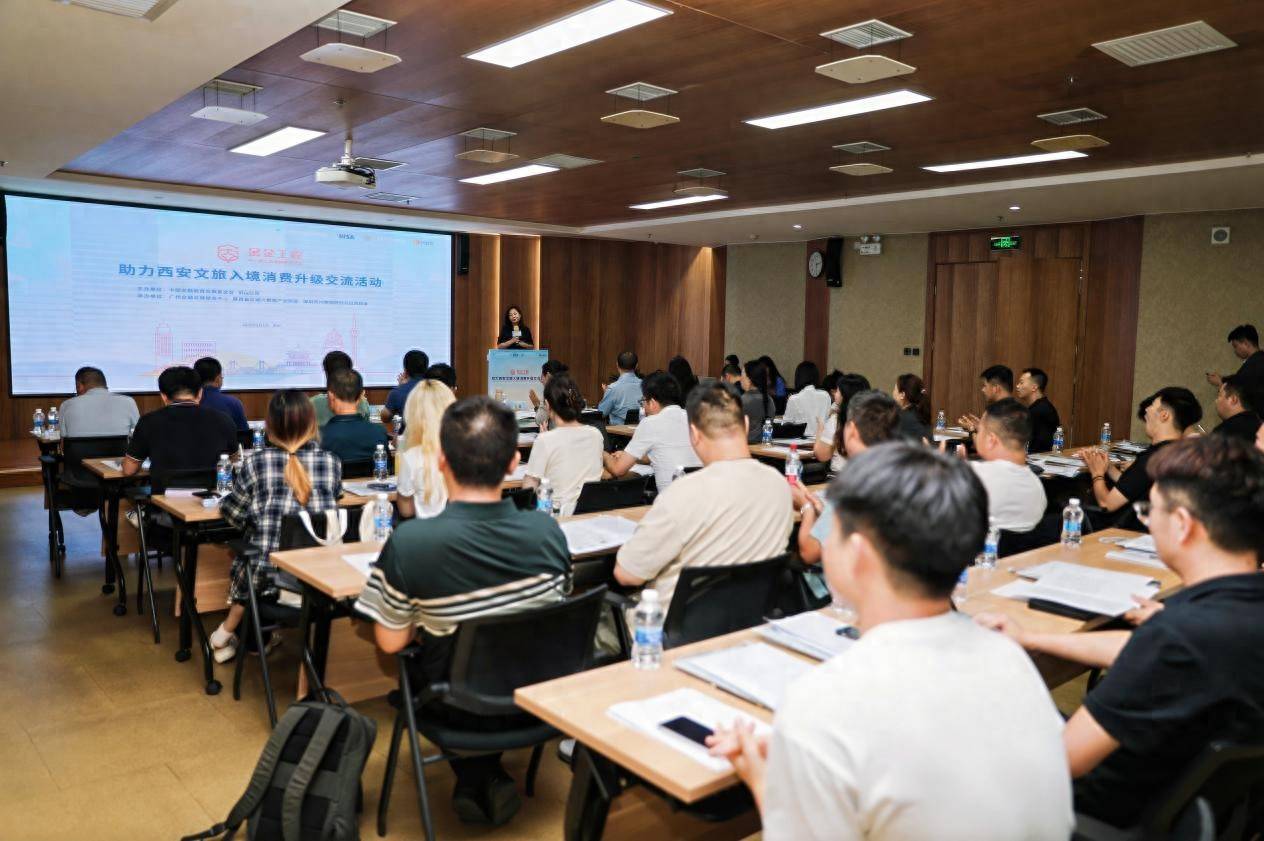
Core Viewpoint - The "Golden Enterprise Project" aims to enhance inbound consumption in Xi'an by integrating digital technology with cultural tourism, focusing on financial education for small and micro enterprises, and optimizing cross-border payment capabilities [1][12]. Group 1: Event Overview - The event was organized by the China Financial Education Development Foundation and Visa, with support from various financial and data industry associations [3]. - Experts from Xi'an, industry associations, financial institutions, and small and micro enterprises participated in the event [3]. Group 2: AI and Cultural Tourism - The General Manager of Chuangmao Group in Xi'an presented on how AI can empower new experiences in cultural tourism consumption, emphasizing its role in enhancing visitor experiences and reducing costs [5]. - The presentation highlighted a core logic of "technology output—service implementation—challenge response—future innovation" [5]. Group 3: Globalization of Cultural Tourism - The General Manager of Yinuo Jinqi Cross-border Logistics Management Co., Ltd. discussed the role of logistics in supporting the globalization of cultural tourism consumption, noting trends towards diversified products, high-end services, and convenient payments [8]. - A dual strategy of "green logistics + cultural export" was proposed to activate innovation in the cultural tourism sector [8]. Group 4: Payment Facilitation - A representative from Visa focused on optimizing the foreign card acceptance system to enhance payment convenience for inbound tourists, aiming to attract more foreign visitors and expand domestic demand [10]. - The discussion included practical experiences and innovative directions for improving international business for cultural tourism enterprises [10]. Group 5: Xi'an's Strategic Position - Xi'an is positioned as a key node in the "Belt and Road" initiative and has implemented four major actions to boost consumption, enhancing international payment convenience and digital services [12]. - The "Golden Enterprise Project" aims to elevate cultural tourism consumption capabilities through digital infrastructure, cross-border ecosystem reconstruction, and smart logistics collaboration [12].
推动我国新型工业化金融基础更牢固
Guo Ji Jin Rong Bao· 2025-08-11 09:16
Core Viewpoint - The recent joint issuance of the "Guiding Opinions on Financial Support for New-Type Industrialization" by seven government departments is expected to play a significant role in promoting new-type industrialization in China [1] Group 1: Financial System Development - The Opinions propose the establishment of a financial system suitable for new-type industrialization, aiming for a mature financial system by 2027 that supports high-end, intelligent, and green development in manufacturing [2] - Financial products will become more diverse, with improved connectivity among loans, bonds, equity, and insurance, enhancing service adaptability and meeting the effective credit demand of manufacturing enterprises [2] Group 2: Support for Key Areas - The Opinions outline targeted financial support measures for key areas, including optimizing financial policy tools to support critical technology breakthroughs and enhancing comprehensive financial services for key enterprises in the industrial chain [3] - Development of technology finance, green finance, and digital finance is emphasized, along with the establishment of credit management mechanisms to facilitate industrial transfer to central and western regions [3] Group 3: Financial Policy Implementation - Financial institutions are required to implement more effective financial policies, such as lowering financing thresholds for key technology projects and encouraging long-term patient capital for technology transformation [4] - The promotion of industrial chain financial services is highlighted, exploring financing methods that do not rely on core enterprise credit, thus reducing financing barriers for small and medium-sized enterprises [4] Group 4: Service Capability and Mechanism Construction - The Opinions stress the need for financial institutions to enhance service capabilities and establish long-term mechanisms, including differentiated credit policies for various industries and stages of enterprise growth [5] - Collaboration with educational institutions to cultivate finance and technology talent is encouraged, aiming to improve the professional capabilities of financial institutions in supporting new-type industrialization [6]
金融活水润黔中 中信担当谱新篇——中信银行贵阳分行绘就新时代西部大开发金融长卷
Zhong Guo Jin Rong Xin Xi Wang· 2025-08-11 06:38
Core Viewpoint - The article highlights the efforts of CITIC Bank's Guiyang branch in promoting financial services that support the development of various sectors in Guizhou, focusing on technology, green finance, inclusive finance, pension finance, and digital finance as part of the "Five Major Articles" strategy to foster economic growth and improve living standards in the region [1][10]. Group 1: Technology Finance - CITIC Bank's Guiyang branch has provided 1.884 billion yuan in technology finance loans to 72 enterprises in sectors such as big data, renewable energy, and biotechnology by June 2025 [2]. - The "Science and Technology e-loan" product has been introduced to support "specialized, refined, distinctive, and innovative" enterprises, facilitating their financing needs [2]. - A comprehensive service plan for employee stock ownership prior to IPO has been implemented, providing 16.49 million yuan in financing for a local tech company [2]. Group 2: Green Finance - The bank has established a green credit balance of 2.217 billion yuan by the end of 2024, supporting the ecological civilization construction in Guizhou [3]. - Innovative models combining green finance, ecological agriculture, and rural revitalization have been developed, exemplified by a 20 million yuan credit loan to a national agricultural enterprise [3]. Group 3: Inclusive Finance - CITIC Bank is addressing the financing challenges faced by small and micro enterprises through products like "Distribution e-loan," which reduces financing burdens by 30%-50% for distributors [4][5]. - The bank's inclusive finance loans have reached nearly 1.5 billion yuan by the end of 2024, significantly benefiting small business owners and enhancing local economic activity [5]. Group 4: Pension Finance - The bank has launched comprehensive pension financial services, including pension planning and community integration for the elderly, enhancing the quality of life for senior citizens [6]. - The establishment of a cloud service platform for elderly education has facilitated access to learning resources for seniors [6][7]. Group 5: Digital Finance - CITIC Bank is advancing its digital transformation strategy, focusing on management, operational efficiency, and service innovation [8]. - The bank has developed a digital financial service system that integrates technology, scene innovation, and ecological collaboration, enhancing supply chain financing in the liquor industry [8][9].
