操作系统

Search documents
独家对话|李治军:国产操作系统与具身智能的双向奔赴
Guan Cha Zhe Wang· 2025-05-13 04:40
Core Insights - The article discusses the integration of artificial intelligence with operating systems, focusing on the development of domestic operating systems in China and the potential of embodied intelligence to reshape human-machine interaction and industrial forms [1] Group 1: Domestic Operating Systems - The importance of domestic operating systems is emphasized due to China's long-standing "lack of core technologies," where "core" refers to operating systems and "chips" refers to hardware [2] - The increasing attention from the government, industry, and market towards operating systems is seen as a positive development for the sector [2] - Current global exploration in the field of robotic operating systems is highlighted, with no mature solutions available yet [3] Group 2: Embodied Intelligence - Embodied intelligence is defined as the integration of artificial intelligence with the physical world, with robots being a key manifestation of this concept [5] - The article outlines the potential applications of robots in various sectors, particularly in B-end markets due to labor shortages and harsh production environments [3][5] - The future of embodied intelligence may involve multi-agent systems, where robots and other intelligent entities operate autonomously in various environments [5] Group 3: Entrepreneurial Insights - The gap between theoretical research and practical application in entrepreneurship is discussed, emphasizing the need for solutions that meet actual market demands rather than just technical specifications [7] - The importance of rapid product iteration based on user feedback is stressed, rather than striving for a perfect product before market introduction [8] - The article notes that the development of embodied intelligence requires a collaborative effort across various sectors, including education and industry [18] Group 4: Industry Trends and Challenges - The article mentions that the development of robotic systems may follow a trajectory similar to that of the mobile phone industry, with a focus on creating ecosystems and applications [11] - The challenges faced by mobile manufacturers entering the robotics field are highlighted, particularly the need for collaboration with industry professionals to navigate the complexities of robotics [11] - The lack of mature competing robotic operating systems is noted, with few companies currently exploring similar solutions [12] Group 5: Investment and Support - The article discusses the challenges of monetizing operating systems, with examples of major systems like Windows and Android illustrating the long investment cycles required [21] - The support from patient capital is emphasized as crucial for the development of operating systems, which often face skepticism regarding their profitability [21] - Collaboration with national innovation centers is highlighted as a means to secure funding and resources for early-stage projects [22] Group 6: Future Directions - The article suggests that the future of embodied intelligence and robotics will require a systemic approach involving government guidance, patient capital, and continuous innovation from technology workers [18][24] - The need for interdisciplinary talent to drive the integration of operating systems and robotics is emphasized, as well as the importance of real-world data for model training [24] - The potential for embodied intelligence to revolutionize human capabilities and societal functions is discussed, indicating a transformative future [18]


粤开市场日报-20250509
Yuekai Securities· 2025-05-09 08:16
Market Overview - The main indices showed a decline today, with the Shanghai Composite Index down by 0.3%, the Shenzhen Component down by 0.69%, and the ChiNext Index down by 0.87% [1] - In terms of industry performance, the top sectors included Beauty Care, Banking, and Textile & Apparel, while Media, Retail, and Real Estate lagged behind [1] - Concept sectors showed mixed results, with Continuous Board, Banking, and Speculative Concepts performing relatively well, whereas Semiconductor Equipment, Operating Systems, and Cloud Computing concepts underperformed [1]
首款鸿蒙电脑亮相
第一财经· 2025-05-08 05:31
Core Viewpoint - Huawei officially launched the "Harmony Computer" at the HarmonyOS 5 technology and ecosystem communication conference held in Shenzhen on May 8, showcasing the deep integration of AI capabilities with underlying hardware, operating systems, and software applications [1] Group 1 - The "Harmony Computer" is powered by HarmonyOS 5, indicating a significant advancement in Huawei's operating system technology [1] - The event highlighted the strategic direction of Huawei in merging AI with its hardware and software ecosystem, which may enhance user experience and operational efficiency [1]
鸿蒙电脑,大消息!
第一财经· 2025-05-08 02:12
Core Viewpoint - Huawei's HarmonyOS for computers was officially launched on May 8, showcasing significant advancements in technology and patent accumulation over five years [1] Group 1 - HarmonyOS has accumulated over 2,700 core patents during its development [1] - The operating system is designed to cover multiple verticals, catering to basic office needs and core scenarios [1]

操作系统——信息时代的关键基础设施(开卷知新)
Ren Min Ri Bao· 2025-05-06 10:01
Core Viewpoint - The article emphasizes the critical role of operating systems in the information age, highlighting their importance in managing computing resources and ensuring the security of key sectors through domestically developed systems [1][6]. Group 1: Importance of Operating Systems - Operating systems are the core software that manages and controls computing resources, essential for the functioning of both hardware and software [1][4]. - The development of operating systems is crucial for the security of key areas in the information age, necessitating a focus on domestically produced systems [6][7]. - The evolution of operating systems reflects the changing nature of computing resources, from single computers to networks and mobile devices [2][3]. Group 2: Development and Ecosystem - The development of operating systems requires a systematic and continuous approach, as they serve as the foundation for a wide range of hardware and software applications [6][5]. - The success of domestic operating systems is linked to the richness of their application ecosystems, which enhances their functionality and performance [6][7]. - The article advocates for increased collaboration between government and market mechanisms to foster a balanced development of the information industry ecosystem [7].

粤开市场日报-20250430
Yuekai Securities· 2025-04-30 11:58
Market Overview - The A-share market showed mixed performance today, with the Shanghai Composite Index down by 0.23% closing at 3279.03 points, while the Shenzhen Component Index rose by 0.51% to 9899.82 points, and the ChiNext Index increased by 0.83% to 1948.03 points [1][10] - Overall, 3443 stocks rose and 1766 stocks fell, with a total trading volume of 11693 billion yuan, an increase of approximately 147.2 billion yuan compared to the previous trading day [1] Industry Performance - Among the Shenwan first-level industries, the leading sectors included Computer, Automobile, Media, Electronics, and Machinery Equipment, with gains of 2.33%, 1.59%, 1.39%, 1.31%, and 1.30% respectively [1][10] - Conversely, the sectors that experienced declines included Banking, Steel, Building Materials, Transportation, and Public Utilities, with losses of 2.09%, 1.35%, 0.82%, 0.77%, and 0.72% respectively [1][10] Concept Sector Performance - The top-performing concept sectors today were Smart Speakers, Operating Systems, and Auto Parts, among others, showing significant gains [2][12] - In contrast, sectors such as Banking, High Send Transfer, and Cobalt Mining experienced declines [12]
Canalys:一季度中国智能手机市场同比增长5% 小米(01810)重回第一
智通财经网· 2025-04-27 06:53
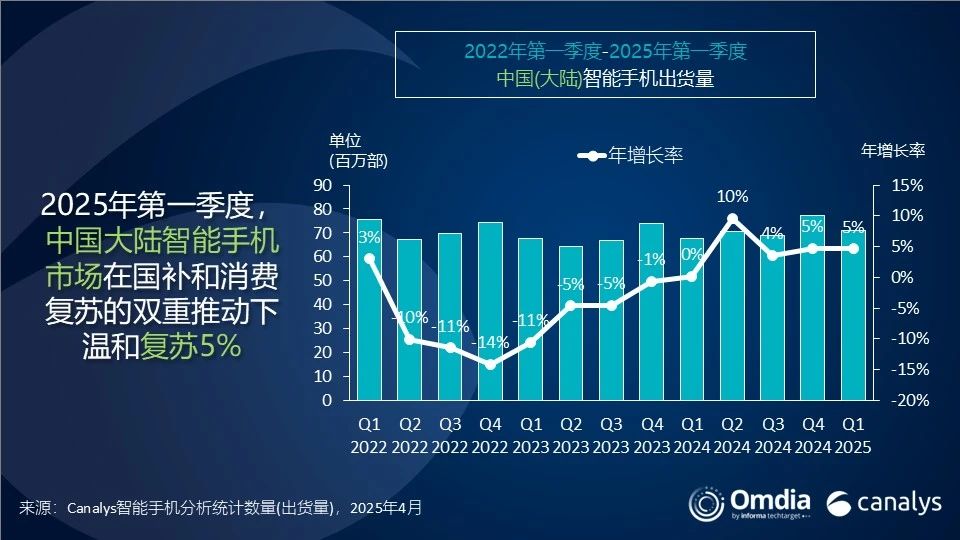
Core Insights - The Chinese smartphone market experienced a mild growth of 5% year-on-year in Q1 2025, with shipments reaching 70.9 million units, driven by national subsidy policies and consumer recovery [1][3] Group 1: Market Performance - Xiaomi led the market with shipments of 13.3 million units, a 40% increase year-on-year, capturing a market share of 19% [1][5] - Huawei followed closely with 13 million units shipped, maintaining double-digit growth [1][5] - OPPO and vivo ranked third and fourth with shipments of 10.6 million and 10.4 million units, respectively [1] - Apple saw a decline in shipments to 9.2 million units, an 8% drop year-on-year, placing it fifth in the market [1][5] Group 2: Impact of National Subsidy Policy - The national subsidy policy implemented in January has positively influenced market performance, prompting some consumers to upgrade their devices earlier, reflecting a shift in demand rather than organic growth [3] - The policy has also reinforced the dominance of major retail channels and e-commerce platforms like Tmall and JD.com [3] Group 3: Company Strategies and Innovations - Xiaomi's growth is attributed to its product and channel synergy, with a unified pricing strategy that reduces consumer decision costs [5] - Huawei is focusing on effective channel management and expanding its product offerings, including advancements in foldable devices and the development of the HarmonyOS ecosystem [5] - The penetration rate of AI smartphones in China reached 22% in 2024 and is expected to exceed 40% in 2025, highlighting the importance of innovation in areas like foldable screens and operating systems [5]