
新能源

Search documents
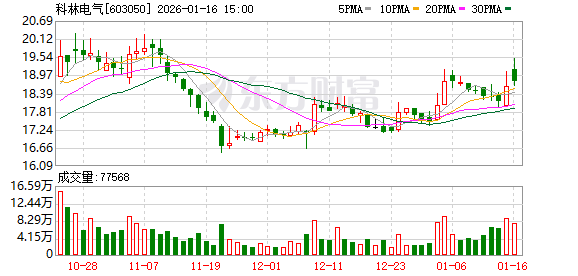
科林电气:公司将从传统的电气设备硬件制造企业逐步向新型智慧能源科技企业转型
Zheng Quan Ri Bao· 2026-01-16 12:17
Group 1 - The core viewpoint of the article is that Colin Electric aims to transform from a traditional electrical equipment manufacturer to a world-class new intelligent energy technology enterprise, focusing on technological leadership, quality assurance, cost-effectiveness, and optimal experience [2] - The company plans to solidify its foundation and prioritize the development of AI computing centers, the new energy market, and overseas markets to elevate its industry position [2]


苏大维格:全资子公司拟2000万元认购基金份额
Zheng Quan Shi Bao Wang· 2026-01-16 11:23
Core Viewpoint - The company Su Da Wei Ge (300331) is accelerating its investment in strategic emerging industries, particularly in the semiconductor sector, by partnering with Suzhou Shunrong Zeshi Management Consulting Partnership to invest in a venture capital fund [1] Group 1: Investment Details - The company's wholly-owned subsidiary, Wei Ge Investment, has signed a limited partnership agreement to invest 20 million yuan, acquiring a 10.2302% stake in the fund [1] - The fund will focus on investing in unlisted companies within the semiconductor, new energy, AI, and aerospace sectors, aiming for exits through IPOs and mergers and acquisitions [1]

安永中国主席陈凯:借力粤港澳大湾区独特优势 把握“一带一路”全新投资机遇
中国基金报· 2026-01-16 11:21
Core Viewpoint - The article emphasizes the importance of leveraging the unique advantages of the Guangdong-Hong Kong-Macao Greater Bay Area to seize new investment opportunities presented by the Belt and Road Initiative, especially in the context of the uncertain international geopolitical landscape [2]. Group 1: Investment Opportunities - Chinese enterprises are deepening investment cooperation with countries along the Belt and Road, with non-financial direct investment maintaining rapid growth [5]. - The investment direction of Chinese capital is shifting from traditional energy and infrastructure to emerging fields such as green energy, advanced manufacturing, digital economy, artificial intelligence, and life sciences [6]. - The asset management industry must enhance its understanding of emerging industries and frontier technologies while establishing a robust investment framework to balance risk management and returns [6]. Group 2: Risks in Investment - The article identifies three main risks in cross-border asset allocation: compliance risk, funding risk, and uncertainty in political, legal, and cultural environments of some Belt and Road countries [8]. - Compliance risk arises from stricter global financial regulations, requiring asset management institutions to maintain consistent compliance standards across different jurisdictions [8]. - Funding risk is influenced by exchange rate fluctuations, capital controls, and market liquidity changes, necessitating diversified asset allocation to mitigate single market risks [8]. Group 3: Role of Hong Kong - Hong Kong serves as a "super connector" and "super value creator," linking domestic resources with international markets, thereby enhancing the Greater Bay Area's competitiveness in global resource allocation [9]. - Under the "One Country, Two Systems" framework, Hong Kong has established a common law system and international regulatory rules, making it a crucial international financial hub for Belt and Road investments [9]. Group 4: Technological Innovation in the Greater Bay Area - The Greater Bay Area is positioned as one of China's three major international technology innovation centers, with the "14th Five-Year Plan" marking a critical period for its development [10]. - The focus of technological innovation will be on strategic emerging industries such as artificial intelligence, life sciences, high-end manufacturing, new energy, and the digital economy, which require long-term capital and cross-regional collaboration [10]. - Asset management institutions are encouraged to adopt a long-term investment logic that combines industry understanding with strategic allocation, enhancing overall investment efficiency [10].

高盛王亚军:2026年港股市场将“涛声依旧”
Zheng Quan Ri Bao Wang· 2026-01-16 11:12
Group 1 - The core viewpoint is that the Hong Kong capital market experienced significant growth in 2025, with expectations for continued activity in 2026, described as "涛声依旧" [1] - In 2025, the total equity financing in the Hong Kong stock market reached $96 billion, a 173% increase from $35.2 billion in 2024, indicating a substantial rise [1] - The IPO market in 2025 was robust, with total IPO financing soaring from $11.3 billion in 2024 to $37.5 billion, an increase of over 230% [1] - The refinancing scale, including placements and rights issues, surged from approximately $9 billion to around $45 billion, a growth of about five times, aligning with Goldman Sachs' earlier predictions [1] - Convertible bonds maintained a high financing level of about $20 billion, accounting for approximately 20% of total financing, above historical averages [1] Group 2 - The structural characteristics of the 2025 IPO market showed that nearly half of the financing came from A-share companies listing in Hong Kong, while the other half was from companies listing for the first time in Hong Kong [2] - In 2026, the IPO momentum is expected to continue, with a shift towards more first-time listings, particularly in AI and hard technology sectors, which will test the pricing power and liquidity of the Hong Kong market [2] - The refinancing market is anticipated to remain at high levels in 2026, driven by an increasing number of Chinese enterprises listed in Hong Kong, especially in high capital expenditure sectors like renewable energy and AI [2] - The concentration of Chinese AI and related industry companies going public is highlighted as a key theme for 2026, with significant capital needs still present in the sector [2] Group 3 - The phenomenon of new stocks breaking below their issue price in Q4 2025 is explained as a normal price discovery mechanism in mature markets, with no fundamental shift in the Hong Kong market [3] - Consumer stocks are emphasized as a core attraction for the Hong Kong market in 2026 due to their simple and transparent business models, predictable earnings growth, and attractive valuations [3]
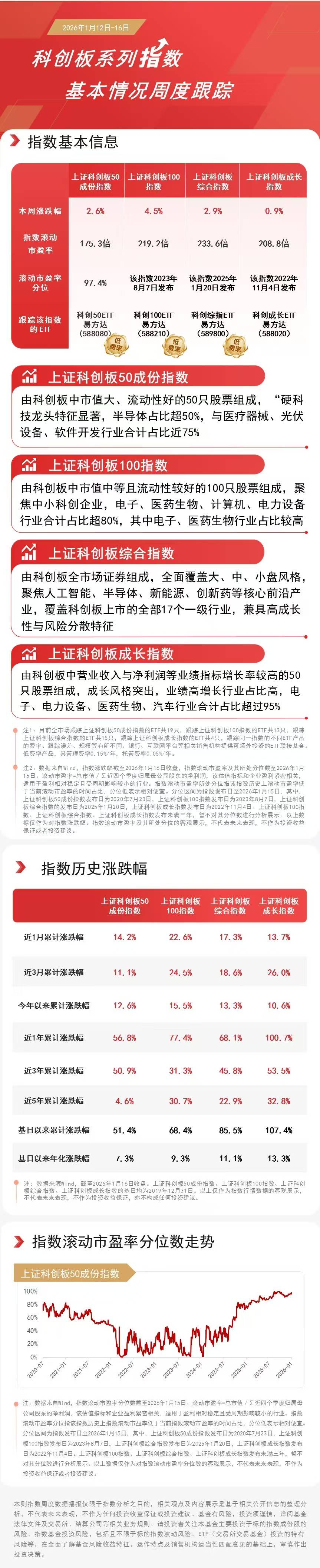
我国团队攻克新型半导体材料领域难题,关注科创50ETF易方达(588080)等产品中长期投资机会
Sou Hu Cai Jing· 2026-01-16 10:44
Market Performance - The Sci-Tech 100 Index increased by 4.5%, the Sci-Tech Composite Index rose by 2.9%, the Shanghai Sci-Tech 50 Component Index went up by 2.6%, and the Shanghai Sci-Tech Growth Index saw a rise of 0.9% this week [1][3]. Industry Developments - A significant breakthrough in the development of new semiconductor materials was achieved by a team from the University of Science and Technology of China, which successfully constructed a programmable, atomically flat "mosaic" heterojunction in two-dimensional ionic soft crystal materials. This technology overcomes the challenges of traditional processes that tend to damage soft crystal structures, paving the way for the development of high-performance light-emitting and integrated devices [1]. Index Composition - The Shanghai Sci-Tech 100 Index consists of 100 stocks with medium market capitalization and good liquidity, focusing on small and medium-sized tech enterprises, with over 80% of its composition in the electronics, biopharmaceuticals, computer, and power equipment sectors [5]. - The Shanghai Sci-Tech Composite Index covers all market securities, focusing on core frontier industries such as artificial intelligence, semiconductors, new energy, and innovative pharmaceuticals, encompassing all 17 primary industries listed on the Sci-Tech Board [5]. - The Shanghai Sci-Tech Growth Index is composed of 50 stocks with high growth rates in revenue and net profit, with over 95% of its composition in high-growth sectors like electronics, power equipment, biopharmaceuticals, and automotive [5]. ETF Tracking - There are currently 19 ETFs tracking the Shanghai Sci-Tech 50 Component Index, 13 ETFs for the Shanghai Sci-Tech 100 Index, 15 ETFs for the Shanghai Sci-Tech Composite Index, and 4 ETFs for the Shanghai Sci-Tech Growth Index, with varying fee rates and tracking errors [5].
美国介入委内瑞拉,重油遇轻油,一场共赢合作还是资源陷阱?
Sou Hu Cai Jing· 2026-01-16 10:41
Core Viewpoint - The U.S. government's recent intervention in Venezuela's affairs, including the potential appointment of Secretary of State Rubio as the "governor" of Venezuela, raises questions about its true intentions, particularly regarding energy strategy and control over Venezuela's oil resources [1]. Group 1: Venezuela's Oil Reserves - Venezuela holds approximately 303 billion barrels of heavy oil, accounting for 18% of the world's reserves, which presents a significant opportunity for the global oil market if utilized [3]. - The refining of heavy oil is challenging due to its high viscosity and sulfur content, making it less desirable compared to U.S. shale oil, which is lighter and easier to process [3]. Group 2: U.S. Oil Strategy - U.S. refineries typically use a mixing ratio of 3:7 of light to heavy oil, which can reduce refining costs by 20%, indicating a strong demand for this blended oil in international markets [5]. - The U.S. proposal to ease sanctions on Venezuela in exchange for light oil and a non-interference promise in its political structure appears beneficial for Venezuela, which is facing economic difficulties [5][6]. Group 3: Geopolitical Implications - The U.S. aims to control Venezuela's oil resources to strengthen its energy dominance and suppress Russia's oil revenue, which is crucial for the Russian economy, contributing about 30% to its GDP [10]. - By potentially increasing global oil supply by 1.5 million barrels per day through Venezuelan oil, the U.S. could maintain lower oil prices, reminiscent of past strategies that weakened Russia's economy [10]. Group 4: Impact on Renewable Energy - The U.S. strategy may also delay global investment in renewable energy, as maintaining low oil prices could extend reliance on fossil fuels, providing a buffer period for U.S. companies to enhance their renewable technology [12]. - The International Energy Agency predicts that prolonged low oil prices could reduce global renewable investments by 12% and slow the growth of solar and wind energy installations by 15% [14]. Group 5: Dollar Dominance - Controlling Venezuela's vast oil reserves would further solidify the U.S. dollar's position in global energy trade, as 80% of oil transactions are currently conducted in dollars [14]. - The U.S. maintains over 750 military bases worldwide, with strategic locations near Venezuela, reinforcing its influence over oil transactions and deterring alternative currency settlements in the region [16]. Group 6: Conclusion - The U.S. strategy in Venezuela, framed as technical cooperation, is fundamentally about securing control over oil resources to enhance its global energy hegemony, suppress Russian oil revenues, and fortify the dollar's dominance in energy markets [16].
苏大维格:全资子公司拟参与投资设立基金 投向半导体、新能源、AI、航空航天等领域
Xin Lang Cai Jing· 2026-01-16 10:30
Group 1 - The company announced that its wholly-owned subsidiary, Weige Investment, has signed a partnership agreement with Suzhou Shunrongze Management Consulting Partnership and other limited partners [1] - Weige Investment will invest 20 million yuan, acquiring a 10.2302% stake in the investment fund [1] - The fund focuses on investing in unlisted companies within industrial technology and strategic emerging industries, including semiconductors, new energy, AI, and aerospace [1]
中国一重(601106.SH):2025年度预亏3.1亿元至4.6亿元
Ge Long Hui A P P· 2026-01-16 10:26
Core Viewpoint - The company, China First Heavy Industries (601106.SH), expects to report a net profit attributable to shareholders of the parent company for 2025 in the range of -310 million to -460 million yuan, indicating a significant reduction in losses compared to the previous year [1] Financial Performance - The company anticipates a reduction in losses by approximately 3.276 billion to 3.426 billion yuan compared to the same period last year [1] - The expected net profit attributable to shareholders after deducting non-recurring gains and losses is projected to be between -662 million and -812 million yuan, with a reduction in losses of about 2.95 billion to 3.1 billion yuan year-on-year [1] Operational Challenges - The company faces operational losses from certain subsidiaries, one-time provisions for internal retirement benefits, and income tax payments from profitable subsidiaries, which contribute to the negative net profit and net profit attributable to shareholders [1] Sector Performance - Despite the overall loss, the power station casting and forging segment, as well as the nuclear power sector, have shown better development due to deep adjustments in energy structure and certain industrial policies [1] - The company's subsidiary, Qiqihar New Energy Co., Ltd., achieved investment income from the sale of wind farms this year, contributing to a significant reduction in losses [1]

宇通客车:欧洲、拉美、东南亚新能源客车需求预计持续增长
Zheng Quan Ri Bao Wang· 2026-01-16 10:19
Group 1 - The core viewpoint of the article is that the demand for new energy buses is expected to continue growing in regions such as Europe, Latin America, and Southeast Asia, driven by economic, technological, and environmental policy factors [1] Group 2 - Yutong Bus (600066) responded to investor inquiries on an interactive platform, highlighting the increasing demand for new energy buses in various regions [1] - The growth in demand is attributed to a combination of economic and technological factors, as well as environmental protection policies [1]

科士达:2025年净利同比预增52.21%-67.43%
Jin Rong Jie· 2026-01-16 09:45
Core Viewpoint - Keda (002518.SZ) forecasts a net profit attributable to shareholders of 600 million to 660 million yuan for the year 2025, representing a year-on-year growth of 52.21% to 67.43% [1] Group 1: Business Performance - The company is expanding its "Data Center + New Energy" business, with continuous increases in orders and shipment volumes across both sectors [1] - The data center segment is benefiting from a new wave of infrastructure investment, while the new energy business is experiencing a recovery in demand from the European market and growth in emerging markets [1]
