
绿色低碳

Search documents
中石油塔石化尿素装置造粒塔封顶
Zhong Guo Hua Gong Bao· 2025-09-08 02:52
Core Viewpoint - The completion of the urea granulation tower at the PetroChina Tashi Chemical Green Low-Carbon Project marks a significant milestone in the project's construction, entering the peak installation phase and nearing the completion of civil works [1] Group 1: Project Overview - The project is located in the Xinjiang Korla Shakush Chemical Industry Park and aims for near-zero carbon dioxide emissions through the use of advanced ammonia synthesis technology based on ethylene-rich tail gas [1] - The urea granulation tower, a core structure of the urea production facility, has a design height of 122.5 meters and a diameter of 24 meters, featuring a reinforced concrete cylindrical structure [1] Group 2: Construction Details - The construction of the granulation tower involves an estimated total concrete pouring volume exceeding 7,000 cubic meters and the use of over 1,600 tons of rebar [1] - The project team has successfully tackled the challenge of using C45 high-strength concrete in the construction of the granulation tower, a first in the country, along with the associated mix ratio testing [1]

电冰箱能效新国标出台 节能门槛再提升
Xiao Fei Ri Bao Wang· 2025-09-08 02:51
Core Viewpoint - The new national standard GB 12021.2-2025 for household refrigerators, effective from June 1, 2026, is a significant step towards the green and intelligent transformation of China's refrigerator industry, marking the fifth revision since its initial establishment in 1989 [1] Group 1: Industry Impact - The revision of the standard is based on technological advancements, market demands, and environmental requirements, aiming to promote the green and efficient transformation of the domestic appliance industry [2] - The energy efficiency index for refrigeration and freezing boxes has been raised from ηs≤70% to ηt≤40%, representing a 42.9% increase, which is expected to eliminate approximately 20% of high-energy-consuming refrigerators from the market [2][3] - The current energy efficiency standard has significantly improved the energy efficiency level in the refrigerator market over the past decade, with the proportion of first-level energy efficiency products rising from less than 10% to over 85% [2] Group 2: Corporate Response - Leading companies like Haier have proactively upgraded their products in response to the new regulations, focusing on energy-efficient components and overall energy optimization across the supply chain [3] - Haier's refrigerator series has achieved a volume utilization rate of 61.2%, surpassing the industry average of around 50%, demonstrating that efficiency and aesthetic design can coexist [3] - The implementation of the new standard is expected to accelerate industry consolidation, favoring large enterprises with technological and financial advantages while posing challenges for small and medium-sized enterprises [3][4] Group 3: Consumer Benefits - The new standard introduces smart grid signal response capabilities, allowing refrigerators to operate during off-peak hours, thus transforming them into active components of household energy management [5] - Consumers are encouraged to pay attention to the new energy efficiency labels, which categorize products into five levels, with level 1 being the most efficient [5] - The addition of "volume utilization rate" on the product label indicates that consumers can expect more usable space within the same external dimensions, enhancing the value proposition of new refrigerators [5] Group 4: International Alignment - The revised standard aligns closely with international standards, positioning China's refrigerator industry at the forefront globally, and facilitating easier exports by reducing technical barriers [6] - The new standard is expected to drive technological innovation, increase industry concentration, and promote collaborative efforts across the supply chain towards greener and smarter solutions [6] - Long-term, the Chinese refrigerator industry aims to strengthen its global leadership through innovation and sustainable development practices [6]

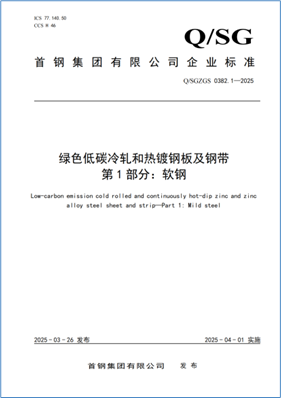
首钢绿色低碳商标、低碳汽车用钢企业标准及价格体系正式发布
Zheng Quan Shi Bao Wang· 2025-09-08 01:21
Core Viewpoint - Shougang Group launched the "SOGREECO" series of green low-carbon products and established the first industry standards for green low-carbon automotive steel plates, emphasizing the company's commitment to environmental sustainability and innovation in response to increasing demand for eco-friendly products [1][2][3]. Group 1: Product Launch and Standards - The "SOGREECO" trademark represents Shougang's green branding efforts, featuring attributes like "green," "low-carbon," and "ecological," with carbon reduction labels ranging from -30% to -70%, and up to near "zero" carbon [2]. - Shougang released the first industry standards for green low-carbon automotive steel plates, which include soft steel, bake-hardened steel, low-alloy high-strength steel, dual-phase steel, and hot-stamped steel [3]. - The standards define green low-carbon products as those achieving a carbon reduction ratio of 30% or more compared to equivalent products from 2020, incorporating lifecycle assessment methods aligned with international standards [3][6]. Group 2: Market Impact and Strategy - The introduction of the green low-carbon product pricing system is based on product standards, lifecycle data, and optimal cost pathways, addressing customer needs for carbon reduction ratios, carbon footprints, and scrap steel ratios [6]. - The formal release of Shougang's green product trademark, low-carbon automotive steel standards, and pricing system aims to support the national dual-carbon strategy and promote a sustainable green steel market [6].

第二十五届投洽会今日启幕,主宾省江苏与主宾国英国提前展开互动从扬子江到泰晤士河,“良伴”同行路不遥
Xin Hua Ri Bao· 2025-09-07 23:44
Core Viewpoint - The 25th China International Investment and Trade Fair has commenced in Xiamen, highlighting the strong partnership between Jiangsu province and the UK, with a focus on mutual investment and cooperation in key sectors. Group 1: Cooperation Directions - Jiangsu and the UK aim to deepen cooperation in three key areas: green low-carbon development, biomedicine, and consumer services [2][3] - In the green low-carbon sector, Jiangsu is building zero-carbon industrial parks and factories to support multinational companies [2] - The biomedicine sector is set for breakthroughs, with Jiangsu welcoming more UK companies to share in the policy benefits of its open innovation in the biopharmaceutical industry [2] Group 2: Trade and Investment Data - From January to July this year, the trade volume between Jiangsu and the UK reached $7.57 billion, marking an 8.2% year-on-year increase [4] - As of July, the UK has established 1,532 foreign investment projects in Jiangsu, with actual foreign investment totaling $4.97 billion [4] - Jiangsu has set up 139 overseas investment projects in the UK, with a total investment amount of $1.6 billion [4] Group 3: Successful Projects - The Jaguar Land Rover production base in Changshu is a benchmark for Sino-British manufacturing cooperation, with plans to produce electric vehicles for the European market [4] - AstraZeneca has invested over $5 billion in Jiangsu over 30 years, with recent investments including $475 million for a new small molecule drug factory in Wuxi [4][5] - GSK and Jiangsu Hengrui Medicine have signed an agreement to jointly develop 12 innovative drugs, enhancing both companies' global strategies [5] Group 4: Future Prospects - Over 100 UK SMEs are attending the fair, seeking to establish diverse collaborations with Jiangsu [6] - Jiangsu's policies and local government support are crucial for fostering a conducive environment for bilateral cooperation [6] - The establishment of the Sino-European (Wuxi) Life Science Innovation Industrial Park is a significant step in promoting open innovation in the biopharmaceutical sector [6]
能源高质量发展专家谈丨扛牢能源安全首要责任 “十四五”煤炭行业实现跃升发展
国家能源局· 2025-09-07 10:55
Core Viewpoint - The coal industry in China has made significant strides in ensuring energy security, promoting green and low-carbon transformation, and enhancing industrial competitiveness during the "14th Five-Year Plan" period [3] Group 1: Energy Security and Supply Capacity - The coal supply capacity has significantly improved, with national coal reserves increasing to 2,186 billion tons by the end of 2023 [4] - Coal production in 2024 is projected to reach 4.78 billion tons, an increase of 880 million tons compared to 2020 [4] - The coal railway transportation volume rose from 2.36 billion tons to 2.82 billion tons, enhancing the national coal resource allocation capacity [4] Group 2: Production and Distribution Optimization - The focus of coal production has shifted towards the central and western regions, with raw coal output in the western region increasing from 2.32 billion tons to 3.04 billion tons [5] - The production capacity of eight major provinces reached 4.36 billion tons in 2024, accounting for 91.3% of the national total [5] - Xinjiang's coal production is expected to reach 540 million tons in 2024, marking a significant increase [5] Group 3: Structural Optimization and Modernization - The number of coal mines has decreased to fewer than 4,300, with an average production scale of 1.7 million tons per mine [6] - The number of large modern coal mines with an annual output of over 10 million tons has increased to 83, with a total capacity of 1.36 billion tons per year [6] - The industry is actively developing new sectors such as advanced computing, new materials, and modern finance [6] Group 4: Green and Low-Carbon Development - The coal industry has implemented green mining technologies, achieving a comprehensive utilization rate of 74.1% for coal gangue and 74.2% for mine water [8] - The comprehensive energy consumption for coal production has decreased to 7.9 kg of standard coal per ton [8] - The industry is transitioning from a single fuel source to a dual focus on raw materials and fuel, with significant progress in developing new coal-based materials [8] Group 5: Technological Innovation and Industry Advancement - The coal industry has seen a significant increase in intelligent mining, with smart mines accounting for over 55% of total coal production capacity [9] - The industry has established several innovative platforms, including a national-level blockchain service platform [9] - The number of patents in the coal sector has been growing at an annual rate of over 25% [9] Group 6: Reform and Regulatory Enhancements - Key reforms in the coal sector have been implemented, including market-oriented reforms and the establishment of a unified coal market system [10] - The energy law and coal law revisions are underway, enhancing the regulatory framework for the industry [10] - In 2024, 26 coal companies made it to the Fortune 500 list, indicating improved market competitiveness [10] Group 7: Safety and Governance Improvements - The coal industry has enhanced its safety production capabilities, with new regulations and standards being implemented [11] - Significant investments in safety management and technology have been made to prevent major disasters [11] - The overall safety performance of coal mines has shown a stable improvement [11] Group 8: Future Outlook - The "15th Five-Year Plan" period is expected to see coal demand peak, with a focus on clean and efficient utilization [12] - The industry aims to further its role in energy security while accelerating green and low-carbon transitions [12] - The goal is to achieve higher quality, efficiency, and safety in coal production, supporting China's modernization efforts [12]
第二十五届投洽会即将举办 厦门进入“九八”时间
Sou Hu Cai Jing· 2025-09-06 09:02
Group 1 - The 25th China International Investment Trade Fair (CIFIT) will be held from September 8 to 11 in Xiamen, Fujian [1] - The event will feature nearly 100 multinational companies, sovereign wealth funds, and over 100 overseas hidden champion enterprises participating [2] - The fair aims to enhance investment attributes, with a focus on financial empowerment and participation from over 70 leading financial institutions and listed companies [2] Group 2 - The event will attract representatives from over 120 countries and regions, with the UK as the guest country sending a delegation of nearly 260 people [3] - Various international organizations will release authoritative investment reports, and multiple bilateral investment promotion activities will be held [3][4] - The fair will also focus on industry connections, utilizing big data and AI to enhance project matching and promote innovative enterprises in emerging fields [4] Group 3 - The theme for this year's fair is "Join Hands with China, Invest in the Future," featuring an exhibition area of approximately 120,000 square meters [5] - More than 70 investment-themed activities and over 100 specialized roadshows will be organized, with participation from over 15,000 enterprises and institutions [5] - The exhibition will be divided into three main sections: "Investing in China," "Chinese Investment," and "International Investment," with a focus on precise matching of investment projects and industry leaders [6] Group 4 - The 2025 International Investment Forum and the 2025 Gulangyu Forum will be held concurrently, featuring various discussions on investment cooperation and sustainable development [7] - A total of 21 authoritative reports will be released during the fair, including the "World Investment Report 2025" and "China Foreign Investment Report 2025" [7]
活力中国调研行丨循环产业做成“链” 旧电池在这里“变废为宝”
Yang Shi Xin Wen· 2025-09-06 02:58
Core Viewpoint - The green low-carbon circular economy is a crucial direction for developing new productive forces and is an urgent requirement for China to achieve its "dual carbon" strategic goals. In Laohokou, Hubei Province, the circular economy has become a key industry, with the industrial output value of a circular economy industrial park accounting for nearly half of the total industrial output of the city last year [1]. Group 1: Circular Economy Development - The circular economy industrial park in Laohokou has established a robust industrial chain, including six major circular economy industries such as recycled lead and aluminum, contributing significantly to local economic growth [17][28]. - The park has transformed from a small fishing village to a significant industrial hub, with industrial output exceeding 20 billion yuan, providing over 1,000 jobs and significantly increasing local incomes [30][40]. Group 2: Lead-Acid Battery Recycling - A lead-acid battery recycling company in Laohokou achieves a recycling rate of 98.5%, processing batteries that typically have a lifespan of 3 to 5 years [4][16]. - The recycling process involves five steps, resulting in pure lead, lead alloys, plastics, and sulfuric acid, with a production cycle of less than two days for a battery [6][8]. - The demand for recycled lead-acid batteries is high, with the company operating at full capacity and achieving an average monthly output value of 200 million yuan, reflecting an 8% year-on-year growth [16]. Group 3: Aluminum Recycling - The largest waste aluminum recycling factory in Central China has an annual production capacity of 200,000 tons, utilizing waste resources from various sectors to produce high-quality aluminum alloy products [18][20]. - The company employs an integrated operation method to minimize waste and reduce solid waste emissions, achieving a daily output of 700 tons of aluminum ingots and aluminum water [22]. - The aluminum products are further processed into components for electric vehicles, creating a closed-loop industrial chain within a 5-kilometer radius [24]. Group 4: Economic Impact and Future Goals - The circular economy industry in Laohokou has become a core engine for local economic growth, with a total industrial output value of 11.09 billion yuan in the first half of the year, a 24.4% increase year-on-year [38]. - The local government aims to achieve a GDP of over 50 billion yuan and enter the top 50 county economies in central China, with confidence in meeting these targets based on current progress [40].
为“好房子”提供更多“好材料” 建材行业推动开展选材标准研究
Jing Ji Ri Bao· 2025-09-06 02:22
Core Viewpoint - The construction materials industry is focusing on developing "good materials" selection standards to support the construction of "good houses," enhancing the effective supply of quality materials and extending the standard management system to application service standards [1][2]. Group 1: Standard Innovation and Industry Development - The promotion of standard innovation mechanisms is seen as a "golden key" to unlocking high-quality development in the construction materials industry, guiding industry upgrades and supporting green development [2]. - As of May 2025, the construction materials industry has implemented 330 group standards, with approximately 50 successfully converted into national or industry standards, and over 100 applied in business contracts and international expansion [1]. Group 2: Carbon Footprint Management - The construction materials industry has released 19 group standards related to carbon footprints, with 9 included in the recommended list of carbon footprint accounting rules by the Ministry of Industry and Information Technology [2]. Group 3: Quality Improvement and Traceability - Standards are becoming the core engine for improving product quality in the construction materials industry, with ongoing development of standards for product usage instructions, quality traceability systems, and product quality grading [3]. - Currently, 17 standards related to quality traceability and product usage instructions are being developed, laying the groundwork for a comprehensive traceability system [3]. Group 4: International Competitiveness - The establishment of group standards is crucial for the construction materials industry to engage in international competition, facilitating the export of products and technologies [3]. Group 5: Regulatory Framework - The number of mandatory national standards in the construction materials industry has reached 36, with ongoing efforts to develop additional mandatory standards for various products [4].
为“好房子”提供更多“好材料”
Jing Ji Ri Bao· 2025-09-05 22:16
Core Insights - The construction materials industry is focusing on developing "good materials" standards to support the construction of "good houses," aiming to enhance the effective supply of quality materials and extend the standard management system from product-centric to application service standards [1][2] Group 1: Standard Innovation and Industry Development - The promotion of standard innovation mechanisms is seen as a key to unlocking high-quality development in the construction materials industry, guiding industry upgrades and supporting green development [2] - As of May 2025, the construction materials industry has implemented 330 group standards, with approximately 50 successfully converted into national or industry standards, and over 100 applied in business contracts and international expansion [1] Group 2: Carbon Footprint and Sustainability - The construction materials industry has released 19 carbon footprint group standards, with 9 included in the recommended list of carbon footprint accounting rules by the Ministry of Industry and Information Technology [2] Group 3: Quality Improvement and Traceability - Standards are becoming the core engine for improving product quality in the construction materials industry, with ongoing work on product usage manuals, quality traceability systems, and quality grading standards [3] - Currently, 17 standards related to quality traceability and product usage manuals are being developed, laying the groundwork for a comprehensive traceability system [3] Group 4: International Competitiveness - The establishment of group standards is crucial for the construction materials industry to enhance international competitiveness and facilitate the export of products and technologies [3] Group 5: Regulatory Framework - The construction materials industry has established 36 mandatory national standards, with ongoing efforts to develop additional mandatory standards for various products to strengthen the implementation of standards [4]
惟楚有材斯为盛 智造双星砥中流——探源湘企敢为人先逐新求变的精神密码
Shang Hai Zheng Quan Bao· 2025-09-05 20:20
Core Viewpoint - Xiangdian Co., Ltd. is positioning itself as a leader in the green low-carbon sector by leveraging its expertise in electromechanical integration and focusing on high-end, intelligent, and green development [2][5][6]. Group 1: Company History and Development - Founded in 1936, Xiangdian has evolved alongside China's growth, becoming a key player in the electrical industry and producing landmark products such as the first domestically made 2MW direct-drive permanent magnet wind turbine generator [2][3]. - The company has a rich history of innovation, with products like the 5800kW synchronous motor and ultra-high-speed permanent magnet motors, showcasing its commitment to technological advancement [2][3]. Group 2: Business Strategy and Market Position - Xiangdian is focusing on "electromagnetic energy + motor + control" as its core business, aiming to expand its product matrix in line with the dual carbon strategy [5][6]. - The company is recognized as one of the largest motor manufacturers in China, with a strong international presence, exporting products to over 80 countries [3][4]. Group 3: Innovation and R&D - Xiangdian has established several national and provincial innovation platforms, including a national-level enterprise technology center and key laboratories for wind power generation [4]. - The company has developed a range of energy-efficient products, including energy storage and recovery systems, which are set to be industrially applied [5][6]. Group 4: Financial Performance - In the first half of 2025, Xiangdian reported a 4.6% year-on-year increase in revenue and a 12.98% rise in net profit attributable to shareholders, driven by enhanced technological innovation and optimized marketing strategies [9][10]. Group 5: Organizational Changes and Management - The company is undergoing significant organizational restructuring to enhance decision-making capabilities and improve performance management systems [10][11]. - Xiangdian is focusing on digital transformation to integrate information technology with business processes, aiming to boost efficiency and support its green initiatives [11]. Group 6: Future Outlook and Market Opportunities - Xiangdian is actively pursuing opportunities in the low-altitude economy and has established partnerships with leading companies in the aerospace sector to capitalize on emerging markets [7][8]. - The company is set to benefit from the growing demand for energy-efficient and environmentally friendly technologies, particularly in high-end manufacturing sectors like semiconductors and biomedicine [8].

