数字金融

Search documents
香港稳定币监管:构建安全、灵活、开放的数字金融生态
2 1 Shi Ji Jing Ji Bao Dao· 2025-07-25 22:27
Core Viewpoint - The Hong Kong Monetary Authority (HKMA) is warning about the risks of over-speculation in stablecoins as the Stablecoin Regulation comes into effect on August 1, indicating a commitment to a balanced development of stablecoins [1][2]. Group 1: Regulatory Framework - The Stablecoin Regulation, passed on May 21, 2025, aims to create a risk-based regulatory environment that aligns with international standards, enhancing the regulatory framework for virtual asset activities while promoting financial innovation and sustainable development [1][2]. - The regulation follows the principle of "same activity, same risk, same regulation," requiring issuers of fiat-backed stablecoins to obtain licenses and adhere to strict asset management and redemption requirements [1][2]. Group 2: Market Dynamics - Stablecoins serve as a crucial link between traditional finance and decentralized finance (DeFi), enhancing market efficiency and accelerating the adoption of Web3.0 technologies, which could attract international capital and innovation to Hong Kong [3]. - As of now, the global cryptocurrency market is valued at approximately $3.35 trillion, with stablecoin supply around $250 billion and trading volume projected to exceed $20 trillion in 2024, indicating a significant market presence [3]. Group 3: Internationalization of Currency - The internationalization of currencies is a long-term process influenced by the overall strength of an economy and the development of financial markets, with Hong Kong positioned to leverage its financial market advantages to support the internationalization of other fiat currencies [4].
建设银行湖北省分行:创新金融产品服务,提振消费促发展
Zhong Guo Jin Rong Xin Xi Wang· 2025-07-25 11:27
Core Viewpoint - The Bank of China Hubei Branch is actively implementing national consumption policies and enhancing comprehensive financial services to boost consumer spending and expand domestic demand [1] Group 1: Consumer Financial Services - The bank has strengthened its comprehensive financial services covering all areas of consumption, focusing on innovative consumer finance products to meet daily and large-scale credit needs [1] - As of June 2025, the bank's quick payment transaction volume reached 384.9 billion yuan, with credit card loan balances at 31.8 billion yuan and consumer credit balances at 20.76 billion yuan, an increase of 2.51 billion yuan since the beginning of the year [3] Group 2: Digital Financial Solutions - The bank has implemented a customized payment system for the newly opened Qincheng Wanxianghui shopping mall, enhancing payment efficiency through a centralized cash register system and providing smart POS machines for over 60 merchants [2] - The bank has integrated credit card discounts and promotional activities through its mobile app to enhance consumer engagement and drive foot traffic in shopping areas [2] Group 3: Support for Tourism and Green Consumption - The bank has developed a comprehensive financial service package for the newly opened Wuhan Chengjian Kaiyuan Senbo Resort, providing tailored financing solutions and operational support for the tourism industry [4] - As of June 2025, the bank's loans for the happiness industry reached 43.5 billion yuan, with an increase of nearly 7.6 billion yuan, reflecting a growth rate of 21% [4] Group 4: Promotion of Large-Scale Consumer Events - The bank participated in the "Guanggu Auto Hi-Purchase" event, which attracted over 1,000 participants and generated more than 300 million yuan in consumer spending, offering subsidies of up to 4,000 yuan for car purchases [5] - The bank has facilitated the issuance of government consumption vouchers, with a total of 23.2 million yuan in vouchers processed, leading to a transaction volume exceeding 1.4 billion yuan [5] Group 5: Future Outlook - The bank aims to deepen the integration of financial services to meet the financial needs of the public and contribute to the economic development of Hubei as a strategic hub in central China [6]

大摩邢自强:香港稳定币新政即将落地,谁将抢占数字金融先机
Zhi Tong Cai Jing· 2025-07-25 09:28
Group 1 - Hong Kong is positioned as a strategic testing ground for stablecoins, driven by regulatory policies and the preparation for cryptocurrency trading, which will benefit issuers, brokers, and fintech companies [2][5] - The upcoming Stablecoin Ordinance, effective August 1, 2025, marks Hong Kong's leading role in the global stablecoin regulatory race, reshaping the global stablecoin landscape and creating new opportunities in fintech and cross-border trade [5][6] - The global stablecoin market has reached $250 billion, with 99% denominated in USD, highlighting the urgency for China to accelerate its digital finance initiatives in response to the U.S. regulatory framework [6][8] Group 2 - Early beneficiaries of stablecoin development will include issuers, brokers, and fintech companies with mature blockchain technology, such as Futu Holdings and ZongAn Online, which are well-positioned to capitalize on the stablecoin business [3][7] - Traditional financial institutions may experience a slower transformation due to the limited impact of stablecoins on traditional banking services, as they do not generate interest or serve lending functions [7][8] - The low-cost and instant settlement advantages of stablecoins in cross-border e-commerce could reduce transaction costs by up to 90%, although widespread adoption may be hindered by existing payment systems in developed markets [7][8] Group 3 - The development of the Renminbi stablecoin (CNH) may lag behind USD and HKD stablecoins due to constraints such as limited offshore RMB liquidity and competition with existing cross-border settlement tools [4][8] - Despite challenges, there are long-term opportunities for the Renminbi stablecoin, particularly if it can integrate with the RMB cross-border payment system (CIPS) and expand offshore RMB bond issuance [8][10] - Hong Kong's stablecoin initiatives are a strategic choice for China to respond to global digital finance competition and solidify its status as an international financial center [10]
郑州银行深耕 “五篇大文章” 赋能区域高质量发展
Huan Qiu Wang· 2025-07-25 09:01
Core Viewpoint - Zhengzhou Bank focuses on serving the real economy, emphasizing "two highs and four efforts," and innovatively constructs a specialized financial service system to empower regional economic transformation and high-quality development [1][2][3] Group 1: Technology Finance - Zhengzhou Bank has established four technology-focused branches and a professional team to support SMEs and young talent in innovation and entrepreneurship [1] - The bank collaborates with relevant funds and partners to explore cooperative models, becoming one of the first financial institutions to participate in the "Zheng Science Loan" program [1] - By the end of 2024, Zhengzhou Bank has supported a total of 4,991 technology enterprises [1] Group 2: Green Finance - The bank has implemented a "Green Bank Credit Strategy" and established a leadership group for green finance, achieving a green credit balance of 9.146 billion yuan, a year-on-year increase of 123.73% by the end of 2024 [2] - Zhengzhou Bank aims to optimize its green finance strategy and enhance its service system to contribute to the province's green and low-carbon transformation [2] Group 3: Inclusive Finance - The bank has established a mechanism for coordinating financing for small and micro enterprises, implementing a "one leader" responsibility system and a three-level linkage mechanism [2] - Zhengzhou Bank has launched 12 products tailored for small and micro enterprises, optimizing the loan approval process through financial technology [2] - By the end of 2024, the balance of inclusive small and micro loans reached 53.685 billion yuan, with a year-on-year growth of 7.46% [2] Group 4: Pension Finance - Zhengzhou Bank actively explores pension finance, increasing financial support for the pension and health industries, and enhancing services for the elderly [2] Group 5: Digital Finance - The bank is seizing opportunities in digital finance, enhancing its technology, data, and innovation capabilities to improve service safety and reliability [3] - Zhengzhou Bank continues to optimize its financial products and processes to enhance customer trust and satisfaction while ensuring data security and privacy [3]
央行、农业农村部联合部署
Jin Rong Shi Bao· 2025-07-25 08:13
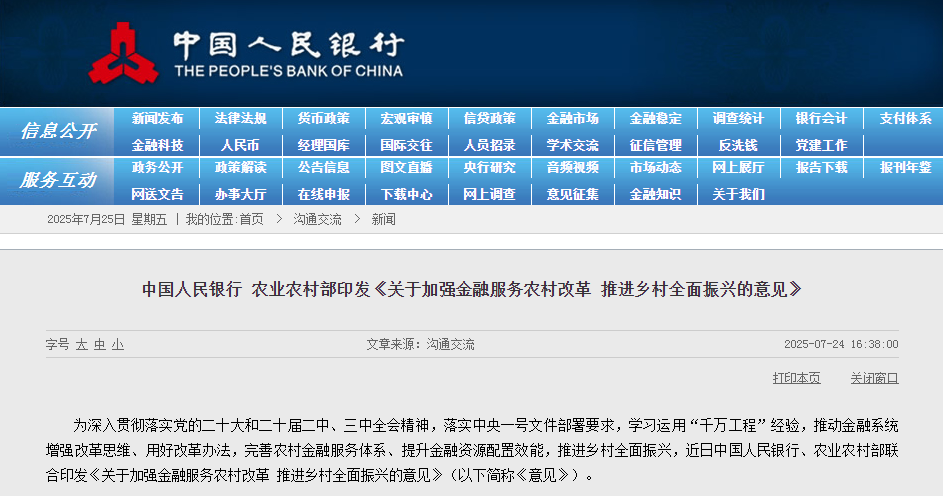
Core Viewpoint - The People's Bank of China and the Ministry of Agriculture and Rural Affairs jointly issued an opinion to enhance financial services for rural revitalization, proposing 19 measures across seven areas to improve the quality and efficiency of financial services in rural areas [1][3]. Group 1: Financial Support for Agriculture - The opinion emphasizes enhancing financial security for food safety, consolidating financial assistance achievements, and deepening financial services for rural industries [3]. - Financial institutions are encouraged to focus on local agricultural products, developing differentiated credit policies and innovative financing models for rural specialties [4]. - Support for agricultural product quality improvement, brand development, and standardized production is highlighted, along with financing for agricultural processing and modern circulation networks [4]. Group 2: Digital Financial Empowerment - The opinion stresses the importance of developing digital finance to enhance rural revitalization financial services [5]. - It aims to implement financial technology initiatives to support smart agriculture and improve the digital financial service level in rural areas [5][6]. - Collaboration with local governments and agricultural entities is encouraged to create comprehensive service platforms integrating governance and financial services [5]. Group 3: Institutional Mechanisms for Financial Services - The opinion calls for improving the institutional mechanisms for financial services in rural reforms, promoting standardized trials for rural property rights transactions [8]. - It suggests exploring financing models for rural land management rights and enhancing long-term loans for forestry operations [8]. - Development banks and commercial banks are urged to increase credit support for key areas of rural revitalization, while local banks should focus on supporting small agricultural enterprises [8][9].

九方智投控股配售月被质疑存违规风险 年初被责令改正
Zhong Guo Jing Ji Wang· 2025-07-25 06:41
Core Viewpoint - The article discusses the controversies surrounding Chen Wenbin and Jiufang Zhitu's transformation, highlighting the similarities between Jiufang Zhitu's current practices and the past issues faced by Yinke Holdings, particularly in terms of compliance and customer engagement strategies [1][2]. Group 1: Company Background and Controversies - Chen Wenbin, founder of Yinke Holdings, faced controversies due to irregularities in commodity trading, leading to the establishment of Jiufang Zhitu, which continues to operate on the edge of legality [1]. - Jiufang Zhitu's business practices show similarities to those of Yinke Holdings, particularly in high leverage and frequent trading that amplified investor losses [1]. - The company has been accused of using misleading marketing tactics and high-pressure sales strategies reminiscent of Yinke Holdings' past practices [1][5]. Group 2: Business Operations and Financials - Jiufang Zhitu has transitioned to software subscription and investment advisory services, yet continues to engage in practices that may lead to customer misguidance, such as high-priced membership fees and frequent service upgrades [1][2]. - The company announced a share placement agreement to sell 20 million shares at HKD 39.25 each, representing approximately 4.46% of its existing share capital, with a projected increase in issued share capital by about 4.27% [2][3]. - The estimated net proceeds from the share placement are approximately HKD 746 million, intended for developing on-chain financial resources and exploring digital asset advisory models [3][4]. Group 3: Regulatory Issues - Jiufang Zhitu has faced scrutiny from regulatory bodies, with the Shanghai Securities Regulatory Bureau identifying misleading promotional content and unauthorized investment advice practices [5][6]. - The company has been ordered to rectify its operations due to violations of investment advisory regulations, including providing advice without proper registration [6].
渤海银行App建设如何?部分栏目界面有优化,但底层功能提升较迟缓
Xin Lang Cai Jing· 2025-07-25 06:09
Core Viewpoint - The evaluation of Bohai Bank's mobile banking app indicates that while there have been updates and improvements in certain areas, significant issues remain in user experience and core functionalities, particularly in performance and customer interaction [1][12][35]. User Experience - The app received a score of 73.070 out of 100, reflecting ongoing updates and iterations, particularly in wealth management and fund sections, but still showing gaps in search interactions and customer service [1][12]. - The user registration process has been streamlined, but issues with card binding persist, requiring users to visit a physical branch for certain functionalities [13][35]. - The app's logout experience has improved, but overall interaction quality, especially in customer service, remains limited [21][35]. Functionality Services - The app's core channels have been optimized in version 7.0, yet fundamental issues such as the "asset-liability overview" feature lag behind industry standards [1][12][35]. - Investment and fund sections have seen upgrades, but the purchasing process for financial products is still not fully refined, leading to potential user journey disruptions [28][30]. - The app supports various banking functions, including transfers and account management, but lacks comprehensive features for transaction details and user notifications [25][30]. Performance and Security - The app's performance metrics, including response times and loading speeds, are significantly below industry averages, indicating a need for improvement in technical infrastructure [32][35]. - Security features are in place, such as automatic logout after inactivity and password management, but the absence of a dedicated "security center" is noted [32][35]. Development and Innovation - Bohai Bank is focusing on digital transformation, aiming to enhance customer service and product innovation through its mobile banking platform [33][35]. - The app has introduced a "Bohai e-Manager" service for family financial management, although the underlying functionalities have not seen substantial improvements [30][35]. - The bank's approach to user engagement and content delivery lacks a systematic operational framework, limiting the effectiveness of its informational resources [34][35].

深耕“五篇大文章”创新驱动显成效
Nan Fang Du Shi Bao· 2025-07-24 23:09
Core Viewpoint - The Industrial and Commercial Bank of China (ICBC) Jiangmen Branch is actively enhancing its financial services to support the local economy, focusing on innovation in key areas such as technology finance, pension finance, and digital finance, contributing to high-quality economic development [2]. Group 1: Technology Finance - The bank addresses the financing challenges faced by technology-oriented small and micro enterprises by utilizing "Internet+" thinking and big data to create customer screening, credit limit assessment, and risk monitoring models [3]. - New financial products such as "Specialized, Refined, Unique, and Innovative Loans" and "E-Expansion Loans" have been launched, along with optimized approval processes and pricing discounts to improve financing efficiency for tech enterprises [3]. - As of June, the bank's coverage of settlement services for high-tech enterprises reached 67%, an increase of 17 percentage points since the beginning of the year, with a 5.7% growth in technology loan balances [3]. Group 2: Pension Finance - The bank is committed to building a multi-level pension service system, actively participating in the construction of "smart elderly dining halls" and creating a smart pension settlement platform to enhance the experience for the elderly [4]. - By June 2025, the bank had launched 19 "Smart Elderly Dining Halls," serving over 60,000 elderly individuals [4]. - The bank supported a pension industry company with a loan of 2.8 million yuan for core raw material procurement, contributing to the supply of essential products for the elderly, with pension finance loan balances increasing by 15.68% since the beginning of the year [4]. Group 3: Digital Finance - The bank has successfully launched the "Rong E Ju" platform for various industries, facilitating digital transformation and providing high-quality digital financial services to support the real economy [6]. - As of June, the bank connected with 199 clients through the open banking model, serving 4.74 million C-end users for payment services [6]. - The bank is promoting digital RMB and has established the first digital RMB experience area in Wuyi University, completing over 500,000 transactions since the pilot began in 2023 [6]. Group 4: Green and Inclusive Finance - The bank is actively implementing green and inclusive finance initiatives, with green credit balances reaching 29.494 billion yuan, an 18.55% increase since the beginning of the year [7]. - Inclusive loan balances reached 14.714 billion yuan, benefiting over 12,400 customers, showing significant growth since the beginning of the year [7].


消费金融供给提质增效
Jing Ji Ri Bao· 2025-07-24 22:07
Core Viewpoint - The People's Bank of China emphasizes that boosting consumption is the primary task for economic work in 2025, highlighting the crucial role of consumer finance in stimulating economic growth [1] Group 1: Consumer Credit Expansion - Financial institutions have increased consumer credit supply, with the total consumer loan balance reaching 58.7 trillion yuan by the end of 2024, which is 7.8 times that of 2010 [2] - Recent guidelines from multiple regulatory bodies encourage financial institutions to focus on key consumption scenarios such as food, housing, travel, and entertainment, while promoting payment convenience [2][4] - Local banks, such as Changsha Bank and Zhejiang Rural Commercial Bank, are launching targeted financial support initiatives to enhance consumer spending capabilities [2] Group 2: Financial Services Innovation - Consumer finance companies are expanding their service offerings to meet diverse consumer needs, particularly in niche markets like pet care and health management [3] - Financial institutions are enhancing their consumer finance measures to stabilize the market, although challenges remain in matching credit supply quality with consumer demand [3][4] - The integration of financial services into consumer experiences is being emphasized, with initiatives like promotional events that combine credit services with shopping experiences [3] Group 3: Policy Support and Financial Infrastructure - The People's Bank of China has established a 500 billion yuan re-lending facility to support service consumption and the elderly care industry [4] - The government encourages financial institutions to increase personal consumer loan offerings while ensuring risk control [4][5] - Financial institutions are urged to optimize their services and enhance consumer satisfaction through various financial innovations [5][6] Group 4: Digital Financial Transformation - Digital finance is becoming a key driver for financial institutions' transformation, enabling them to better meet consumer needs through data analysis and online services [7][8] - The shift to digital platforms allows for improved customer experience and broader reach, particularly in underserved areas [7][8] - Financial institutions are leveraging advanced technologies, including AI, to redefine business models and enhance operational efficiency [8][9]
王健林,再割肉
盐财经· 2025-07-24 10:21
Core Viewpoint - Wang Jianlin is selling assets again, this time in the internet finance sector with the sale of Kuaiqian Financial [2] Group 1: Transaction Details - On July 22, China Ruyi announced that its indirect wholly-owned subsidiary Shanghai Ruyi Xingchen Enterprise Management Co., Ltd. signed a share transfer agreement to acquire 30% of Kuaiqian Financial for 240 million yuan, payable in three installments, valuing Kuaiqian Financial at approximately 800 million yuan [3][4] - After the transaction, China Ruyi will become the largest single shareholder of Kuaiqian Financial, but Kuaiqian will not become a subsidiary of China Ruyi [4] - Kuaiqian Financial is primarily owned by Shanghai Wanda Network Financial Services Co., Ltd., which is part of Dalian Wanda Group [5][7] Group 2: Historical Context - In late 2014, Wanda acquired a controlling stake in Kuaiqian for 315 million USD (approximately 2.257 billion yuan), marking Wanda's first acquisition in the internet finance sector [10] - Kuaiqian had a transaction volume exceeding 2 trillion yuan in 2014, ranking fourth after UnionPay Business, Alipay, and Tenpay [10] - Wanda had previously expressed ambitions to integrate Kuaiqian's extensive partner network to become the largest O2O enterprise in China [11] Group 3: Value and Risks of Kuaiqian - According to industry analysts, Kuaiqian's core value lies in its full licensing qualifications and the scarcity of such licenses in the current regulatory environment, allowing China Ruyi to acquire national payment qualifications at a low cost [15] - However, Kuaiqian has faced over 10 million yuan in penalties in the past three years, indicating weaknesses in its risk control system, which China Ruyi will need to address [15] - The payment industry is heavily reliant on scenarios, and while China Ruyi may provide resource synergies, Kuaiqian's revenue is primarily from offline transactions, which are currently in decline [15]