智能制造

Search documents
热搜第一!雷军最新发声
Zhong Guo Ji Jin Bao· 2025-11-20 06:11
Core Points - Xiaomi has officially rolled out its 500,000th vehicle, marking a significant milestone in its automotive journey [1][3] - The company aims to deliver over 400,000 vehicles in 2025, indicating a shift towards large-scale production and consumer acceptance [3][11] Group 1: Milestone Achievement - The 500,000th vehicle was produced in just 1 year and 7 months, showcasing Xiaomi's rapid growth in the automotive sector [4][8] - CEO Lei Jun emphasized the importance of this milestone for Xiaomi, stating it signifies a new starting point for the company [9] Group 2: Financial Performance - In Q3 2025, Xiaomi's revenue from its smart electric vehicle and AI segments reached 29 billion CNY, with 28.3 billion CNY coming from electric vehicles alone [11] - The company delivered 108,796 new vehicles in Q3 2025, setting a new historical record [11] Group 3: Future Plans and Challenges - Xiaomi plans to maintain a focus on safety and delivery, while also enhancing technological innovation and integrating AI with smart manufacturing [9][12] - The company anticipates challenges in 2026 due to reduced purchase tax subsidies and increased competition in the automotive industry [11]


热搜第一!雷军最新发声
中国基金报· 2025-11-20 06:05
Core Viewpoint - Xiaomi has officially rolled out its 500,000th vehicle, marking a significant milestone in its automotive journey, showcasing its capabilities in R&D, manufacturing, sales, delivery, and service [2][4][7]. Group 1: Milestone Achievement - The 500,000th vehicle was produced at Xiaomi's super factory in Beijing, indicating the company's entry into a new phase of scale [2]. - Xiaomi's founder Lei Jun expressed gratitude towards users, suppliers, and government support, emphasizing the achievement as a new starting point for the company [7]. Group 2: Future Plans and Commitments - Xiaomi aims to deliver over 400,000 vehicles in 2025, with a focus on safety, delivery, technological innovation, and the integration of AI and smart manufacturing [2][7]. - Lei Jun reiterated the importance of safety in vehicle design, addressing previous controversies regarding the company's priorities [7]. Group 3: Financial Performance - In Q3 2025, Xiaomi's revenue from its smart electric vehicle and AI segment reached 29 billion yuan, with the electric vehicle segment contributing 28.3 billion yuan [9]. - The company delivered 108,796 vehicles in Q3 2025, achieving a historical high, and plans to meet its annual delivery target of 350,000 vehicles [9][10]. Group 4: Market Position and Challenges - Xiaomi's YU7 series ranked first in the SUV sales chart in mainland China as of October 2025, with a growing presence in 402 sales outlets across 119 cities [9]. - The company anticipates challenges in 2026 due to reduced purchase tax subsidies and increased competition in the automotive industry [9].
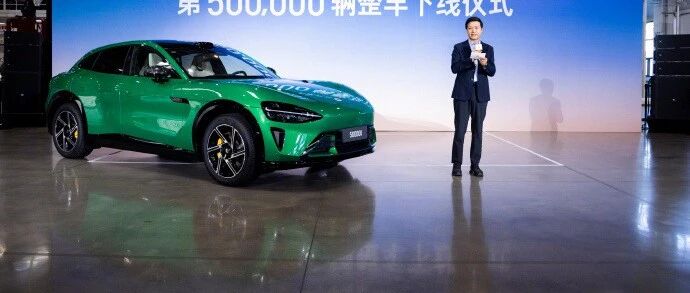
小米第50万辆汽车下线,雷军:下一步推进安全、科技创新
Sou Hu Cai Jing· 2025-11-20 04:48
11月18日,小米集团发布三季度财报显示,该季度交付汽车超10万辆,创单季度历史新高,同比增长173.4%。今 年前三季度,小米汽车累计交付量超26万辆,9月、10月连续2月交付量超4万辆,预计本周将提前完成35万台的交 付目标。值得注意的是,三季度,小米汽车业务首次实现单季度盈利,智能电动汽车收入为283亿元。 另外,第三方统计数据显示,截至今年10月,小米SU7位列2025国内中大型轿车销量第一;小米YU7连续3个月位 列中大型SUV销量第一,其中10月登顶国内全品类SUV销量第一。 小米汽车副总裁于立国在现场透露,汽车工厂共有98个质量检测工位和143台质量高精检测设备,坚持用严苛的检 测标准保证质量;坚持用先进的工艺和自动化的设备,目前工厂内的生产机器人超过1100台;坚持技术创新,超 级大压铸等技术不断升级,工厂2025年取得先进制造专利近百项。于立国说,截至目前,小米汽车工厂已完成35 次技术改造升级,生产效率大幅提升,向用户交车的时间越来越短。 11月20日,小米集团创始人、董事长兼CEO雷军宣布,第50万辆小米汽车在位于北京经济技术开发区(北京亦 庄)的小米汽车超级工厂下线。雷军表示,"从第1 ...
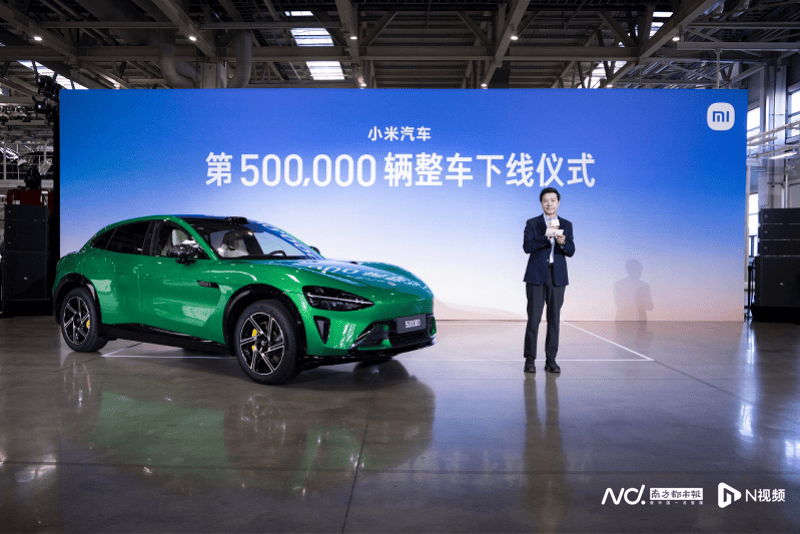
小米汽车第50万辆下线,雷军:将坚持不懈抓安全、抓交付
Sou Hu Cai Jing· 2025-11-20 04:26
Group 1 - The core achievement of Xiaomi Auto is the production of its 500,000th vehicle, setting a record for the fastest time to reach this milestone among global new energy vehicle manufacturers, achieved in just 602 days since the launch of its first model, SU7, on March 28, 2024 [1] - Xiaomi Group's founder and CEO Lei Jun emphasized that this milestone validates the company's complete capabilities in research and development, manufacturing, sales, delivery, and service, indicating a new phase of scale for Xiaomi Auto [3] - Lei Jun announced that Xiaomi Auto expects to deliver over 400,000 vehicles in 2025, highlighting the company's commitment to safety, delivery, and technological innovation [5] Group 2 - The company plans to enhance its core technology research and integrate AI with smart manufacturing, aiming to meet consumer expectations through tangible actions [5]


小米汽车第50万辆下线,雷军称安全是基础将加快生产
Xin Lang Ke Ji· 2025-11-20 04:24
Core Insights - Xiaomi has achieved a significant milestone by rolling off its 500,000th vehicle from its production line in just 602 days, marking the fastest record for any global new energy vehicle company [1][2] - The achievement signifies the validation of Xiaomi's complete system capabilities in research, manufacturing, sales, delivery, and service, indicating broad consumer recognition and entry into a new phase of scale [1] Group 1 - The 500,000th vehicle marks a new starting point for Xiaomi's automotive division, emphasizing the importance of safety and delivery as foundational elements [2] - Xiaomi plans to accelerate production while ensuring safety and quality, highlighting a commitment to technological innovation and the integration of AI and smart manufacturing [2] Group 2 - Xiaomi's CEO Lei Jun stated that the company will focus on three main areas: ensuring safety and delivery, enhancing technological innovation, and deepening the integration of AI and smart manufacturing [2]

三星公布首批2纳米芯片性能数据,加速追赶台积电;我国成功发射实践三十号A、B、C星丨智能制造日报
创业邦· 2025-11-20 04:01
Group 1 - A new lightweight and high-strength composite material developed by the University of Toronto can withstand temperatures of 500℃, showing potential applications in the aerospace sector [2] - NIO's self-developed advanced intelligent driving chip "Shenji NX9031" has begun technical licensing to an automotive chip company, with potential contract values ranging from millions to billions of dollars depending on the licensing type [2] - Huawei has completed the testing of 5G-A cellular passive IoT technology, marking a first in the industry, under the IMT-2020 (5G) promotion group [2] - China successfully launched the Practice-30 A, B, and C satellites for space environment detection and technology verification, marking the 608th flight of the Long March series rockets [2] - Samsung has announced the first performance data for its upcoming 2nm chip process, indicating a 5% performance improvement and an 8% increase in power efficiency compared to its 3nm process, aiming to close the gap with TSMC [2]

第50万辆下线!雷军披露小米汽车全年交付计划
Bei Jing Ri Bao Ke Hu Duan· 2025-11-20 03:32
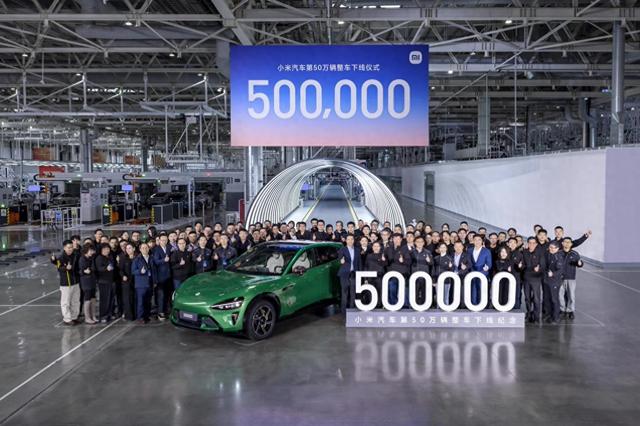
Core Insights - Xiaomi's automotive division achieved a significant milestone by producing its 500,000th vehicle in just 602 days, setting a record for the fastest production ramp-up in the global new energy vehicle sector [1][3] - The company plans to deliver over 400,000 vehicles in 2025, indicating a strong growth trajectory and consumer acceptance of its products [3] Production and Sales Performance - The Xiaomi SU7 has become the best-selling mid-to-large sedan in China for 2025, while the YU7 has topped the sales charts for mid-to-large SUVs for three consecutive months, including being the best-selling SUV across all categories in October [3] - In Q3, Xiaomi delivered over 100,000 vehicles, marking a historical high for a single quarter and a year-on-year increase of 173.4% [3] - Cumulatively, Xiaomi has delivered over 260,000 vehicles in the first three quarters of the year, with September and October seeing monthly deliveries exceeding 40,000 units [3] Financial Performance - Xiaomi's automotive business achieved its first quarterly profit in Q3, with revenue from smart electric vehicles reaching 28.3 billion yuan [3] - The company is on track to meet its delivery target of 350,000 vehicles ahead of schedule [3] Industry Impact - As a leading player in the smart manufacturing and new energy vehicle industry in the Beijing-Tianjin-Hebei region, Xiaomi's production capabilities have positively influenced over 300 upstream component suppliers [3]
林武会见韩国新任驻华大使卢载宪
Da Zhong Ri Bao· 2025-11-20 01:11
Core Points - The meeting between Shandong Provincial Secretary Lin Wu and South Korea's new ambassador to China, Lu Jae-hyun, highlights the importance of Shandong in Sino-Korean relations and the commitment to deepen cooperation in various sectors [1] - Lin Wu emphasized Shandong's role as a major province in population, culture, and economy, aiming to accelerate the construction of a green, low-carbon, high-quality development zone [1] - The discussion included enhancing bilateral investment and cooperation in fields such as artificial intelligence, biomedicine, healthcare, modern agriculture, and cultural tourism [1] Summary by Categories - **Political Context** - The visit of Ambassador Lu Jae-hyun and participation in the China (Shandong) - South Korea Friendship Week reflects the strong ties and mutual respect between Shandong and South Korea [1] - Recent high-level meetings between Chinese President Xi Jinping and South Korean President Lee Jae-myung have set a positive direction for local cooperation [1] - **Economic Cooperation** - Shandong aims to become a significant economic growth pole in northern China, focusing on high-level opening-up and green development [1] - There is a solid foundation for cooperation between Shandong and South Korea, with increasing exchanges in personnel and trade [1] - **Sectoral Collaboration** - The meeting underscored the intention to strengthen traditional industry cooperation while also expanding into emerging sectors such as smart manufacturing, renewable energy, and cultural consumption [1]
武汉成全球巨头青睐的投资热土
Chang Jiang Ri Bao· 2025-11-20 00:34
Group 1 - Global automotive electronics company Visteon has signed an agreement to establish its second technology center in Wuhan Economic Development Zone, indicating a strong commitment to the region [1] - ZF Group's new factory in Wuhan has officially commenced production, marking the third major project by the group in Wuhan within two years, highlighting the city's growing appeal to global automotive giants [3] - Xiaomi's smart home appliance factory in Wuhan has achieved a product first-pass yield rate exceeding 99%, with an average production rate of one high-end air conditioner every 6.5 seconds, showcasing advanced manufacturing capabilities [4] Group 2 - The establishment of various AI companies' regional headquarters and R&D centers in Wuhan, including Huawei and ByteDance, signifies rapid growth in the smart economy sector [5] - ZF Group has made its third investment in Wuhan within five years, emphasizing the city as a core engine for global automotive technology innovation [6] - The influx of technology giants is attracting top-tier capital, technology, and high-end talent to Wuhan, creating a "catfish effect" that enhances the local economy and innovation ecosystem [7] Group 3 - Wuhan's comprehensive advantages, including location, talent pool, and supportive policies, have created a favorable business environment that attracts investment [8] - The city has a significant number of higher education institutions, with over 130,000 students graduating annually, contributing to its talent advantage [8] - The rapid project construction pace in Wuhan, exemplified by Xiaomi's factory being built in about one year, reflects the city's efficient operational capabilities [8] Group 4 - Wuhan has launched a 1 billion yuan special fund to support the cultivation of 1,000 technology innovation projects, focusing on seed-stage investments [9] - The city aims to ensure that companies not only establish a presence but also thrive and grow, emphasizing the importance of application scenarios and service-driven support [9]


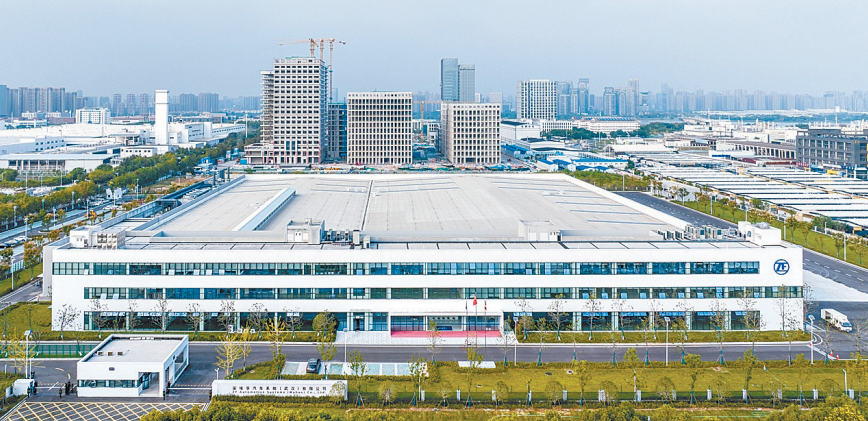
埃斯顿携手京东方传感设立1.5亿元合资公司 深耕高端伺服业务
Zhong Guo Zheng Quan Bao· 2025-11-20 00:33
Core Insights - Nanjing Estun Automation Co., Ltd. plans to establish a joint venture with Suzhou BOE Sensor Technology Co., Ltd. to focus on servo system-related businesses, enhancing strategic positioning in smart manufacturing core components [1][2] - The joint venture will have a registered capital of RMB 150 million, with BOE Sensor contributing RMB 90 million (60% stake) and Estun contributing RMB 60 million (40% stake) [1] - Estun will provide core technology licensing and supporting technical services worth RMB 50 million to the joint venture, ensuring effective operation and technology implementation [1] Company Strategy - The partnership is expected to strengthen Estun's position in the servo system component segment and enhance its comprehensive solution capabilities in the smart manufacturing sector [2] - This investment aligns with Estun's long-term development strategy and is anticipated to positively impact the company's future financial status and operational results [2]